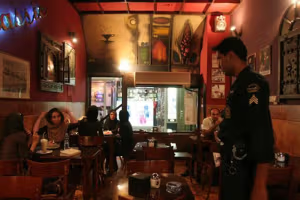
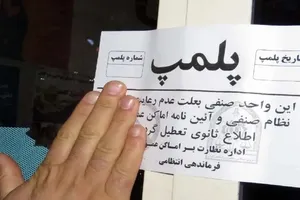
Tehran police detain several prominent actors at birthday party
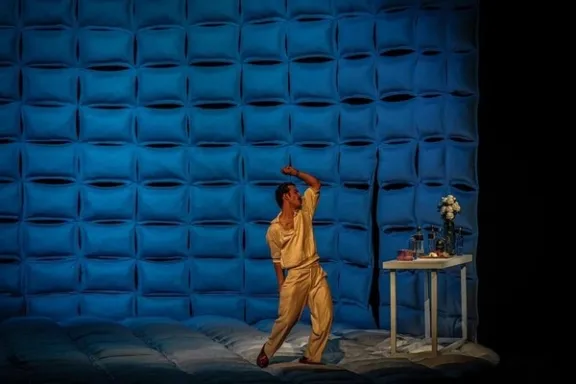
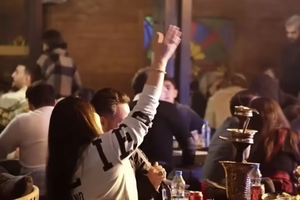
Iranian police detained more than 20 people during a raid on a birthday party at a film star’s home in Tehran and seized 38 liters of homemade alcohol, Iranian media reported.
Iranian police detained more than 20 people during a raid on a birthday party at a film star’s home in Tehran and seized 38 liters of homemade alcohol, Iranian media reported.


The online newspaper Seday-e Iran (Voice of Iran) dedicated its Thursday issue to Niloufar Ghalehvand, a young coach killed along with her parents in an Israeli strike.
However, the newspaper used a real photograph showing her wearing a cap rather than a headscarf, falling short of the mandatory veiling rules promoted by the Islamic Republic.
The choice triggered angry reactions from several conservative activists and ultra-loyalist groups.
Among the critics was Mehri Talebi Darestani, a prominent hardline commentator, who questioned whether the outlet was justified in “ignoring divine boundaries (hijab) and promoting wrongdoing for the sake of a lofty divine goal (maximum outreach)”.
In a lengthy post, she argued that no individual or institution “has ironclad immunity,” quoting past remarks by Khamenei that everyone must remain accountable under the law — comments she framed as a rebuke to those shielding the Khamenei-linked publication from criticism.
The pro-establishment group “Banouye Tamaddon-Saz” (Civilization-Building Woman) also joined the backlash, echoing objections to showcasing an unveiled image of a female “martyr,” a term used by the state for those killed in the conflict.
The controversy drew further attention after Fars News, an outlet affiliated with the Revolutionary Guard entered the debate.
Defending Khamenei’s office, Fars published an AI-generated veiled photo of Ghalehvand to show that producing such images “is not difficult,” adding that the newspaper had deliberately used the real photograph “based on the core media principle of truthful storytelling.”

Fars argued that authentic representation carries several messages: that Israel “targets Iranians, regardless of appearance, clothing, taste, or lifestyle”; that victims of the war come from “all social and ideological backgrounds” and should not be reshaped to fit a predetermined narrative; and that showing reality “deepens the human dimension of their suffering” and elevates the story from a partisan frame to a national one.
The dispute reflects a broader struggle inside Iran’s conservative camp over the mandatory hijab, which is widely flouted by the public these days, at a time the Islamic Republic or at least the relatively moderate government of Masoud Pezeshkian seeks to project unity after the brief but intense conflict with Israel.
"Some of Khamenei’s supporters believe that once the 'hijab frontline' is captured by the public, the rest will fall as well. So they insist that this frontline must be retaken," says London-based journalist Mohammad Rahbar.
"For that reason, they are now seeking to enforce the hijab law even without the morality police — by making conditions so strict and penalties so severe that they can somehow re-impose the old mandatory-hijab order. But it is highly unlikely they have the power to reverse what has taken root in society."

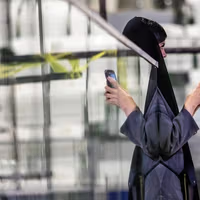
The outlet’s journalists observed women and girls moving openly through public spaces without headscarves, a practice once met with immediate censure under years of tight enforcement. Along northern Tehran’s Vali-e Asr Street, uncovered hair was common among women of all ages.
“When I moved to Iran in 1999, letting a single strand of hair show would immediately prompt someone to tell me to tuck it back under my headscarf out of fear of the morality police taking me away,” Holly Dagres, a senior fellow at the Washington Institute for Near East Policy, told AP. “To see where Iran is today feels unimaginable: Women and girls openly defying mandatory hijab.”
“Authorities are overwhelmed by the sheer numbers across the country and worry that if they crack down – at a delicate time marked by power blackouts, water shortages, and a rotten economy – they could spur Iranians to return to the streets,” Dagres added.
Scenes around Tajrish Square, north of Tehran, according to the report, showed schoolgirls shedding their headscarves immediately after class and women shopping uncovered at the bazaar as police officers stood by.
“All of my life I had to wear hijab… at school, at university, everywhere in public,” an Iranian woman who recently emigrated to Canada told AP. “I always tried to follow the rules but it made me feel a lack of confidence… because I wore the hijab and I didn’t believe in that.”

Dissatisfaction acknowledged at the top
Iran’s rulers have long relied on strict hijab enforcement by police and Basij forces, with only limited periods of relaxed oversight. The current hesitation comes amid persistent power cuts, water shortages and a weakened economy, all of which risk fueling further anger, the report added.
Supreme Leader Ali Khamenei has so far avoided directly addressing the issue since the year’s war with Israel and US strikes on nuclear sites.
The protests that erupted after the 2022 death of Mahsa Amini, a 22-year-old Kurdish Iranian woman detained by the morality police for allegedly violating Iran’s veiling rules, marked a turning point. Her death sparked some of the largest demonstrations in decades, with women publicly removing or burning their headscarves in defiance of the compulsory veiling law.
AP cited comments by President Masoud Pezeshkian’s social affairs adviser Mohammad-Javad Javadi-Yeganeh, who said unpublished polling by the Iranian Students Polling Agency shows widespread public discontent. The findings align with low turnout in last year’s presidential vote and continuing frustration over inflation, currency volatility and unemployment.
“We are answerable since we cannot provide services to people,” Pezeshkian said recently.
Elias Hazrati, head of the Pezeshkian administration’s information council, confirmed earlier this week that Khamenei had sent directives on hijab enforcement to the government, describing opponents of mandatory hijab as “a small number of people” engaged in “social disorder.” Days earlier, Pezeshkian told the Supreme Council of the Cultural Revolution that state bodies “must adhere to national laws and norms” on hijab.
Judiciary chief Gholamhossein Mohseni-Ejei also instructed prosecutors to act against what he called “organized, foreign-linked” groups involved in “social disorder.”
For Iranians worn down by years of sanctions, economic stagnation and the fear of renewed conflict, uncertainty persists.
“Sometimes that fear is with me,” the woman in Canada said. “Sometimes when I’m behind the wheel, I try to find my headscarf on my head. That fear is still with me.”

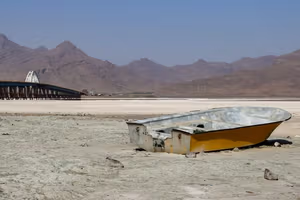
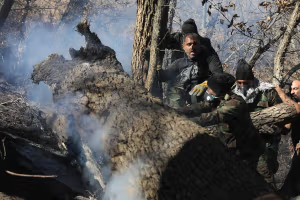
The commander of Iran’s Forest Protection Unit, Colonel Majid Zakariaei, said fires this year have scorched about 46,000 hectares of national land, forest and rangeland.
He told state media that from March to November more than 2,300 fires were recorded nationwide – a 12-percent rise in the number of incidents compared with the same period last year, though the total burned area was about two percent smaller.
Zakariaei said around 95 percent of fires were linked to human activity, including careless visitors and campers, compounded by drought and rising temperatures.
“Climate change, reduced rainfall, and dryness have turned natural areas into tinder,” he said, calling for better public awareness and faster local response systems.
While the largest recent fires in the Hyrcanian Forests – the ancient, UNESCO-listed woodlands along the Caspian Sea – have been extinguished, authorities warned that dry conditions persist and that access will remain restricted until effective autumn rains arrive.
“The situation is still fragile. Until we have sufficient rainfall, unnecessary entry to the forests is prohibited,” Zakariaei said, announcing that bans now cover the Hyrcanian, Zagros and Arasbaran forest zones.
The measure, which includes parts of Mazandaran, Golestan, Ardabil and North Khorasan provinces, is aimed at preventing new flare-ups.
Firefighting teams remain on full alert and village councils near the forests have been told to prepare local emergency stations.
Political and media reactions
The government’s handling of the fires has triggered debate in Iranian media and on social networks.
The newspaper Farhikhtegan said in an article on Wednesday that several of the northern fires may have been intentionally set, describing them as “organized acts” rather than the result of drought or accident.
The paper cited unnamed officials who said about 20 suspects had been detained.
The article suggested that such incidents were meant to “undermine confidence in the state’s crisis management,” framing the destruction as part of broader attempts to disrupt the country.
Environmental officials have not endorsed those claims and maintain that negligence remains the dominant cause. They say most of the recent fires began near roads, farms or picnic areas rather than in inaccessible terrain.
Iran’s environmental community has urged a focus on prevention with experts saying that weak firefighting infrastructure, limited aerial equipment and late detection continue to leave forests vulnerable.
The Hyrcanian Forests, believed to be among the world’s oldest surviving temperate forests, are home to hundreds of endemic plant and animal species. Prolonged drought and land encroachment have already reduced much of their natural resilience.
Zakariaei said Iran plans to expand its firefighting bases and training programs, with 21 stations now designated nationwide and more in development. “With better readiness and local participation, we hope to reduce next year’s figures,” he said.

Iran International learned that actors Parsa Pirouzfar and Ali Shadman, and actresses Setareh Pesyani and Sahar Dowlatshahi were among more than 20 guests detained.
Shadman and Pesyani remain in custody, with cases opened in Tehran’s Ershad (morality) prosecutor’s office against Shadman and six others on charges including “violating public decency, promoting vice, drinking alcohol, and possession of alcoholic beverages,” according to people familiar with the matter.
Sources said Pirouzfar was taken to hospital after the raid.
Several detainees were released later on undertakings or bail, while separate files were opened for other guests, many from the theater community.


There was no immediate comment from Tehran police or the judiciary on the reported detentions.
Alcohol is banned in Iran and violations carry fines, lashings or prison, with stiffer penalties for production and distribution. The prohibition dates to 1979, but homemade brewing and smuggling have created a steady underground supply. Rights groups and health officials report periodic mass poisonings from counterfeit liquor.
Despite the ban, discreet drinking has edged into some public venues. Iranian and state‐affiliated outlets have acknowledged “secret menus” at a handful of restaurants and cafés, where beer or spirits are served under code names or in disguised containers.
Prosecutors and police regularly announce raids and closures for serving alcohol, mixed-gender dancing or hijab violations, part of wider morality crackdowns.
Authorities have stepped up enforcement over the past two years, sealing cafés in Tehran and other cities and publicizing arrests.
Officials say tougher action is needed to deter bootlegging and to uphold Islamic codes. Critics counter that decades of prohibition have pushed consumption into riskier, unregulated channels.