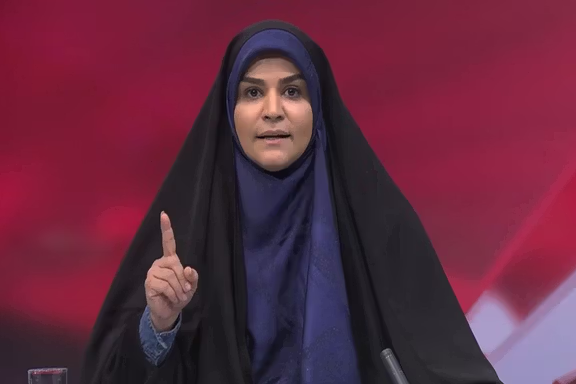
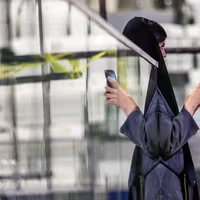
State broadcaster presenter Sahar Emami during a live broadcast as Israel bombed the Islamic Republic of Iran Broadcasting (IRIB) headquarters in Tehran on June 16, 2025
The decision by Iran’s state broadcaster to produce a film about a female presenter whose image went viral when Israeli missiles hit its headquarters has sparked a wave of criticism and accusations of political propaganda.
The planned feature, Re-Birth, casts actress Atefeh Habibi as Sahar Emami—presented by state media as a symbol of defiance during Iran’s 12-day war with Israel in June.
Emami was on air when IRIB’s Glass Building in Tehran was bombed on June 16. She rushed out of the studio but returned to present from another set within minutes.
“(She) bravely continued her program after the attack,” the film’s promoter asserted Thursday, branding her a hero.
But many remain unconvinced, accusing the broadcaster of glossing over “real heroes” and victims of the war.
'Propaganda’
“Making a film about Sahar Emami is not a cultural choice. It is a propaganda project,” a commentary in the moderate outlet Rouydad24 argued.
“What is it that makes her stand out from all others?” it asked, offering a characteristically factional answer: “It is easy propaganda that conveys their ideological perspective,” referring to IRIB’s leadership and its ties to the ultrahardline Paydari Front.
The commentary also criticised the lack of scrutiny of the broadcaster itself.
In the days after the attack, state TV filled its programming with tributes to Emami, sponsored billboards across Tehran, and received praise from senior officials—including Supreme Leader Ali Khamenei—for her “bravery.”
Critics said the network was exploiting the incident to deflect attention from its declining viewership.
Dwindling popularity
IRIB holds a legal monopoly over broadcasting in Iran; private television networks are not permitted.
In recent years, however, a proliferation of digital platforms—often backed by different branches of the state or powerful institutions—has begun to challenge that dominance in entertainment.
In news, IRIB’s audience has been shrinking for years, with Persian-language broadcasters in exile becoming the main source of information for most people inside Iran.
An official survey in late 2024 put IRIB’s popularity at just 12.5%, while the head of its internal polling unit claimed it was closer to 72%, adding the figure “could have been higher if, like elsewhere in the world, Generation Z had not turned away from national television.”
A survey by the Netherlands-based polling institute GAMAAN also found that only a small minority of Iranians tuned in to IRIB during and after the June war with Israel.
The broadcaster’s chief has since requested additional funding to rebuild the damaged headquarters, saying rubble will be cleared by January with reconstruction to follow.
Critics note that IRIB’s current budget of 350 trillion rials (more than $300 million) exceeds that of ten ministries combined.
The broadcaster also receives ad-hoc allocations in US dollars from the national reserve alongside lucrative advertising revenue.
The office of Iran's Supreme Leader has come under fire from hardline supporters after its online newspaper posted a photo of a woman killed in June’s war with Israel without a headscarf, sparking a rare public dispute within the pro-theocracy camp.
The online newspaper Seday-e Iran (Voice of Iran) dedicated its Thursday issue to Niloufar Ghalehvand, a young coach killed along with her parents in an Israeli strike.
However, the newspaper used a real photograph showing her wearing a cap rather than a headscarf, falling short of the mandatory veiling rules promoted by the Islamic Republic.
The choice triggered angry reactions from several conservative activists and ultra-loyalist groups.
Among the critics was Mehri Talebi Darestani, a prominent hardline commentator, who questioned whether the outlet was justified in “ignoring divine boundaries (hijab) and promoting wrongdoing for the sake of a lofty divine goal (maximum outreach)”.
In a lengthy post, she argued that no individual or institution “has ironclad immunity,” quoting past remarks by Khamenei that everyone must remain accountable under the law — comments she framed as a rebuke to those shielding the Khamenei-linked publication from criticism.
The pro-establishment group “Banouye Tamaddon-Saz” (Civilization-Building Woman) also joined the backlash, echoing objections to showcasing an unveiled image of a female “martyr,” a term used by the state for those killed in the conflict.
The controversy drew further attention after Fars News, an outlet affiliated with the Revolutionary Guard entered the debate.
Defending Khamenei’s office, Fars published an AI-generated veiled photo of Ghalehvand to show that producing such images “is not difficult,” adding that the newspaper had deliberately used the real photograph “based on the core media principle of truthful storytelling.”
A photo published by Fars News displaying an AI-generated veiled photo of the war victim (left) and the original one
Fars argued that authentic representation carries several messages: that Israel “targets Iranians, regardless of appearance, clothing, taste, or lifestyle”; that victims of the war come from “all social and ideological backgrounds” and should not be reshaped to fit a predetermined narrative; and that showing reality “deepens the human dimension of their suffering” and elevates the story from a partisan frame to a national one.
The dispute reflects a broader struggle inside Iran’s conservative camp over the mandatory hijab, which is widely flouted by the public these days, at a time the Islamic Republic or at least the relatively moderate government of Masoud Pezeshkian seeks to project unity after the brief but intense conflict with Israel.
"Some of Khamenei’s supporters believe that once the 'hijab frontline' is captured by the public, the rest will fall as well. So they insist that this frontline must be retaken," says London-based journalist Mohammad Rahbar.
"For that reason, they are now seeking to enforce the hijab law even without the morality police — by making conditions so strict and penalties so severe that they can somehow re-impose the old mandatory-hijab order. But it is highly unlikely they have the power to reverse what has taken root in society."
Iran’s Karkheh Dam hydroelectric power plant has stopped generating electricity because of a sharp drop in the reservoir’s water level, state media reported on Saturday.
Amir Mahmoudi, head of the Karkheh Dam and power plant, said water is now being released through lower outlets to supply downstream needs after the generating units went offline. He said the dam’s reservoir currently holds about one billion cubic meters of water, with the water level 40 meters below normal operating height.
Mahmoudi said the Karkheh basin has endured several years of drought and low rainfall, urging conservation of water for drinking, farming, livestock, and industrial use.
The Karkheh Dam, one of the largest earthen dams in the world and the biggest in Iran and the Middle East, was built on the Karkheh River about 22 kilometers northwest of Andimeshk in Khuzestan province. It has a total generating capacity of 400 megawatts.
The shutdown comes as Iran faces one of its worst droughts in decades, with reservoirs across the country running dangerously low. Domestic media have reported steep drops at Tehran’s Karaj and Latian dams, while officials in Mashhad, Kerman and Yazd warn of collapsing aquifers and forced water rationing.
The Kurdish rights group Hengaw said this week that authorities in western Iran have also increased pressure on local journalists covering the crisis. Reporters in the city of Baneh were summoned or threatened by security agents after publishing reports on water shortages that left some neighborhoods without running water for more than three days.
The group said some journalists were accused of “spreading public anxiety” and forced to sign written pledges not to report further on the issue.
Defiance of compulsory veiling is now widespread in Iran, the Associated Press reported, after a government-approved visit in November found women and girls appearing in public without headscarves in one of the most visible social shifts since Mahsa Amini’s death in 2022.
The outlet’s journalists observed women and girls moving openly through public spaces without headscarves, a practice once met with immediate censure under years of tight enforcement. Along northern Tehran’s Vali-e Asr Street, uncovered hair was common among women of all ages.
“When I moved to Iran in 1999, letting a single strand of hair show would immediately prompt someone to tell me to tuck it back under my headscarf out of fear of the morality police taking me away,” Holly Dagres, a senior fellow at the Washington Institute for Near East Policy, told AP. “To see where Iran is today feels unimaginable: Women and girls openly defying mandatory hijab.”
“Authorities are overwhelmed by the sheer numbers across the country and worry that if they crack down – at a delicate time marked by power blackouts, water shortages, and a rotten economy – they could spur Iranians to return to the streets,” Dagres added.
Scenes around Tajrish Square, north of Tehran, according to the report, showed schoolgirls shedding their headscarves immediately after class and women shopping uncovered at the bazaar as police officers stood by.
“All of my life I had to wear hijab… at school, at university, everywhere in public,” an Iranian woman who recently emigrated to Canada told AP. “I always tried to follow the rules but it made me feel a lack of confidence… because I wore the hijab and I didn’t believe in that.”
Dissatisfaction acknowledged at the top
Iran’s rulers have long relied on strict hijab enforcement by police and Basij forces, with only limited periods of relaxed oversight. The current hesitation comes amid persistent power cuts, water shortages and a weakened economy, all of which risk fueling further anger, the report added.
Supreme Leader Ali Khamenei has so far avoided directly addressing the issue since the year’s war with Israel and US strikes on nuclear sites.
The protests that erupted after the 2022 death of Mahsa Amini, a 22-year-old Kurdish Iranian woman detained by the morality police for allegedly violating Iran’s veiling rules, marked a turning point. Her death sparked some of the largest demonstrations in decades, with women publicly removing or burning their headscarves in defiance of the compulsory veiling law.
AP cited comments by President Masoud Pezeshkian’s social affairs adviser Mohammad-Javad Javadi-Yeganeh, who said unpublished polling by the Iranian Students Polling Agency shows widespread public discontent. The findings align with low turnout in last year’s presidential vote and continuing frustration over inflation, currency volatility and unemployment.
“We are answerable since we cannot provide services to people,” Pezeshkian said recently.
Elias Hazrati, head of the Pezeshkian administration’s information council, confirmed earlier this week that Khamenei had sent directives on hijab enforcement to the government, describing opponents of mandatory hijab as “a small number of people” engaged in “social disorder.” Days earlier, Pezeshkian told the Supreme Council of the Cultural Revolution that state bodies “must adhere to national laws and norms” on hijab.
Judiciary chief Gholamhossein Mohseni-Ejei also instructed prosecutors to act against what he called “organized, foreign-linked” groups involved in “social disorder.”
“Sometimes that fear is with me,” the woman in Canada said. “Sometimes when I’m behind the wheel, I try to find my headscarf on my head. That fear is still with me.”
Under unprecedented strain at home and abroad after the June war, Tehran is adopting new tones and messaging to steady its own base.
The clearest example comes from a darkened political talk show where once-unshakeable Iranian commanders now appear compelled to sit for unusually probing interviews.
A general adjusts the ring on his finger before answering. Another clears his throat to buy time. All are addressing—or attempting to address—now-unavoidable questions verbalised by host Javad Mogui, a documentary filmmaker long aligned with the establishment.
Since the 12-day war with Israel, the show’s tone has visibly shifted: clipped, direct, and edged with the frustrations circulating inside the system.
‘Too soft on the US’
One recent guest was senior Revolutionary Guards commander Mohammad Reza Naghdi.Mogui asked him about Iran’s retaliatory strike on a US base in Iraq following the killing of Quds Force commander Qassem Soleimani in January 2020.
“Many believe the roots of the recent war go back to that moment,” Mogui said in the dim light. “That our response was too soft.” Then, quietly: “Do you accept that we did not hit the Americans well enough?”
Naghdi smiled, though not comfortably. His replacement was quietly confirmed days later.
No Americans were killed in that attack, not least because Tehran reportedly telegraphed its intentions to Washington with enough notice.
‘At home’
In another episode Mogui asked air defence chief Gholamreza Jalali where he had been when Israel struck Tehran, killing many of Iran’s top brass.
“I was at home,” Jalali said. Mogui paused. “Should the armed forces not have been ready?” Jalali replied: “We did not expect that they would target the homes of commanders.”
Other senior figures have appeared under the same narrow pool of light: foreign minister Abbas Araghchi, parliament speaker Mohammad Bagher Ghalibaf, IRGC chief’s top adviser Ahmad Vahidi among others.
Each was asked about missed signals and the war’s opening hours—unamiganable without a nod from the highest authorities.
Political analyst Jaber Rajabi told Iran International TV that the candor reflects unease inside the system.
“The questions the host asks are the same ones being asked within the Revolutionary Guards and among pro-government supporters,” he said. “If they do not hear convincing answers, it could cause defections within these ranks.”
Patriotic turn
That insecurity is mirrored in Tehran’s cultural messaging.
In recent weeks the city unveiled a towering statue in Revolution Square depicting the Roman emperor Valerian kneeling before Shapur I, echoing a Sasanian relief.
The project anchors a campaign titled “You will kneel before Iran again,” launched near the anniversary of the 1979 embassy seizure.
Beneath the statue sit twelve panels narrating moments of “resistance” from Persian myth to the fight against ISIS and the recent twelve-day war.
The unveiling featured mobile LED trucks and orchestral performances, but officials insisted it was not a promotional event.
“This is the continuation of a historical truth: every invader has bowed before the will of the Iranian people,” the head of Tehran’s Beautification Organization said.
Tone not intent
Foreign reporting has noticed the same shift.
The Financial Times this week highlighted insiders arguing that Iran “must decide whether it wants to be a force that challenges or supports regional security.”
The Economist, asked whether the regime can survive five more years, replied that it likely will, though the “big question” is whether a change of leader would mean a change of regime.
Middle East correspondent Nicolas Pelham added that Iran appears to be “trying to reinvent itself,” pointing to the rise of explicit nationalist symbols.
Together, these strands point to a tactical revision rather than transformation: a state unsettled enough to justify decisions it once presented as self-evident, and determined to wrap that unease in a grander narrative of historical inevitability.
It is a shift more in register than structure—an Iran 0.2 more than 2.0.
Iran held large-scale state funerals this week for unidentified soldiers from the 1980s war with Iraq, nearly six months after its 12-day clash with Israel, and amid deepening public distrust fueled by ongoing security, economic, and environmental crises.
For years, ceremonies known as the “burial of anonymous martyrs” have served as a tool for mobilizing Islamic Republic loyalists and projecting an image of grassroots support.
The latest round came on Monday, when Major General Abdolrahim Mousavi, Iran’s armed forces chief of staff, praised what he called the “unparalleled and indescribable presence” of devout citizens at the receptions and funeral processions, framing their attendance as an act of obedience to the Supreme Leader.
In the Islamic Republic’s terminology, an "anonymous martyr” is a body buried without a confirmed identity — often never identified even decades later.
More than 36 years after the Iraq war’s end, the true nature of what lies in many of these coffins remains unclear. Images and past reports suggest some contain only fragments of bone.
Mahmoud Tavallaie, the former head of Iran's Institute for Advanced Biotechnology Research, acknowledged in 2022 that many remains had deteriorated in harsh conditions, making scientific identification impossible in numerous cases.
Psychology of glorifying death
Speaking to Iran International, social psychoanalyst Saba Alaleh said the state has long elevated death into a sacred, heroic ideal in order to maintain psychological control over society.
“Iran’s rulers try to turn death into a total value — one tied to loyalty, sacrifice, and obedience,” she said, noting that this glorification feeds a narrative in which dissent is framed as disrespect for the dead. “Authoritarian systems like the Islamic Republic constantly rely on such displays of blood-earned legitimacy.”
Alaleh argued the Islamic Republic seeks to instill a persistent sense of indebtedness and guilt, reinforcing the message that “people died for this system, so you must follow their path and have no right to oppose it.”
Symbolism and political agenda
Asked what the state aims to achieve through these ceremonies, Alaleh said their primary purpose is to stage symbolic power.
“These funerals help the Islamic Republic reassert the revolutionary moral codes of 1979,” she said. Anyone objecting to them is quickly portrayed as insulting the sacrifices of others, creating social pressure against dissent.
Official data from the war years show 116 unidentified soldiers were buried during the conflict itself, though authorities now say there were roughly 50,000 unidentified dead in total, with over 30,000 later identified and returned to their families.
Citing updated figures, Iranian officials say more than 13,000 bodies have been interred across roughly 1,300 memorial sites and 3,000 locations nationwide — from city squares and universities to mosques, seminaries, and military zones. Tehran’s Behesht-e Zahra cemetery alone houses over 4,000 such graves.
Why public spaces?
The Islamic Republic says burials in public or academic spaces reflect local demand, but critics argue the practice serves to symbolically “occupy” civic environments.
Student activists in the 2000s repeatedly protested the installation of tombs on campuses, viewing them as a pretext for increased presence of security forces.
Clashes erupted at several universities — including Shahid Rajaee, Iran University of Science and Technology, Sharif University, and Amirkabir — as students demanded referendums on the burials. Despite opposition, the burials proceeded, often backed by the municipality, the Revolutionary Guards, and hardline political bodies.
Student protests against burials of 'anonymous martyrs' in campuses
Institutional machinery
Until 2018, the armed forces’ Missing in Action Search Committee oversaw excavation, transfer, and burial operations. A multi-agency structure now coordinates locations, logistics, and ceremonies, with representatives from the Cultural Heritage Organization, the Martyrs Foundation, the Interior Ministry, and the armed forces.
These funerals are typically held during major religious periods such as Fatimiyya — the days when Shiites mourn the death anniversary of Prophet Muhammad's daughter Fatima — though the coffins also appear during other state and religious commemorations, maintaining a continuous symbolic presence in public life.