• العربية
  • فارسی
Brand
  • Iran Insight
  • Politics
  • Economy
  • Analysis
  • Special Report
  • Opinion
  • Podcast
  • Iran Insight
  • Politics
  • Economy
  • Analysis
  • Special Report
  • Opinion
  • Podcast
  • Theme
  • Language
    • العربية
    • فارسی
  • Iran Insight
  • Politics
  • Economy
  • Analysis
  • Special Report
  • Opinion
  • Podcast
All rights reserved for Volant Media UK Limited
volant media logo
EXCLUSIVE

Iran negotiators ordered to return after internal rift over Islamabad talks

Apr 14, 2026, 18:57 GMT+1Updated: 20:53 GMT+1
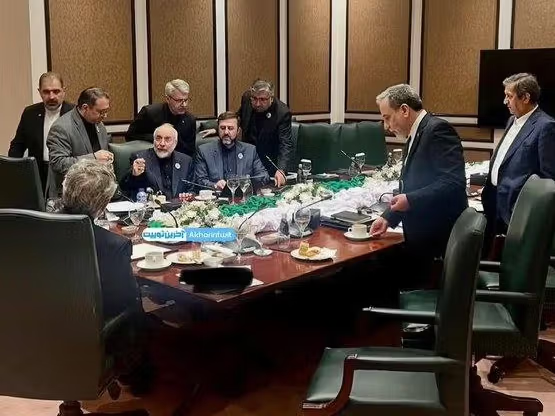
Members of Iran's negotiating team in Islamabad

Sharp disagreements among members of Iran’s negotiating team led them to abandon US talks in Islamabad and return to Tehran on April 11 following an order from Iran's top security official, sources familiar with the deliberations told Iran International.

The sources said that during Friday’s negotiations with the United States, Foreign Minister Abbas Araghchi showed signs of flexibility in some of his positions, particularly regarding reducing or halting financial and military support for the so-called Axis of Resistance, including Lebanon’s Hezbollah.

According to the sources, this approach drew a strong reaction from Mohammad Bagher Zolghadr, the Secretary of the Supreme National Security Council, in Tehran.

The sources said Zolghadr, who was briefed on the talks, submitted a report to the leadership and senior IRGC commanders, which fueled anger at the highest levels. The report reportedly cited “deviation from the delegation’s mandate” and engagement in discussions beyond the leadership’s directives.

Following consultations at the leadership level, and with the involvement of Hossein Taeb, an advisor to the supreme leader, an order was issued on Saturday afternoon for the delegation’s immediate return to Tehran, the sources said.

Reports of similar internal rifts had surfaced earlier. On March 28, accounts emerged of serious disagreements between President Masoud Pezeshkian and IRGC Chief-Commander Ahmad Vahidi.

Informed sources told Iran International that the rifts stemmed from disagreements over the conduct of the war and its impact on livelihoods and the wider economy.

Three days later, reports indicated Pezeshkian was dissatisfied with being in a “complete political deadlock” and had even lost authority over appointing officials killed during the war.

According to those reports, Vahidi had said that due to wartime conditions, all key managerial positions should be directly controlled by the IRGC until further notice.

Despite the diverse composition of Iran’s negotiating delegation in Islamabad, reports suggest representatives aligned with the IRGC held significant influence.

Iran’s insistence on continuing its nuclear program and maintaining control over the Strait of Hormuz ultimately contributed to the failure of the Islamabad talks, according to reports.

Following the breakdown, the United States announced a naval blockade targeting Iran’s southern ports, with US Central Command saying from Monday morning it would prevent ships from entering or leaving Iranian ports. The blockade was implemented as scheduled.

Despite the failure of the first round of talks, Pakistan said on Monday that consultations with both sides were ongoing and another round of talks remained possible.

US President Donald Trump also told the New York Post on Tuesday that talks with Iran “could resume within two days” in Pakistan.

Sources had earlier told Reuters that despite the apparent deadlock, diplomatic channels remain open, with an Iranian embassy official in Pakistan saying the next round of talks could take place later this week or early next week.

•
•
•

More Stories

Iran’s central bank warns economy may take 12 years to rebuild after war

Apr 14, 2026, 00:30 GMT+1

Iran’s central bank has warned President Masoud Pezeshkian that rebuilding the country’s war-damaged economy could take more than a decade, sources familiar with internal deliberations told Iran International.

In a stark assessment delivered to the president in recent days, senior economic officials said the damage inflicted during the 40-day war with the United States and Israel—combined with Iran’s already fragile economic situation—could take up to 12 years to repair.

Several major airports were damaged during the conflict, while strikes also targeted oil facilities, refineries and petrochemical installations that are central to Iran’s export revenues and industrial supply chains.

Officials involved in the discussions warned that the destruction of production capacity could trigger a sharp surge in inflation in the coming months. According to the assessment presented to the president, inflation could reach as high as 180% if shortages of industrial inputs persist.

The same projections estimate that unemployment could rise by around two million people as factories, service providers and small businesses struggle to resume operations.

According to sources familiar with the discussions, central bank governor Abdolnaser Hemmati has been urging Pezeshkian to take urgent steps to stabilize the economy, including restoring full internet access and pursuing an agreement with the United States.

Tehran and Washington appear to be exploring the possibility of further talks following the one in Pakistan last weekend. Iranian economists have long argued that a diplomatic thaw and easing of sanctions could be the best path toward economic stabilization.

Iran has maintained a nationwide internet shutdown for weeks during the conflict, a move officials say was intended to counter cyber threats but which has also severely disrupted businesses that rely on global connectivity.

Iran’s digital economy accounts for roughly 5–6% of the country’s GDP, and the shutdown has cut off millions of entrepreneurs from customers, payment systems and online platforms.

Small businesses, freelancers and startup founders have been among the hardest hit. Many rely on services such as Instagram, messaging apps and foreign-hosted websites to reach clients.

Economists inside the government warn that prolonged restrictions could deepen the downturn and slow recovery even further.

The bleak economic projections have heightened concerns among members of Pezeshkian’s team, according to the sources.

Some officials fear that if the economic crisis worsens or the state faces financial collapse, powerful figures within the Islamic Revolutionary Guard Corps could seek to shift blame onto the president, they said.

Iran entered the war already under heavy economic strain from years of sanctions, high inflation and currency instability.

What the US naval blockade would mean for Iran’s economy

Apr 13, 2026, 17:40 GMT+1
•
Miad Maleki

The US naval blockade of Iran, which started on Monday, could rapidly cripple the country’s economy, cutting off most of its trade, halting oil exports and triggering inflation and currency pressure within days.

The blockade, targeting Iranian ports and imposing partial restrictions in the Strait of Hormuz, took effect at 10 a.m. Eastern Time.

Iran’s heavy reliance on southern shipping lanes leaves its economy exposed to maritime disruption, with more than 90% of its $109.7 billion annual trade passing through the Strait of Hormuz.

The blockade is expected to cut off nearly all of Iran’s seaborne trade, wiping out an estimated $435 million in daily economic activity and forcing oil field shutdowns within weeks.

A blockade would effectively zero out Iran’s export revenues within days and trigger cascading effects across its financial system.

Oil exports would be hit first

Crude oil shipments would be the first and most severe casualty. Iran has been exporting roughly 1.5 million barrels per day, generating about $139 million daily based on wartime pricing assumptions.

  • Iran keeps oil flowing to China as Hormuz pressure forces reserve release

    Iran keeps oil flowing to China as Hormuz pressure forces reserve release

Nearly all of that volume departs via Kharg Island, which handles over 90% of crude exports and lacks viable alternative routes outside the Persian Gulf.

A blockade would eliminate these flows almost immediately, cutting off the Islamic Republic’s primary source of foreign currency earnings.

Petrochemicals and non-oil trade

Petrochemical exports, valued at roughly $54 million per day based on recent trade data, would also be halted. Facilities at Assaluyeh, Imam Khomeini, and Shahid Rajaei ports all sit within the Persian Gulf and depend on uninterrupted maritime access.

Non-oil exports – including minerals and metals – would see similar disruption. Of approximately $88 million in daily shipments, around 90% would be blocked, removing another $79 million a day in revenue.

Ports play a central role in this vulnerability. Shahid Rajaei alone handles more than half of Iran’s cargo operations, while Imam Khomeini is a key entry point for basic goods imports.

Bushehr ports handled about 57 million tons of cargo last year, underscoring how deeply Iran’s trade is concentrated in southern waters.

Limited alternatives beyond the region

Efforts to develop alternative export routes appear insufficient to offset losses.

The Jask terminal, designed as a bypass to Hormuz, operates far below its intended capacity, with effective throughput estimated at around 70,000 barrels per day.

Chabahar port and Caspian Sea facilities handle only a fraction of the volumes moved through Persian Gulf ports.

Combined, these routes could replace less than 10% of current volumes.

Imports and inflation pressures intensify

On the import side, Iran brings in about $159 million in goods daily, including industrial inputs, machinery, and food.

Disruptions to these flows would likely accelerate inflation, which has already surged. Food prices have risen sharply, with staple items such as rice increasing up to sevenfold in recent months.

Any interruption to imports would deepen supply shortages and place further strain on household purchasing power.

Storage limits create shutdown risk

A critical constraint lies in Iran’s oil storage capacity.

Iran has approximately 50–55 million barrels of onshore oil storage capacity, about 60% of which is already filled. Spare capacity stands at around 20 million barrels.

  • Iran shields its oil exports as Hormuz flows falter

    Iran shields its oil exports as Hormuz flows falter

With surplus production of 1.5 million barrels per day that is normally exported, this capacity would be filled in about 13 days. After that, Iran would be forced to shut in oil wells.

This is highly significant because when mature oil wells are shut, water from below can intrude into the reservoir – a process known as “water coning.”

In this situation, some of the oil becomes permanently trapped within rock pores and can no longer be recovered. Iran’s oil fields are already declining at a rate of 5–8% per year.

Forced shutdowns could permanently eliminate 300,000 to 500,000 barrels per day of production capacity – equivalent to $9–15 billion in annual revenue lost forever.

Currency faces renewed pressure

The loss of export revenues would also affect Iran’s currency markets.

The rial has already weakened sharply, trading near 1.6 million per dollar in unofficial markets, with inflation running close to 50%.

  • Dollar-pegged pizza in Tehran points to a different kind of regime change

    Dollar-pegged pizza in Tehran points to a different kind of regime change

A halt in foreign exchange inflows would likely intensify depreciation, further limit access to cash, and could push the currency toward hyperinflation.

Banks have already imposed withdrawal limits, reflecting existing financial strain.

Economic pressure builds rapidly

Taken together, the figures suggest a blockade would impose roughly $13 billion in monthly economic damage, combining export losses and disrupted imports.

Iran’s economic structure, heavily dependent on the Persian Gulf transit routes and energy exports, makes continued resistance economically impossible under the US naval blockade.

The figures show how quickly pressure could build if shipping lanes are closed, with immediate fiscal impacts followed by longer-term damage to production capacity and financial stability.
Tehran sends tough message but keeps diplomacy door open

Apr 13, 2026, 03:43 GMT+1
•
Maryam Sinaiee

Reactions in Tehran to the collapse of the Islamabad talks suggest Iran’s leadership is settling on a dual message: defiance toward Washington’s pressure while still leaving the door to diplomacy open.

Across Iran’s political spectrum—from senior officials to hardline lawmakers—the failure of the 21-hour negotiations has been framed not as the end of talks but as a moment to test leverage, particularly around the Strait of Hormuz and Washington’s newly announced naval blockade.

Speaker Mohammad-Bagher Ghalibaf, who was part of the Iranian delegation in Islamabad, placed responsibility for the breakdown squarely on Washington while leaving room for further engagement.

In a post on X, he wrote that distrust toward the United States stems from “the experiences of the previous two wars,” adding that Washington failed to convince Tehran while leaving open whether the Americans could “earn our trust.”

President Masoud Pezeshkian struck a softer tone, signaling conditional openness to diplomacy.

“If the American government abandons its totalitarianism and respects the rights of the Iranian nation, ways to reach an agreement will certainly be found,” he wrote on X.

All about Hormuz

The Strait of Hormuz—through which roughly a fifth of global oil flows—has rapidly emerged as both a bargaining chip and a symbolic red line in Tehran’s messaging.

President Donald Trump announced a US naval blockade aimed at preventing vessels from entering or leaving Iranian ports and intercepting ships that pay transit fees to Tehran.

US Central Command said the blockade would begin Monday and apply to vessels of all nations calling at Iranian ports.

Iran’s Islamic Revolutionary Guard Corps Navy warned that any escalation in the waterway could have severe consequences, cautioning that “any miscalculation will trap the enemy in deadly whirlpools in the strait.”

Hardline voices have increasingly framed control of the waterway as a source of revenue and national prestige.

“From now on… we will have a third source of income called the Strait of Hormuz,” lawmaker Amir-Hossein Sabeti said at a pro-government rally.

University professor and commentator Foad Izadi suggested in a post on X that future confrontation could transform the strait into Iran’s “most important source of income,” while hinting that alternative export routes could become targets.

‘Taboo broken’

Some Iranian analysts warn that the US blockade risks pushing both sides closer to military confrontation.

Political analyst Ruhollah Rahimpour described the move as “beating the drums of war,” arguing that Washington is effectively testing Iran’s economic lifeline.

“Iran’s economy is locked into the chokepoint of Hormuz, and now Trump has decided to test this lock with a hammer,” he said. “In such a situation, either the lock opens, or the whole door will be torn off.”

Reformist voices, however, emphasized the historic nature of the talks themselves.

Former lawmaker Mahmoud Sadeghi described the direct engagement as “a major taboo-breaking moment,” noting the significance of Iranian and American officials meeting at such a level after nearly half a century.

Journalist Ahmad Zeidabadi similarly argued that failure in Islamabad “does not mean a definite failure of diplomacy,” warning that a return to full-scale war would produce an “irreversible catastrophe for all parties.”

Former Vice President Mohammad-Ali Abtahi also struck a cautious tone, writing that “47 years of open hostility cannot be resolved in a few hours.

Worst outcome is Islamic Republic’s survival, ex-CIA official says

Apr 12, 2026, 22:50 GMT+1
•
Negar Mojtahedi

As a fragile ceasefire holds between the United States and Iran, former CIA analyst and former National Security Council director Ken Pollack is warning that the greatest risk may be a war that ends with the Islamic Republic still intact.

“I don't see anything from the Trump administration that indicates an interest in absolutely getting rid of this regime,” Pollack said, referring to the prospect of regime change.

“The initial rhetoric about regime change is just gone. In fact, the president is constantly talking about how wonderful this leadership is, that it's better, that it is more reasonable than we had at the beginning, which I just see as absolutely fantastical.”

US-Iran talks were held in Pakistan on Saturday but ended without a deal.

In those discussions, there was little mention of the people of Iran. Just weeks ago, politicians across Washington and beyond spoke openly about them. Now, as diplomacy and de-escalation dominate the headlines, that focus appears to be fading.

For Pollack, the greatest concern is not the escalation of war but the survival of the regime.

“This war ending with this leadership in control of this regime—that's about the worst outcome that I can possibly imagine,” Pollack told the Eye for Iran podcast.

For many inside Iran, that fear is deeply personal.

The concern is not simply that the regime remains in power after absorbing military strikes. It is that a wounded but surviving leadership could emerge even more brutal, convinced it has weathered the storm and defeated outside pressure.

Pollack described the current leadership as “more willing to use force, both against their own people and against the people of the Middle East.”

Since the 40-day war, several political dissidents have been hanged in Iran. Arrests and crackdowns—with the regime’s repressive apparatus taking over the streets—are fueling fears that any pause in military confrontation may be followed by intensified domestic repression.

Ceasefire or a pause

Pollack was skeptical that the current lull in fighting represents any meaningful end to the conflict, saying it was a “partial ceasefire” at best.

“Both sides have agreed to a ceasefire, [but] it's not at all clear that they've agreed to the same ceasefire,” he said, arguing that the disconnect reflects a deeper strategic problem: each side believes it has leverage.

According to Pollack, Tehran appears convinced it has demonstrated an ability to absorb punishment while still imposing political and economic costs on Washington, particularly through threats to oil markets and shipping routes.

That perception matters because survival itself can be transformed into regime messaging.

A leadership that emerges from war still standing can portray endurance as victory—both to its internal security forces and to the wider region.

The people of Iran risk being forgotten again

For Iranians who had hoped strikes on the regime’s security apparatus might open space for political change, the ceasefire raises a different fear: that the world’s focus will once again shift away from them.

That concern was central to Pollack’s warning.

He said Iran had been in a “pre-revolutionary state,” with the public one spark away from another mass uprising. But a bad ending to the war could shatter that fragile sense of possibility.

“I worry that the outcome of the war may cause Iranians to simply decide that there is no opportunity to overthrow this regime,” he said.

That may be the deepest consequence of all.

“I don't see a good outcome that includes having this regime still in place,” Pollack said.

You can watch Eye for Iran on YouTube or listen on any podcast platform of your choosing

Iran brings unusually broad team to US talks to blunt future blame

Apr 11, 2026, 22:45 GMT+1
•
Maryam Sinaiee

Iran has sent a negotiating team to the Islamabad talks with the United States spanning an unusually broad political spectrum—suggesting a possibly calculated effort to pre-empt future hardline backlash while pursuing negotiations.

The delegation which held lengthy talks with the US team in Islamabad on Saturday includes not only Parliament Speaker Mohammad-Bagher Ghalibaf and his political allies but also Ali-Akbar Ahmadian, Secretary of the Defence Council, and more moderate technocrats such as Central Bank of Iran Governor Abdolnaser Hemmati.

However, the presence of Mahmoud Nabavian—a hardline parliamentarian known for his staunch opposition to negotiations with the West—has generated particular surprise.

Nabavian, a cleric affiliated with the ultra-conservative Paydari (Steadfastness) Party, has for years denounced figures like Mohammad-Javad Zarif and the relatively moderate government of Hassan Rouhani as “traitors” for pursuing the 2015 nuclear deal, formally known as the Joint Comprehensive Plan of Action.

His inclusion in the delegation appears to be interpreted as a calculated move by Ghalibaf. By bringing a vocal critic of negotiations into the process, he may be attempting to share responsibility for the outcome and pre-empt future criticism from hardline factions that wield significant influence within Iran’s political and military structures.

With figures like Nabavian involved, any eventual agreement—or failure to reach one— is less easily attributed to a single political camp.

According to political activist Hossein Shirzad, the delegation’s structure suggests a broader objective beyond traditional diplomacy. “The composition of the delegation … indicates that negotiations are aimed at presenting a ‘political business plan’ to Donald Trump’s representatives for Iran’s future,” he wrote on X. He added that “the discussions are likely about the quality of an agreement, not the agreement itself.”

Shirzad also claimed that “the issue has already been resolved behind the scenes. Ghalibaf wants to prove that he has the expertise and executive capability to manage Iran and control the remaining structure. He is seeking personal and factional guarantees.”

Mojtaba's green light

Despite the significance of the negotiations, Iran’s new supreme leader has not issued an explicit public endorsement.

However, in a written message marking the fortieth day after his father’s death, Mojtaba Khamenei referred to the “announcement of the decision to negotiate with the enemy” and called for public mobilization to influence the outcome, remarks that many interpret as implicit approval of the negotiation process.

He also referenced verses from Surah Al-Fath in the Quran, alluding to the Treaty of Hudaybiyyah—a peace agreement between Prophet Muhammad and his adversaries in Mecca. In Islamic tradition, this treaty is seen as a strategic move that reduced conflict and ultimately strengthened Muslims despite their weaker position at the time.

Such symbolic references carry strong weight among the Islamic Republic’s ideological base.

Ghalibaf and his rivals in the conservative camp

Divisions and rivalry within Iran's conservative camp remain pronounced. On one side stands Ghalibaf and his pragmatic allies—often described as technocratic conservatives—who advocate negotiation from a position of strength. They reject ultimatums but view diplomacy as a rational tool for managing tensions and reducing external pressure, with indirect talks seen as the most viable path under current conditions.

For Ghalibaf, success in these talks could significantly bolster his political standing after multiple failed bids for the presidency over the past two decades. A diplomatic breakthrough could help secure his position as a leading figure in Iran’s future political landscape.

On the other side are more radical conservatives, including Saeed Jalili and factions such as the Paydari Party, who have consistently opposed any engagement with the United States. These groups have framed past agreements as “surrender” and continue to adopt a hardline stance.

Jalili has remained notably silent in recent days, fueling speculation in political circles that under the new leadership he may have been replaced in his role at the Supreme National Security Council by Ali Bagheri-Kani, also present alongside the delegation.

Hardline opposition beyond political elites

Hardline opposition extends beyond political elites into public discourse. In street protests and on social media, critics have condemned any potential agreement as a sign of “humiliation” and “betrayal of the leader’s blood.”

In one widely circulated video, a speaker denounced Ghalibaf’s trip to Pakistan for talks with JD Vance, prompting crowds to chant “Hayhat Min al-Dhilla” (“Never accept humiliation”)—a phrase historically attributed to Imam Hussain on the Day of Ashura.

State media also reflects this tension. While negotiations are widely understood to require leadership approval, some broadcasters have continued to voice dissent.

For instance, a presenter on IRGC-affiliated Ofogh TV questioned the rationale for talks, asking: “If the Zionist regime has violated the ceasefire, based on which commitment should we remain silent and go negotiate? Three of Iran’s ten conditions for negotiation have been violated.”

Even so, other voices within state media have pointed to historical precedents, noting that several Shia Imams engaged in dialogue or cooperation with their adversaries, suggesting that negotiation, in itself, is not incompatible with ideological principles.

Most Viewed

Iran negotiators ordered to return after internal rift over Islamabad talks
1
EXCLUSIVE

Iran negotiators ordered to return after internal rift over Islamabad talks

2
EXCLUSIVE

Iran’s central bank warns economy may take 12 years to rebuild after war

3
INSIGHT

Iran's digital economy battered by prolonged blackout

4
ANALYSIS

US blockade enters murky phase as tankers spoof signals and buyers hesitate

5
ANALYSIS

Why the $100 billion Hormuz toll revenue is a myth

Banner
Banner

Spotlight

  • Hardliners push Hormuz ‘red line’ as US blockade tests Iran’s leverage
    INSIGHT

    Hardliners push Hormuz ‘red line’ as US blockade tests Iran’s leverage

  • Ideology may be fading in Iran, but not in Kashmir's ‘Mini Iran'
    INSIGHT

    Ideology may be fading in Iran, but not in Kashmir's ‘Mini Iran'

  • War damage amounts to $3,000 per Iranian, with blockade set to add to losses
    INSIGHT

    War damage amounts to $3,000 per Iranian, with blockade set to add to losses

  • Why the $100 billion Hormuz toll revenue is a myth
    ANALYSIS

    Why the $100 billion Hormuz toll revenue is a myth

  • US blockade targets Iran oil boom amid regional disruption
    ANALYSIS

    US blockade targets Iran oil boom amid regional disruption

  • Iran's digital economy battered by prolonged blackout
    INSIGHT

    Iran's digital economy battered by prolonged blackout