Iran's digital economy battered by prolonged blackout

Maryam Sinaiee
Iran International

More than 1,000 hours of internet shutdown in Iran is crippling small businesses and startups, with officials estimating losses of at least $35 million per day.
Iran International
More than 1,000 hours of internet shutdown in Iran is crippling small businesses and startups, with officials estimating losses of at least $35 million per day.
The disruption has cut off companies that depend on global connectivity, from e-commerce retailers to freelance service providers.
With access largely limited to domestic platforms, many users cannot reach essential global tools such as search engines, email services and widely used social media networks.
Iran’s digital economy accounts for an estimated 5% to 6% of the country’s gross domestic product, underscoring the scale of the impact.
According to Communications Minister Sattar Hashemi, the shutdown is costing more than $35 million per day—roughly $1.5 billion since the start of the conflict.
Independent estimates suggest the losses may be even higher. Afshin Kolahi, a representative of Iran’s Chamber of Commerce, has said the total daily economic damage, including indirect effects, could reach $80 million.
Officials say the restrictions are necessary to counter cyberattacks targeting government infrastructure. Many Iranians, however, believe the shutdown is also intended to make it harder for protests to spread.
‘Completely bankrupt’
Many small businesses have shut down or are close to collapse, while millions of workers have been partially or entirely pushed out of the economic cycle.
Entrepreneurs who once relied on platforms such as Instagram, Telegram and WhatsApp to reach customers have been cut off for more than six weeks. For many, rebuilding on domestic platforms feels like starting from scratch.
The challenge is particularly severe for businesses whose websites are hosted abroad. With only domestic domains widely accessible, many companies have lost access not only to customers but also to backend systems and data.
The disruption has also hit home-based producers, many of them women, who rely heavily on social media to market their products. Many had already lost customers during the 12-day war in June and the unrest earlier this year.
Some entrepreneurs say the shutdown has wiped out their income.
Amir, a YouTube podcaster, wrote that his income from YouTube, Instagram and other platforms had dropped to zero.
“I am completely bankrupt,” he said. “I can’t pay my loan installments and have to sell my equipment.”
Another user who runs an embroidery workshop said the shutdown forced layoffs.
“Until forty-something days ago, I had 37 employees. Now I’ve only been able to keep five.”
Costly workarounds
In response to mounting pressure, authorities have introduced a limited system known as “professional internet”.
Under the program, business owners can apply for unfiltered internet access via their SIM cards by submitting documentation and paying a higher fee. The access, however, applies only to the individual subscriber and does not extend to customers.
Critics say the measure does little to help businesses whose clients remain offline.
“They still don’t understand that for these businesses to function, their customers also need internet access,” one user wrote.
Some rely on VPNs, satellite services such as Starlink, or roaming through foreign SIM cards. These workarounds often come at a high cost, forcing households to reprioritize spending.
“I cut down on everything else just to stay connected,” one user wrote on social media, describing internet access as essential not only for business but also for staying informed.
Enforcement against attempts to bypass restrictions has intensified. Text messages sent to users warn that unauthorized access to the international internet—through VPNs or proxy services—violates cybercrime laws and could lead to prosecution.
An underground market for VPN services has flourished on domestic platforms, often with high prices tied to data usage. Reports of fraud are also common, with users saying they paid for access that never worked.
Access has been selectively granted through a “whitelist” system covering certain media outlets, companies and universities, creating uneven levels of connectivity across sectors.
Authorities have also stepped up efforts to confiscate satellite equipment used to access services such as Starlink, further narrowing the few remaining pathways to the global internet.






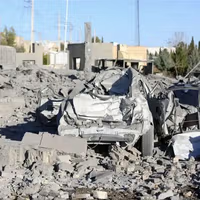
The blockade, targeting Iranian ports and imposing partial restrictions in the Strait of Hormuz, took effect at 10 a.m. Eastern Time.
Iran’s heavy reliance on southern shipping lanes leaves its economy exposed to maritime disruption, with more than 90% of its $109.7 billion annual trade passing through the Strait of Hormuz.
The blockade is expected to cut off nearly all of Iran’s seaborne trade, wiping out an estimated $435 million in daily economic activity and forcing oil field shutdowns within weeks.
A blockade would effectively zero out Iran’s export revenues within days and trigger cascading effects across its financial system.
Oil exports would be hit first
Crude oil shipments would be the first and most severe casualty. Iran has been exporting roughly 1.5 million barrels per day, generating about $139 million daily based on wartime pricing assumptions.
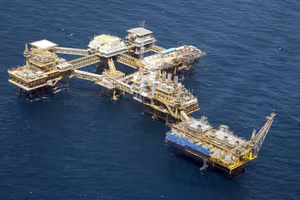
Nearly all of that volume departs via Kharg Island, which handles over 90% of crude exports and lacks viable alternative routes outside the Persian Gulf.
A blockade would eliminate these flows almost immediately, cutting off the Islamic Republic’s primary source of foreign currency earnings.
Petrochemicals and non-oil trade
Petrochemical exports, valued at roughly $54 million per day based on recent trade data, would also be halted. Facilities at Assaluyeh, Imam Khomeini, and Shahid Rajaei ports all sit within the Persian Gulf and depend on uninterrupted maritime access.
Non-oil exports – including minerals and metals – would see similar disruption. Of approximately $88 million in daily shipments, around 90% would be blocked, removing another $79 million a day in revenue.
Ports play a central role in this vulnerability. Shahid Rajaei alone handles more than half of Iran’s cargo operations, while Imam Khomeini is a key entry point for basic goods imports.
Bushehr ports handled about 57 million tons of cargo last year, underscoring how deeply Iran’s trade is concentrated in southern waters.
Limited alternatives beyond the region
Efforts to develop alternative export routes appear insufficient to offset losses.
The Jask terminal, designed as a bypass to Hormuz, operates far below its intended capacity, with effective throughput estimated at around 70,000 barrels per day.
Chabahar port and Caspian Sea facilities handle only a fraction of the volumes moved through Persian Gulf ports.
Combined, these routes could replace less than 10% of current volumes.
Imports and inflation pressures intensify
On the import side, Iran brings in about $159 million in goods daily, including industrial inputs, machinery, and food.
Disruptions to these flows would likely accelerate inflation, which has already surged. Food prices have risen sharply, with staple items such as rice increasing up to sevenfold in recent months.
Any interruption to imports would deepen supply shortages and place further strain on household purchasing power.
Storage limits create shutdown risk
A critical constraint lies in Iran’s oil storage capacity.
Iran has approximately 50–55 million barrels of onshore oil storage capacity, about 60% of which is already filled. Spare capacity stands at around 20 million barrels.
With surplus production of 1.5 million barrels per day that is normally exported, this capacity would be filled in about 13 days. After that, Iran would be forced to shut in oil wells.
This is highly significant because when mature oil wells are shut, water from below can intrude into the reservoir – a process known as “water coning.”
In this situation, some of the oil becomes permanently trapped within rock pores and can no longer be recovered. Iran’s oil fields are already declining at a rate of 5–8% per year.
Forced shutdowns could permanently eliminate 300,000 to 500,000 barrels per day of production capacity – equivalent to $9–15 billion in annual revenue lost forever.
Currency faces renewed pressure
The loss of export revenues would also affect Iran’s currency markets.
The rial has already weakened sharply, trading near 1.6 million per dollar in unofficial markets, with inflation running close to 50%.
A halt in foreign exchange inflows would likely intensify depreciation, further limit access to cash, and could push the currency toward hyperinflation.
Banks have already imposed withdrawal limits, reflecting existing financial strain.
Economic pressure builds rapidly
Taken together, the figures suggest a blockade would impose roughly $13 billion in monthly economic damage, combining export losses and disrupted imports.
Iran’s economic structure, heavily dependent on the Persian Gulf transit routes and energy exports, makes continued resistance economically impossible under the US naval blockade.
The figures show how quickly pressure could build if shipping lanes are closed, with immediate fiscal impacts followed by longer-term damage to production capacity and financial stability.
The ceasefire announced on April 7 has offered temporary relief to the United States and, by extension, the global economy. Oil prices have since fallen below $100 per barrel, the Strait of Hormuz may finally reopen, and global stock markets have rallied, recovering part of the losses recorded over the previous 40 days.
The coming days may prove crucial for stabilizing seasonal supply chains, particularly for fertilizer inputs transiting the strait during the peak planting period in the Northern Hemisphere.
Inside Iran, however, the outlook is far more complex.
The war effectively froze Iran's economic crises, shuttered markets, and halted price discovery. A similar pattern followed the 12-day conflict earlier in the war, when markets closed temporarily before reopening to renewed upward pressure as underlying imbalances reasserted themselves. This time, the damage is far greater.
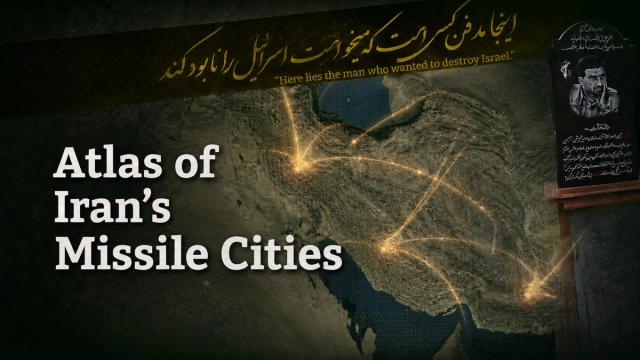
During US-Israeli airstrikes on Iran’s strategic infrastructure, attacks on Mahshahr and Asaluyeh petrochemical facilities hit sites Iranian officials say account for 85% of the country’s petrochemical export capacity.
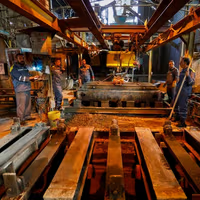
The steel industry was also hit. Since these sectors supply downstream industries from plastics to automotive manufacturing and construction, the full scale of disruption has yet to be assessed.
The Tehran Stock Exchange has been closed for more than 40 consecutive days.
The head of the Securities and Exchange Organization has indicated that war-damaged companies will return to trading at a later stage, meaning that even if the exchange reopens, a significant portion of major firms may remain inactive.
Reopening without viable export-oriented companies could trigger heavy selling pressure in a market where banks and automakers are already loss-making and reliant on state support.
Inflation remains the most pressing crisis. Before the US-Israeli airstrikes, annual inflation had surpassed 70 percent — the highest since World War II. Food inflation reached triple digits, with bread and grains rising by 140 percent and cooking oil by more than 200 percent.
The war temporarily suppressed these pressures: demand fell amid unemployment, banking disruptions reduced the velocity of money, and property and automobile transactions slowed sharply.
With the Pakistani-brokered ceasefire, that suppressed demand is likely to return.
The fiscal picture offers no relief. The approved budget included a 65-percent rise in taxes, but roughly 60 percent of working-age individuals are currently unemployed.
In effect, the government is attempting to tax its way out of a fiscal crisis in an economy where the majority of working-age adults have no income to tax. Post-war military expenditures and reconstruction obligations have increased sharply, with no significant new revenue streams available.
Compounding this is the disruption of Iran's primary financial channel through Dubai, which for years served as a central hub for trade and currency transactions worth $16 billion to $28 billion annually.
Following recent attacks on Dubai, Emirati authorities reportedly detained dozens of currency dealers linked to Iran's Revolutionary Guard and shut down associated front companies.
Alternative channels in Herat and Erbil remain active but lack Dubai's scale. When suppressed demand for foreign currency returns, it will hit a narrower, less efficient set of channels, amplifying exchange rate volatility.
The ceasefire offered the world a reprieve. For Iran, it removed the only thing suppressing a crisis that had been building for months. When markets reopen, they will price in not only pre-war imbalances but the destruction of the export capacity that once generated foreign currency.
The rial will face a market that has every reason to reprice it sharply downward, and a state with fewer tools than ever to intervene. Iran's economy has not returned to its pre-war condition. It has moved past it.
Yet the ceasefire itself is fragile, reportedly violated several times within its first 48 hours. Even in the best-case diplomatic scenario, the technology and capital required for reconstruction will not materialize within weeks, and as long as the risk of renewed conflict remains, investors are unlikely to commit long-term capital.
What comes next at the negotiating table will shape whether any of it matters.