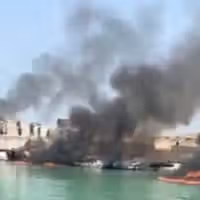
A facility at Bandar Imam Petrochemical Company on the shores of the Persian Gulf
Tehran is shifting its sanctions-busting strategy away from crude oil toward more lucrative and less scrutinized petroleum products to boost revenues even as restrictions tighten.
Iran’s oil and petroleum product revenues jumped 16 percent to almost $66 billion in the fiscal year ending March 2025, according to Central Bank data—triple the level of 2020, the last year of US President Donald Trump’s first term.
Roughly one-third of this income now comes from petroleum products such as naphtha and liquefied petroleum gas (LPG).
Data from data analytics platform Kpler reviewed by Iran International shows LPG exports have nearly doubled since pre-2018 sanctions levels, while naphtha shipments have more than tripled since 2021.
Unlike crude, which is almost entirely sold to China, Iran’s petroleum products reach a wider mix of buyers, led by the United Arab Emirates and China but also including Malaysia, Singapore, India, Pakistan and Indonesia.
Plumes for cash
The surge in naphtha and LPG exports stems from a policy shift: Tehran has ramped up domestic consumption of mazut fuel oils, one of the dirtiest fuels, while freeing up cleaner, higher-value products for sale abroad.
A confidential Oil Ministry document obtained by Iran International shows refinery output has barely grown—domestic processing of crude and condensates rose only 7 percent since 2021.
Instead, daily mazut use has jumped 57 percent while exports have fallen nearly 40 percent.
Together, exports of naphtha, LPG and mazut now exceed 700,000 barrels per day. Added to 1.45 million barrels of crude and condensate, this shows how central petroleum products have become, accounting for about one-third of Iran’s oil revenues.
In effect, Tehran is burning more of its dirty, low-value fuel at home to free up cleaner, higher-value fuels for export.
Health hazard
Iran’s mazut contains about 3.5 percent sulfur—seven times the International Maritime Organization’s standard—leaving it with few export markets.
Burning it domestically has worsened air pollution: Tehran recorded only seven clean-air days last year and just six so far this year, while schools and offices in several provinces were forced to shut during smog episodes.
Last year alone, hundreds were hospitalized with respiratory and cardiovascular illnesses linked to severe smog.
Health officials estimate tens of thousands of deaths each year from pollution.
In December 2024, Health Minister Mohammadreza Zafarghandi put the toll at 40,000, while parliament’s Environment Committee cited 30,000 deaths in 2023—both underscoring the steep human cost of Tehran’s strategy: exporting cleaner fuels for hard currency while consuming dirtier ones at home.
More than $95 billion in foreign currency from Iran’s non-oil exports since 2018 has not been repatriated to the country, the Guards-linked Tasnim news agency reported on Friday, citing official trade data.
“Out of over $270 billion in total non-oil exports from 2018 to 2025, nearly $95.6 billion—about 35 percent—has yet to return to Iran’s official financial system,” Tasnim said.
The report said the unreturned funds relate to exports excluding government-controlled sectors such as oil, gas, and electricity.
Iran's top non-oil exports are dominated by petrochemical products such as liquefied propane, methanol, and bitumen, as well as agricultural products like pistachios and saffron. Key export destinations include China, Iraq, and the United Arab Emirates, though China has recently been a particularly important market for petrochemicals.
In the period since 2022, Iran recorded $146 billion in non-oil exports, of which $56 billion, or nearly 38 percent, has not been brought back into the country.
Hossein Samsami, a member of the parliament’s economic committee, criticized the government’s handling of the issue following recent remarks by the president about a shortage of foreign exchange.
“The president said that we do not have even one billion dollars and must bargain to find it,” Samsami wrote on his personal page. “Meanwhile, nearly 100 billion dollars of export revenues have not returned to the country over the past seven years. If the law were properly enforced, we would even have surplus currency.”
Under Iranian law, exporters are required to repatriate foreign currency earned abroad, and failure to do so constitutes a violation under anti-smuggling legislation. However, Tasnim quoted experts as saying that lax enforcement and loopholes have allowed large sums to remain overseas or be used for informal imports.
Hydropower generation at the Amir Kabir Dam in Karaj, west of Tehran, has stopped after storage fell to 25 million cubic meters, while lawmakers warned that several provinces could soon face acute drinking water shortages.
The Amir Kabir Dam, inaugurated in 1960 as Iran’s first multipurpose dam, is now at its lowest level in more than six decades of operation. Once vital to supplying Tehran province, it currently holds only about 14 percent of its 205 million cubic meter capacity, according to the Iran Water Resources Management Company.
“At present, nearly 86 percent of the reservoir is empty,” the agency said in its latest assessment, citing low inflows from upstream rivers and continued extractions for urban, agricultural, and environmental needs.
A year ago, the dam contained around 111 million cubic meters of water, with the long-term seasonal average closer to 120 million cubic meters. The year-on-year comparison reflects a 76 percent decline in stored volume.
Hydropower operations were suspended earlier this autumn when levels fell below 28 million cubic meters, disabling the facility’s turbines. Officials said the dam has not yet reached its “dead storage” level of 10 million cubic meters, below which the water becomes unusable.
In central Iran, Isfahan officials warned that the city’s water crisis has grown beyond provincial boundaries and could soon affect several regions.
Mohammad-Taghi Naghdali, head of Isfahan’s parliamentary delegation, said the situation required “a national commitment and cross-provincial coordination.” A task force known as the “water command” has been established to pursue solutions, he added.
“We have exhausted all legal and parliamentary means to stop unauthorized withdrawals,” Naghdali said. “If action is delayed, the entire country will face a grave catastrophe.”
Experts have cautioned that decades of overconsumption, mismanagement, and uneven rainfall have left Iran’s reservoirs critically depleted, threatening both electricity production and drinking water supplies nationwide.
Leaked documents and media investigations indicate a Berlin businesswoman allegedly ran oil sales for Iran from her apartment, with the proceeds apparently reaching Iran’s Ministry of Defense through a web of front companies operating in Asia.
According to leaked documents published by the exile platform Wiki-Iran and analyzed by German broadcaster ZDF, emails in the dataset of Sepehr Energy Jahan (SEJ) — an Iranian oil firm tied to the defense ministry — refer to a Berlin-based trading company, suggesting possible links to Iran’s sanctioned oil network.
The documents, which include contracts, customer lists and bank data, show how Iran moves sanctioned crude oil to China using shadow tankers and complex invoicing chains.
On August 28, Germany, France, and the United Kingdom — known as the European Troika — in response to Iran’s violation of its nuclear commitments, initiated the process of activating the snapback mechanism.
Ultimately, all United Nations sanctions against the Islamic Republic, which had been suspended under the framework of the JCPOA, were reimposed on September 28.
Xu told ZDF middlemen typically use false names and altered paperwork so that they themselves would not be involved in the trade.
A Berlin address in the documents
The materials released by Wiki-Iran include email exchanges referencing a Berlin company address and attaching a copy of the businesswoman’s identification card.
From her apartment, investigators believe, she coordinated multimillion-liter oil shipments disguised through renamed firms and falsified invoices.
When confronted by ZDF, the woman admitted knowing Iranian oil traders but denied participating in any commercial transactions.
No official investigation has yet been opened against her, the Berlin prosecutor’s office told ZDF, adding that “no proceedings have been filed regarding the company.”
Customs authorities declined to comment on specific cases.
The broader context
Wiki-Iran, which has previously released credible leaks from within Iran, said it obtained internal SEJ records that trace oil sales through intermediaries in Malaysia and Singapore.
ZDF journalists who followed those leads on the ground found most of the data consistent, strengthening suspicions about the Berlin connection.
Under German law, oil trade with Iran is permitted unless entities tied to the Iranian defense ministry are involved.
“If the Ministry of Defense participates, then they are committing a criminal offense,” said Christian von Soest, head of Peace and Security Studies at the GIGA Institute in Hamburg.
A conservative Iranian lawmaker said parliament is reviewing an emergency motion to stop the implementation of Iran’s conditional approval to join a United Nations convention against terror financing, arguing it would expose the country’s sanction-busting networks.
Mojtaba Zonouri, a member of parliament from Qom, said on Friday the measure on joining the UN Convention for the Suppression of the Financing of Terrorism (CFT) remains suspended in parliament, and that a “triple-urgency motion” submitted by Tehran lawmaker Malek Shariati is under review to prevent it from taking effect.
“As long as we are forced to bypass sanctions to meet the country’s needs, joining the CFT is like putting a rope around our own necks,” Zonouri said, according to Iranian media. He added that Iran could join the convention only “when sanctions are fully lifted.”
His remarks come after Iran’s Expediency Council — the body overseen by Supreme Leader Ali Khamenei that resolves disputes between parliament and the Guardian Council — conditionally approved the country’s accession to the UN convention earlier this month, after years of delay.
The CFT, one of the 49 measures linked to the Financial Action Task Force (FATF) standards, requires countries to track and report financial transactions to combat money laundering and terror financing. Hardliners argue that joining would expose Iran’s financial channels used to evade sanctions and support allied armed groups across the Middle East.
The conditional approval followed the reimposition of UN sanctions on Iran on September 28 under the nuclear deal’s snapback mechanism. In April, over 150 lawmakers had urged the Council to reject the convention until “the risk of renewed sanctions is entirely eliminated.”
The United States has long accused Tehran of using its regional allies to fund and coordinate attacks across the region, labeling Iran the world’s leading state sponsor of terrorism for 39 consecutive years.
A general view of an oil dock is seen from a ship at the port of Kalantari in the city of Chabahar, 300 km (186 miles) east of the Strait of Hormuz January 17, 2012
The United States on Thursday imposed new sanctions on dozens of companies and individuals it accuses of helping Iranian energy exports and facilitating the acquisition of US chip technology by Iran's military and regional allies.
The Treasury’s Office of Foreign Assets Control (OFAC) blacklisted 26 firms and three addresses in China, Turkey, and the United Arab Emirates, placing them under strict export controls.
Two subsidiaries of US chipmaker Arrow Electronics in China and Hong Kong were also added for allegedly routing American parts to Iran-linked groups a rare move against a US-listed company.
Arrow said it complies with export regulations and is cooperating with US authorities.
In a separate announcement, the Treasury sanctioned 10 individuals and 38 entities for helping Iran evade petrochemical and shipping restrictions.
"This action targets a network moving hundreds of millions of dollars’ worth of Iranian LPG, along with nearly two dozen shadow fleet vessels, a China-based crude oil terminal, and an independent “teapot” refinery," OFAC said in a statement.
Those named include Indian nationals Niti Unmesh Bhatt, Piyush Maganlal Javiya, and members of the Kasat family along with Chinese citizen Wenlong Gu and Turkish businessman Aykut Yavruca.
The sanctioned companies are based in Hong Kong, Turkey ,the UAE and the Marshall Islands.
'Degrading Tehran's cash flow'
The measures are part of a broader US campaign to curb Iran’s weapons procurement and financing. Last week, Washington sanctioned 38 alleged Iran-China networks for sourcing missile and helicopter parts.
Treasury Secretary Scott Bessent said the United States will continue blocking Tehran’s “malign objectives.”
“The Treasury Department is degrading Iran’s cash flow by dismantling key elements of Iran’s energy export machine," Bessent added.
In September, the Treasury also sanctioned four Iranians and several UAE- and Hong Kong-based firms accused of laundering hundreds of millions of dollars through oil and cryptocurrency to fund missiles, drones, and Hezbollah.
That same week, the State Department revoked Iran’s Chabahar Port waiver, warning shipping operators of possible penalties.