• العربية
  • فارسی
Brand
  • Iran Insight
  • Politics
  • Economy
  • Analysis
  • Special Report
  • Opinion
  • Podcast
  • Iran Insight
  • Politics
  • Economy
  • Analysis
  • Special Report
  • Opinion
  • Podcast
  • Theme
  • Language
    • العربية
    • فارسی
  • Iran Insight
  • Politics
  • Economy
  • Analysis
  • Special Report
  • Opinion
  • Podcast
All rights reserved for Volant Media UK Limited
volant media logo

World Bank warns of deeper recession in Iran after UN sanctions and June war

Oct 7, 2025, 07:54 GMT+1Updated: 00:30 GMT+0
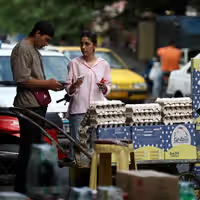
Iranian people walk at the Tehran Bazaar after the approval of the bill to remove four zeros from the national currency, in Tehran, Iran, October 5, 2025.

Iran’s economy is set to shrink this year and next as tighter sanctions, falling oil exports, and the aftermath of this year’s conflict weigh heavily on output, the World Bank said on Tuesday, even as it raised its overall growth forecast for the broader Middle East region.

The World Bank projected Iran’s gross domestic product to contract by 1.7% in 2025 and by 2.8% in 2026, reversing its earlier April forecast of modest growth.

The downturn, it said, reflects “a contraction in both oil exports and non-oil activity amid tighter sanctions, including the reimposition of UN measures, and disruption following the conflict in June.”

The report added that Iran’s oil sector has struggled to recover since renewed USand European pressure and United Nations sanctions took effect last month, targeting Tehran’s nuclear and military programs.

Those restrictions -- reinstated under the snapback mechanism -- have curtailed exports and complicated access to financial markets, deepening the strain on Iran’s heavily sanctioned economy.

The bank said the June conflict, which saw Israel and the United States strike Iranian nuclear sites, further disrupted trade and investment, slowing both industrial output and services.

Non-oil sectors, already weakened by inflation and currency depreciation, have seen a sharp drop in domestic consumption and private investment.

The report contrasts Iran’s outlook with that of its Persian Gulf neighbors, where higher non-oil growth and eased production curbs have lifted regional performance.

The World Bank now expects the MENAAP region -- covering the Middle East, North Africa, Afghanistan and Pakistan -- to grow 2.8% in 2025, up from 2.6% in its April forecast.

Still, it warned that developing oil exporters like Iran and Libya face the steepest challenges from conflict, energy disruptions, and global uncertainty.

Iran, home to the world’s second-largest gas reserves, has seen years of volatile growth amid sanctions and political isolation. The World Bank said the return of UN restrictions and regional instability risk prolonging the country’s economic stagnation, with output unlikely to recover until sanctions relief or new trade channels emerge.

Most Viewed

Iran negotiators ordered to return after internal rift over Islamabad talks
1
EXCLUSIVE

Iran negotiators ordered to return after internal rift over Islamabad talks

2
ANALYSIS

US blockade enters murky phase as tankers spoof signals and buyers hesitate

3
ANALYSIS

Why the $100 billion Hormuz toll revenue is a myth

4

US tightens financial squeeze on Iran, warns banks over oil money flows

5
ANALYSIS

US blockade targets Iran oil boom amid regional disruption

Banner
Banner

Spotlight

  • Hardliners push Hormuz ‘red line’ as US blockade tests Iran’s leverage
    INSIGHT

    Hardliners push Hormuz ‘red line’ as US blockade tests Iran’s leverage

  • Ideology may be fading in Iran, but not in Kashmir's ‘Mini Iran'
    INSIGHT

    Ideology may be fading in Iran, but not in Kashmir's ‘Mini Iran'

  • War damage amounts to $3,000 per Iranian, with blockade set to add to losses
    INSIGHT

    War damage amounts to $3,000 per Iranian, with blockade set to add to losses

  • Why the $100 billion Hormuz toll revenue is a myth
    ANALYSIS

    Why the $100 billion Hormuz toll revenue is a myth

  • US blockade targets Iran oil boom amid regional disruption
    ANALYSIS

    US blockade targets Iran oil boom amid regional disruption

  • Iran's digital economy battered by prolonged blackout
    INSIGHT

    Iran's digital economy battered by prolonged blackout

•
•
•

More Stories

'Worse every day': Iranians detail surging food prices in wake of sanctions

Oct 6, 2025, 19:40 GMT+1

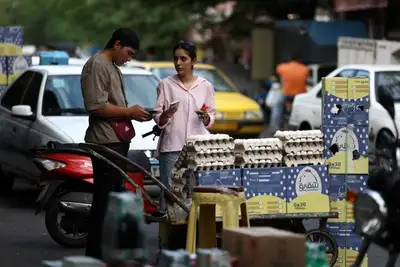
People in Iran face skyrocketing prices for food and everyday goods, according to text and multimedia submissions sent to Iran International, as the return of UN sanctions slams the economy and deepens anxiety.

The value of Iran's currency plumbed new lows after the UN sanctions triggered by European states resumed late last month, raising already eye-watering costs of living.

In one video sent to Iran International, a man displays grocery bags containing apples, peaches, grapes and bananas while criticizing Iranian authorities for what he described as economic mismanagement.

“I bought four basic items, not luxury fruits, and it cost 16,000,000 rials ($14). The more people tolerate you government folks, the worse you act," he said. "People have shown patience, and you’ve ruined the country. You get worse every day. What happened after the war? Executions and skyrocketing prices. How much more?”

Another man shared a video showing his grocery purchases and chiding Iran's Supreme Leader for saying sanctions have had no impact.

“I bought one kilogram (2.2 pounds) of cucumbers, one kilo of eggplants, one and a half kilos of potatoes, one and a half kilos of onions and one kilo of tomatoes—it totaled 7,290,000 rials ($6.6). Then Khamenei says sanctions have no effect. God damn you for dragging us to hell,” he said.

In another video, a shopper focuses on the price tag of a tray of eggs, comparing the cost before and after the reimposition of sanctions while addressing Iranian president Masoud Pezeshkian.

“Look at this egg price, it’s 1,980,000 rials for 30 ($1.8). Before the snapback mechanism, it was 1,300,000 rials ($1.2). Mr. Pezeshkian, maybe the mechanism didn’t affect you, but it hit chickens and eggs hard,” he said.

Bread and dates

One video uses sarcasm to highlight the rising price of dates, a fruit often referenced in Islamic teachings.

“They told us all our lives that the Prophet and Imams lived on bread and dates. A 700-gram (1.5 pounds) box of the ‘Prophet and Imams’ food’ now costs 3,760,000 rials ($3.4). We’ve crossed the peak—we’re heading to the skies,” he said.

Iran’s minimum wage for 2025 is 104 million rials per month, equivalent to about $94.

To offset inflation, the Iranian government has issued a series of vouchers known as Kalabarg to help low-income households.

The vouchers are valued at 5,000,000 rials ($4.5) per person for income deciles 1–3, and 3,500,000 rials ($3.1) for deciles 4–7.

A woman in another video shows her purchases using a family voucher and questions its effectiveness.

“I got a four-person voucher worth 14,000,000 rials ($12.6). With it, I bought one tray of eggs, one box of tea, two tomato pastes, one laundry liquid, one pack of noodles, and one pack of gum. All this hype about vouchers, and that’s all it got me,” she said.

China trades cars for Iranian copper as sanctions revive barter economy - BBG

Oct 6, 2025, 17:45 GMT+1

China and Iran have quietly stepped up their mutual trade via barter transactions, Bloomberg reported, exchanging Chinese cars for Iranian copper and zinc to circumvent deepening international sanctions.

The Bloomberg report citing people familiar with the matter said Chinese carmakers are exchanging vehicles and auto parts for Iranian copper and zinc, allowing both nations to bypass US restrictions on dollar transactions.

At the heart of the arrangement are companies based in China’s Anhui province, including Chery Automobile and Tongling Nonferrous Metals Group.

Chery, which recently raised $1.2 billion in a Hong Kong IPO, sells parts and technology to another firm in Anhui that assembles semi-knocked down vehicles.

Those partially built cars are then shipped to Iran, where they are finished and sold under the Modiran Vehicle Manufacturing (MVM) brand — a local venture Chery established in 2004 that went on to become Iran’s most popular foreign car line.

In exchange, containers of Iranian copper and zinc are sent to China, feeding the country’s vast metals industry, Bloomberg added.

Tongling Nonferrous, one of China’s biggest metals producers, reportedly helps broker the trade.

None of the companies involved are accused of breaching sanctions, since they operate entirely outside the US or European financial systems and trade in local currencies — yuan and rials — rather than dollars or euros. Under Chinese law, such commerce remains legal.

Fragmented global trade

This barter system emerged as a creative response to the financial squeeze Iran faced after the US withdrew from the 2015 nuclear deal in 2018.

The reinstatement of US sanctions after President Donald Trump withdrew from a 2015 nuclear deal effectively cut Tehran off from global banking, making it nearly impossible for Iranian firms to pay foreign suppliers through conventional means.

Barter, once a relic of Cold War trade long plied by an isolated Soviet Union, offered a practical workaround.

The car-for-copper model underscores how sanctions have fragmented global trade and encouraged alternative systems that exclude the US dollar.

Similar arrangements have been reported between Iran and Sri Lanka, which swapped tea for oil, and even between China and Russia since 2022.

For Iran, these deals provide vital access to consumer goods and industrial materials that would otherwise be scarce under sanctions. For China, they secure steady supplies of raw materials while expanding its industrial influence in sanctioned markets.

Chery’s history with Iran reflects Beijing’s long-term strategy of using trade to deepen ties with isolated economies.

When Chinese President Xi Jinping visited Tehran in 2016, Chery’s CEO accompanied him — a symbol of how industrial cooperation forms part of China’s Belt and Road Initiative.

Despite pledging in its IPO filings to reduce exposure to sanctioned markets, Chery’s enduring presence in Iran demonstrates how resilient and adaptable this trade relationship remains.

While modest in scale compared with China’s overall $9 billion annual exports to Iran, the revival of barter trade highlights a broader geopolitical trend: as Western sanctions proliferate, countries like China and Iran are forging parallel economic systems that operate beyond Washington’s reach.

Iran's oil minister says new field discovery could ease energy crunch

Oct 6, 2025, 16:35 GMT+1

Iran’s oil minister announced the discovery of a new oil and gas field in the country's south on Monday, saying it could help ease the country’s growing energy shortages wrought by sanctions and aging infrastructure.

Mohsen Paknejad said that for the first time during exploration drilling, the team reached a horizontal layer containing at least 200 million barrels of crude oil.

The newly discovered reserve lies within the Pazan field in southern Fars province, extending north toward Bushehr province.

Paknejad said the field also "has a reserve of 10 trillion cubic feet of gas and can play an important role in offsetting the country’s energy imbalance in the coming years."

“Assuming a 70% recovery factor for the gas field, the recoverable volume is estimated at 7 trillion cubic feet,” state media cited him as saying.

Despite vast energy wealth, Iran faces lingering shortages with electricity and gas demand exceeding production and frequent outages and industrial disruptions marring economic activity.

Sanctions have hampered Iran's ability to import and renew its energy infrastructure, much of which is decades old and struggles to extract already proven reserves.

Since November 2024, the crisis has deepened due to aging infrastructure, according to data published in July by the Iranian Union of Exporters of Oil, Gas and Petrochemical Products.

The discovery comes as Iran faces deepening economic pain amid new sanctions. In late September, France, Germany and the United Kingdom triggered the resumption of UN sanctions citing Iran’s alleged non-compliance with nuclear commitments.

The move restored restrictions on oil, gas, and petrochemical exports, further isolating Tehran’s energy sector and limiting foreign investment needed for modernization.

Recent statistics from the National Iranian Gas Company show that household gas consumption rises from 250 million cubic meters per day in summer to 650 million cubic meters in winter, creating a daily shortfall of over 200 million cubic meters, the report said.

“Iran is currently the world’s third-largest gas producer and the second-largest in reserves. According to recent data from energy research institutes, Iran’s gas consumption is twice that of the European Union,” said Reza Padidar, head of the Sustainable Development, Environment, and Standards Commission at the Iran Chamber of Commerce.

According to 2021 data from the Iranian Gas Engineering and Development Company, Iran’s total energy supply is equivalent to 2.2 billion barrels of crude oil. Gas accounts for 72% of total supply, oil and derivatives 26.5%, and coal and other sources less than 1.5%.

EU seeks to make Iran a responsible regional partner, foreign policy chief says

Oct 6, 2025, 13:08 GMT+1

The European Union aims to work with regional partners to encourage Iran to act as a responsible power in the Middle East, EU foreign policy chief Kaja Kallas said on Sunday, as the bloc is reimposing UN and EU sanctions.

Speaking at the EU-Gulf Cooperation Council High-Level Forum on Regional Security and Cooperation in Kuwait, Kallas said the reactivation of UN sanctions on Iran marked a setback but not the end of diplomacy.

She said Europe would continue outreach to Tehran and other stakeholders to pursue a sustainable negotiated solution to the nuclear dispute.

The EU’s decision follows the snapback of sanctions triggered by France, Germany and the United Kingdom last month over Iran’s breaches of the nuclear accord.

“The reimposition of restrictions must not be the end of diplomacy,” Kallas said, calling for continued dialogue to reduce tensions and re-establish Iran’s credibility in regional affairs.

Kallas also linked growing instability in the Red Sea to Iran’s regional activities, condemning renewed attacks by Yemen’s Iran-backed Houthi militia on commercial vessels.

She said the EU’s naval mission, Operation Aspides, had so far protected more than 560 ships and would continue safeguarding key maritime routes vital to global trade.

Germany’s Foreign Minister Johann Wadephul, who also attended the forum, accused Tehran of using the Houthis to project destabilizing influence across the Middle East.

He said the group’s attacks endangered both Israel and international shipping, urging joint EU-GCC action to address what he described as the root causes of regional insecurity.

Both officials emphasized the need for coordinated policy responses between Europe and Persian Gulf states, saying collective diplomacy and maritime cooperation were essential to preserving stability and countering escalation in the region.

Iran resumes wheat imports from Caspian nations after three-year halt - Tasnim

Oct 6, 2025, 12:02 GMT+1

Iran has resumed wheat imports from Caspian Sea countries for the first time in three years, with the arrival of an initial shipment at Amirabad port in northern Mazandaran province, the semi-official Tasnim news agency reported on Monday.

“The first shipment of imported wheat, part of a 30,000-ton import permit and weighing nearly 5,000 tons, has reached Amirabad port and will soon be transferred to provincial silos,” said the head of Mazandaran’s Grain and Commercial Services, as quoted by Tasnim.

The move follows sustained efforts by provincial authorities to diversify wheat supplies and improve food quality amid recurring drought and local production challenges. Officials said mixing imported grain with domestic wheat is expected to enhance flour quality across the province.

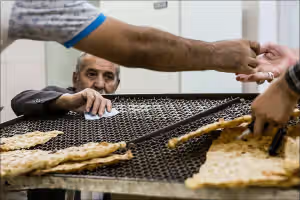
  • Rampant inflation may ignite bread riots in Iran, economist warns

    Rampant inflation may ignite bread riots in Iran, economist warns

  •  Iran sees steep bread price hikes as inflation bites

    Iran sees steep bread price hikes as inflation bites

Caspian nations including Russia, Kazakhstan, Turkmenistan and Azerbaijan are among the region’s key grain producers.

Mazandaran officials also discussed tighter oversight of the flour and bread supply chain, including mandatory GPS and camera systems for flour transport vehicles to prevent diversion and ensure transparency, Tasnim said.

Provincial economic deputy governor Mohammad Ebrahim Toulaei added that Iran aims to strengthen local mills and improve the quality of subsidized bread, while providing loans to bakers for upgrading dual-fuel and backup power equipment.