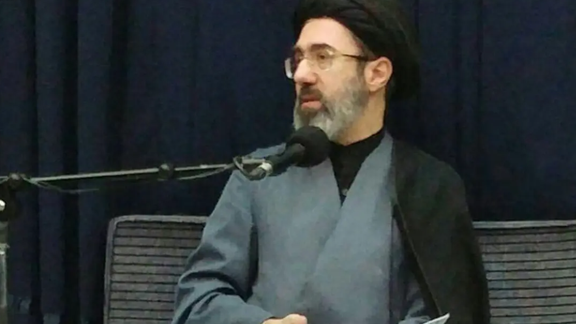
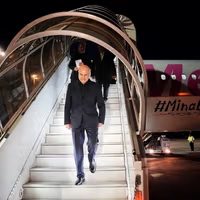
Mojtaba Khamenei seen during one his seminary lectures. Undated
An Iranian news agency’s use of the title “Ayatollah” for Mojtaba Khamenei has rekindled suspicions that he's being groomed to succeed his father as Supreme Leader.
Social media users have widely interpreted Rasa News Agency’s attempt to promote the supreme leader's son as an ayatollah as confirmation that he's being groomed for leadership. The Supreme Leader being also the highest religious authority must be at least recognized as an ayatollah by Grand Ayatollahs.
The news agency used the title in an announcement for registration of Mojtaba Khamenei’s theology course, (kharej fiqh), at Qom seminary where he has been studying and teaching for a few years now.
Kharej fiqh is the highest level of Shia seminaries and ayatollah is an honorific title for high-ranking Twelver Shia clergy. Unlike academic titles that one gains automatically after completion of a degree, Shia scholars are usually confirmed as ayatollahs only when their teachers, and peers, address them as such.
The 53-year-old Mojtaba Khamenei, the second eldest of Khamenei’s four sons, has until now only been recognized as a hojjat ol-eslam, a much lower rank in the Shiite clerical hierarchy.
The news agency calls itself a private media outlet established by seminary scholars and researchers but some Iranian media affiliated with reformists such as the Jamaran news website have claimed that Rasa is funded and run bythe IRGC and criticized it for “meddling in politics”.
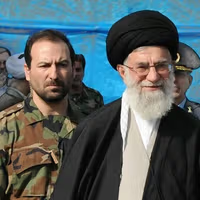
Mojtaba Khamenei seen greeting former Qods Force commander Qasem Soleimani
Earlier in August, Mir Hossein Mousavi who has been under house arrest since February 2011, warned the nation over the introduction of hereditary leadership, referring to Khamenei’s son Mojtaba. Mousavi’s warning revived rumors about Mojtaba’s activities and his alleged ambition to succeed his father.
Rumors about Mojtaba Khamenei’s ambitions have been circulating in Iran since 2005 when he was first accused of rigging the presidential election in a bid to bring like-minded politicians to power.
Mousavi who served as the Islamic Republic's first prime minister from October 1981 to August 1989, under then President Ali Khamenei, was put under house arrest nearly two years after the disputed 2009 presidential elections, when the incumbent Mahmoud Ahmadinejad was announced the winner in suspicious circumstances at Mousavi’s expense.
During the protests that followed, protesters often chanted against Mojtaba Khamenei who they held responsible for meddling with the election result, bringing Ahmadinejad to power and the crackdown on protesters. “Die, Mojtaba, may you never achieve leadership,” they chanted.
During the past years there have also been rumors about Mojtaba’s involvement in financial corruption cases involving the IRGC. The rumors also charged that he supervised the IRGC Intelligence when Hossein Ta’eb, who was recently fired by Khamenei, headed the organization.
Mojtaba Khamenei is an enigmatic figure who holds no public office in the government and is rarely seen in public but reportedly wields much more influence than the leader’s other sons in powerful organizations such as his father’s office and the IRGC Intelligence Organization (SAS).
Mojtaba Khamenei also has great influence in the country’s propaganda machine including the state-broadcaster (IRIB), and behind-the-scenes political dealings.
Iran’s Railway Company says about half of Iran's locomotives are grounded, noting that out of 950 locomotives, only about 500 are active.
Confirming the figures, the country’s Roads and Urban Development Minister Rostam Ghasemi says Iran faces a severe shortage of freight rail fleet, adding that the sector needs at least a thousand locomotives.
According to an article by the Shargh Daily on Thursday, Ghasemi said that the lack of functioning locomotives has led to long delays in delivering materials for steel, iron smelting, copper and mines industries.
He added that delays of more than 20 days in transporting cargos have reduced the production capacity of some factories and disrupted heavy industries.
The article says the country needs to transfer about 300 million tons of cargo only in the steel sector, but the total volume of cargo transferred in Iran's railway system barely reaches 40 million tons.
Criticizing Iran’s old and ramshackle locomotive fleet, the article said the minimum speed of freight trains in the world is about 80 kilometers per hour but in Iran it is about 20-25 km/h.
In addition to the rail system, an Iranian lawmaker said earlier this month that due to sanctions on the country the quantity and qualityinIran's aviationsector is also decreasing day by day.
Criticizing Roads and Urban Development Ministry, Alireza Pakfetrat, the representative of Shiraz in the parliament, said the ministry is spending most of its time and budget on housing projects and forgets that the aviation industry is also part of its responsibilities.
Ataollah Mohajerani, a former Iranian official residing in Britain
A rights organization has filed a complaint in Britain against a former Iranian official, now living in the UK, for having defended Salman Rushdie’s execution.
Justice for Iran, a London-based non-governmental human rights organization, filed its complaint against Iranian politician and author Ataollah Mohajerani for incitement to terrorism in a 1989 book, Critique of the Satanic Verses Conspiracy, and for defending a death fatwa for blasphemy against Rushdie by Iran’s late leader Ayatollah Ruhollah Khomeini.
“Almost all Muslim schools of jurisprudence share the view that whoever insults the prophet deserves to be killed. His repentance cannot be accepted,” Mohajerani, who was also a cleric in Iran, wrote in his book in which he called the Indian born British writer an “apostate”.
The complaint was filed with the counterterrorism unit of UK police on August 16 against Mohajerani, a British citizen who resides in London, Shadi Sadr, human rights lawyer and one of the Co-founders of Justice for Irantold Iran international Thursday [August 25].
British officials have not yet commented about the complaint filed against Mohajerani.
Some Iranian public figures have allegedthat western governments’ “forbearance of the Islamic Republic’s terrorist activities and hatemongering” paved the way for the recent knife attack on Rushdie in the United States while others have accused Mohajerani of defending Khomeini’s fatwa and being an apologist for the Islamic Republic.
An undated photo of Shadi Sadr
“How is it possible that the British government allows a former official of the Islamic Republic of Iran to live in the UK and call for the murder of a British citizen. Mohajerani still defending the fatwa against Salman Rushdie,” Masih Alinejad US-based activist Masih tweeted August 15.
In a series of tweets after Rushdie's stabbing, Mohajerani, a former vice-president and minister of culture and Islamic guidance, implicitly defended writing the book in praise and justification of Khomeini’s fatwa, describing the royalties from the book’s sales as “legitimate and sweet”. Mr. Mohajerani has refused talking to Iran International and other foreign based Persian language media.
Mohajerani later tweeted to deny that he approves of the attack on Rushdi and called the attempt on his life a ‘tragic incident’ but also said he hopes that the British author will cease “insulting prophets and religions during the rest of his life”.
He has responded to the possibility of being investigated by the British authorities and a trial by saying that this will provide him with a “golden opportunity” that he is ready to exploit.
Sadr told Iran International that her organization consulted a group of expert British lawyers about the case before filing its complaint. “The British lawyers said Mohajerani’s writings are evidence of “incitement of terrorism” and “sharing terrorist content”, she said.
Sadr added that the lawyers who were provided with the English translation of Mohajerani’s writings and recent tweets on the attempt on Rushdie’s life in New York in August filed the complaint with the British authorities on behalf of Justice for Iran.
Iran's hardliner media doubled down on praise for the attack on Rushdie as many condemned the stabbing by a man allegedly sympathetic to Shiite extremism.
Khomeini's death fatwa against Rushdie resulted in several failed assassination attempts against him as well as his publishers and translators. Satanic Verses’ Japanese translator, Hitoshi Igarashi, was killed, its Italian translator, Ettore Capriolo, was seriously injured in a stabbing attack, itsNorwegian publisher,William Nygaard, was shot, and an arson attack by a fundamentalist mob against its Turkish translator, Aziz Nesin, at a hotel in Sivas, Turkey, in 1993 led to the death of 37 people. Nesin narrowly escaped.
Former president Hassan Rouhani and President Ebrahim Raisi in August 2021
An extensive effort is under way in Iran to downplay a major financial corruption case at the Mobarakeh Steel Plant, involving many influential regime insiders.
The details of the corruption scheme reaching $3 billion was exposed by a social media activist after the Iranian parliament published the outcome of an investigation into the case, without naming names.
Although the report presented by the Majles (parliament) vaguely pointed out that many individuals and government organizations were implicated in the case, documents revealed by whistleblowers on social media showed that many regime insiders and organizations affiliated with both leading political factions took bribes from the steel company.
The steel firm paid threw around hundreds of millions of dollars trying to coopt all regime insiders and buy their silence, while its managers engaged in corrupt business practices.
Mobarakeh Steel is a publicly traded company, but government entities hold most shares and managers are political appointees similar to dozens of other government businesses.
Those implicated include political and cultural figures, journalists, publishers, top clerics and their family members, as well as tens of media outlets affiliated with various political factions in Iran.
Semi-officials news agency ISNA reported on Monday that 168 of the 290 lawmakers at the Majles voted for referring the case to the Judiciary. However, various actors have been trying to downplay the significance of the case.
Corruption ‘not systemic’
There has also been a great deal of efforts in the media to prove that corruption is not institutionalized in the government. There is also a lot of sensitivity on the part of government officials including President Ebrahim Raisi toward the term "systemic corruption." Raisi's preferred description is "organized corruption."
Some influential members of Iran's political elite listening to Supreme Leader ALi Khamenei, April 12, 2022
Meanwhile, in a paradoxical statement, the public relations office of the Majles has said the sheer publication of this report indicates the system is not corrupt. Earlier President Raisi had also reiterated that "The system is clean," although in the same statement he called on the Judiciary to deal with those behind the corruption case.
Denial and silence by those implicated
ISNA reported that former Vice President Es'haq Jahangiri, former chief of staff of the Presidential office Mahmoud Vaezinejad, and reformist journalist and newspaper publisher Mohammad Atyrianfar have already tried to deny their involvement in the case. This comes while, seminarians and other top clerics as well as government officials implicated have remained silent.
The Iranian state television, IRIB has also offered brief explanations about hundreds of billions of rials it has received from the Mobarakeh Steel Plant. The IRIB accused the publishers of the report of inaccuracy.
Meanwhile, other reports say the suspension of the steel plant from the Tehran Stock Exchange was reversed after one day. Nonetheless, many investors and small shareholders have said on social media that their investments have been ruined.
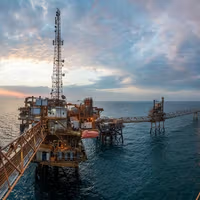
A general view of the Mobarakey Stell Plant near Esfahan
Other hardline media outlets including Kayhan which operates under the aegis of Supreme Leader Ali Khamenei's office and Javan newspaper, the mouthpiece of the Revolutionary Guard, IRGC, have so far remained silent about getting money from the steel plant. Also remaining silent are the social media influencers who have reportedly got hefty sums to turn a blind eye to the plant's inappropriate financial transactions.
Despite the reports about referring the case to the Judiciary, no complaint had been filed until Tuesday according to Judiciary Chief Gholamhossein Mohseni Ejei, ISNA reported.
Discrediting leaked information
The Majles PR Office stressed that the report and figures published on social media are not the final report about the case and thus are not accurate. This comes while according to social media activists, even the head of the investigation committee has received money from the steel plant although there is no independent verification of the accusation.
What is certain is that social media activists, including hardliner Seyyed Mostafa Bijani have said that reformists and hardline conservative are equally responsible for and involved in the corruption case.
Lotfollah Siahkali, the deputy chief of the Majles investigation committee has said that the corruption case at the Mobarakeh Steel Plant is only the tip of the iceberg and corruption is far more widespread in the government. Nonetheless, Majles Speaker Mohammad Bagher Ghalibaf said on Wednesday that the report should have not been published before due legal investigation.
Although some elements at the Majles still insist that the report is genuinely significant and alarming, it appears that many in the Iranian government would like to push the case under the carpet as too many influential individuals and organizations including the Ministry of Intelligence are involved in the case. Their solution appears to be keeping silent until the case is forgotten or superseded by the next controversial issue in the country.
A frame grab from a video of the water protests in Hamedan
Protests by residents of Iran’s western city of Hamedan, an ancient capital, continued for the second night over a lack of water in the past ten days.
Videos and photos surfaced on social media showing people chanting slogans against the government and authorities' incompetence for their mismanagement of the water resources in the province.
Protesters gathered in front of the governor’s office and some iconic landmarks in the city, carrying placards and empty bottles while security forces – backed by special anti-riot forces -- were trying to disrupt the gatherings. Some clashes were also reported during the police standoff with people.
The popular protests against the government's inefficiency in water supply have also been reported in the city of Kazeroon (Kazerun) in southwestern Fars province.
Iran’s Energy Minister admitted on Wednesday that the main problem of water tensions in Iran is the government's negligence in building water supply infrastructure, whereas Hamedan’s governor had blamed the farmers for the water crisis.
Earlier in the month, a large group of people in the city of Shahrekordin Chaharmahal-Bakhtiari -- a traditionally water-rich region in the Zagros mountains -- held a protest rally after nine days with no drinking water.
In recent years, many cities across the country were scenes of massive protests against the authorities’ mismanagement of water resources or harmful dam building and politically motivated diversion of rivers that have devastated agriculture and drinking water sources, while the Iran has been suffering from drought for at least a decade.
Iranian and US flags next to each other in 2015 when the JCPOA was finaized
The hardliner Kayhan daily in Iran, close to the Supreme Leader, has again attacked the impending nuclear agreement with the United States calling it worthless.
The hardliner paper wrote in an August 23 commentary that "all the claims about the nuclear agreement are lies and no sanctions are going to be lifted as a result of a deal" with Washington.
The Kayhan repeated its own rude rhetoric about the West in this commentary, calling Europe "a dog trained by the United States" and claimed that Europeans have turned to burning logs [as a result of fuel shortage caused by the war in Ukraine] and consuming rotten food [as a result of food shortage for the same reason]."
While parties are still negotiating to revive the 2015 agreement, JCPOA, Kayhan lashed out at its domestic supporters, mainly Iranian reformists, and wrote: "Weren't they saying every day that Iran was suffering a $100 million loss per day as the revival of the JCPOA was delayed? What has the Iranian economy gained after all that hurry to strike a deal?"
The hardliner daily accused the supporters of a deal with the United States of “throwing the country into a bottomless well."
Meanwhile the daily attributed the closure of several Iranian industrial plants to the nuclear deal while Iranian experts have said repeatedly that those firms were shut down after they were confiscated by the government and because inefficient government management pushed them into bankruptcy and closure.
Many politicians and pundits in recent days have argued that a nuclear deal is not a magic wand that will quickly fix Iran’s economic crisis. They pointed out that financial corruption and the government's inefficiency are responsible for up to 80 percent of the economic crisis in Iran and no breakthrough will happen unless those two problems are effectively tackled.
Incidentally, a report published on the same day in Didban Iran website in Tehran noted that more than half of government employees in Iran have been hired based on their connections, adding that more than 45 percent of government employees in Iran are inefficient as they lack the right skills.
Meanwhile, reformist politician Mehdi Ayati told Nameh News website in Tehran on Tuesday that the revival of the JCPOA will definitely have a positive impact on Iran's economy, but added that the agreement should facilitate Iran's ability to economically benefit from it.
In another development, Iran's nuclear Chief Mohammad Eslami said that "Iran will not accept Israel's positions as the agenda of the International Atomic Energy Agency (IAEA)." Reacting to safeguard questions raised by the IAEA and European and US negotiators' insistence on the need for Iran to respond to questions about enriched Uranium traces in several locations, Eslami said: "These accusations are not new, and Tehran has been responding to them for 20 years now." But did not say why Iran has failed to convince the IAEA.
In one of the latest developments regarding a possible agreement, Iran's Security Chief Ali Shamkhani told the press in Tehran that the Supreme Council of National Security which he heads, has had no resolution yet about the negotiations. He added that a possible agreement will be first approved by the SCNS before being put to vote at the parliament (Majles).