• العربية
  • فارسی
Brand
  • Iran Insight
  • Politics
  • Economy
  • Analysis
  • Special Report
  • Opinion
  • Podcast
  • Iran Insight
  • Politics
  • Economy
  • Analysis
  • Special Report
  • Opinion
  • Podcast
  • Theme
  • Language
    • العربية
    • فارسی
  • Iran Insight
  • Politics
  • Economy
  • Analysis
  • Special Report
  • Opinion
  • Podcast
All rights reserved for Volant Media UK Limited
volant media logo

A Dam And An Ancient Capital In Iran Have No Water Left

Maryam Sinaiee
Maryam Sinaiee

Iran International

Aug 23, 2022, 08:40 GMT+1Updated: 17:24 GMT+1
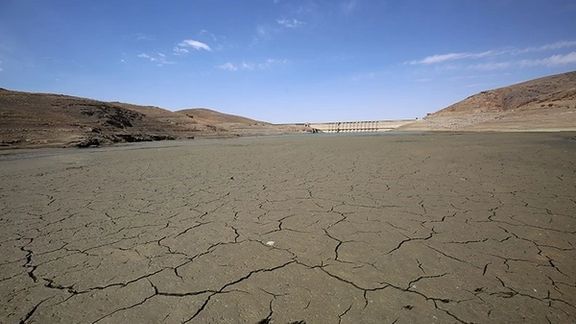
The Ekbatan dam in western Iran has no water inflow, leaving Hamedan thirsty. August 2022

Residents in the ancient Iranian capital, Hamedan, are grappling with severe water shortage, sometimes going without any water for as long as 24 hours.

The crisis which has seriously affected the everyday lives of the majority of the city’s nearly 600,000 population in the past few days, has been attributed to the critical depletion of the water in the Ekbatan Dam reservoir, with zero inflows.

With nothing in the pipes, water for drinking and other purposes is now being distributed by tanker trucks. Iran’s Red Crescent has also been distributing bottled water in the city.

A month ago, during a visit to Hamedan, capital of a province of the same name, President Ebrahim Raisi ordered the related authorities to solve the city’s water problem within two months.

Water being delivered to residents of Hamedan by tanker trucks, August 2022
100%
Water being delivered to residents of Hamedan by tanker trucks, August 2022

In recent years, many cities across the country have been scenes of massive protests to the authorities’ mismanagement of water resources, harmful dam building, and politically motivated diversion of rivers that have devastated agriculture and drinking water sources. Also, there is rising temperatures and sand storms, expert attribute to global warming.

in July 2021 big crowds protested in over a dozen cities and towns in the southwestern province of Khuzestan where at least 700 villages were receiving regular supplies of water by tanker trucks.

In July 2021, Protests over water shortages in Khuzestan lasted for more than a week and it spread to several neighboring and nearby provinces including Chahar Mahal-Bakhtiari, Esfahan, Lorestan, and Bushehr.

A man injured by shotgun 'birdshots' in Esfahan during water protests, November 26, 2021
100%
A man injured by shotgun 'birdshots' in Esfahan during water protests, November 26, 2021

Later in November water protests in the city of Isfahan, the capital of the central province of Esfahan, turned into anti-government unrest. Security forces cracked down on protesters with heavy handed tactics and many were injured by shotgun pellets.

Earlier this month, a large group of people in the city of Shahrekord in southwest Iran held a protest rally after nine days with no piped water. Officials said the problem stemmed from the recent flash floods in the region and the lack of any water treatment plant for the province. Water has been cut in Shahrekord, and four other cities due to the recent floods and increased water turbidity.

An aerial view of the ancient Iranian capital, Hamedan
100%
An aerial view of the ancient Iranian capital, Hamedan

Ironically, despite a dam-building craze in the past 30 years, most of the water from this summer’s exceptional monsoon rains was lost in plains and deserts.

Iran is in the midst of a long drought that has become worse in the past couple of years. Ninety-seven percent of Iran’s land is arid or semi-arid.

The rapid growth in demand for water has led to severe depletion of available sources. The annual renewable water availability per capita reached a crisis level in 2021. Studies by the United Nations Development Program (UNDP) indicate that by 2040 Iran is likely to face a severe water stress level.

Several human factors, experts say, are contributing to the worsening situation: population growth, industrial demand, mismanagement of water resources including allocation to water-intensive industries, and planting many water-intensive crops including rice and sugarcane.

Steel mills are particularly blamed for draining available water resources. Most of Iran's largest steel factories are in arid regions such as Esfahan, Yazd, and Kerman provinces despite the very high water usage in steel production.

Critics blame Iran's development model, or lack of one, in the past few decades and unbalanced sectoral growth for much of the water crisis in the country.

Iran is also among the ten countries in the world that extract most groundwater and a hotspot of land subsidence induced by groundwater withdrawal.

Most Viewed

Iran negotiators ordered to return after internal rift over Islamabad talks
1
EXCLUSIVE

Iran negotiators ordered to return after internal rift over Islamabad talks

2
ANALYSIS

US blockade enters murky phase as tankers spoof signals and buyers hesitate

3
ANALYSIS

Why the $100 billion Hormuz toll revenue is a myth

4

US tightens financial squeeze on Iran, warns banks over oil money flows

5
ANALYSIS

US blockade targets Iran oil boom amid regional disruption

Banner
Banner

Spotlight

  • Hardliners push Hormuz ‘red line’ as US blockade tests Iran’s leverage
    INSIGHT

    Hardliners push Hormuz ‘red line’ as US blockade tests Iran’s leverage

  • Ideology may be fading in Iran, but not in Kashmir's ‘Mini Iran'
    INSIGHT

    Ideology may be fading in Iran, but not in Kashmir's ‘Mini Iran'

  • War damage amounts to $3,000 per Iranian, with blockade set to add to losses
    INSIGHT

    War damage amounts to $3,000 per Iranian, with blockade set to add to losses

  • Why the $100 billion Hormuz toll revenue is a myth
    ANALYSIS

    Why the $100 billion Hormuz toll revenue is a myth

  • US blockade targets Iran oil boom amid regional disruption
    ANALYSIS

    US blockade targets Iran oil boom amid regional disruption

  • Iran's digital economy battered by prolonged blackout
    INSIGHT

    Iran's digital economy battered by prolonged blackout

•
•
•

More Stories

Iran’s Revolutionary Guard General Killed In Syria - State Media

Aug 22, 2022, 22:08 GMT+1

A senior member of Iran’s Revolutionary Guard’s Ground Force was killed in Syria in the early hours of Monday, according to Iranian state media. 

Iran’s state-run media claimed that General Abolfazl Alijani was killed as he was serving as a "military advisor" in the country, adding that he was from the central city of Esfahan (Isfahan).

It is noteworthy that the general was not a member of the extraterritorial Quds (Qods) Force but an IRGC Ground Force officer. 

Calling him a ‘martyr,’ the state media said his body is to be transferred to Iran in the coming days for his funeral. 

There have been recent Israeli strikes, but they do not align with the timing of his death as announced by the Iranian media. The latest such attack was on August 14, when a series of Israeli airstrikes hit Iranian targets close to Russia's main Syrian bases on the Mediterranean coast and areas near the ancestral home region of the Syrian president.

Iran has been deeply involved in the Syrian civil war for more than a decade, deploying tens of thousands of its own forces as well as hired Afghan, Iraqi and Pakistani Shiite fighters, who helped save Bashar al-Assad’s regime, with help from Russia.

However, since 2017 Iran has been trying to set up a presence on the Israeli border, possibly to create a new front to complement what the Lebanese Hezbollah has in southern Lebanon against Israel. 

The Israeli air force has conducted hundreds of strikes against Iranian bases in Syria since 2017, targeting mostly weapons transfers and warehouses.

Massive Corruption At Steel Plant Rocks Iran’s Political System

Aug 22, 2022, 21:34 GMT+1
•
Iran International Newsroom

Deatils about a major corruption case at Iran's Mobarakeh Steel Plant have implicated dozens of media outlets, influential individuals and state entities .

Documents posted on social media revealed that some 125 Iranian media outlets have been receiving hefty sums of money from the MSP possibly to turn a blind eye on financial corruption at the company and its widespread financial conglomerate including several wealthy subsidiaries.

Earlier this week, the steel plant, with majority ownership by state institutions, was suspended by the Tehran Stock Exchange (TSE) following a scathing parliament report about an alleged $3 billion corruption case.

On August 22, investigative journalist Saba Azarpeik posted a ten-page list of individuals and legal entities on the MSP's payroll. The list includers several individuals linked to grand ayatollahs, as well as media outlets including the state television and hardline daily Kayhan which operates under the direct supervision of Supreme Leader Ali Khamenei. There were also journalists and newspaper publishers including some well-known reformist figures, state organizations including Iran's notorious Intelligence Ministry, and Friday prayer imams in scores of Iranian cities.

Social media users noted that President Ebrahim Raisi has ordered some of those involved in wrongdoings at the steel plant to be fired. As one user observed, "They are fired to leave the country and have a good time abroad with the windfall money. We expected some punishment, but apparently, no one knows what will happen to the people's money."

Mehdi Mahdavi-Azad, a political contributor to Iran International TV discussing the massive corruption scandal
100%
Mehdi Mahdavi-Azad, a political contributor to Iran International TV discussing the massive corruption scandal

Iranian political analyst Mehdi Mahdavi-Azad said in an interview with Iran International TV that big corruption cases in Iran happen in the absence of supervisory bodies, free media, and an independent judiciary. He said there has been no contract whatsoever for some of the money paid to the media. Mahdavi added that some Twitter influencers were paid to deny any report on financial corruption.

Raisi said while commenting on the unusually big corruption scandal that "Despite financial corruption cases the regime comes clean." Political activist Asieh Amini told Iran International that "Officials have told the media to describe the case as organized corruption rather than systemic corruption to avoid generalizing the wrongdoings to the entire Iranian political system." Like Mahdavi-Azad, Ms. Amini attributed the corruption to lack of transparency of the legislative and executive bodies and the absence of free press and independent judiciary.

Amini said corruption appears quite natural in a non-democratic political structure. Raisi in a way denies the corruption because he knows that systematic corruption is so widespread in the Iranian political system that all parts of the government, the legislative and the judiciary branches contribute to it. She added that many major corruption cases in Iran since the 1990s have ended in a way that everything was swept under the carpet.

Economist Ahmad Alavi explained how a major economic conglomerate which is present in the stock market can be overwhelmed by financial corruption. He said, "The problem is that true privatization is impossible in Iran and the so-called privatized companies are being controlled by the elements linked to the regime and its key people. Even the smallest private companies are usually blackmailed and milked by security officials, IRGC officers and clerics such as Friday prayers imams."

Alavi added that "there are different forms of corruption in Iran including political, economic, judicial, security, and media corruption. Even the educational and sports systems as well as religious and political institutions are corrupt in Iran. In such a system, no company in Iran can evade corruption."

Iranian Police Seize Over 9,000 Cryptocurrency Mining Devices

Aug 22, 2022, 20:35 GMT+1

Iranian police have discovered and confiscated 9,404 illegal cryptocurrency mining devices in Tehran since the beginning of the Persian calendar year, which started on March 21. 

Kambiz Nazerian, head of Tehran Electricity Distribution Company, said on Monday that the energy-guzzling devices were discovered by inspectors in different districts of the capital.

In recent years, Iranian authorities have regularly announced the discovery of illegal cryptocurrency mining machines in different parts of the country. Many of these operations were based in public locations such as schools and mosques that receive free or heavily-subsidized electricity.

Cryptocurrencies are created through a process known as mining, where powerful computers compete with each other to solve complex mathematical problems. The process is highly energy-intensive, often relying on electricity generated by fossil fuels, which are abundant in Iran.

Iran has a complex relationship with crypto-currencies, which have helped hide various kinds of illicit trades banned by US and other European sanctions.

However, many reports in Iranian media have indicated that large scale crypto mining has been taking place by influential or well-connected networks and some Chinese companies have also been present in Iran using cheap, subsidized electricity.

A 2021 study found that 4.5 percent of global Bitcoin mining – worth around $1 billion then – was in Iran, leading to pressure on electricity supply in peak times and to repeated government assurances that the sector would be better regulated.

Executed Wrestler's Brother Threatened With Death In Prison

Aug 22, 2022, 14:44 GMT+1

Saeed Afkari, the brother of the executed Iranian wrestler Navid Afkari, says their jailed brother Vahid has been threatened with death in prison in Shiraz.

Saeed Afkari said on social media that the warden of Adel-Abad Prison, in southwestern province of Fars, wants to reinstall a surveillance camera in Vahid’s solitary confinement cell for his protection.

Saeed said the warden told him that he has information that “some people” want to take advantage of the lack of a camera inside his cell and kill him. He expressed grave concern for the life of his brother.

Earlier reports said that Vahid had broken the security camera inside his cell a few times, and will not allow the authorities to set up new cameras.

Vahid Afkari was sentenced to 54 years and 6 months in prison and 74 lashes and is held in solitary confinement.

Amnesty International said in June 2021 that Vahid and Habib, another brother who has since been freed, were being subjected to torture and other ill-treatment in Adel-Abad prison in Shiraz, and were denied access to adequate healthcare, fresh air, telephone calls and face to face family visits.

Navid Afkari was arrested along with his brothers Habib and Vahid during protests in Iran in 2018 and was executed despite international campaigns to save his life.

He initially received a death sentence for an “act of war against God” for his participation in protests, the authorities later charged him and his brothers with the murder of a government employee.

According to the Oslo-based Iran Human Rights in September 2021, Shahin Naseri, a prisoner who testified that Navid Afkari was tortured to confess to the killing, died in custody in Greater Tehran penitentiary “in suspicious circumstances”.

Officials Tell Iranians A Nuclear Deal Will Not Be Their Financial Salvation

Aug 22, 2022, 14:29 GMT+1
•
Iran International Newsroom

As desperate Iranians await a nuclear deal to see economic improvement, officials have begun telling the public that lifting US sanctions will not bring about a miracle.

While many Iranians including some lawmakers complain about growing poverty, officials such as IRGC Commander Hossein Salami insist that people's economic situation is satisfactory and "Iran can now send satellites to the space, crack atoms, use artificial intelligence and Quantum and Nano technologies and be a part of the digital age."

Meanwhile, information leaked from a meeting between chief nuclear negotiator Ali Bagheri and Iranian reporters indicate that Iran's oil revenue may soon be doubled if a nuclear deal is reached, and Tehran can find access to billions of dollars of its frozen assets in other countries.

Nonetheless, Iran's former nuclear chief Fereidoun Abbasi who is a member of parliament (Majles) says Iranians should not expect a positive impact on their livelihoods if a nuclear agreement is reached with the United States and sanctions lifted.

Iran's former nuclear chief Fereidoun Abbasi who is a member of parliament (file photo)
100%
Iran's former nuclear chief Fereidoun Abbasi who is a member of parliament

Probably based on insider information, Abbasi told Entekhab news website that the agreement with the United States does not include a clause about easing Iran's international banking operations. That probably is the reason why he thinks the agreement will not be followed by an economic breakthrough.

Earlier, former government Spokesman Ali Rabiei, and centrist commentator Saeed Leylaz had pointed out that financial corruption could still adversely affect Iran’s economy even after an agreement. Meanwhile, Iranian social media users speculate that Iran might spend the lion's share of any financial windfall on strengthening its militant proxy groups in the region.

Saeed Leylaz (file photo)
100%
Saeed Leylaz

Abbasi also noted that even with an agreement at hand, international companies may still avoid coming and investing in Iran fearing another US unilateral withdrawal from the deal.

On Sunday, hardline cleric Hossein Ebrahimi, a member of Tehran's notorious right wing clerical association told the press, "An agreement will not solve our problems. The people of Iran should be patient and help the government to solve the country's economic problems."

He added, "Although a large part of sanctions against Iran will be lifted as a result of the agreement, it does not mean that life will be a rose garden for Iranian people from the morning after. Certainly, many problems will be solved, but many challenges will also remain."

Ebrahimi particularly pointed out that prices which have skyrocketed are not going to come down because of the agreement. Another cleric had said earlier on Sunday that many things may become available in the market, but still at a high price.

Iran is facing a 54-percent annual inflation rate and food prices have risen by more than 100 in the past year.

Economist Ehsan Soltani (file photo)
100%
Economist Ehsan Soltani

Meanwhile, in a report about the impact of an agreement on Iran's economy, Rouydad24 news website quoted economist Ehsan Soltani as saying that an agreement will not totally fix Iran's economy as there are many who benefit from the rising prices. He said those who benefit control the government and they are unlikely to allow the government to bring prices down.

Soltani said the Iranian government also benefits from the rise in prices as it collects inflation-induced tax from the lower and middle-classes.

Soltani also added that despite the probable real and psychological impact of an agreement, one should note that the main problem with the Iranian economy is financial corruption and the government inefficiency.