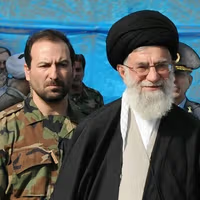
Mojataba Khamenei (R) speaking with his father's chief of staff. Undated
Iran’s hardliners have fiercely attacked Mir-Hossein Mousavi, who published a scathing attack hinting at plans for Supreme Leader’s son to succeed his father.
In a frontpage note Wednesday, Tehran's hardliner daily Kayhan, linked to Supreme Leader Ali Khamenei, called Mousavi “the delusional old man” and “the leader of sedition” and accused him of giving “all-out backing for Israel and Da’esh” but made no reference to his warning about alleged plans to appoint Khamenei’s enigmatic son Mojtaba as his successor.
Mir-Hossein Mousavi, a prime minister in the 1980s who has been under house arrest since February 2011, warned the nation on Tuesday over the alleged ‘hereditary leadership’ scheme.
Mousavi said there are regime loyalists who have suggested that the Experts Assembly, whose members are to appoint the country’s future leader, will choose Mojtaba Khamenei as the Islamic Republic’s next leader and “leader of the world’s Shiites”, a title born by Khamenei now. “May their tongues dry! Have the 2500-year-old monarchies been revived that [they are now talking about] sons’ succession [to leadership] after their fathers?”
Focusing on Mousavi’s criticism of Iran's support for the Syrian President Bashar Assad and other regional activities, the IRGC-linked Javan newspaperand Tasnim news agency also assailed Mousavi but made no mention of his warning about Khamenei’s succession. Tasnim also demanded that the reformist front and its leaders including former President Mohammad Khatami break their silence and condemn “Mousavi’s terrorist statement”.
Mojtaba Khamenei with the former commander of IRGC Qods Force Qasem Soleimani
Rumors about Mojtaba Khamenei’s ambitions to succeed his father have been circulating for nearly two decades. Khamenei and other officials have never commented on the rumors. “Why don’t they deny the rumors if they are not thinking of Mojtaba’s rise to the throne?” Mousavi asked.
Mousavi’s note has revived rumors about Mojtaba Khamenei’s activities and his alleged ambition to succeed his father for which he direly needs to qualify as an ayatollah by leading sources of emulation (grand ayatollahs). He is still only recognized as a hojjat ol-eslam, a much lower rank in the Shiite clerical hierarchy, among the top clerics of Qom, the center of Iran's religious seminaries where he teaches theology classes.
The 53-year-old Mojtaba is the second eldest of Khamenei’s four sons. He is an enigmatic figure who holds no public office in the government and is rarely seen in public but reportedly wields much more influence than the leader’s other sons in powerful organizations such as his father’s office and the Revolutionary Guards (IRGC) Intelligence Organization. Mujtaba’s close associate Hossein Taeb, a former co-fighter in the Iran-Iraq War (1980-1988), was removed from his positionas chief of SAS in June.
Mojtaba Khamenei also has great influence in the country’s propaganda machine including the state-broadcaster (IRIB), and behind-the-scenes political dealings.
In November 2019, the 40th anniversary of the US embassy hostage crisis, US treasury sanctioned nine individuals in Khamenei’s inner circle, including Mojtaba.
Mousavi, 81, who served as the Islamic Republic's first prime minister from October 1981 to August 1989, under then President Ali Khamenei, was put under house arrest nearly two years after the disputed 2009 presidential elections, when the incumbent Mahmoud Ahmadinejad was announced the winner in suspicious circumstances at the expense of Mousavi.
During the protests that followed, protesters often chanted against Mojtaba Khamenei who they held responsible for meddling with the elections, bringing Ahmadinejad to power and the crackdown on protesters. “Die, Mojtaba, may you never achieve leadership”.
Photo published by government media in Iran apparently showing the Russia launch vehicle. August 9, 2022
Iranian government spokesman Ali Bahadori Jahromi says the country plans to order three more versions of the Khayyam satellite with the cooperation of Iranian scientists.
In a tweet on Thursday, he said the stabilization process of the satellite, dubbed Khayyam after a 12th-century Persian polymath, was done successfully.
He added that Iranian knowledge-based companies will be able to use its images and data in various fields.
As Iran’s homegrown attempts at putting satellites into orbit have largely failed due to its technological limitations, Russia agreed to build and launch the Kanopus-V Earth-observation satellite that can resolve features as small as 3.9 feet (1.2 meters) on Earth's surface at a cost of about $40 million in a deal negotiated nearly four years. Iran claims it was designed by the country’s scientists but it is one of a series of satellites developed by the All-Russian Scientific Research Institute of Electromechanics.
The satellite sparked controversy last week when The Washington Post quoted two Western security officials as saying that Moscow intends to use the space platform for several months or longer, to enhance its surveillance of military targets for its war in Ukraine, and Iran may not be able to take control of the satellite right away.
Iran's Space Agency denied the report on August 7, saying the satellite will be fully operated and controlled by the Islamic Republic from inside Iran.
Palais Coburg hotel, the venue of Iran nuclear talks in Vienna
Iran's Supreme National Security Council says no high-level meeting has yet been held regarding the EU-proposed "final text" to revive the 2015 nuclear deal.
In a report on Wednesday, Nour News, a website affiliated with the secretary of Iran's Supreme National Security Council (SNSC), Ali Shamkhani, said since Tehran’s lead negotiator Ali Bagheri-Kani and his team returned from Vienna "the process of examining the ideas proposed by the European Union coordinator has started at the expert level and is still continuing."
No high-level meeting has yet been held to review the EU’s ideas in Tehran, and according to the usual procedure, after the completion of the expert review process, the preliminary results will be presented to the relevant decision-making bodies for a final decision, the report said.
On Monday, August 8, Iran’s Foreign Minister Hossein Amir-Abdollahian and the European Union foreign policy chief Josep Borrell discussed the latest round of Vienna nuclear talks, reiterating that all parties involved in the talks must take serious steps toward reaching the final text of an agreement.
Hardliners dominating the Iranian parliament surrounding President Ebrahim Raisi
IRGC media accuse ‘reformist’ media in Iran of being in “unison” with their foreign-based peers, criticizing the government for forced hijab and nuclear policy.
In a commentary Tuesday, the IRGC-linked Fars news agency attacked reformist media for printing articles and commentaries that it said were “in unison with hostile media”.
Iranian officials and hardliners refer to Persian language media based outside Iran such as the BBC’s Persian channel, Iran International TV, Voice of America (VOA), and Manoto TV as ‘hostile media’.
Fars specified criticism of the government’s nuclear policies and crackdown on women for not abiding by hijab rules. Critics say that confronting, harassing and arresting women on the streets is similar to the way the Taliban in Afghanistan act. Fars said that the media’s coverage of this criticism shows their shared goals.
One of the newspapers attacked by Fars in its commentary was Etemad, which in a recent article headlined “Radical Principlists Fear [Nuclear] Agreement” said ultra-hardliners are pressuring the government to forego the revival of the 2015 nuclear deal.
The commentary then cited an analysis by the website of Voice of America which argued that failing to reach an agreement with world powers to restore the deal, officially known as the Joint Comprehensive Plan of Action (JCPOA) within a few weeks would entail military and economic risks for Iran.
Loss of trust in the state media’s impartiality in reporting among many Iranians has led to the ever increasing popularity of foreign-based Persian language television channels at the expense of the state broadcaster (IRIB) despite its huge budget and massive organization employing more than 40,000 people.
A poll conducted by Gamaan polling agency in the Netherlands in 2021 found Iran International TV and Manoto TV, both based in London, as the most popular media outlets in Iran.
Iran has one of the world’s worst media and internet censorships, with tens of thousands of websites blocked since the early 2000s and most social media platforms banned. In the absence of free media and the very high level of censorship, many Iranians turn to social media for political news and information.
Some 60 percent of those contacted by Gamaan said they never watch the news on the Iranian state-run television, the agency said, adding that generalization of the results of the survey to the general public are valid by a 95% coefficient.
Those taking part in the survey were literate Iranians over 19 years of age, representative of 85 percent of the adult population in Iran.
According to the findings of the survey, 33% respondents in the poll said they watch the Iran International TV daily. This makes the network the most popular Persian speaking foreign based news channel in Iran.
Next on the popularity ladder were Manoto TV with 30%, BBC Persian TV with 17%, both London-Based, as well as Jam TV, based in Turkey, with 16.5%, followed by the Iranian state TV at 16 percent, the Washington-based VOA TV also known as PNN with 11 percent popularity.
The country’s only broadcasting organization which operates under the supervision of Supreme Leader Ali Khamenei’s office is now controlled by ultra conservatives. Khamenei also appoints the IRIB’s chief.
Ali Khamenei embracing his most favorite eulogist Mahmoud Karimi
In an odd move unprecedented in the history of Iranian press, the government-owned newspaper, Iran, has published a 16-page special supplement about a eulogist.
The subject of the supplement, Mahmoud Karimi, is one of favorite 'maddahs' or eulogists of Iran’s Supreme Leader Ali Khamenei, who during three decades of his leadership, has given a special status to religious eulogists. A status some grand ayatollahs sometimes covet.
Under Khamenei, maddahs who used to sing tragic songs in graveyards for families of the deceased or chant tragic stories during the mourning month of Muharram to earn a living, are now the Islamic Republic’s political theoreticians, influential figures in political groups and government offices. They can put anybody’s business on fast track, albeit against a fee, using their influence as individuals close to Khamenei.
Even at election times, associations of eulogists conduct propaganda for candidates for a fee. The closer the eulogist is to Khamenei, the higher are his fees and of course his influence. Karimi enjoying that status is one of the richest and most famous eulogists of Tehran.
In 2005, a hundred maddahs signed a petition calling on the nation to vote for Mahmoud Ahmadinejad for president. Before that, in 1997 Ali Akbar Nategh Nouri used eulogists to help his campaign.
A maddah who can make Khamenei weep during the Muharram mourning ceremonies can do anything during the year.
A maddah kneeling on front of Khamenei tokiss his hand
Islamic Iran’s first leader, Ayatollah Ruhollah Khomeini once said, “Islam (Shiism) is alive thanks to and because of these two months.” But eulogists do not just eulogize. They organize the Ashura and Arbaeen religious marches in the streets of Tehran and throughout the neighboring country of Iraq where they helped establish the Islamic Republic’s long reach.
Meanwhile, maddahs have been seen during protests since 2009 helping the IRGC to crack down on protesters. Mahmoud Karimi was one of them particularly in 2009. He is also famous for taking advantage of his position. Media reports in the 2010s include a story about him shooting at a driver who wanted to get past his car in one of Tehran’s tunnels.
Eulogists’ associations in downtown Tehran including the Islamic Coalition Party and the Mahdiyeh are famous for their political influence in hardliner circles and for bossing around state officials. Mansour Arazi, a renowned maddah is famous for using swear words against former Presidents Mahmoud Ahmadinejad and Hassan Rouhani when he fell out with them, or when they fell out with Khamenei.
The 16-page supplement published by Iran newspaper on the first day of Muharram, was full of praise for Karimi. A singer who is not even the poet of what he sings. He is famous for copying, or as Iranian musicians say “covering” Bollywood movie songs with substandard Persian poetry. Sometimes, his eulogies have turned out to be controversial as he “covered” the famous songs of Los Angeles-based Iranian pop singers and moving to the beats of the music.
The extensive supplement includes an interview with Karimi’s mother as part of the publicity stunt. Meanwhile, the supplement quoted ultra conservative politician Saeed Jalili, the arch enemy of an agreement with the United States, as saying, “Principlists [ultraconservatives] have failed to value their friends. This supplement is a token of appreciation for one of their friends.”
Karimi is known for his verbal attacks on former Foreign Minister Javad Zarif, an advocate of a nuclear deal with the United States.
Most maddahs are rich, thanks to their ties with men of power. In return, they protect politicians against rivals, but their main job is organizing and mobilizing mobs to attack opponents of hardliners or protesters perceived as threats to the regime’s core.
Iranian dissident figure and former prime minister Mir Hossein Mousavi
Iranian dissident figure Mir Hossein Mousavi has warned the nation over the introduction of hereditary leadership, referring to current ruler Ali Khamenei’s son.
Mousavi (Musavi), 81, who has been under house arrest since February 2011, was Iran’s Prime Minister from 1981 to 1989. He was a candidate in the disputed presidential election in 2009 and challenged the results leading large protests for months before he was arrested and put under house arrest without a trial. His wife Zahra Rahnavard and another candidate Mehdi Karroubi suffered a similar fate as all three were accused of “sedition” against the regime.
Although he had a sizable following at the time, support for him was almost non-existent during several waves of nationwide protests since December 2017.
In a statement released by Kaleme website, Mousavi referred to rumors about Khamenei’s son being groomed to succeed his father, and said, “Have the 2500-year-old monarchies returned to power that we are talking about Khamenei’s son’s succession?”
Rumors about Mojtaba Khamenei’s ambitions have been circulating in Iran since 2005 when he was first accused of rigging the presidential election in a bid to bring like-minded politicians to power. No official statement has ever been made by Mojtaba or others at Khamenei’s office about the idea of his succession. However, Mousavi asked: “Why they do not deny the rumors if they are not thinking of Mojtaba’s rise to the throne?”
Mojtaba Khamenei (R) with former IRGC commander Qasem Soleimani. Undated
During the past years there have also been rumors about Mojtaba’s involvement in financial corruption cases involving the IRGC. The rumors also charged that he supervised the IRGC intelligence when Hossein Ta’eb, who was recently fired by Khamenei, headed the organization.
Former state television chief Mohammad Sarafraz wrote in his memoires extensively about Mojtaba’s and Ta’eb’s involvement in financial corruption. Mojtaba is a stealthy figure who is hardly seen in any high-profile political gathering. Nonetheless, he is believed to be Khamenei’s most influential offspring.
Meanwhile, Mousavi criticized Khamenei for Iran’s intervention in Syria and charged that the Islamic Republic has committed “stigmatic crimes” in the Middle East and has created a tragedy for a nation overwhelmed by poverty, hunger and dictatorship.
Mousavi further accused Khamenei of supporting the oppressive Syrian regime in the name of protecting Islamic sanctities. “The regime has even changed the title of Arab Spring to Islamic Awakening and has made words devoid of meaning,” he said.
Mousavi reminded Khamenei that protesters in recent years have been chanting slogans such as “Leave Syria alone and think of us” and “Neither Gaza nor Lebanon, Long live Iran.” He further warned Khamenei that “It would be a grave mistake to manipulate other nations’ aspirations.”
Many social media users in Iran characterized Mousavi’s statement as “brave”. At the same time many others said Mousavi’s slogan of “Returning to the golden age of Imam Khomeini” only reminds of his silence in the face of Khomeini’s documented order to kill thousands of political prisoners in Iranian jails in 1988.”