Why war may no longer be the worst outcome for Tehran

Ata Mohamed Tabriz
Iran analyst
Iran analyst
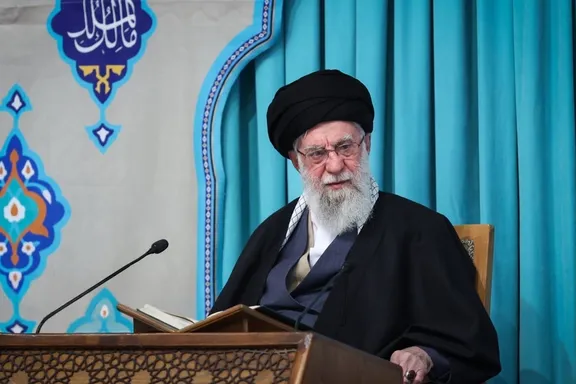
Tehran’s posture increasingly resembles that of an embattled state that sees greater odds of survival in confrontation than in compromise—one that views a decisive clash not as catastrophe, but as a potential turning point.






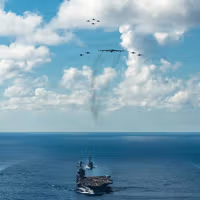
On February 17, while Iran’s negotiating team was in Geneva for talks with US officials, Supreme Leader Ali Khamenei delivered a stark warning in Tehran that reflected this outlook. “More dangerous than the aircraft carrier,” he said, “is the weapon that can send it to the bottom of the sea.”
Soon afterward, state-aligned poets circulated verses declaring, “We are leaves; we will fall at the foot of this tree.”
Even as negotiations continue abroad, the establishment in Tehran—and its media ecosystem—appear intent on preparing the public not for agreement, but for the possibility of a decisive confrontation.
A shift in expectations
One striking difference between the current talks and previous rounds is the fading expectation of peace.
Earlier negotiations were framed by officials as diplomacy conducted from a position of strength—what Iranian leaders described as being “peace-seeking but capable of war.” Today, many voices close to the establishment express doubt that talks will produce an agreement.
Officials present negotiations primarily as a means of managing escalation and avoiding uncontrolled regional conflict. But in state-aligned media, a parallel narrative has taken hold—one that increasingly treats war as both plausible and potentially advantageous.
Some commentary focuses on technical readiness, discussing force posture and missile deployment. Other voices frame the situation in theological terms, arguing that divine providence will guide Iran to victory. Compromise, in this telling, is not pragmatic diplomacy but strategic defeat.
The comparison frequently invoked is Libya. In this account, Muammar Gaddafi’s decision to abandon his weapons programs paved the way for foreign influence, internal weakening, and eventual collapse. Agreement, within this framework, is seen as the beginning of the end. War, by contrast, could reset the strategic balance—producing ceasefire, deterrence, and renewed legitimacy.
War as mission and test
This outlook draws on a broader ideological shift that has intensified in recent years. The Islamic Republic’s political language has long contained religious and messianic elements, but such themes have grown more prominent following recent conflicts.
Within this framework, confrontation is as civilizational as it is geopolitical. Resistance, even at high cost, is framed as a test of faith in a larger struggle between opposing moral forces.
State-aligned commentators and officials increasingly describe the confrontation in existential terms. Military figures have shifted their rhetoric from deterrence to preparedness, suggesting Iran is ready not only to withstand conflict but to prevail. Structural weaknesses or social tensions are interpreted not as vulnerabilities, but as trials to be endured.
This perspective reflects a theological logic deeply embedded in the system’s ideological foundations. Victory, in this view, depends not solely on material advantage but on steadfast adherence to divine principles. Even loss or sacrifice can be reframed as spiritual triumph.
Such thinking also intersects with apocalyptic and messianic narratives present in segments of the regime’s ideological landscape, where the state is cast as an actor in a larger historical and religious mission.
The survival trap
Underlying these narratives is a stark strategic calculation. From the leadership’s perspective, compromise carries existential risks.
An agreement with the United States could require limits on Iran’s missile program, nuclear activities, or regional posture. Such constraints, Iran’s rulers appear to believe, would weaken the system’s core pillars and ultimately threaten its survival.
War, paradoxically, may appear less dangerous.
Proponents of this thinking frequently cite what they see as lessons from past confrontations, arguing that external conflict did not produce collapse or widespread internal revolt. Some even maintain that wartime conditions can strengthen internal cohesion and reinforce legitimacy.
This does not mean that Tehran seeks war for its own sake. Rather, it reflects what might be called a survival trap: a situation in which both diplomacy and confrontation carry risks, but only confrontation preserves the possibility of strategic recovery.
Iran’s military doctrine emphasizes asymmetric warfare and regional escalation, expanding conflict beyond its borders to impose costs on adversaries and create leverage. Such a strategy could transform a limited strike into a broader crisis, forcing negotiations under more favorable terms.
The paradox is stark. Negotiation is intended to prevent war. Yet the very act of negotiating—and the concessions it might entail—can appear more dangerous to the system than war itself.
Iran’s recent nationwide protests, which were met with a deadly crackdown unmatched in the country’s modern history, stem directly from five decades of Islamic Republic rule.
More than half the population lives near or below the $3-a-day abject poverty line. The national currency is in free fall, with hyperinflation and famine in sight. The state seeks to control every aspect of citizens’ lives. Add to this systemic corruption, international isolation, apocalyptic environmental devastation, and a catastrophic brain drain that has driven more than 5% of Iranians to live outside the country.
During a period when most developing countries achieved major gains in living standards, Iran’s GDP per capita under the Islamic Republic has remained below its pre-revolution level for nearly half a century. Once competitive among middle-income nations, Iran’s per capita income has fallen behind war-torn Iraq and now more closely resembles that of low-income neighbors such as Pakistan.
The rulers in Tehran have proven unable to address urgent and mounting economic challenges: soaring inflation, a bankrupt financial system, a shrinking capital stock, and non-viable state-owned enterprises (SOEs).
Beyond these immediate crises, Iran faces deep structural problems that will persist for decades. The population is aging and the demographic window is closing. Soon, ever-larger cohorts will reach retirement with little or no savings. The water crisis is also unlikely to improve, constraining agricultural output and heightening food security risks.
These compounding crises, especially under external pressure, could trigger the Islamic Republic’s collapse—or at least force fundamental changes in its governing structure. Regardless of what political system emerges, Iran’s institutions must be aligned with both political and economic development objectives.
We believe any strategy capable of generating a virtuous cycle of change must prioritize one core objective: building a credible, stable, and legitimate state. Without this foundation, prescriptions for “sound” macroeconomic policy or state-capacity reforms will remain technocratic exercises that fail to take hold, endure, or deliver.
At the highest level, these political transformations can be summarized as follows:
1. State: scaling back
While Iran’s formal central government budget is relatively small (about $50 billion), the state’s true economic footprint is far larger, encompassing well over half of economic activity through para-statal foundations (bonyads), state-linked banks, and SOEs. Some efficiency gains may be possible through spending cuts, including transfers to ideological or religious bodies. But the core challenge is to rationalize and properly govern this broader quasi-state sector.
This requires consolidating and privatizing SOEs, gradually strengthening tax collection, and integrating off-budget entities into a transparent and accountable fiscal framework, while addressing longer-term structural challenges.
2. Democratic accountability
While democracy is an end in itself, strengthening democratic accountability plays a vital role in providing the legitimacy needed for the state to implement painful economic reforms and address short-term dislocations. A political leader elected through a free and meaningful process can better shield technocratic reformers from political pressures and enable difficult but necessary policy decisions.
3. Rule of law
Reforming the rule of law is the slowest and most complex task. While formal legal rules can be changed rapidly, transforming institutional practices and cultural norms is far more difficult. It is unlikely that any future judicial system will immediately apply the law equally to ordinary citizens and elites. But even a “good enough” system—as seen in countries such as China—could be sufficient to support sustained economic growth.

A successful transformation of political institutions could launch a new period of sustained growth. Optimism about a post-Islamic Republic Iran rests on its human capital, natural resources, and a highly capable diaspora able to invest and reconnect the economy to global markets.
Under a stable and legitimate system, near- to medium-term gains could come from lifting sanctions, activating underused capacity—especially in energy—attracting domestic and foreign investment, improving productivity, and expanding tourism and trade.
We estimate these channels could add $100–150 billion to output over five years, raising average incomes by only $3–5 per person per day. Claims of a trillion-dollar economy, as stated by some commentators, are as unrealistic as the Islamic Republic’s long record of unfounded projections.
History offers wide variation in the outcomes of institutional reform in post-authoritarian states. In the post-communist transition, for example, Russia endured a severe contraction of more than 40% of GDP, while Poland pivoted relatively quickly toward sustained growth. A decisive factor in Poland’s success was the prospect of joining the European Union, which provided a powerful external anchor for reform.
Unfortunately, Iran’s trajectory of political and economic transformation appears more likely to resemble Russia’s experience than Poland’s.
In the MENA region, Tunisia and Iraq have undergone post-authoritarian institutional reforms in recent decades. Tunisia, initially viewed as the Arab Spring’s only democratic success, has since regressed into authoritarianism, and its per-capita GDP remains roughly at pre-revolution levels.
Iraq, following the 2003 invasion, has seen per-capita GDP rise from about $1,500 to over $6,000, largely driven by increased oil production, while inflation has generally remained stable. Yet progress in controlling corruption has been limited, with only modest improvements in corruption perceptions.
A post-Islamic Republic government may initially enjoy high legitimacy, but that window will be brief. It must deliver tangible results quickly while managing overlapping crises and unavoidable distributional conflicts over who gains, who loses, and who must wait. Economic recovery and political stability will be tightly linked—and failure in one will undermine the other.
Experience from other transitions is sobering. Beyond early gains, post-authoritarian growth is often slow, fragile, and reversible. Stagnant living standards can create fertile ground for populist politicians who promise shortcuts.
Iran therefore needs a development strategy that integrates political and economic reform. Without it, the country risks remaining trapped in its current low equilibrium.
Brent crude rose to around $70.50 a barrel after surging more than 4% in the previous session, while US crude climbed above $65, as traders priced in the possibility of supply disruptions from the oil-producing region.
“The balance of risks now tilts to a US strike after market close Friday,” said Michael Every, senior global strategist at Rabobank, adding that any military action could last weeks rather than ending quickly.
European shares also edged 0.1% lower on Thursday after a mixed set of corporate results, with energy stocks rising alongside firmer oil prices as US-Iran tensions kept investors cautious.
Increased US military activity in the region has left markets on edge, despite diplomatic efforts in Geneva this week aimed at narrowing differences over Iran’s nuclear program.
Safe-haven demand pushed spot gold up 0.5% to around $5,004 per ounce, after a more than 2% jump the previous day. US gold futures also edged higher.
“If there’s anything fundamental you could point to that would be supporting gold prices, it’s the prospect of conflict in the Middle East and the kind of safe-haven demand that goes along with it,” said Kyle Rodda, senior market analyst at Capital.com.
Gold has also drawn support from expectations that US interest rates could ease later this year, though minutes from the Federal Reserve’s January meeting showed policymakers were in no rush to cut rates and some remained open to further hikes if inflation stays elevated.
Asian equities were mixed, with gains in technology stocks offsetting caution over geopolitics. MSCI’s broadest index of Asia-Pacific shares outside Japan rose 0.4%, while Japan’s Nikkei gained 0.7%. South Korea’s Kospi jumped more than 3% to a record high, buoyed by renewed optimism over artificial intelligence-related shares.
Still, analysts said geopolitical risk was capping broader risk appetite.
“The two nations have long been at loggerheads over Iranian nuclear activity,” one market participant in Asia told Reuters, adding that any disruption to shipping routes or energy infrastructure could ripple through global supply chains.
For now, traders say oil and gold are likely to remain sensitive to headlines from Washington and Tehran, with volatility expected to persist as the prospect of military action looms.