• العربية
  • فارسی
Brand
  • Iran Insight
  • Politics
  • Economy
  • Analysis
  • Special Report
  • Opinion
  • Podcast
  • Iran Insight
  • Politics
  • Economy
  • Analysis
  • Special Report
  • Opinion
  • Podcast
  • Theme
  • Language
    • العربية
    • فارسی
  • Iran Insight
  • Politics
  • Economy
  • Analysis
  • Special Report
  • Opinion
  • Podcast
All rights reserved for Volant Media UK Limited
volant media logo

Iranian MPs urge legal action against Trump, Netanyahu and Grossi

Nov 5, 2025, 11:02 GMT+0
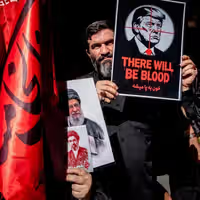
Iranian lawmakers chanting slogans against the US at parliament on November 4, 2025

Seventy-six Iranian lawmakers urged the justice minister on Wednesday to file international complaints against US President Donald Trump, Israeli Prime Minister Benjamin Netanyahu and Rafael Grossi, head of the UN atomic watchdog.

Lawmakers said Iran must pursue official complaints before international courts over what they called crimes committed against the Iranian nation, according to state media.

They did not give details of the complaints, but Iran has previously accused Grossi of political bias and of failing to condemn US and Israeli airstrikes on Iranian nuclear sites in June.

Earlier this year, hardline media called for Grossi’s arrest and execution, while a senior judiciary official said he could face trial in absentia for “deceptive actions.” Tehran has accused the International Atomic Energy Agency of sharing sensitive nuclear data with Israel and the United States.

The appeal came a day after parliament marked the anniversary of the 1979 seizure of the US Embassy in Tehran, when lawmakers chanted “Death to America” and “Death to Israel.” During that session, Deputy Speaker Ali Nikzad said Iran would not yield to foreign pressure and accused Washington of decades of interference.

'No plan for US talks'

Tensions between Tehran and Washington remain high after a June conflict that saw US and Israeli strikes on Iranian nuclear facilities. Iranian Foreign Minister Abbas Araghchi said on Wednesday that any possible future talks with the United States would only concern the nuclear issue, adding that Tehran currently has no plans to hold talks with Washington.

Iran’s Foreign Ministry last week confirmed that messages between Tehran and Washington continue through intermediaries but said they do not amount to negotiations.

Iran’s parliament, dominated by conservatives, has repeatedly pressed the government to hold Western leaders accountable for sanctions and military actions. Lawmakers said the justice minister should take the lead in pursuing such complaints through international tribunals.

Most Viewed

Iran negotiators ordered to return after internal rift over Islamabad talks
1
EXCLUSIVE

Iran negotiators ordered to return after internal rift over Islamabad talks

2
ANALYSIS

US blockade enters murky phase as tankers spoof signals and buyers hesitate

3
ANALYSIS

Why the $100 billion Hormuz toll revenue is a myth

4

US tightens financial squeeze on Iran, warns banks over oil money flows

5
ANALYSIS

US blockade targets Iran oil boom amid regional disruption

Banner
Banner

Spotlight

  • Hardliners push Hormuz ‘red line’ as US blockade tests Iran’s leverage
    INSIGHT

    Hardliners push Hormuz ‘red line’ as US blockade tests Iran’s leverage

  • Ideology may be fading in Iran, but not in Kashmir's ‘Mini Iran'
    INSIGHT

    Ideology may be fading in Iran, but not in Kashmir's ‘Mini Iran'

  • War damage amounts to $3,000 per Iranian, with blockade set to add to losses
    INSIGHT

    War damage amounts to $3,000 per Iranian, with blockade set to add to losses

  • Why the $100 billion Hormuz toll revenue is a myth
    ANALYSIS

    Why the $100 billion Hormuz toll revenue is a myth

  • US blockade targets Iran oil boom amid regional disruption
    ANALYSIS

    US blockade targets Iran oil boom amid regional disruption

  • Iran's digital economy battered by prolonged blackout
    INSIGHT

    Iran's digital economy battered by prolonged blackout

•
•
•

More Stories

US calls death of Iranian man who burned Khamenei photo suspicious

Nov 5, 2025, 09:28 GMT+0

The United States on Wednesday called the death by gunshot of a young Iranian man after he had filmed himself burning a photo of Supreme Leader Ali Khamenei suspicious and suggested the state was involved.

"The United States strongly condemns the tragic death of Omid Sarlak, a young Iranian man whose body was found riddled with bullets in the city of Aligudarz shortly after he posted an anti-regime message online," the US State Department said on its Persian language account on X.

Sarlak was found dead in a car in the city of Aligoudarz in Western Iran after he shared a video of himself burning a picture of the 86-year-old theocrat with a speech of Iran's last shah playing in the background.

"The suspicious timing and circumstances surrounding the incident strongly suggest regime involvement," it added.

Authorities said his death was a suicide, but family members and rights activists have rejected the explanation.

"This is yet another example of the Iranian regime’s brutal repression of dissent and its ongoing campaign to silence those who dare to speak out against it," the State Department added. "The United States stands firmly with the Iranian people in their struggle for justice, dignity, and freedom."

  • Crowds chant ‘Death to Khamenei’ at funeral of man who burned leader’s photo

    Crowds chant ‘Death to Khamenei’ at funeral of man who burned leader’s photo

  • Young man found dead after posting video burning Khamenei's photo

    Young man found dead after posting video burning Khamenei's photo

Videos from Sarlak’s funeral on Monday showed crowds chanting “Death to Khamenei” in one of the largest public outpourings of anti-government anger in recent months.

His death came as senior Iranian clerics renewed calls for severe punishment of those who insult or threaten the Supreme Leader, with one prominent official saying such acts amount to “waging war against God” and warrant the death penalty.

Iran says any possible talks with US would focus only on nuclear issue

Nov 5, 2025, 09:13 GMT+0

Any possible talks between Iran and the United States would be limited to the nuclear file, Foreign Minister Abbas Araghchi said on Wednesday.

Speaking after a cabinet meeting in Tehran, Araghchi said Washington had often raised missile and regional topics in past discussions, but Iran’s position was unchanged. “If there are talks with the US, they will only concern the nuclear issue,” he said.

Araghchi also added that Tehran currently has no plans for talks with the US and therefore sees no need for mediation.

Earlier this month, Araghchi told Al Jazeera that Iran would not stop uranium enrichment or hold talks over its missile program and warned that any new Israeli attack would have “bad consequences.”

He said Iran managed the June conflict with Israel effectively and prevented it from spreading to the wider region. The minister said several nuclear sites were damaged but that enrichment technology remained intact and nuclear material was still located at the bombed facilities.

  • Araghchi says Israel duped US on Iran threat, urges Trump to reverse course

    Araghchi says Israel duped US on Iran threat, urges Trump to reverse course

  • Araghchi says Iran will not halt uranium enrichment or negotiate on missiles

    Araghchi says Iran will not halt uranium enrichment or negotiate on missiles

On Sunday, Araghchi accused Israel of misleading Washington with what he called a fabricated nuclear threat and urged President Donald Trump to change course. He said Israel and the US attacked Iranian nuclear sites under “false pretenses” and cited comments from the UN atomic watchdog and Oman’s foreign minister confirming that Iran was not developing nuclear weapons.

Araghchi said Tehran’s nuclear work remains peaceful and that diplomacy, not confrontation, guides its policy. He added that Iran and Oman hold regular consultations every six months, alternating between Tehran and Muscat.

The United States and Israel launched strikes on Iranian facilities in June after talks over Tehran’s nuclear program collapsed. A ceasefire ended the 12-day conflict, but inspections of damaged sites remain suspended under Iranian law.

UN watchdog presses Iran to restore nuclear site access

Nov 5, 2025, 08:23 GMT+0

Iran must make a serious improvement in its cooperation with United Nations nuclear inspectors to prevent further escalation with Western powers, International Atomic Energy Agency (IAEA) chief said, the Financial Times reported on Wednesday.

Rafael Grossi told the newspaper that although the IAEA has conducted roughly a dozen inspections in Iran since its June conflict with Israel, inspectors have not been allowed to access key nuclear sites -- including Fordow, Natanz, and Isfahan -- which were bombed during US airstrikes.

The agency chief said the IAEA was maintaining dialogue with Tehran despite “bumpy” relations but warned that Iran remained bound by its obligations under the Nuclear Non-Proliferation Treaty (NPT).

“You cannot say, ‘I remain within the non-proliferation treaty,’ and then not comply with obligations,” Grossi was quoted as saying. “Otherwise, what I will have to do is report that I have lost all visibility of this material.”

Grossi added that while some movement had been detected near Iran’s enriched uranium stockpiles in October, it did “not imply that there is activity on enrichment.” 

Iranian officials dismissed his comments at the time, accusing the IAEA of spreading “unfounded opinions.” 

Foreign Ministry spokesperson Esmail Baghaei said Grossi was “fully aware of the peaceful nature” of Iran’s nuclear program.

Tehran has also blamed the IAEA for allegedly giving Israel a pretext to attack its facilities, after the agency’s board voted in June to declare Iran in violation of its NPT commitments.

Western diplomats have voiced growing concern over the IAEA’s limited visibility into Iran’s nuclear activities following the strikes and subsequent restrictions on inspections. 

No regrets: Khamenei ramps up defiance of US with hostage crisis praise

Nov 5, 2025, 07:17 GMT+0
•
Behrouz Turani

Almost half a century after young revolutionaries stormed the US embassy in Tehran, Iran’s Supreme Leader Ali Khamenei once again defended the move, leaning into the original break between the arch-foes and all but ruling out rapprochement.

Speaking Monday on the anniversary of the November 4, 1979 seizure of the embassy, Khamenei described Iran’s enmity toward the United States as “existential rather than tactical,” a confrontation that cannot be resolved.

“The inherently arrogant nature of the US accepts nothing but submission,” he said. “Every US president desired this. Some concealed it, others expressed it openly. The current president has made it explicit, revealing the US’s true nature.”

For Khamenei, the threat lies not in sanctions or military pressure but in ideological erosion. America’s demands—whether over nuclear activities, missiles, or regional policy—are, to him, attempts to take away what defines the system that has become synonymous with his name.

'Victory day’

Khamenei tried to illustrate this point with both history and scripture.

“Our problem with the United States began on August 19, 1953, not November 4, 1979,” he said, invoking the CIA-backed coup against Prime Minister Mohammad Mossadegh seventy-odd years ago.

On the latter date, he echoed his mentor and predecessor Ruhollah Khomeini in calling it “a day of honor and victory,” doubling down on a bet many insiders now publicly regret.

Even senior conservatives like Ali Akbar Nateq Nouri, once chief inspector of the Supreme Leader’s office, have called the storming of the US embassy “a big mistake,” admitting that the ensuing hostage crisis was “the starting point” of many of Iran’s troubles.

But Khamenei is adamant that repentance equals betrayal. History, as he tells it, shows that every concession to the United States only invites more demands—a conviction hardened through experience.

Impossible conditions

When Donald Trump first took office, he declared that all he wanted from Tehran was a pledge not to pursue nuclear weapons, signaling he had no quarrel with Iran’s theocratic order.

But midway through indirect negotiations in the spring of 2025, his stance shifted toward a more conventional hardline: curbs on missiles, abandonment of regional allies, and most recently, recognition of Israel.

Khamenei’s Monday speech contained a direct reply: “If they stop supporting the Zionist regime, remove military bases from the region and cease interfering in regional affairs, these matters could potentially be reviewed,” he said, referring to calls for engagement with the United States.

The conditions were impossible by design—a reminder that what Washington calls diplomacy, he sees as ideological surrender.

‘Unconditional surrender’

Even when hinting at pragmatic concessions such as curbing enrichment, he was dismissive: “This isn’t something foreseeable for now, nor for the near future.”

Trump’s post on Truth Social in mid-October, calling for Iran’s “unconditional surrender” just days into Israel’s war on Iran, may have been the epitome of what Khamenei always asserted: that America seeks capitulation, not coexistence.

His answer was unambiguous: “Expecting the Iranian nation to submit, given its level of capabilities, wealth, intellectual and spiritual background and its vigilant and motivated youth, is meaningless.”

Khamenei shows no sign of repentance or retreat. To him, the struggle with the United States is not about sanctions or missiles but about identity. In his twilight, he seems as convinced as ever that the system must endure as it is, or not at all.


Iranian cleric says threats against Khamenei deserve death penalty

Nov 5, 2025, 04:59 GMT+0

A senior Iranian cleric said on Tuesday that threatening Supreme Leader Ali Khamenei should carry a death sentence, days after a young man died in Western Iran after filming himself burning the 86-year-old theocrat's photo.

"Any threat against the supreme leader is waging war on God, which carries a death sentence," Ahmad Khatami, a member of Iran's Assembly of Experts, said in a speech in Tehran.

Omid Sarlak was found dead in a car in western Iran on Saturday, shortly after posting a video of himself burning a photo of Khamenei. Police called it a suicide, but his family said he was killed by the state.

Mourners in city of Aligoudarz on Monday chanted slogans against Khamenei during Omid’s funeral.

In recent days, some ultra-conservative figures in Iran have called for tough sentences to curb social unrest.

"The sentence for someone who rejects the hijab is execution. If the martyrs were here today, they would skin alive those who stripped themselves bare with the slogan 'Woman, Life, Freedom,'" Hassan Hassannia, a former Islamic Revolutionary Guard Corps (IRGC) commander, said on Saturday.

Islamic Penal Code provisions for insulting the Islamic Republic's leader prescribe six months to two years in prison.

In the latest example of such imprisonment sentences, Forough Khosravi, a primary school teacher from Behbahan, was sentenced to 15 years in prison by the city's Revolutionary Court.

Two years of her sentence were for "insulting the leader" and two years for "insulting the founder of the Islamic Republic."