• العربية
  • فارسی
Brand
  • Iran Insight
  • Politics
  • Economy
  • Analysis
  • Special Report
  • Opinion
  • Podcast
  • Iran Insight
  • Politics
  • Economy
  • Analysis
  • Special Report
  • Opinion
  • Podcast
  • Theme
  • Language
    • العربية
    • فارسی
  • Iran Insight
  • Politics
  • Economy
  • Analysis
  • Special Report
  • Opinion
  • Podcast
All rights reserved for Volant Media UK Limited
volant media logo

Pezeshkian says Iran will bolster nuclear program, rules out bomb

Nov 2, 2025, 09:36 GMT+0Updated: 00:03 GMT+0
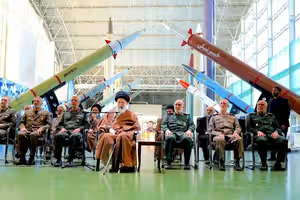
Iranian President Masoud Pezeshkian visits the Iranian Atomic Energy Organisation in Tehran, Iran, November 2, 2025.

Iran is determined to rebuild its nuclear facilities, President Masoud Pezeshkian said on Sunday, stressing that the country’s program is peaceful and not aimed at a bomb.

Speaking during a visit to the Atomic Energy Organization of Iran, Pezeshkian said Tehran’s nuclear drive is intended to “meet the essential needs of the people and enhance national welfare.”

He said that while the destructive potential of nuclear technology is well known, “only a fraction of its applications relate to weapons,” and the rest serves medicine, agriculture, and industry.

The president’s remarks come amid heightened tensions with the West over Iran’s nuclear activity following the reimposition of UN sanctions and renewed scrutiny by the International Atomic Energy Agency (IAEA).

Pezeshkian said Iran’s nuclear scientists are working on the production of radiopharmaceuticals and medical isotopes, calling their efforts “a form of scientific jihad and sincere service to the nation.”

He rejected Western accusations that Iran seeks to develop nuclear arms, saying that “building a nuclear weapon is not on our agenda and they know this well.”

Instead, he accused global powers of using false claims to block Iran’s technological independence and maintain control over high-tech industries and markets.

Pezeshkian also criticized what he called the waste of national resources through excessive fossil fuel consumption and urged scientists to focus on clean technologies and renewable energy.

“We burn millions of barrels of oil and gas daily and ignore the potential of science to create added value,” he said, adding that this neglect fuels environmental damage and economic dependency.

The president vowed full government support for advancing the country’s peaceful nuclear program, saying that Iran must strengthen its position in the global market for radiopharmaceuticals and other nuclear-related technologies.

“With careful planning and the efforts of our scientists, we can expand our share of the international market,” he said.

Iranian President Masoud Pezeshkian speaks with Mohammad Eslami, Head of the Iranian Atomic Energy Organisation, in Tehran, Iran, November 2, 2025.
100%
Iranian President Masoud Pezeshkian speaks with Mohammad Eslami, Head of the Iranian Atomic Energy Organisation, in Tehran, Iran, November 2, 2025.

Iran plans eight new reactors

Iran plans to build eight new nuclear power plants in cooperation with Russia as part of a long-term strategy to expand its nuclear energy capacity, Mohammad Eslami, the head of the Atomic Energy Organization of Iran (AEOI), said on Sunday.

Eslami said the new facilities would be located along the country’s northern and southern coasts.

He told reporters that the projects are part of a roadmap to generate 20,000 megawatts of nuclear power by 2041.

Eslami said four of the planned reactors would be built in Bushehr -- home to Iran’s existing nuclear plant -- and four elsewhere, with site details to be announced later.

He added that Iran is also pursuing domestic projects, including a power plant in Darkhoveyn and a desalination project in Bushehr, aimed at addressing electricity and water shortages.


Most Viewed

Iran negotiators ordered to return after internal rift over Islamabad talks
1
EXCLUSIVE

Iran negotiators ordered to return after internal rift over Islamabad talks

2
ANALYSIS

US blockade enters murky phase as tankers spoof signals and buyers hesitate

3
ANALYSIS

Why the $100 billion Hormuz toll revenue is a myth

4

US tightens financial squeeze on Iran, warns banks over oil money flows

5
ANALYSIS

US blockade targets Iran oil boom amid regional disruption

Banner
Banner

Spotlight

  • Hardliners push Hormuz ‘red line’ as US blockade tests Iran’s leverage
    INSIGHT

    Hardliners push Hormuz ‘red line’ as US blockade tests Iran’s leverage

  • Ideology may be fading in Iran, but not in Kashmir's ‘Mini Iran'
    INSIGHT

    Ideology may be fading in Iran, but not in Kashmir's ‘Mini Iran'

  • War damage amounts to $3,000 per Iranian, with blockade set to add to losses
    INSIGHT

    War damage amounts to $3,000 per Iranian, with blockade set to add to losses

  • Why the $100 billion Hormuz toll revenue is a myth
    ANALYSIS

    Why the $100 billion Hormuz toll revenue is a myth

  • US blockade targets Iran oil boom amid regional disruption
    ANALYSIS

    US blockade targets Iran oil boom amid regional disruption

  • Iran's digital economy battered by prolonged blackout
    INSIGHT

    Iran's digital economy battered by prolonged blackout

•
•
•

More Stories

Iran can build nuclear bomb quickly but chooses not to, ex-Khamenei advisor says

Nov 2, 2025, 08:33 GMT+0

Former Iranian official Mohammad‑Javad Larijani said his country has developed a new theoretical doctrine: one in which a state capable of building a nuclear bomb in under two weeks chooses not to do so.

He pointed out that the fatwa by Supreme Leader Ali Khamenei against nuclear weapons has strong Shia jurisprudential foundations.

Larijani, a former senior judiciary official who also served as a top adviser to the Supreme Leader, added that he supports the expansion of Iran’s nuclear capabilities, framing them as a deterrent and emphasizing the country’s decision not to weaponize.

He also voiced sharp criticism of the 2015 nuclear deal, saying the so-called “diplomacy doctrine” of the Joint Comprehensive Plan of Action (JCPOA) had led Iran to “distress and reversed courage.”

Larijani, speaking at a conference examining the thoughts of Ali Khamenei, said that the JCPOA doctrine -- based on trading rights for concessions -- was akin to surrendering part of Iran’s rights in order to preserve others, and he invoked Iran’s war-era ethos of resisting aggressors.
  • Khamenei's Nuclear Fatwa: A Fiction From The Start

    Khamenei's Nuclear Fatwa: A Fiction From The Start

  • Official daily says Khamenei banned use, not production of nuclear weapons

    Official daily says Khamenei banned use, not production of nuclear weapons

  • Iranian lawmakers urge review of defense doctrine, call for nuclear weapons

    Iranian lawmakers urge review of defense doctrine, call for nuclear weapons

Larijani’s comments reflect a nuanced position often heard from Tehran: while Iran signals that it remains technically close to nuclear weapon capability, it continues to assert that its policy remains peaceful and that the decision not to build such weapons stands.

The remarks come amid international scrutiny of Iran’s nuclear program, where questions remain over enrichment levels and stockpiles, and where the authenticity and legal force of Khamenei’s so-called fatwa have been contested by analysts.

International experts say the Iranian stance complicates diplomatic efforts, as Tehran’s acknowledgement of capability but insistence on conditional restraint leaves room for ambiguity.

Critics argue this could be designed to serve both as deterrence and diplomatic leverage.

Iran seeks peace but will fight well if war is imposed, says deputy FM

Nov 2, 2025, 07:49 GMT+0

Tehran seeks peace but will deliver a decisive response if attacked, Iran’s deputy foreign minister said in an interview with CTV Belarus on the sidelines of the Eurasian Security Conference in Minsk, according to Iranian media.

The recent confrontation in June had shattered long-standing assumptions about Israel’s military power, Saeed Khatibzadeh said.

“The myth of Israel’s invincibility collapsed after Iran’s response,” he added, describing Tehran’s military action as a turning point that proved Iran’s capacity to retaliate.

Earlier this year, the United States held five rounds of negotiations with Tehran over its disputed nuclear program under a 60-day deadline set by President Donald Trump.

When no agreement was reached by the 61st day, on June 13, Israel launched a surprise military offensive, followed by US strikes on June 22 targeting key nuclear facilities in Isfahan, Natanz, and Fordow.

“Iran has no choice but to secure a decisive victory against the aggressor,” Khatibzadeh said, arguing that any attack on Iran would be met with a response aimed at ensuring that “the aggressor will undoubtedly regret its decision.”

‘We are peace-seeking, but we fight well’

Iran does not seek confrontation but will not hesitate to defend itself, Khatibzadeh said. “We are a peace-seeking people, but if war is imposed on us, we fight well… We never sought confrontation, but they chose the path of confrontation.”

The deputy minister linked Iran’s stance to what he called the “geopolitical ambitions” of the United States and Israel, urging other countries to recognize Iran’s right to defend itself.

“We have never accepted the language of force,” he said. “Our message is clear: respect, justice, and balance must define international relations.”

  • Iran says diplomacy, not submission, guides Tehran’s foreign policy

    Iran says diplomacy, not submission, guides Tehran’s foreign policy

The 12-day conflict ended on June 24 after a US-brokered ceasefire, but global alarm over Tehran’s nuclear program deepened as 400 kilograms of Iran’s highly enriched uranium remained unaccounted for.

Tehran says the material lies buried beneath debris from US and Israeli airstrikes, rendering it unreachable, yet it has so far refused to grant international inspectors access to the damaged sites.

Venezuela turns to Iran, Russia, China for military aid amid US buildup - WP

Nov 1, 2025, 20:26 GMT+0

Venezuela is seeking military help from Russia, China and Iran — from drone technology to missile support — as it faces a rising US military buildup in the Caribbean, according to internal US documents reported by The Washington Post.

Venezuelan Transport Minister Ramón Celestino Velásquez recently coordinated a shipment of military equipment and drones from Iran while planning a visit to that country, the Washington Post reported citing the documents.

The Venezuelan minister told an Iranian official that his country was in need of “passive detection equipment,” “GPS scramblers” and “almost certainly drones with 1,000 km [600 mile] range,” the report added citing the documents.

The report does not clarify how Russia, China or Iran have responded to the outreach, nor whether any of the requested items are already en route.

However, Venezuelan officials have maintained close ties with all three countries in recent years, relying on them for economic, energy and security support as sanctions have deepened the country’s isolation from the West.

The overtures come as the United States has significantly increased its naval presence in the Caribbean, deploying ships and aircraft in what US officials say is part of counter-narcotics and security operations.

President Nicolas Maduro’s government has portrayed the buildup as a direct threat, accusing Washington of preparing for intervention and using the regional military posture to justify its push for foreign defense assistance.

The Trump administration has secretly authorized the CIA to conduct covert action in Venezuela, The New York Times reported last month citing US officials.

Gunmen kill two Revolutionary Guard forces in Iran's restive southeast

Nov 1, 2025, 17:49 GMT+0

Two members of the Revolutionary Guard’s Basij paramilitary forces were killed in an armed attack on the Khash–Zahedan road, local authorities announced on Saturday, in the latest of a series of clashes with Sunni militants in Iran’s restive southeast.

The vehicle of Mohammad-Reza Shahouzehi, a tribal elder of the Shahouzehi clan, came under fire by armed militants while he was inspecting the area under his jurisdiction near Eskalabad, close to Dehpabid in Sistan and Baluchestan province, the Quds base of the IRGC Ground Forces said.

Two of his companions, identified as Esmail Shavarzi and Mokhtar Shahouzehi, were seriously wounded in the attack and later died from their injuries, the IRGC said in its statement, calling it an act of terrorism.

The killing follows several similar incidents in recent months, mostly claimed by the Sunni militant group Jaish ul-Adl, designated as a terrorist organization by both Iran and the United States.

In September, Reza Azarkish, a local Basij militia member, was shot dead in Iranshahr. Earlier in the month, Iraj Shams Askani, a member of the Revolutionary Guards, was gunned down by Jaish ul-Adl in the border town of Rask.

Last month, Parviz Kadkhodaei, a local Basij commander in Nikshahr, was killed in a separate assault. Prominent tribal leader Mullah Kamal Salahi-zehi was also killed in October when unidentified gunmen opened fire on his vehicle in Iranshahr.

The province, bordering Pakistan and Afghanistan, has long been the scene of attacks by Sunni insurgent groups that Tehran says are backed by foreign intelligence services.

Oman urges Iran and US to resume nuclear talks

Nov 1, 2025, 12:08 GMT+0

Oman on Saturday called on Iran and the United States to resume suspended nuclear negotiations, as Tehran’s foreign minister ruled out halting uranium enrichment or curbing its missile program.

Omani Foreign Minister Badr Albusaidi said during the Manama Dialogue conference in Bahrain that Muscat wanted to see “a return to negotiations between Iran and the United States.” He said the talks, which Oman had hosted earlier this year, were derailed in June when Israel launched air and missile strikes on Iranian nuclear sites.

“Just three days before the sixth and possibly decisive round of talks, Israel unleashed its bombs and missiles in an illegal and deadly act of sabotage,” Albusaidi said, according to AFP.

Oman, a traditional mediator between Tehran and Washington, has helped facilitate indirect talks this year aimed at reaching a deal to limit Iran’s nuclear work in exchange for sanctions relief.

Iran’s Deputy Foreign Minister Majid Takht-Ravanchi visited Muscat earlier this week for a meeting of the Iran-Oman Political Strategic Committee, where he and Albusaidi discussed regional developments and plans to expand bilateral cooperation, according to Iranian media.

Tehran denies US message via Oman

The United States did not send a message to Iran through Oman, Iran’s IRGC-affiliated Tasnim News Agency reported on Saturday, citing an informed source. The outlet said the comment came after Iraq’s Baghdad Al-Youm alleged that Washington had used Muscat to convey a proposal to resume suspended nuclear talks.

Iranian Foreign Minister Abbas Araghchi told Al Jazeera on Saturday that Tehran would not stop uranium enrichment or negotiate on its missile program, warning that any new Israeli attack would have “bad consequences.”

Araghchi said Iran was open to indirect talks with Washington to reach what he called a fair agreement on its nuclear program but would not make concessions after being attacked. He added that Iran would not accept Western pressure or what he described as “dictates.”

Cairo urges Iran, IAEA to resume cooperation

His comments came a day after Egypt said it had urged both Iran and the International Atomic Energy Agency to end the standoff over inspections of damaged nuclear sites. Egyptian Foreign Minister Badr Abdelatty said he conveyed the appeal to Araghchi and IAEA chief Rafael Grossi in separate phone calls aimed at reviving cooperation between the two sides.

Iran suspended full cooperation with the UN nuclear watchdog after the June war with Israel and the United States. Under a post-war law, inspections now require approval by Iran’s Supreme National Security Council and exclude access to bombed facilities.

Albusaidi said regional states should seek dialogue rather than confrontation. “Over the years, the Gulf Cooperation Council has at best sat back and permitted the isolation of Iran,” he said. “I believe this needs to change.”







