• العربية
  • فارسی
Brand
  • Iran Insight
  • Politics
  • Economy
  • Analysis
  • Special Report
  • Opinion
  • Podcast
  • Iran Insight
  • Politics
  • Economy
  • Analysis
  • Special Report
  • Opinion
  • Podcast
  • Theme
  • Language
    • العربية
    • فارسی
  • Iran Insight
  • Politics
  • Economy
  • Analysis
  • Special Report
  • Opinion
  • Podcast
All rights reserved for Volant Media UK Limited
volant media logo

Turkey freezes assets linked to Iran’s nuclear program

Oct 2, 2025, 01:55 GMT+1Updated: 00:32 GMT+0
Iranian President Masoud Pezeshkian (center) stands next to Turkish President Recep Tayyip Erdoğan (seated on the right) during the OIC–Arab League Extraordinary Summit in Doha on September 15, 2025 / Photo by Turkish Presidency

Turkey has frozen the assets of dozens of individuals and entities tied to Iran’s uranium enrichment and nuclear activities, moving in lockstep with the latest UN sanctions against Tehran.

The decision, signed by President Recep Tayyip Erdogan, extends to organizations across Iran’s energy, shipping, banking, and research sectors.

The Atomic Energy Organization of Iran, Bank Sepah and several firms involved in nuclear fuel production and uranium conversion are among the most significant entities blacklisted by Ankara.

Other sanctioned entities include Isfahan Nuclear Fuel Research and Production Center (NFRPC), Isfahan Nuclear Technology Center (ENTC), First East Export Bank, Irano Hind Shipping Company, IRISL Benelux NV, Jaber Ibn Hayyan, Karaj Nuclear Research Center, Kavoshyar Company, Mesbah Energy Company, Modern Industries Technique Company, Novin Energy Company, Agriculture and Medical Nuclear Research Center, Pars Trash Company, Pishgam Energy Industries, South Shipping Line Iran and Tamas Company.

The decision was made official on Wednesday when it was published in Turkey’s Official Gazette — the government’s legal record of new laws and decrees.

The measure updates earlier Turkish actions from 2006, 2015, and 2021 that implemented United Nations Security Council resolutions on Iran.

The latest decree underscores Ankara’s alignment with a renewed global pressure campaign targeting Tehran’s nuclear ambitions.

The coordinated steps follow the United Nations’ recent reimposition of sanctions against Tehran through the so-called snapback mechanism.

The sanctions had been lifted under the 2015 nuclear deal, but European powers triggered the mechanism citing Tehran’s failure to comply with its obligations.

Turkey’s decision to free Iran’s assets signaled its support for the broader international effort to contain Iran’s nuclear and military programs, even as Ankara maintains complex trade and diplomatic ties with its eastern neighbor.

Most Viewed

Iran negotiators ordered to return after internal rift over Islamabad talks
1
EXCLUSIVE

Iran negotiators ordered to return after internal rift over Islamabad talks

2
ANALYSIS

US blockade enters murky phase as tankers spoof signals and buyers hesitate

3
ANALYSIS

Why the $100 billion Hormuz toll revenue is a myth

4

US tightens financial squeeze on Iran, warns banks over oil money flows

5
ANALYSIS

US blockade targets Iran oil boom amid regional disruption

Banner
Banner

Spotlight

  • Hardliners push Hormuz ‘red line’ as US blockade tests Iran’s leverage
    INSIGHT

    Hardliners push Hormuz ‘red line’ as US blockade tests Iran’s leverage

  • Ideology may be fading in Iran, but not in Kashmir's ‘Mini Iran'
    INSIGHT

    Ideology may be fading in Iran, but not in Kashmir's ‘Mini Iran'

  • War damage amounts to $3,000 per Iranian, with blockade set to add to losses
    INSIGHT

    War damage amounts to $3,000 per Iranian, with blockade set to add to losses

  • Why the $100 billion Hormuz toll revenue is a myth
    ANALYSIS

    Why the $100 billion Hormuz toll revenue is a myth

  • US blockade targets Iran oil boom amid regional disruption
    ANALYSIS

    US blockade targets Iran oil boom amid regional disruption

  • Iran's digital economy battered by prolonged blackout
    INSIGHT

    Iran's digital economy battered by prolonged blackout

  • G7 blames Iran for renewed sanctions, urges immediate US talks

    G7 blames Iran for renewed sanctions, urges immediate US talks

•
•
•

More Stories

G7 blames Iran for renewed sanctions, urges immediate US talks

Oct 1, 2025, 19:09 GMT+1

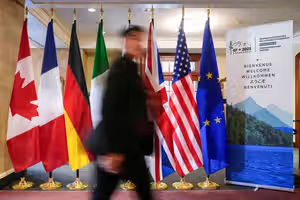
The G7 grouping of wealthy democracies plus the European Union on Wednesday blamed Iran for newly-imposed international sanctions and urged Tehran to resume talks with Washington and allow inspections of its nuclear sites.

Meanwhile, Russia, itself heavily sanctioned by the West announced it would flout the new UN sanctions it unsuccessfully opposed at the UN Security Council last week.

“The E3 and the United States have repeatedly offered diplomatic avenues in good faith to Iran to avoid the snapback and reach a durable and comprehensive negotiated resolution,” the G7 said in a joint statement.

It was signed by the foreign ministers of Canada, France, Germany, Italy, Japan, the United Kingdom, and the United States, along with the EU High Representative.

'Diplomacy essential'

The statement referred to the European troika of Britain, Germany and France which invoked the return of UN sanctions citing what they called Iran’s lack of transparency on its nuclear program.

“Diplomacy remains essential now that the UNSC process has led to the reimposition of sanctions. We call on Iran to refrain from any escalatory action, immediately engage in direct talks with the United States, and make demonstrable progress toward fully meeting its nuclear non-proliferation obligations,” the ministers said.

They urged Iran to fully cooperate with the International Atomic Energy Agency (IAEA) without delay, including by implementing its Comprehensive Safeguards Agreement under the Nuclear Non-Proliferation Treaty (NPT).

“This includes allowing IAEA inspections to resume in all nuclear facilities and accounting for all nuclear material it holds,” the statement said.

Iran denies seeking a nuclear weapon and has called the sanctions a violation of international law and its sovereignty.

Russia set to defy sanctions

Russia announced on Wednesday it will not recognize or implement the reinstated UN sanctions on Iran.

“We’ll be living in two parallel realities, because for some snapback happened, for us it didn’t,” Moscow’s UN envoy Vassily Nebenzia told reporters.

Russia’s UN envoy also claimed the move could serve as a pretext for another round of military strikes on Iran, referencing the 12-day war during which Israel and the United States targeted major nuclear sites.

“This development is fraught with the risk of major escalation around Iran, because it opens the door for those countries who want to finish off Iran’s nuclear program,” Nebenzia added.

Iran, as a signatory to the NPT, is obligated to host IAEA inspections of its nuclear facilities.

Tehran has warned the return of UN sanctions threatens its collaboration with the IAEA, and the diplomatic impasse over Iran's disputed nuclear program appears to have no end in sight.

Disgruntled students protest at Iranian universities, videos show

Oct 1, 2025, 18:41 GMT+1

Protests against university authorities and gripped several campuses across Iran, according to videos sent to Iran International, pointing to widespread anxiety among students which stopped short of overtly political grievances.

In one video, filmed at night, students are seen protesting disciplinary measures and calling for an end to harsh punishments.

At Khajeh Nasir Toosi University of Technology they chanted, “University is not a barracks; expulsion is no longer the answer.” The dispute related to student dissatisfaction with food and accommodation.

University administrators in Iran frequently deploy expulsion to silence pushback and punish students who protest their conditions.

Tabriz University of Medical Sciences also witnessed series of protests alleging administrators' alleged mismanagement and provision of substandard accommodation.

A video obtained by Iran International showed students chanting slogans including “incompetent official, resign!” and “university officials, shame shame!”

Bus crash tragedy

A separate incident in the town of Sorkheh north of Tehran has left the community reeling. A bus carrying female paramedical students crashed on Tuesday, killing two and leaving five others in critical condition.

In a recorded meeting with the dean, one student described the scene as horrific and said some victims were impossible to identify because their faces were badly damaged.

“Seeing two of your friends’ faces crushed, unrecognizable — we identified them by their clothes and nail polish. Someone you were talking and laughing with, and now they’re being brought back as a corpse, it’s very hard,” she said.

Multiple videos show students pressing the dean and university administrators for accountability.

Provincial authorities pledged a full investigation into the crash.

Iranian university students have continued staging demonstrations despite heavy pressure from authorities, demanding accountability and an end to harsh disciplinary measures such as expulsions and suspensions.

Slogans on walls

Other citizen-submitted videos showed dissidents painting slogans on city walls and on large billboards around Tehran in several separate locations.

Large-scale political protests have been rare since authorities quashed with deadly force the so-called Woman, Life, Freedom protests sparked by the death of a young woman in morality police custody in 2022.

One man is filmed writing messages in favor of Iran's monarchy, which was ousted by the Islamic Revolution in 1979, while others call on citizens to resist authorities: “Break the silence, compatriot, while there’s still time.”

Another slogan directly addresses the country’s Supreme Leader: “Khamenei should know he will be overthrown soon.”

UN sanctions reactivated by European powers took effect over the weekend and are set to deepen Iran's economic pain.

Iran denies seeking nuclear weapons the West accuses it of pursuing and has warned the measures could deepen civil unrest.

Disinformation during June war favored Tehran, Israeli think tank says

Oct 1, 2025, 17:13 GMT+1

The majority of disinformation circulated across global digital platforms during the Israel-Iran war in June served Iran's narrative, a new report by the Israel Internet Association (IIA) found.

The study, titled "Ballistic Fakes: Disinformation and Fact-Checking Efforts during the Israel-Iran War", analyzed the work of fact-checking organizations in 23 countries.

Among the most active were Misbar in Jordan, AFP in France, Newschecker in India and Teyit in Turkey — each contributing a significant volume of war-related fact-checks.

In assessing the motivations behind the spread of false information, the IIA asked which party might gain from the dissemination of misinformation and coded each answer.

It found that in 72% of cases, the content was likely to serve Iranian strategic narratives, while 24% appeared to support the Israeli side. The remaining 4% could not be clearly classified, the research said.

Video content accounted for 85% of all disinformation reviewed. Of this, 82% was found to be outdated, 68% misattributed geographically, and 77% presented with false contextual framing. 17% of video content was generated using artificial intelligence, and 12% was entirely fabricated.

“A large proportion of the fact-checks (71%) concerned false connections and decontextualized content,” the report said. “In these instances, genuine material was accompanied by misleading captions or narrative framing, producing an effect contrary to the original meaning.”

One example cited was a demonstration in San Diego during the war. While the event was accurately located and timed, it was misrepresented online as a protest related to the Israel–Iran conflict. It was images from a domestic protest known as "No Kings" against US President Donald Trump's domestic policies.

Other examples included an image of a hotel fire in China from 2009 portrayed as the aftermath of an Iranian missile strike in Israel as well as footage of an Israeli strike in Lebanon circulated as evidence of Iranian attacks.

Generative AI

In total, the report found that a fifth of fact-checked items were created using generative AI, primarily fabricated images and videos. These included depictions of destroyed Israeli infrastructure, the downing of Israeli aircraft, an Israeli soldier allegedly surrendering and fabricated scenes of domestic anti-war protests.

Fabricated claims, entirely invented events, actions or quotes, made up 15% of the sample. These included false reports of Israeli aircraft crashes in Iran, captured Israeli pilots, and nuclear attacks by both sides.

An additional 2% of items involved impersonation. These included a forged resignation letter from Iran’s president and a deepfake video purporting to show Russian President Vladimir Putin declaring support for Iran.

The most common theme in disinformation content concerned physical damage to infrastructure, featuring in 44% of the items reviewed.

False reports included alleged Iranian missile strikes on Tel Aviv’s Azrieli Towers and Israeli attacks on Tehran’s airport.

Many items focused on explosions, often accompanied by misattributed images or video clips. One widely circulated example included a fabricated report of an attack on the Fordow nuclear site, while another falsely described an explosion in Haifa Bay.

New US sanctions target Iran’s military procurement network

Oct 1, 2025, 17:03 GMT+1

The US Treasury on Wednesday imposed sanctions on 38 individuals and companies from Iran and China it accused of advancing Iran’s military procurement including surface-to-air missiles and US-manufactured helicopter parts.

The sanctions, the Treasury said in a statement, focus on networks that facilitate the transfer of sensitive goods and technology to Iran’s Ministry of Defense and Armed Forces Logistics (MODAFL).

“Under President Trump’s leadership, we will deny the regime weapons it would use to further its malign objectives,” Treasury Secretary Scott Bessent said in a statement.

The Treasury also reminded UN member states that UN sanctions on Iran were reimposed as of September 28 and must be enforced.

These measures include restrictions on Iran’s nuclear, missile and arms programs, embargoes, export controls, travel bans, asset freezes and prohibitions on entities like banks involved in Iran’s weapons activities.

Sanctioned Iranian entities include Abzar-e Daghigh-e Taha Company, Beh Joule Pars Commercial Engineering Company and Business United Unipessoal Lda, which is tied to Pasargad Helicopter Company.

Several Chinese-based firms such as Westcom Technology Co Limited, UIY Inc, Rocket PCB Solution Ltd, and Rayming Technology were also designated.

The list further names Iranian individuals such as Mehdi Shirazi Shayesteh and Mehdi Nili Ahmadabadi, along with Chinese nationals Liu Baojuan and Sun Zhaola.

The new designations come as part of Washington’s broader effort to enforce the return of UN sanctions reactivated by European powers in response to what they say is Tehran's defiance of negotiations and nuclear inspections.

Iran denies seeking a nuclear bomb and has rejected sanctions and curbs on its conventional weapons as illegal violations of its sovereignty.

US officials argue that tightening sanctions is essential to block Tehran from acquiring advanced technologies that could bolster both its firepower and potential nuclear capabilities.

Tehran faces worsening water shortage, official says

Oct 1, 2025, 14:18 GMT+1

Tehran is facing an escalating water crisis as dammed reservoirs drop to critical lows, a senior sanitation official said, with rainfall and dam inflows reduced by nearly half leaving most of the capital’s reservoirs nearly depleted.

“Rainfall has dropped 40% and dam inflows 42%, leaving most of the capital’s five dams near dead storage. Only Taleghan Dam remains relatively stable,” Abbasali Mosarzadeh, CEO of Tehran’s Sewage Company cited on Tuesday as saying by official media.

“Tehran’s reserves in October fell to 258 million cubic meters, 227 million less than last year," he added. These figures were cited by Iran’s Water Resources Management Company.

The crisis extends far beyond the capital. Nationally, water reserves have fallen to alarming lows, with Iranian energy officials acknowledging that 19 of the country’s major dams are operating at below 20 percent capacity.

Independent reporting by Iran International based on satellite data showed Tehran’s Amir Kabir reservoir at roughly 6 percent of usable volume in July, with the Lar and Latyan reservoirs also at historic lows.

Groundwater depletion is worsening the picture. Research cited by Iranian geoscience institutes shows parts of Tehran sinking by more than 10 centimeters a year due to subsidence.

Agriculture, which consumes about 80 percent of the country’s water according to government and international environmental assessments, remains highly inefficient, further straining supplies.

Experts warn that without sweeping reforms in consumption and water management, Iran risks deeper shortages, environmental collapse, and growing public unrest.