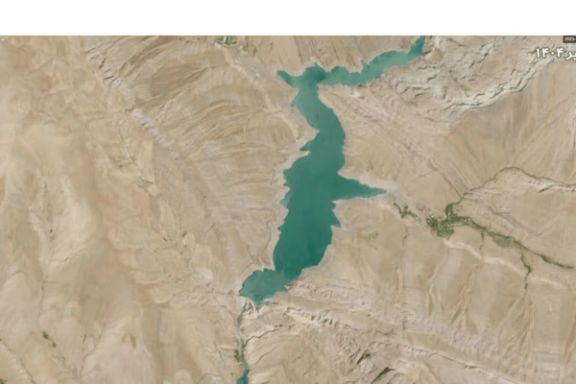
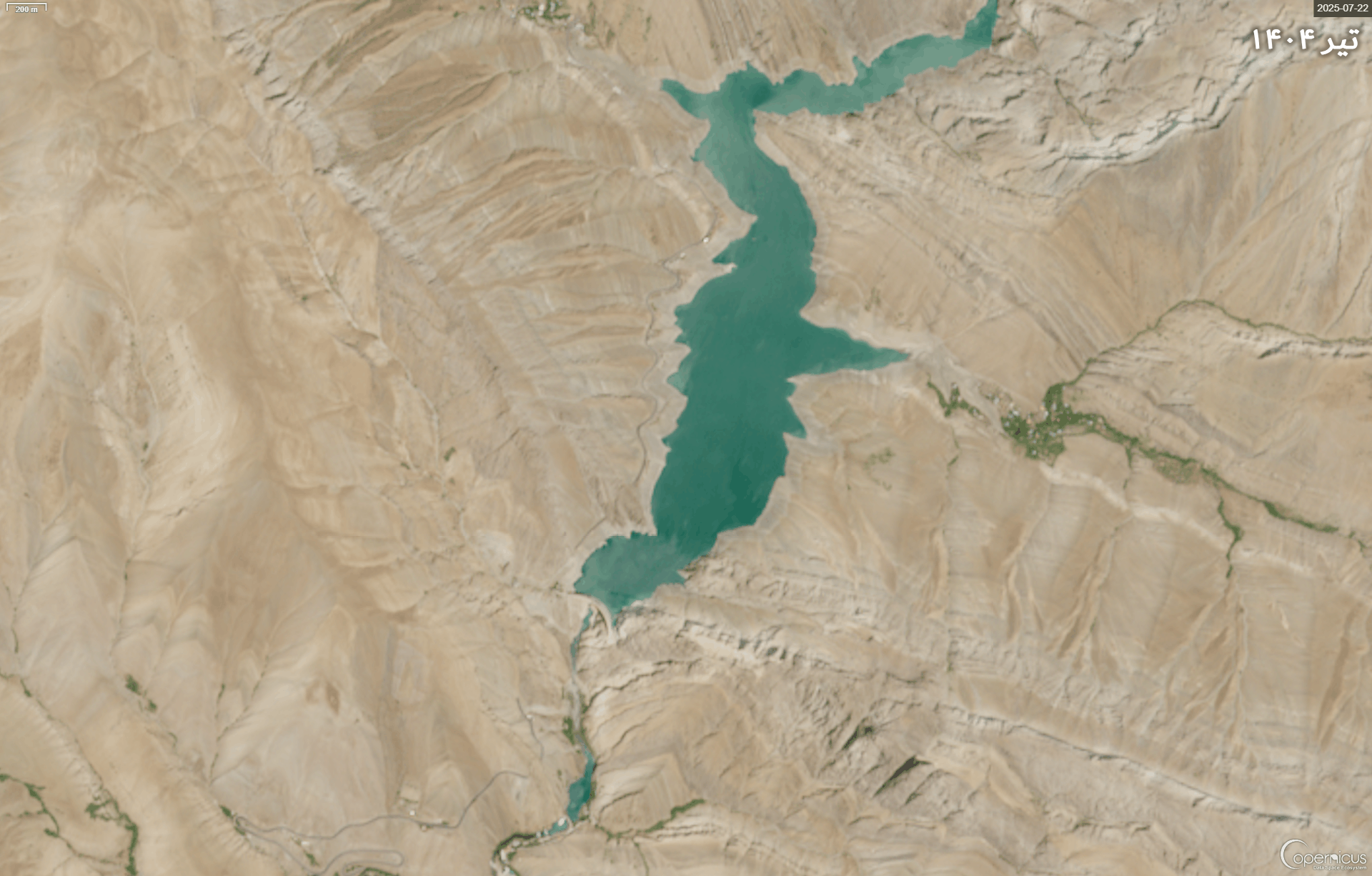
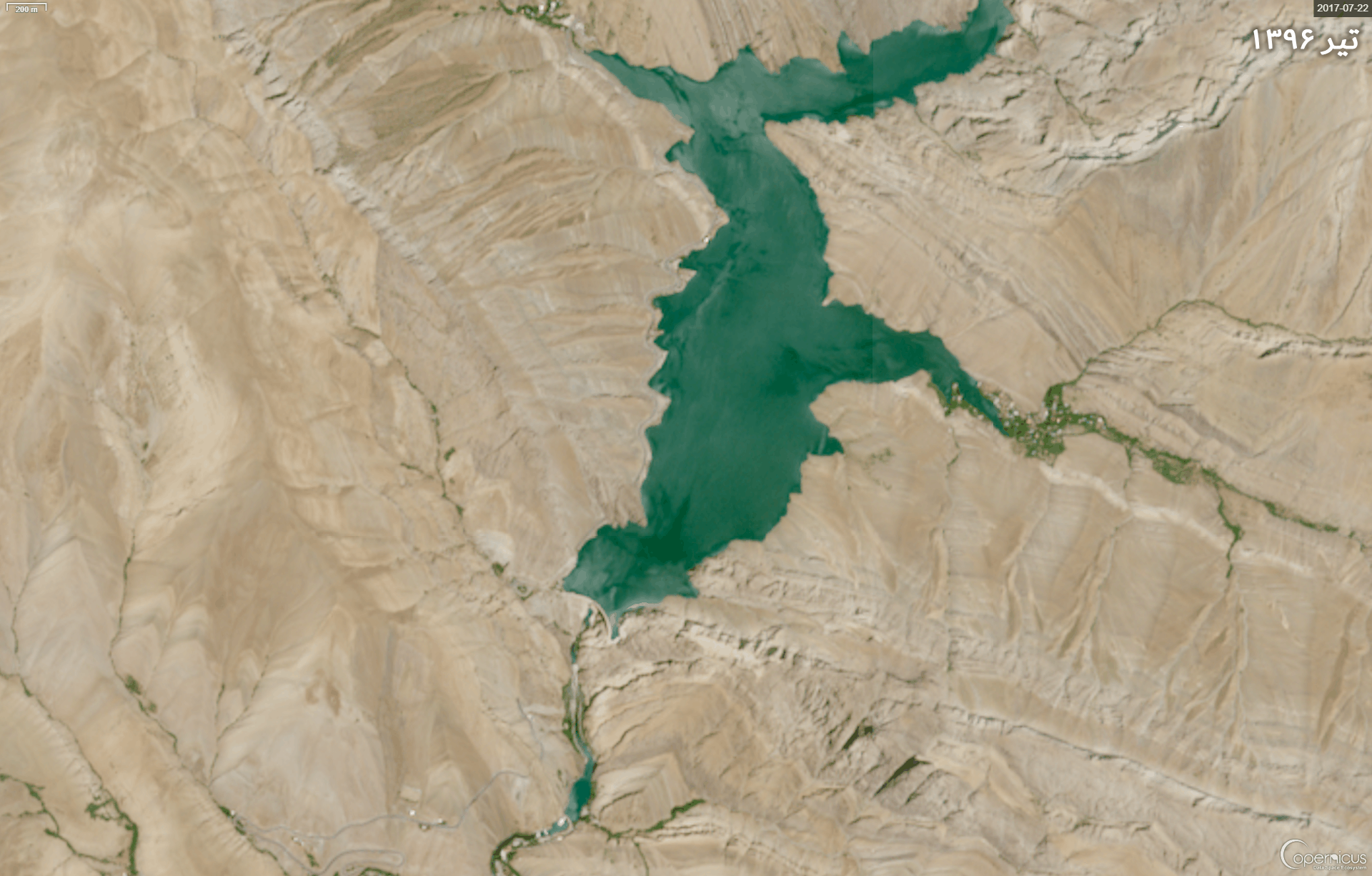
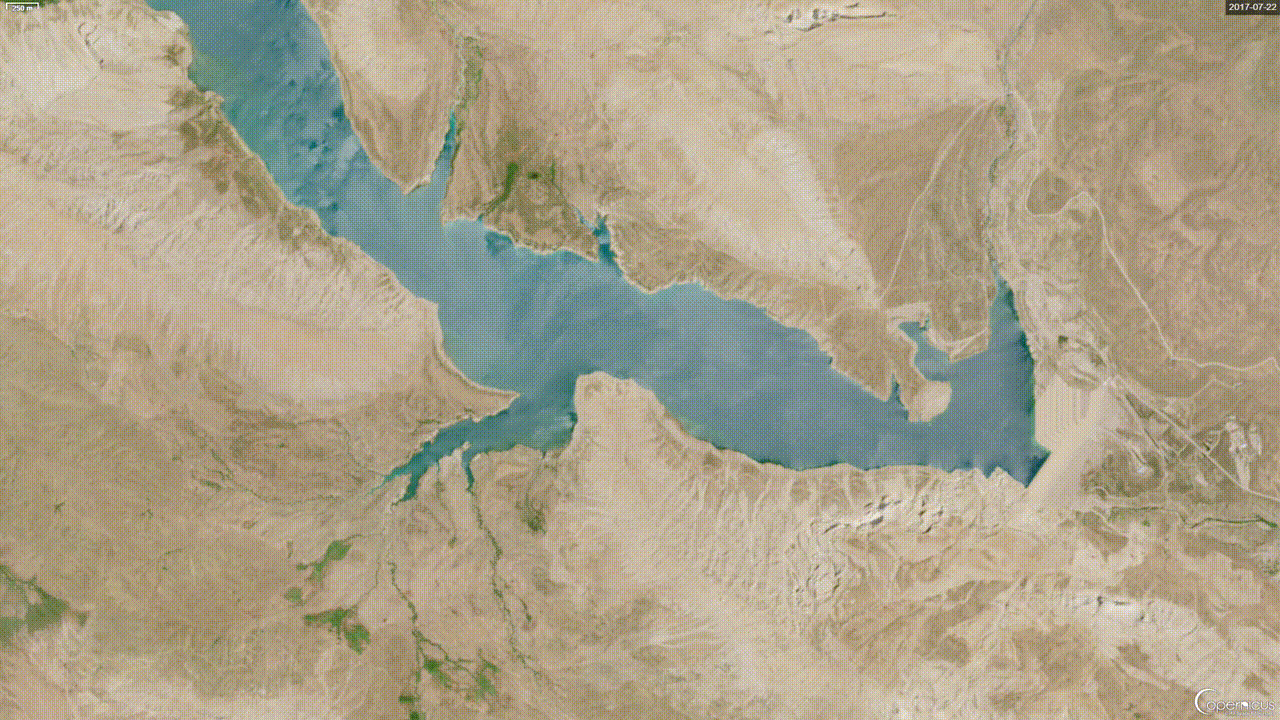
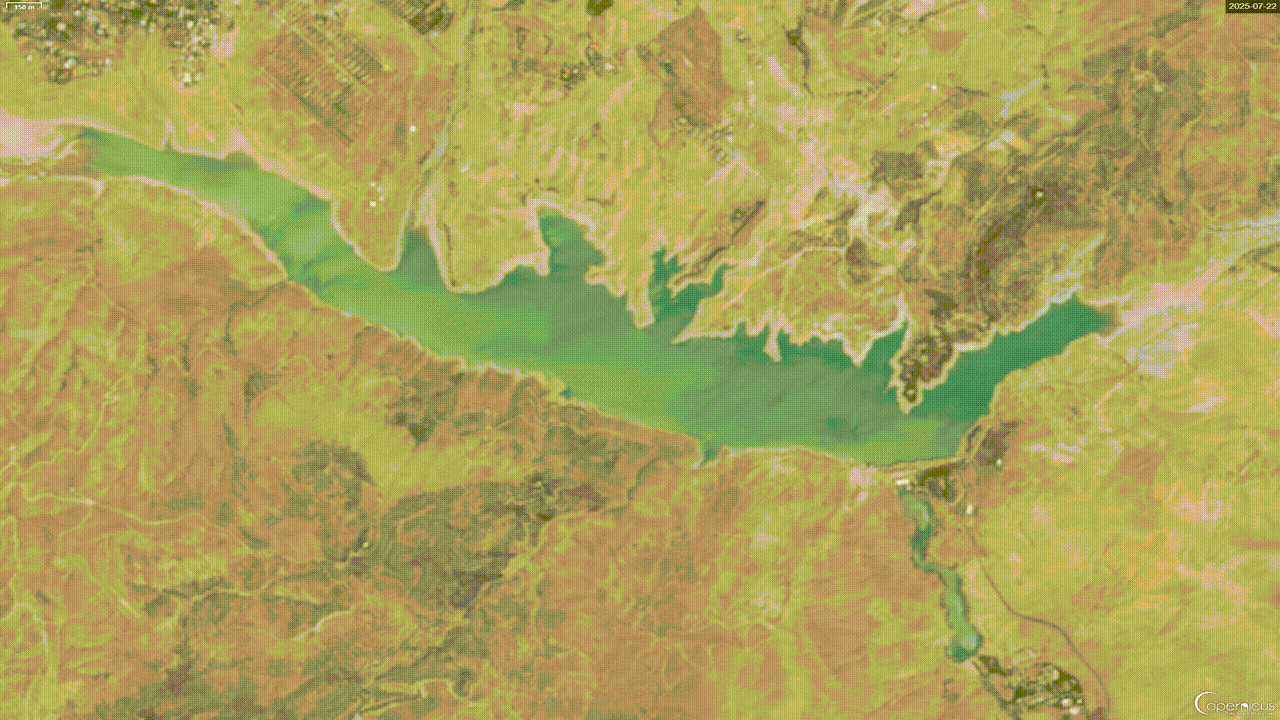
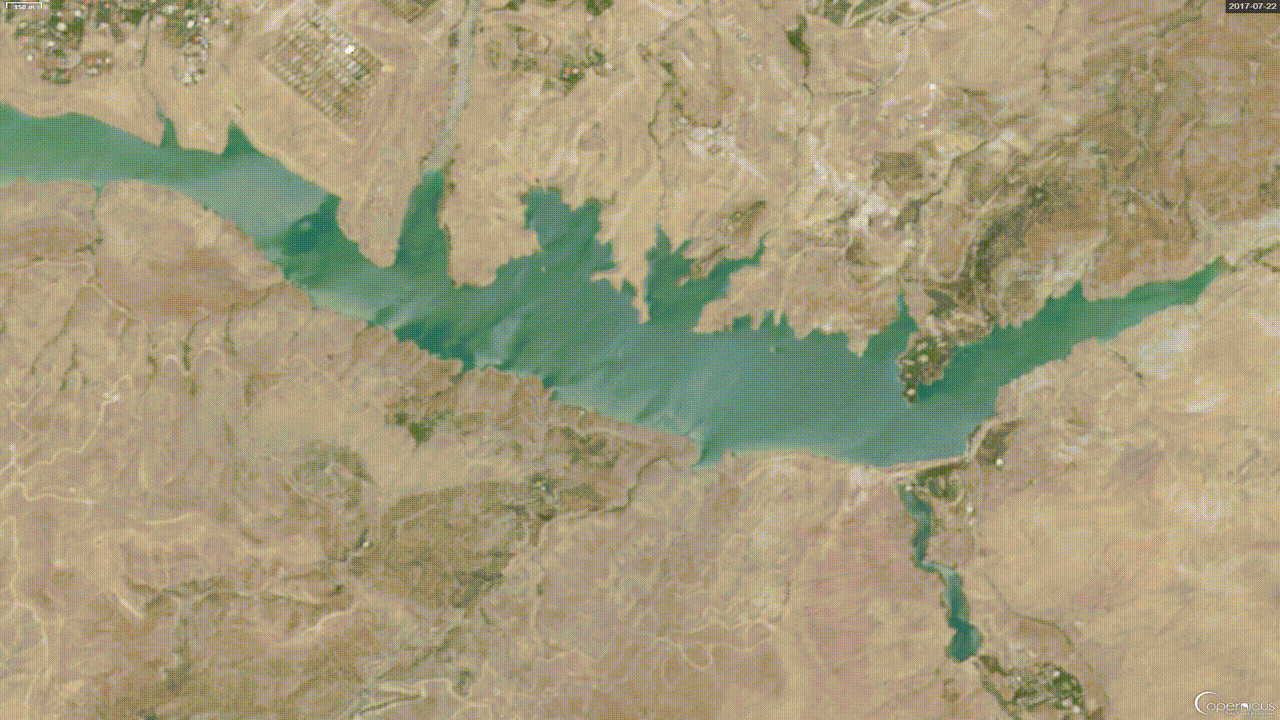
Water levels in Tehran’s reservoirs have dropped to the lowest levels in years, research by Iran International based on satellite images from the European Union’s Sentinel program shows.
The research concentrates from 2017 to summer 2025, on reservoirs like Amir Kabir (Karaj), Lar and Latyan in Iran.
Newly released images show that in no previous period has the decline in water reserves at these reservoirs been as severe as in the summer of 2025.
“This could be summed up in one term: water bankruptcy,” Kaveh Madani, head of the United Nations University's Water, Environment and Health Institute said after observing the satellite images.
“The situation is not merely a crisis but a state of failure, as some of the damage is irreversible,” Madani added.
After
Before
Drag the handle left or right to compare
Amir Kabir Reservoir, one of the key sources of drinking water for Tehran and agricultural use in Alborz Province with a storage capacity of over 200 million cubic meters currently holds only about six percent of its usable volume.
Tehran on the brink of thirst
Iran has recently faced an unprecedented heatwave, and many natural and engineered water reservoirs across the country particularly in Tehran, Alborz and Fars provinces are nearly depleted.
In the capital Tehran, officials have attempted to curb consumption through emergency measures, including repeated water and electricity outages and temporary office closures on certain days.
"While dams have played a major role in development and cannot be completely dismissed, the overreliance on these structures and the absence of sound policymaking have been grave mistakes,” Madani said.
"You cannot keep expanding Tehran forever and expect the skies to keep raining or the aquifers to keep producing water,” Madani added.
After
Before
Drag the handle left or right to compare
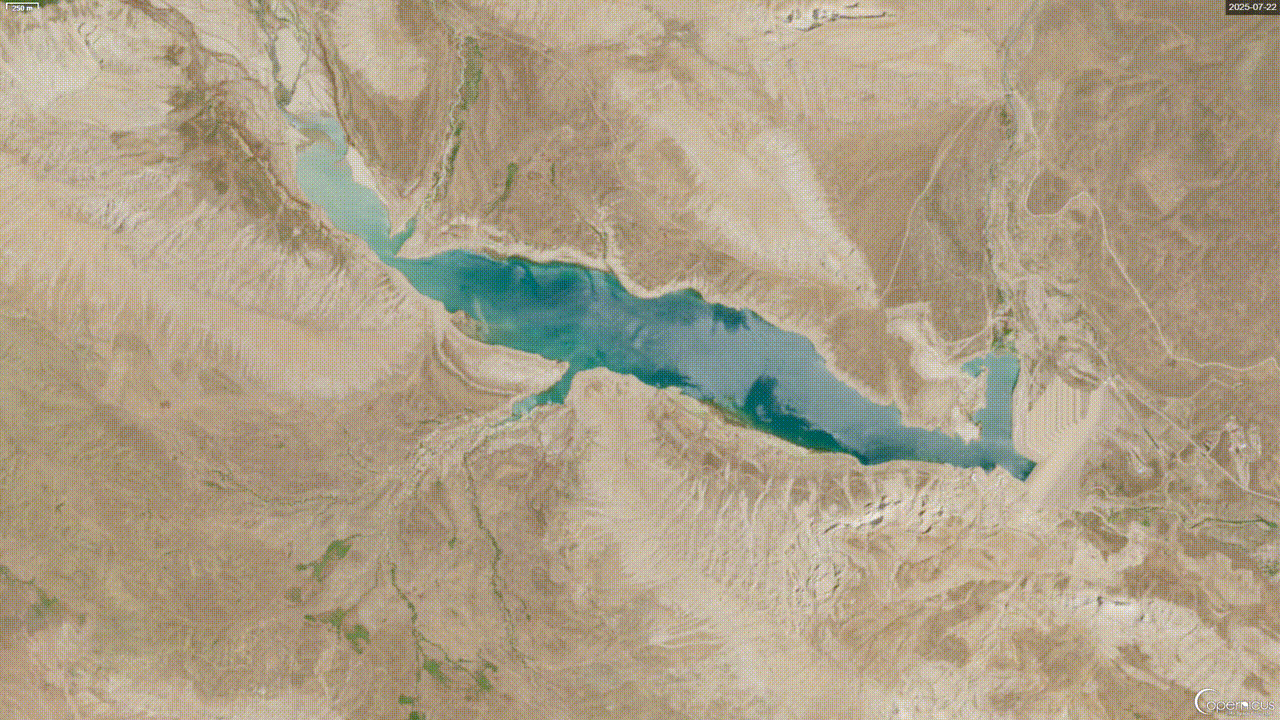
Lar Reservoir, with a capacity of about 960 million cubic meters, supplies drinking water to parts of eastern and northern Tehran. Its reserves have now fallen below 10 percent.
Water scarcity, infrastructure erosion
Latyan Reservoir, another key source for eastern Tehran is now operating at just about 10 percent of its 95 million cubic meter capacity. In addition to drinking water, the reservoir also plays a role in seasonal flood control, and its sharp decline poses multi-dimensional risks.
The drop in Latyan Dam’s reservoir level has severely impacted both drinking water supplies and the ecological functioning of the surrounding system.
Exposure of policy failures
The satellite images reveal go beyond a seasonal drop. Tehran traditionally sources around 60 to 70 percent of its drinking water from the Lar, Latian, and Amir Kabir reservoirs. The simultaneous depletion of all three—coupled with the overdrawn state of groundwater resources—has placed the capital at risk of a systemic water crisis.
"The dramatic reduction in water volumes at Tehran’s reservoirs is not just a passing warning, but evidence of a structural failure in the country's water resource management,” said Roozbeh Eskandari, an environmental researcher.
“If this trend continues, the capital could face widespread drinking water rationing, loss of agricultural land, further depletion of aquifers and even social unrest,” Eskandari added. “The crisis is the result of a complex interplay of climate change, uncontrolled consumption growth, and poor governance in the water sector.”
The Islamic Republic will not easily submit to a challenge and will fight to preserve its rule, Republican Congressman Darrell Issa of California said in an interview with Iran International.
"The Soviet Union collapsed without a revolution. A transformation is possible. But in Iran, I fear change will be violent, and the current regime will not go quietly," Issa said.
US President Donald Trump mooted regime change and even killing Iran's Supreme Leader Ali Khamenei at the height of combat amid a 12-day war between Iran and Israel last month.
As a ceasefire took hold, the administration backed away from the hawkish rhetoric but a senior Trump aide said this week that change could only come from within.
Issa, whose constituency south of Los Angeles is home to many Iranian-Americans, criticized Iranian opposition groups and exiled figures, saying their disagreements undermined their goal of toppling Tehran.
"They spend more time attacking each other than working together. That’s a strategic failure. If they were united, I believe regime change would already be underway."
A series of mass protests triggered by the death of a young Iranian woman, Mahsa Amini, in morality police custody in 2022 led to nationwide protests which challenged Tehran's authority but were quashed with deadly force.
Congressman Issa also advocated for intensifying pressure on Tehran, calling for the full implementation of Trump's maximum pressure campaign.
"Take those ships, empty them in friendly ports, and don’t let them sail again," he said, referring to vessels carrying Iranian oil. "Cut off Iran’s oil revenue, and you’ll cripple the regime."
Asked about countries like China that continue to buy Iranian oil, Issa suggested offering alternative energy sources.
"I don’t want to deny China oil, but they shouldn’t get it from Iran. We must make it very expensive for Iran to raise revenue for its oppressive regime."
One of the first steps the Trump administration took against Iran was the reimposition of the maximum pressure campaign from his first term which aims at halting Tehran's oil revenues.
Turning to a bipartisan bill that would allow Israel access to advanced US military technology such as stealth aircraft and bunker-buster bombs, Issa was skeptical.
"Our stealth capability is unmatched. If strikes are necessary, we don’t need to hand over those weapons — we can do it ourselves, as President Trump demonstrated," Issa said.
The United States attacked Iran’s three main nuclear sites at Natanz, Fordow and Isfahan on June 24.
Iranians driving their cars into a shallow river to beat the summer heat near the Caspian city of Sari, July 23, 2025
Officials in Tehran blame drought and public overuse for Iran’s worst water shortage in living memory, but the crisis stems from decades of mismanagement, short-sighted policy and institutional denial.
Iran consumes about 100 billion cubic meters of water each year—more than twice Turkey’s usage, despite similar populations. Around 90% goes to agriculture, 6% to households and the rest to industry.
Per capita household water use is similar to Turkey’s, but Iran recycles only about 20% of wastewater, compared to 85% in Turkey, 95% in the United Arab Emirates and 98% in Germany.
Despite a UN “red warning” 25 years ago, Iran expanded hydropower rather than wastewater treatment.
The Islamic Revolutionary Guard Corps (IRGC) has built over 60 dams in recent decades. More than half are now empty, with hydropower generation operating at just one-third of its nominal capacity.
Hydropower’s share in Iran’s electricity mix has fallen below 5%. Meanwhile, 80% of untreated wastewater is dumped into rivers, deserts and underground wells, contaminating the very sources Iran increasingly depends on.
Agriculture: high consumption, low output
The agricultural sector accounts for nearly all of Iran’s water use but contributes just 11% to GDP. Most farming still relies on flood irrigation.
In contrast, Turkey has reduced agriculture’s share of national water use from 75% to under 64%, while doubling the value of its agricultural output, which now stands at $60 billion, 13 times higher than Iran’s.
Perhaps more staggering, Turkey has achieved that using only a third of what Iran uses annually for farming.
Young men pumping water from a pond near the southern town of Karkheh, Iran, July 23, 2025
Overextraction is reducing Iran’s groundwater reserves by 5 billion cubic meters annually. In Turkey, by contrast, aquifer recharge rates exceed extraction by a factor of three.
Drought is real, so is bad policy
Past policies pushing grain self-sufficiency worsened the problem.
In 2014, a deputy agriculture minister dismissed claims that farming consumed over 90% of the country’s water—insisting on continuing the strategy despite mounting environmental costs.
Iran, like many countries in the region, faces rising water stress.
Last year’s rainfall totaled around 400 billion cubic meters, but 70% of it evaporated, compared to a 50% loss in Turkey, which saw 537 billion cubic meters of precipitation.
Official figures show Iran’s dam reserves are just 46% full nationwide, and only 13% in the capital region. Turkey’s dam levels are at 57%, down from 70% a decade ago.
Both countries experience erratic rainfall but Turkey’s investments in water recycling, storage and irrigation have helped stabilize its system. Iran’s have not.
Iran’s water crisis isn’t simply the result of climate stress. It’s the consequence of institutional neglect, poorly prioritized infrastructure, and refusal to heed decades of expert warnings.
While others adapted, Iran doubled down on wasteful practices and political denial. The result: a deepening crisis, no longer possible to blame on nature alone.
Tehran will continue enriching uranium and maintain a firm stance on its nuclear rights during talks with France, Britain and Germany in Istanbul on Friday, Iran’s foreign minister said on Thursday.
“The discussions that will be held tomorrow are a continuation of previous talks. Our position is completely clear,” Abbas Araghchi was quoted as saying by Iran’s official IRNA.
“The world must know that there has been no change in our position, and we continue to firmly and resolutely defend the rights of the Iranian people to peaceful nuclear energy, particularly enrichment.”
The meeting with the three European powers, collectively known as the E3, will be the first since last month’s US and Israeli strikes on Iranian nuclear sites.
It comes as pressure mounts ahead of the October expiry of a 2015 nuclear deal which remains in effect among Iran, the E3, China and Russia after the United States withdrew in 2018. The accord lifted international sanctions in exchange for curbs on Iran’s nuclear program.
Washington and its European allies have set an end-of-August deadline for Iran to reach a nuclear deal or face the reimposition of full UN sanctions under the JCPOA’s snapback mechanism.
Under UN Security Council Resolution 2231, any party to the accord can file a complaint accusing Iran of non-compliance.
If no agreement is reached within 30 days to maintain sanctions relief, all previous UN sanctions would automatically “snapback,” including arms embargoes, cargo inspections and missile restrictions.
Snapback mechanism focus of Istanbul talks
The meeting in Istanbul on Friday will be focused on the snapback mechanism, Reuters reported earlier on Thursday, citing diplomats from Europe, the Middle East and Iran.
The E3 is due to float the possibility to Iran of extending the snapback mechanism by up to six months, the report said.
In return, Iran would need to make commitments on key issues, including eventual talks with Washington, full cooperation with the UN nuclear watchdog, and accounting for its stockpile of highly enriched uranium.
A former security guard at the US Embassy in Oslo has been formally indicted on charges of espionage for allegedly leaking sensitive information to Iranian and Russian intelligence services, Norwegian prosecutors said this week.
The defendant, identified as Mohamed Orahhou, a Norwegian national in his 20s, was arrested in November 2024. He is accused of collecting and passing classified information that prosecutors say could damage Norway’s national security and undermine the safety of US diplomatic staff.
According to the indictment filed by Norway’s National Authority for Prosecution of Organized and Other Serious Crime, Orahhou shared a wide range of sensitive material between March and November 2023.
Orahhou allegedly passed on a classified list of couriers from Norway’s intelligence service; names, addresses, and phone numbers of US Embassy staff, diplomats, and their family members; embassy floor plans and evacuation routes; security procedures and equipment details; records of pre-booked visits; and photos of garage facilities and communications infrastructure.
Prosecutors allege that the information was handed over to Russian and Iranian agents in clandestine meetings in Norway, Serbia, and Turkey.
In exchange, Orahhou received €10,000 from Russian authorities and 0.17 Bitcoin—then worth approximately $10,000—from Iranian operatives. The indictment also includes charges of tax fraud.
According to the indictment, Orahhou attempted to conceal the payments by channeling them through family members’ and friends’ bank accounts before retrieving the funds.
Orahhou is charged under Norwegian espionage laws, which carry a maximum sentence of 21 years in prison if convicted.
Prosecutors argue that the information he passed on “violated fundamental national interests” and posed a significant security risk to both Norway and the United States.
His defense attorneys, Inger Zadig and John Christian Elden, confirmed that Orahhou acknowledges the factual elements of the indictment but denies that his actions meet the legal criteria for espionage.
“At its core, this case concerns legal interpretation—specifically, whether and to what extent the information in question was ‘classified’ under the law, and whether it was capable of harming fundamental national interests,” Zadig said in an email to the Associated Press. “If not, then sharing the information is not a criminal offense.”
“Our client did not hold a security clearance, and his access to information that could threaten vital national interests was more or less non-existent. These issues will be thoroughly addressed in court,” she added in a message to The New York Times.
Following his arrest in November, Orahhou admitted to interrogators that he had shared information with an officer from Russia’s foreign intelligence service (SVR), as well as with unidentified Iranian officials. Authorities also reported seizing a “large” volume of digital material from his home, which they are continuing to analyze.
At the time, Orahhou was also studying for a bachelor’s degree in security and preparedness at Norway’s Arctic University (UiT) and operated a private security company.
His trial is scheduled to begin on August 19 in Oslo District Court, with two weeks allotted for proceedings.
The case has emerged against the backdrop of growing concerns across Europe over a surge in espionage activities linked to Russia and Iran.
A study by the International Institute for Strategic Studies found that suspected Russian sabotage operations in Europe nearly quadrupled between 2023 and 2024.
Meanwhile, MI5 Director General Ken McCallum said in October 2024 that the UK had disrupted at least 20 Iranian-backed plots posing potentially lethal threats to British citizens.
Current Trump aide Sebastian Gorka speaks annual at the annual Conservative Political Action Conference (CPAC) in 2018.
A senior White House official said the Trump administration has no plans to topple the Islamic Republic by force but said Washington hoped what he described as the people of Persia would ultimately "liberate themselves".
“We are not in the business of deploying the 82nd Airborne to do regime changes anywhere,” Sebastian Gorka, deputy assistant to the president and senior director for counterterrorism at the White House, told an event at Washington DC thinktank the Foundation for Defense of Democracies.
“We would like the people of Persia, including all the minorities in Persia, to eventually liberate themselves.”
A ceasefire late last month ended a 12-day conflict between Israel and Iran that was capped off by US strikes on Iranian nuclear sites.
Israeli Prime Minister Benjamin Netanyahu and US President Donald Trump both mooted killing Iran's Supreme Leader Ali Khamenei at the height of the conflict and Trump hinted at favoring Iranian regime change.
"It’s not politically correct to use the term, 'Regime Change,' but if the current Iranian Regime is unable to MAKE IRAN GREAT AGAIN, why wouldn’t there be a Regime change??? MIGA!!!" Trump said in a post on Truth Social in late June.
Israel’s prime minister also said on Tuesday that Iran’s clerical leadership will fall from within not through any foreign military intervention.
“Everybody talks about regime change and they envision the American army and Israeli forces invading Iran — boots on the ground and all that stuff people spew. No,” Netanyahu said in an interview with the Full Send Podcast.
Israel's surprise campaign of airstrikes and drone attacks killed hundreds of Iranians including civilians, military personnel and nuclear scientists. Iran's retaliatory missile strikes killed 27 Israeli civilians.