• العربية
  • فارسی
Brand
  • Iran Insight
  • Politics
  • Economy
  • Analysis
  • Special Report
  • Opinion
  • Podcast
  • Iran Insight
  • Politics
  • Economy
  • Analysis
  • Special Report
  • Opinion
  • Podcast
  • Theme
  • Language
    • العربية
    • فارسی
  • Iran Insight
  • Politics
  • Economy
  • Analysis
  • Special Report
  • Opinion
  • Podcast
All rights reserved for Volant Media UK Limited
volant media logo

Guards-linked media admits Iran used online photos in Israel intelligence film

Sep 26, 2025, 10:19 GMT+1Updated: 00:35 GMT+0
Esmaeil Khatib, Iran’s intelligence minister, during the televised presentation of alleged stolen Israeli data and documents aired on state TV, Wednesday, Sept. 24, 2025.

An outlet tied to Iran’s Revolutionary Guards acknowledged that a recent documentary from the Ministry of Intelligence relied on archival images from the internet, despite presenting them as exclusive material obtained from Israel.

Fars News Agency described the use of online images as “poor judgment” and said it gave rival outlets grounds to call the entire program fabricated. “Labeling all images, including archival ones, as exclusive allowed hostile media to portray the film as fake,” Fars wrote.

The documentary, broadcast on September 24 under the title The Spider’s Hideout, was presented as evidence of an intelligence penetration into Israel. It displayed materials said to be connected to Israeli nuclear facilities, including the Dimona site, along with details about individuals described as involved in the country’s nuclear program.

Intelligence Minister Esmail Khatib appeared in the program, calling the operation “a major infiltration” that yielded “a treasure of top-secret intelligence.” He described the outcome as the result of “months of complex planning and multiple successful operational phases inside the enemy’s structure.”

Since its release, however, attention has centered on the documentary’s reliance on readily available online photos, presented as exclusive visuals. The revelation has fueled ridicule across social media and intensified criticism of the government’s narrative.

The film was promoted as part of a broader presentation that Iran had secured “millions of pages” of Israeli defense documents. Earlier this year, state media reported that Iranian intelligence had obtained “abundant strategic and sensitive information” from inside Israel. At the time, Israeli security analysts told Iran International those assertions were exaggerated and part of psychological warfare.

Observers assess that The Spider’s Hideout is part of an effort to recast Iran’s recent setbacks against Israel, including intelligence and military losses, as victories. The exposure of online-sourced material has instead raised doubts over the credibility of the government’s portrayal, even among domestic audiences.

Most Viewed

Iran negotiators ordered to return after internal rift over Islamabad talks
1
EXCLUSIVE

Iran negotiators ordered to return after internal rift over Islamabad talks

2
ANALYSIS

US blockade enters murky phase as tankers spoof signals and buyers hesitate

3
ANALYSIS

Why the $100 billion Hormuz toll revenue is a myth

4

US tightens financial squeeze on Iran, warns banks over oil money flows

5
ANALYSIS

US blockade targets Iran oil boom amid regional disruption

Banner
Banner

Spotlight

  • Hardliners push Hormuz ‘red line’ as US blockade tests Iran’s leverage
    INSIGHT

    Hardliners push Hormuz ‘red line’ as US blockade tests Iran’s leverage

  • Ideology may be fading in Iran, but not in Kashmir's ‘Mini Iran'
    INSIGHT

    Ideology may be fading in Iran, but not in Kashmir's ‘Mini Iran'

  • War damage amounts to $3,000 per Iranian, with blockade set to add to losses
    INSIGHT

    War damage amounts to $3,000 per Iranian, with blockade set to add to losses

  • Why the $100 billion Hormuz toll revenue is a myth
    ANALYSIS

    Why the $100 billion Hormuz toll revenue is a myth

  • US blockade targets Iran oil boom amid regional disruption
    ANALYSIS

    US blockade targets Iran oil boom amid regional disruption

  • Iran's digital economy battered by prolonged blackout
    INSIGHT

    Iran's digital economy battered by prolonged blackout

•
•
•

More Stories

Iran security chief rejects US demands on its missile program

Sep 25, 2025, 21:03 GMT+1

Iran’s top security official Ali Larijani said on Thursday US demands that Tehran curb its missile program were a non-starter and that looming UN sanctions ought not to pinch Iran as much as current US measures.

Speaking in a televised interview, Larijani, head of Iran’s Supreme National Security Council, said Washington has demanded Iran halt all uranium enrichment and curb its missile program.

“The Americans insist we must negotiate, specifically about Iran’s missiles,” Larijani said. “They came and said you shouldn’t have any enrichment at all … They said no missiles, sometimes below 300 kilometers (185 miles), now below 500 kilometers (310 miles)—meaning they want to strip us of key defensive and offensive capabilities.”

For years, Iran has voluntarily capped its missile range at 2,000 kilometers, which it says is sufficient to reach its main regional adversary, Israel.

France, Britain and Germany triggered the resumption of UN sanctions against Iran last month through the “snapback” mechanism of a 2015 nuclear deal, accusing Tehran of not conforming to nuclear obligations outlined in the agreement.

The measures are scheduled to take effect September 28. Larijani dismissed their impact, arguing that US sanctions remain far harsher.

“Some politicians in Iran ask why we don’t resolve this sooner. We’re trying to resolve it; we don’t want unnecessary pressure on the country. But is there any politician in Iran who would agree to cut our missile range below 500 kilometers?” he asked.

Supreme Leader Ali Khamenei on Tuesday rejected talks with Washington, calling US President Donald Trump’s demand that Iran end domestic uranium enrichment an “insult” that had earned him a “slap in the face” from the Iranian people.

President Masoud Pezeshkian, addressing the UN General Assembly in New York on Wednesday, denounced Israeli raids on Iran’s nuclear facilities in June as illegal and condemned European powers for reimposing UN sanctions.

Bad terms

Larijani said that Iran is open to dialogue but unwilling to accept terms he called “illogical.”

“The issue is they want us to negotiate. Negotiate, fine—has anyone said don’t negotiate? But if the endgame is already decided, no sensible person will accept it. We’ve tried all paths, but if they insist on these illogical demands, we must stand firm.”

Israel launched a surprise military campaign on June 13, striking military and nuclear sites in Iran. Air raids killed nuclear scientists along with hundreds of military personnel and civilians. Tehran retaliated with drone and missile attacks that killed 31 Israeli civilians and one off-duty soldier.

The United States entered the conflict on June 22, bombing major nuclear facilities including Fordow, Natanz, and Isfahan, before brokering a ceasefire on June 24.

Washington said the strikes set back Iran’s nuclear program by years, though the International Atomic Energy Agency has yet to verify the damage due to lack of access.


India tells US it needs Iran, Venezuela crude to offset Russian cuts

Sep 25, 2025, 14:07 GMT+1

Indian officials have told the Trump administration that any significant reduction in Russian oil imports would require Washington to allow purchases from sanctioned suppliers Iran and Venezuela, Bloomberg reported.

A delegation in Washington this week voiced New Delhi’s position in meetings with US officials, stressing that simultaneously cutting Russian, Iranian and Venezuelan flows would risk driving up global prices, the reported cited people familiar with the talks as saying.

India, the world’s third-biggest crude importer, meets nearly 90% of its oil needs from abroad. Its refiners have relied on discounted Russian barrels to ease costs after sanctions curbed Moscow’s wider trade, while Iranian and Venezuelan oil could offer similar discounts.

Commerce Minister Piyush Goyal said this week India wanted to increase US oil and gas purchases, but added that “our energy security goals will have a very high element of US involvement.”

India halted Iranian oil imports in 2019 and stopped buying Venezuelan crude this year as US sanctions tightened.

Replacing those supplies with Middle Eastern barrels would be more expensive, officials said.

West races to build cheap drones modelled on Iran’s Shahed - WSJ

Sep 25, 2025, 12:46 GMT+1

Western militaries and defense firms are racing to develop low-cost attack drones modelled on Iran’s Shahed after the weapon’s use in Ukraine showed how mass-produced unmanned aerial vehicles can overwhelm air defenses, the Wall Street Journal reported on Wednesday.

The Journal said the Shahed-136’s simple delta wing, propeller engine and composite body enable cheap manufacturing, with Russian-built versions priced at about $35,000 to $60,000 each, compared with Western systems that can cost hundreds of thousands to more than $1 million.

“If you do get into a war, you need deep, deep pockets,” Lt. Gen. André Steur, commander of the Royal Netherlands Air and Space Force, told the paper.

The article, written by Alistair MacDonald, said Russia has deployed Shaheds in large salvos -- sometimes alongside missiles -- to saturate Ukrainian air defenses, prompting US and European companies to field look-alike designs.

At a Pentagon event this summer, 18 American-made drone prototypes were on display, the paper reported, including SpektreWorks’ Lucas and Griffon Aerospace’s Arrowhead, both of which mirror the Shahed’s delta planform and are aimed at mass production.

Western manufacturers argue that higher performance can justify higher unit prices. “If twice as many SkySharks hit their target, then it is much cheaper than a Shahed,” Mike Gascoyne, founder of Britain’s MGI Engineering, told the Journal, describing his SkyShark as able to fly at about 280 miles per hour compared with roughly 115 mph for a Shahed-136.

Analysts and defense officials told the Journal that cheap, one-way loitering munitions deployed in swarms present a strategic challenge because they force defenders to expend costly interceptors.

“Cheap, long-range precision saturation strikes are one of the greatest threats to international security,” James Patton Rogers of the Cornell Brooks Tech Policy Institute was quoted as saying.

The Journal also cited defense industry figures saying some companies are now selling Shahed-like target drones so air-defense units can train against swarm attacks.

Hugo Coqueret, a business development manager at European missile maker MBDA, was quoted saying, “Mass produced at a fraction of the cost of a cruise missile, it will tire out the enemy’s defense.”

Western governments have imposed rounds of sanctions on Iranian drone producers and procurement networks, blaming Tehran for supplying drones to Russia and to regional armed groups.

Iranian political prisoner dies after days in hospital

Sep 25, 2025, 09:51 GMT+1

Iranian political prisoner Somayeh Rashidi died after several days in hospital following her transfer from Qarchak prison, the judiciary's Mizan news agency reported on Thursday.

Mizan said Rashidi, who was arrested in 2022 and 2023 for alleged ties with the exiled opposition group Mujahideen-e-Khalq (MEK), had previously been released under what it called “Islamic clemency” but later resumed contact with the group. It accused her of receiving money to carry out sabotage missions, including arson.

Rights groups and opposition outlets had earlier reported that Rashidi, 43, was repeatedly denied urgent medical treatment despite a serious condition.

Iran International reported earlier in the month that her level of consciousness had dropped and doctors had little hope of saving her.

Family members had voiced concern after Rashidi suffered several seizures and was moved to Mofatteh Hospital in Varamin in recent days.

According to sources who talked to Iran International on condition of anonymity, security officials attempted to pressure the family to describe her hospitalization as the result of a suicide attempt.

Rashidi, born in 1983, was detained in April while writing slogans in Tehran’s Javadieh district and initially held in Evin prison before being transferred to Qarchak after an Israeli strike on the facility in July. She was reportedly beaten during her arrest.

Iran’s Persian carpet exports collapse 95% under sanctions

Sep 25, 2025, 08:53 GMT+1

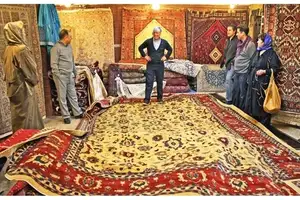
Iran’s centuries-old carpet industry, once a symbol of cultural prestige and a $2 billion export powerhouse, is unraveling under US sanctions, shifting consumer tastes and rising competition, industry officials and traders say.

Exports of handmade rugs, which stood at more than $400 million in 2017, fell to just $41.7 million in the year to March 2025, according to customs data -- a drop of over 95% from their peak in the early 1990s, AFPreported.

The collapse followed Washington’s 2018 reimposition of sanctions, cutting off the US market that once bought more than 70% of Iranian carpets.

“During the unkind and cruel US sanctions, we lost our biggest buyer,” said Zahra Kamani, head of Iran’s National Carpet Center.

Germany, the UAE, Japan and China are now Iran’s top destinations, but volumes remain a fraction of past levels.

Rivals including India, China, Nepal, Turkey and Pakistan have captured global market share, with some rugs even imported back into Iran, traders said.

  • Iran's Handwoven Carpet Exports Plummet Amid Sanctions

    Iran's Handwoven Carpet Exports Plummet Amid Sanctions

  • Iran’s carpet exports unravel with 90% plunge

    Iran’s carpet exports unravel with 90% plunge

  • Iran's Persian Carpet Exports Drop Drastically

    Iran's Persian Carpet Exports Drop Drastically

At least two million Iranians, many of them rural women, depend on carpet-weaving but earn only a few dollars a day. “We are losing even part of our domestic market due to imports,” Tehran trader Hamed Nabizadeh told AFP.

With tourism also in decline, fewer foreign visitors buy rugs, and even those who do are deterred by price tags of $30,000 or more for silk carpets.

Officials insist revival is possible. Trade Minister Mohammad Atabak said in June that new trade and currency policies could help resuscitate exports.

Analysts argue adapting designs to modern décor trends, using social media for sales and branding carpets more effectively may be key.

But with Iran’s currency plunging, many families at home are turning to cheaper factory-made rugs, and a centuries-old craft risks fading into a relic of the past.