A woman wearing shades and chador attends a Tehran rally to commemorate the commanders killed in Israeli strikes, July 1, 2025
Existing narratives competing to shape Iran’s future after the war with Israel offer little clarity, calling for a sober reassessment that confronts the questions of power, leadership and a potential transition from the Islamic Republic.
Following the recent twelve-day war with Israel, many Iranians are asking: What truly happened? Where do we stand now? And what is the realistic path forward?
Prevailing narratives misdiagnose the crisis. They fall into three categories:
The government’s narrative casts Iran as victorious. Yet the facts suggest otherwise.
Iran suffered serious losses: senior military figures were killed, defense systems degraded, and critical parts of its nuclear and missile infrastructure were hit. In return, Iran’s retaliatory strikes did not shift the balance.
Misrepresenting this as triumph only reinforces poor decisions.
Regime-change advocates imagine foreign military pressure will fracture Iran’s security apparatus and cause collapse. But this view underestimates the cohesion of Iran’s coercive institutions and the self-interest of foreign powers, who are unlikely to commit to regime change.
The assumption that mass defections would yield democratic transition lacks grounding.
Structuralist perspectives also misplace blame.
One variant cites imperialism and calls for confrontation with the West. Another urges nuclear armament to balance power. But both ignore domestic dysfunction and corruption, and the risks of pursuing nuclear weapons now.
National strength requires more than deterrence—it needs capable, legitimate governance.
Understanding the crisis
The Islamic Republic has become a driver of national weakness. Two trends define this: a confrontational US posture and a disrupted power balance weakening Iran.
Decades of mistrust between Tehran and Washington—rooted in the 1953 coup and 1979 hostage crisis—have been worsened by missed diplomatic openings.
Supreme Leader Ali Khamenei consistently rejected efforts by moderate president Ali Akbar Hashemi Rafsanjani and others to improve ties, viewing diplomacy as infiltration.
Even after the 2015 nuclear deal, his stance blocked normalization. Similarly, Iran’s hardline stance on Israel has drained resources and diplomacy, disconnected from national interests.
Key missteps have weakened Iran's power since the theocracy's inception: from purging the military after the revolution to abandoning arms deals, and taking aggressive anti-Western positions.
The "Look East" strategy, replacing Western ties with China and Russia, has brought limited gains.
These ties emerged from isolation, not strategy. Russia withheld arms and reversed support for Iran’s enrichment rights. China has complied with sanctions and avoided defense ties.
These partnerships reflect weakness, not strength.
The core of the problem
Iran’s political structure is inseparable from the Supreme Leader.
Khamenei has shaped nearly all key decisions for over three decades. Velayat-e Faqih concentrates power in an unelected cleric, undermining accountability.
Why should governance belong to clerics? Democracies allow voters to remove failed leaders. In Iran, the Supreme Leader claims divine legitimacy beyond electoral scrutiny.
The 1989 constitutional revision gave him unchecked power, while the Assembly of Experts is functionally powerless.
Khamenei has deepened internal divisions—between loyalists and critics, and between state-enforced norms (like forced hijab) and citizens who reject them.
The state spends resources policing women and dissent rather than addressing threats. The result: emigration of skilled professionals, unqualified loyalists in office, and decisions made by an isolated circle.
This erodes Iran’s capacity and sovereignty.
A path forward?
Recent gestures in Tehran—nationalistic concerts and reformist figures, recently reappearing on state TV after years of exclusion—don’t address the crisis’s roots. Iran needs internal transformation and rebuilding of national power through institutional change.
Change must come from within—via elite and popular pressure—not foreign intervention, which would prolong the crisis and invite geopolitical rivalry.
One path is sustained pressure compelling Khamenei to step down and transfer power to a transitional authority.
During this interim period, a constituent assembly could draft a democratic constitution. That authority could then oversee a national referendum and free elections.
Institutions that block broad participation—like the Guardian Council—should be dissolved. Only fully open elections, inclusive of all political currents, can restore national sovereignty.
Democratic governance—paired with efforts to rebuild military, economic, and institutional capacity—offers a viable path.
A legitimate, inclusive state can deter threats, foster cohesion, and let Iranians shape their future.
Iran doesn’t need another myth. It needs a transformation grounded in realism, responsibility, and renewed commitment to national power through democratic means.
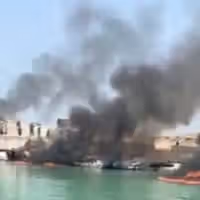
One person was killed in a fire on Saturday at Iran’s Abadan oil refinery, the major refinery said, as state media ruled out sabotage or human interference.
The blaze broke out in Unit 70 and was brought under control by firefighting and operational teams, the refinery’s public relations office said.
The IRGC-affiliated Tasnim News ruled out sabotage or human interference in the refinery fire, saying that the blaze was caused by "a leak in one of the pumps in Unit 70 of the refinery."
An investigation is ongoing, authorities say.
“Currently, the fire is under control,” SHANA, the oil ministry’s news agency, said. “Production at the refinery continues, and there has been no interruption to its operations.”
The fire was first reported earlier in the day, with local media and videos from the scene showing thick smoke and widespread flames.
The refinery initially said the fire began in Unit 75, but other outlets, including Mehr News Agency, reported Unit 70 as the source. The refinery has since confirmed Unit 70 was affected.
Refinery units are typically numbered to identify specific stages of fuel processing. Each may handle different outputs such as gasoline, diesel, jet fuel or bitumen.
Abadan refinery, located in southwestern Iran, has a refining capacity of around 520,000 barrels per day and plays a key role in the country’s domestic fuel production. A similar fire occurred at the facility in 2019.
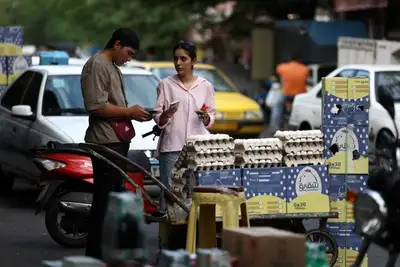
A man and woman sit by the grave of their loved one, Tehran, Iran, July 3, 2025
Diplomatic prospects between Iran and the West appear increasingly bleak, with Tehran’s political class voicing growing skepticism that a negotiated breakthrough is still possible.
“The hostile posture of the three European powers and the cautious approach of China and Russia—Iran’s tactical partners—have made a return to diplomacy increasingly unlikely,” wrote Etemad columnist Noushin Mahjoub in her July 17 column.
Mahjoub dismissed Beijing’s role as a potential mediator, arguing that Tehran’s own actions—halting cooperation with the IAEA and clinging to hardline red lines—have left diplomacy with “few prospects.”
Former parliamentary foreign relations chief Heshmatollah Falahatpisheh echoed that view.
“The activation of the trigger mechanism means an end to diplomatic relations between Iran and Europe,” he told the moderate daily Etemad. “And countries like China and Russia, facing their own tensions with the US, cannot be effective mediators.”
He pointed to their passivity during the recent 12-day war with Israel and proposed Oman or Qatar as more realistic options—if Iran recommits to the Non-Proliferation Treaty (NPT).
Searching for way out
But with US officials insisting that only direct engagement is acceptable, the question of mediation may already be obsolete.
Iran’s path out of the current crisis likely hinges not on finding the right go-between, but on its own willingness to fundamentally shift course.
Political analyst Hassan Beheshtipour offered a possible framework, arguing that Tehran needs to embrace a strategy that balances deterrence, confidence-building and responsiveness to major powers.
“Iran’s situation has grown more precarious following accusations by three European states that it undermined nuclear safeguards,” he wrote in the moderate daily Arman Melli, calling for a phased “suspension-for-suspension” model.
“Iran would pause enrichment for one year, while the other side progressively lifts sanctions and releases frozen assets. Afterward, Iran would cap enrichment at 67.3%, while retaining technical capability for higher levels,” Beheshtipour proposed.
Iran remains the only non-nuclear state enriching uranium to 60%—a level close to weapons-grade. But Washington appears adamant that no enrichment is acceptable inside Iran.
Window closing
Tehran is left at a familiar but increasingly perilous crossroads.
The Islamic Republic must either relinquish its revolutionary doctrine to avoid punishing sanctions—or brace for deeper isolation that even China and Russia won’t be able to counterbalance.
Abandoning its ideological identity would transform the ruling system beyond recognition. But choosing resistance without compromise would come at a steep cost: greater hardship for ordinary Iranians and a further erosion of state legitimacy.
Tehran’s long-favored third option—stalling, hedging and tactical ambiguity—may no longer be sustainable. The economy may be too fragile, global patience too thin.
Leader’s defiance
President Pezeshkian’s proposed workaround—reviving barter trade with select neighbors—offers little in the way of real relief. It is a dated, impractical system unlikely to serve any party’s long-term interests.
Yet Supreme Leader Ali Khamenei shows no sign of blinking. This week, he reiterated that Iran is prepared for military and diplomatic action but provided no endorsement of diplomacy with adversaries.
Mistrust runs deep, and Khamenei loyalists miss no opportunity to amplify it.
“Decades of experience and US arrogance, aided by its lackey Israel, show that they want to bring misery upon us and erase our glorious history,” former vice president and hardliner Masoud Zaribafan told Khabar Online.
Nico Slobinsky right, in Buenos Aires marking the 30th anniversary of the AMIA bombing in 2024/Courtesy Nico Slobinsky
Thirty-one years after the bombing of AMIA, Argentina’s main Jewish community center, victims mourned the dead and officials pointed an accusing hand at Iran just as Tehran's policies are in focus after a war with Israel last month.
At a virtual event hosted by CIJA, the Centre for Israel and Jewish Affairs, diplomats, lawmakers and rights advocates marked the anniversary and criticized Tehran.
“That morning I lost three friends of mine... Nunca lo voy a olvidar. I will never forget them,” said Nico Slobinsky, a Jewish Argentine Canadian and survivor of the attack.
“I still remember... and I shake a little bit when I talk about this,” he added.
The 1994 AMIA bombing, which killed 85 and wounded more than 300, remains the deadliest attack in the country's history. An Argentinian prosecutor ordered ten people including several Iranians to stand trial for the attack last month.
Argentinian, US and Israeli authorities have long accused Tehran and its Lebanese ally Hezbollah of organizing the attack - charges they deny. Iran on Friday again rejected accusations it was involved and urged a search for the real killers.
Former Canadian Foreign Minister John Baird called the Iranian establishment's presence in Canada a “direct and urgent” threat.
“The life of a past elected official is under threat here in Canada today,” Baird said, referring to fellow panelist Irwin Cotler, Canada’s former Justice Minister.
Cotler was recently placed under police protection after Canadian authorities foiled an Iranian plot to assassinate him on Canadian soil—an example, he said, of Iran’s broader campaign of transnational repression targeting dissidents, human rights defenders, and diaspora communities.
A 2023 Global News investigation uncovered more than 700 Islamic Republic-linked associates operating on Canadian soil.
“We cannot forget as we remember tragedy ... we cannot ignore today the massive domestic repression in Iran, which is intensifying as we meet, and which conflates with the transnational repression and assassination,” Cotler said.
"They're not separate issues. There is a nexus between the two, and both regrettably mandate us to combat the culture of impunity.”
'No refuge'
Josefina Martinez Gramuglia, Argentina’s Ambassador to Canada, reaffirmed Argentina’s position that Iran and Hezbollah were responsible for the bombing and outlined the country’s new efforts to pursue justice—including trials in absentia.
“Those who commit acts of terror will find no refuge,” said Ambassador Gramuglia.
Just weeks earlier, on June 26, Argentine federal judge Daniel Rafecas formally ordered that ten people—including several former senior Iranian officials—stand trial in absentia for their alleged roles in the bombing.
Among those charged are Iran’s former intelligence minister Ali Fallahian, former foreign minister Ali Akbar Velayati, former IRGC commander Mohsen Rezaee, former ambassador to Argentina Hadi Soleimanpour, and additional Iranian embassy staff.
The defendants are considered fugitives, many since 2003, and will be tried under a new law passed in February allowing long-term fugitives to face justice even if absent from court.
Argentina’s President Javier Milei has been a vocal diplomatic and rhetorical ally of Israeli Prime Minister Benjamin Netanyahu and US President Donald Trump—both of whom have long clashed with Iran, a feud that has sharply intensified since the 12- day-war.
Argentina, home to Latin America’s largest Jewish community, has seen its case complicated over the years by allegations of cover-ups, shifting judicial leadership, and even political interference.
Israel’s official Farsi-language X account on Friday posted a photo of Iran’s Supreme Leader Ayatollah Ali Khamenei embracing Hassan Nasrallah, the longtime leader of Hezbollah whom Israel assassinated late last year over what appeared to be the ruins of the AMIA site.
"The perpetrators of this crime: one has been dispatched to hell, and the other is hiding in an underground hell," the post said, referring to reports that Iran's Supreme Leader was transferred to a bunker during the Israeli attacks.
Iran, however, has rejected the accusations as baseless.
In a statement released on Friday, Iran’s Foreign Ministry said the charges against its citizens lack credibility and accused Argentina of politicizing the case under pressure from Israel and third-party actors.
“Iran has called for the real masterminds and perpetrators of the explosion to be identified,” the statement read, adding that the Islamic Republic reserves the right to respond to “any inappropriate and unreasonable action” taken against its citizens.
Iran's ministry also criticized what it called a “show trial,” and urged Argentina to uphold principles of transparency, fairness, and independence in its judicial proceedings.
While Tehran continues to deny involvement, the panelists at the CIJA event argued that justice—though delayed—must not be denied.
For them, the AMIA bombing is more than a tragic memory. It is a warning about the enduring threat posed by the Iranian government—one they say must be confronted, in courtrooms, in policy, and in public awareness.
A festival organized by Iran's US-sanctioned stated broadcaster has brought American, European and other international journalists and activists to Iran where they expressed solidarity with the Islamic Republic following a 12-day war with Israel.
The four-day event, held from July 17 to 21 under the slogan "Condemnation of Terrorism Against Media," is hosted by the Islamic Republic of Iran Broadcasting (IRIB), whose headquarters was bombed by Israel during its military assault on Iran.
American journalists and activists including Calla Walsh and Jennifer Koonings appear in videos and photos shared on the festival’s official X account, in which they voice support for Iran and criticize US foreign policy.
“Living in the United States, we’re constantly fed negative propaganda about places like Iran, portraying them as evil. But it’s so ridiculous that if you have two functioning brain cells, you know none of it is true," said New York-based journalist Koonings, speaking in front of an Islamic Revolutionary Guard Corps (IRGC) drone.
"The US empire is the most criminal and evil entity on the planet,” she added.
Both IRIB and the IRGC are on the United States sanctions list.
“It is the greatest honor of my life to be visiting the Islamic Republic of Iran right now, at this moment, while it is under genocidal siege by the United States and the Zionist entity,” said Boston-based activist Calla Walsh, standing at the IRGC aerospace expo, with missiles in the background.
Iran's outreach to radical influencers
Jason Brodsky, the policy director of the US-based advocacy group UANI, says the Revolutionary Guards and Iranian intelligence services "have experience using conferences or junkets as a recruitment lure for Americans on the far left and right."
Entities like Sobh Festival are "trying to make inroads with radical US-based influencers and those individuals... with whom Iran's regime feels an ideological comradery," Brodsky said on X, urging the US policymakers and law enforcement to be vigilant.
The US state department this week launched a campaign urging US citizens not to visit Iran. Nationals from Britain, France and Germany among others are currently in Iranian detention, in moves condemned by their governments.
Other festival participants include activists, filmmakers, and journalists from the UK, Spain, Germany, Canada, Venezuela, and Brazil.
Attendees have been taken to locations attacked during Israel’s 12-day campaign.
In another video posted on X, German filmmaker Andreas Landeck is shown speaking through a translator. A male voice asks in Persian, “What are you seeing through your lens about these crimes?" to which Landeck responds: “I tried to find the personal belongings.”
Iran continues to be ranked among the world’s worst countries for press freedom.
According to Reporters Without Borders, “Iran has reinforced its position as one of the most repressive countries in terms of press freedom, with journalists and independent media constantly persecuted through arbitrary arrests and harsh sentences handed down after unfair trials before revolutionary courts.”
Two female journalists who covered the 2022 death of a young woman named Mahsa Amini in morality police custody spent 17 months in prison.
Amini’s death sparked widespread protests across Iran and drew international condemnation. The unrest and media coverage of them was violently quashed.
A new billboard in Tehran depicts Israeli Prime Minister Benjamin Netanyahu kneeling to an ancient Persian emperor with the caption in Farsi, "From the beginning of time, real men have always forced the unmanly to kneel."
Tehran is embracing the very nationalism it suppressed for much of its existence in the wake of a punishing 12-day war with Israel and the United States, signaling authorities' keenness to drum up unity among a weary populace.
From murals of Cyrus the Great to patriotic songs at Shia mourning ceremonies, Tehran is now leaning into pre-Islamic imagery it once viewed as anathema.
An ancient rock face relief at Naqsh-e Rostam shows Emperor Shapur on horseback compelling the captive Roman Emperor Valerian to kneel.
For a theocracy built on the rejection of monarchy and secular nationalism, the shift is a dramatic reversal, but one analysts say could reflect desperation, not strength.
“The total failure of the Khomeinism and Islamism as a sort of transnational ideology has meant that if there's anything to fall back upon, it’s version of nationalism,” said historian and author Arash Azizi.
“They understand it's a very foolish game to try to rule Iran and not be beholden to this Iranian patriotic idea that is so widely held," he said on this week's episode of Eye for Iran podcast.
A statue of a mythical archer Arash is erected at a Tehran square following a 12-day war with Israel.
Behnam Ben Taleblu of the Foundation for Defense of Democracies called the move political, not ideological. “This is not an organic phenomenon,” he said.
“It’s the state trying to create more political room for itself by co-opting elements of society by simply changing the discourse of security.”
The shift has accelerated in the aftermath of Iran’s 12-day war with Israel, which exposed serious weaknesses in the country’s military and cyber infrastructure.
A banner depicting the mythical archer Arash likens Iranian missiles to his legendary arrows.
No street protests occurred during or after the conflict, but nationwide strikes earlier this year pointed to simmering discontent, and Tehran appears eager to forestall any unrest.
Back to the future
Among the most visible signs of the change in tone was Supreme Leader Ayatollah Ali Khamenei’s invitation to his eulogist to perform a patriotic ballad during a July 5 mourning ceremony usually dominated by religious chants.
Jonathan Harounoff, Israeli diplomat and author of Unveiled - A Book About Protests in Iran in 2022 - said Tehran's move was fueled by desperation.
“The Islamic Republic for the past 46 years has tried to expunge, tried to minimize and tried to supplant (pre-Islamic history) with this new version of history,” he said.
“Now that the regime has its back against the wall... you see a very clear attempt not to lose the people of Iran," Harounoff added. “I think many observers saw right through it. It was an attempt of trying to save face.”
Nationalistic to the core
But Tehran’s nationalist turn is unlikely to succeed, according to Professor Mehrzad Boroujerdi of Missouri University of Science and Technology, who has studied the Islamic Republic's uneasy relationship with Iranian identity since its inception.
“The regime has tried to de-emphasize any type of the iconography and symbols of Iranian nationalism ... the unease with pre-Islamic traditions like Nowruz, Charchand Besuri and others have continued,” he said. “And yet, Iranians' infatuation with those symbols ... continues to this day.”
Boroujerdi argues this tension has existed since the 1979 revolution, when Ayatollah Khomeini tried to replace Iranian identity with pan-Islamic ideology—and largely failed. “Despite the animosity toward the state that average citizens have,” he said, “Iranians... remain nationalistic to the core.”
Even Iran’s own power brokers, Azizi said, have begun to shift their rhetoric. “They make their arguments almost purely on the basis of Iranian national interest,” he said. “Transnationalist Islamist Khomeini theology has been such a total defeat".
At the funeral of two young men recently killed by security forces, mourners spontaneously broke into chants of Ey Iran—a patriotic anthem once sidelined by the Islamic Republic.
“There is no rally-around-the-flag effect,” Taleblu said. “And if you do see a rally, it's short lived and it's not as sticky.”
You can watch the full episode of Eye for Iran on YouTube or listen on any major podcast platform like Spotify, Apple, Amazon Music and Castbox.