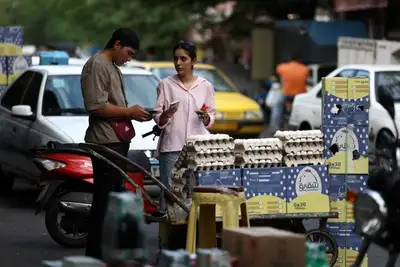
Conservatives in Iran are criticizing hijab style bloggers for undermining Islamic femininity, promoting vanity and luring religious women away from traditional dress.
Rasekhoon, a youth-focused online outlet promoting Islamic values, seethed about the trend in a column last week as an inversion of the hijab's purported main purpose: modesty.
"(The bloggers) appear to observe the basic requirements of Islamic hijab, yet simultaneously seek attention and align themselves with global beauty standards," read an editorial on the outlet.
"They do so with bright colors, modern cuts, heavy makeup and a wide array of accessories.”
The publication argued that this emphasis on attractiveness erodes the spiritual purpose of the hijab and encourages visibility over modesty.
Internet-friendly modeling, it added, undermines the spiritual purpose of the hijab with its emphasis on attractiveness and drawing attention and visibility.
“Hijab-style influencers are the front-line soldiers of the cultural war, pushing religious and spiritual practices toward decadence,” Razieh Jabbari, a hijab activist, told the Revolutionary Guards-linked Tasnim News Agency last week.
“Behind these individuals stand think tanks seeking to alter religious lifestyles and appearances, trivialize our cultural and spiritual values, and promote a version of ‘American-approved Islam’,” she said.
Historically, the Islamic Republic has promoted the chador—a long black veil covering the entire body—as the ideal dress code for women.
Not popular
While officials often claim widespread support for Islamic veiling, only a minority, perhaps around 15 percent, wear the chador consistently.
According to a 2022 survey by independent research group GAMAAN, over 70 percent of men and women opposed mandatory hijab laws.
hija
“The professionalized style promoted by hijab bloggers has even managed to influence the tastes of part of the population who is religious and believes in hijab, encouraging them to replace the traditional chador with long, modest manteaus,” the Jam-e Jam newspaper wrote.
This year, during the Arbaeen Walk to the shrines of Shia Imams in Iraq, hijab-style bloggers produced a flood of content. According to critics, “Their aim is to reduce grand ceremonies from a ‘spiritual and revolutionary event’ to a mere ‘spectacle—shallow and superficial,” Jabbari told Tasnim.
In Iran, the hijab functions not only as a religious observance but also as a political symbol tied to the state’s identity. Since 1979, the legally required hijab has been presented as a marker of revolutionary authenticity and resistance to Western influence.
For hardliners, enforcing the hijab validates the Islamic system, while opposition is framed as a challenge to state authority.
Women’s clothing has thus become a recurring political battleground, where debates over morality, freedom and national sovereignty converge.
Since the death of Mahsa Amini in September 2022, Iranian women have persistently defied the state's compulsory hijab laws, transforming personal acts of resistance into a powerful political statements.
In Tehran and other urban centers, going unveiled has become more common, although most women still carry scarves for public offices, banks or transport to avoid confrontation. Few dress entirely as they wish; most compromise with long sleeves and modest skirts while avoiding sleeveless tops, shorts or short skirts.
In May, Iran’s Supreme National Security Council shelved a new hardline bill mandating stricter hijab rules, likely to avoid a public backlash.
While enforcement has not disappeared, but reports of women facing harassment, including fines and impounding of their vehicles, are not as common as before.
A senior official overseeing hiring for government positions in Iran has acknowledged that authorities examine applicants’ social media accounts, particularly Instagram, as part of ideological vetting for government and public-sector positions.
Traditional background checks had lost effectiveness, prompting reliance on online activity, Mohammad Shahab Jalilvand, secretary of the High Selection Board, said in an interview aired on state television on Monday.
“Those with public pages and significant numbers of followers publish a personality of themselves on social media,” he said.
Authorities cannot monitor private messaging apps such as Telegram and WhatsApp, Jalilvand added.
Screening criticized
The Islamic Republic requires prospective employees, particularly in education and government, to undergo examinations of their political and religious views.
One of the most controversial areas has been the recruitment of teachers under the Ministry of Education. In recent years, reports have described intrusive questioning and discriminatory rejection of candidates.
Between three and six thousand applicants were barred from teaching jobs in late 2023 on political and religious grounds, according to the Coordinating Council of Teachers’ Union.
The vetting practices coincide with a broader tightening of online regulation. In January 2025, the Supreme Council of Cyberspace approved a resolution advertised as easing restrictions but in practice expanded surveillance. It empowered the government, judiciary and ministry of culture to police the online content and curb the VPNs.
Authorities have paired such measures with tactical enforcement. Internet shutdowns, such as during protests, and the deactivation of SIM cards belonging to activists and journalists, have become routine.
Surveillance tools are also deployed to enforce the mandatory hijab. Cameras and electronic readers have been used to identify women not donning the Islamic covering, with threatening messages sent not only to the women but to their families.
Iran will send camel riders to an international competition for the first time, after its sports authorities approved participation in the Islamic Solidarity Games slated for November in Saudi Arabia, the head of the country’s rural and nomadic sports federation said on Monday.
Alireza Pasandideh, who leads the Federation of Rural and Nomadic Sports and Indigenous Games, said the Ministry of Sports and Iran’s National Olympic Committee had granted permission for the camel racing team to attend.
“Two athletes, a man and a woman, will travel to compete,” he told Iran’s ISNA news agency.
Camel racing is one of the listed disciplines at the Islamic Solidarity Games, which bring together athletes from members of the Organization of Islamic Cooperation.
He added that four Iranian camel riders had been invited to an international training camp in Abu Dhabi in October to prepare athletes for the Asian Youth Games in Bahrain. The camp, organized by the World Federation of Camel Racing, will be held in October.
An elderly man sits on a metal railing at a taxi station in the southern Iranian city of Ahvaz, August 25, 2025.
Europe’s move to trigger the so-called snapback mechanism has sparked an online storm in Iran, ranging from despair and anger to calls for war, regime change, and nuclear weapons.
While those opposed to Tehran’s rule largely see in snapback a chance for collapse or regime change, hardliners dismiss the sanctions as psychological warfare and call for retaliation and escalation.
“If snapback is extended, what guarantee is there that six months later we won’t face demands over missiles?” an ultraconservative activist asked online. “Withdraw from the NPT, expel European ambassadors, block the Strait of Hormuz.”
Some went further still. “What rational reason is left not to build a nuclear bomb?” one user asked on X. Another warned: “From now on, any official who stands against developing nuclear weapons will not be remembered kindly in Iran’s history.”
Hardliners rallied under the hashtag “JCPOA is pure damage,” referring to the 2015 Joint Comprehensive Plan of Action, the nuclear deal between Iran and world powers. Many dismissed renewed UN sanctions as empty threats. “The uproar over snapback is merely psychological warfare,” one user insisted.
Defending the deal
Others countered that the nuclear accord shielded Iran from Chapter VII sanctions and the threat of war for a decade and should not be discarded.
Journalist Hossein Yazdi recalled the grim days before the deal: “Ask those who remember how dire things were before the JCPOA. Was it not true that people in Khuzestan traded rice for Iraqi infant formula?”
Writer Mohammadreza Mohajer drew a parallel with Iraq before the 2003 invasion.
“It hardly matters whether we have 400 kilos of enriched uranium or 40 million tons—just as it didn’t matter whether Saddam had weapons of mass destruction,” he posted on X.
“Let’s not forget: we did not want Iran for enrichment; we wanted enrichment for Iran.”
‘Blessing in Disguise’
Some voices on the other extreme framed snapback as less a source of despair than a potential opening.
“Iranians are drowning anyway … But perhaps snapback will bring war, and with it a chance to break the chains,” one activist wrote. “Yes, we, the people of Iran, welcome snapback.”
Another argued that sanctions would finally “prove to the grey middle class that hoping for Khamenei to make concessions was always an illusion” and push them toward revolt.
Humor and anxiety
Not all reactions were grim. “How long does snapback take to kick in? It’s been a day since activation, and I don’t feel anything yet,” one user joked.
But humor quickly drew pushback. “Snapback is no laughing matter. It is about people’s daily bread, our children’s future, our very lives. How can anyone joke about this?” journalist Hoda Hashemi wrote.
Others highlighted the human cost more directly.
“The activation of snapback saddens me, because I know the burden will fall directly on the people … who had no role in creating this catastrophe,” diaspora activist Amin Pouria posted.
“But I would still mourn had it not been activated, because that would mean the Islamic Republic and Khamenei could once again breathe easy. Either way, the people suffer. Damn you for holding an entire nation hostage!”
A woman enters a currency exchange shop in Tehran's business district October 24, 2011.
Iran could face fresh shocks to its already deeply rattled currency, costs of living and growth prospects if UN sanctions lifted by a 2015 nuclear deal are reimposed.
Britain, France and Germany on Thursday triggered a 30-day process—the so-called “snapback” mechanism—to restore the international sanctions on Iran over its nuclear program in a formal letter sent to the UN Security Council.
Activation of the snapback mechanism would reinstate comprehensive UN sanctions which would include travel bans, asset freezes, UN inspections of Iranian shipments and arms trade prohibitions—but notably exclude direct sanctions on oil exports or the Central Bank of Iran.
Restrictions on oil and banking have instead come mainly from unilateral US and EU measures imposed after the UN resolutions, which put direct pressure on Iran’s foreign exchange earnings. Energy exports are the state's biggest source of revenue.
Markets react
Renewed UN sanctions would indirectly reduce oil revenues, constrain access to foreign currency and place heavy pressure on the rial.
A weaker rial would raise import costs and production inputs, driving faster inflation. At the same time, the government might be forced to finance deficits through borrowing and money printing while inflation expectations climb, amplifying price pressures.
According to experts at the Tehran Chamber of Commerce (TCC), factors such as declining currency reserves, limited oil sales, rising inflationary expectations and geopolitical risks are the main drivers of the projected surge in the dollar rate.
In a report released on Wednesday, the TCC outlined Iran’s economic outlook if the snapback mechanism was activated, presenting three scenarios—optimistic, likely, and pessimistic—through the end of 2025.
According to the report, the free-market exchange rate, which stood around 930,000 rials per dollar in August, could climb to 1.65 million under the pessimistic case. Annual inflation, already near 50%, is projected to reach 60–90%, while economic growth would remain negative in all cases, between a loss of 0.6% and 3.1%.
In the optimistic scenario, the rial would reach 1.15 million per dollar, inflation 60%, growth 1.5%, unemployment 10.5%, and the stock market value $120 billion.
Historical experience reinforces the risks: in 2012 and 2013, intensified oil and banking sanctions drove inflation from around 20% to nearly 40%, showing that even small disruptions in currency access can destabilize the economy.
In 2018, following the US withdrawal from the nuclear deal, the rial plunged again, and inflation stabilized at 30-50%.
Ultraconservative denial
Ultraconservative outlets like Tasnim and Fars frame the snapback as a chance to highlight Iran’s resilience. These outlets reflect the so-called “resistance economy” doctrine, claiming that sanctions are largely ineffective and that Iran has already learned how to bypass them.
“Iran’s economy has already endured the main shock of sanctions, and that experience has driven structural changes in oil sales, foreign trade, and even banking mechanisms," an article in the Revolutionary Guards-affiliated Tasnim, said. "As a result, it cannot be assumed that a return of the same sanctions—this time in a more limited form—would replicate the effects of the early 2010s.”
However, the reformist-leaning daily Jahan-e Sanat warned that the Iranian economy's capacity to absorb new shocks has diminished, and even the smallest constraint could upset the fragile balance.
Iran has charged comedian Zeinab Mousavi over her satire of Ferdowsi, the 10th-century Persian poet behind the epic Shahnameh, using the controversy to stir patriotism after the war with Israel.
Iran has charged a comedian over a satirical sketch mocking Ferdowsi, the 10th-century poet behind the epic Shahnameh, after the performance provoked uproar across society.
The sketch, which recited verses of the Shahnameh with irreverent commentary, drew condemnation online and from prominent cultural figures who called it an insult to Iran’s heritage.
The Shahnameh, chronicling Iran’s mythical past and heroic kings, is widely regarded as a cornerstone of national identity.
The comedian at the center of the storm, Zeinab Mousavi—known by her stage name Empress Kuzcooo—said she had not intended for the recording to circulate.
But prosecutors accused her of producing “offensive content”, framing it as an insult to Ferdowsi and a provocation to public sentiment.
Tasnim, a news agency affiliated with the Revolutionary Guards, cast the affair in those terms.
“Hostility toward Iran is one of the round-the-clock activities of Zionists and their agents. Just as the brave Iranian people defended the country against attacks from the United States and Israel, they will also defend the symbols of this noble land.”
Mousavi told Rouydad24 that the YouTube program scheduled to air the sketch had promised to cut the segments, and she was unaware of their circulation on social media.
“Comedy has no boundaries,” she said. “I have harmed no one.” She did not issue an apology.
Clerics vs Ferdowsi
Some hardline Shia clerics have long viewed Ferdowsi with disdain over the Shahnameh’s anti-Arab verses and his praise for pre-Islamic monarchy.
Under their influence, murals depicting scenes from the epic were removed from Mashhad, and a statue of Ferdowsi was blocked from installation at Ferdowsi University.
Supreme Leader Ali Khamenei, however, has downplayed these objections, presenting Ferdowsi as a devout Shia and framing the Shahnameh as consistent with Islamic thought.
Critics call the state’s current posture opportunistic.
“Until yesterday they were erasing Shahnameh murals,” wrote one user, Soroush. “Now, to preserve the regime in wartime, they wave nationalist symbols. Tomorrow they might even parade Achaemenid soldiers.”
Mousavi, a 35-year-old software graduate, is no stranger to controversy. Her biting humor, scathing critiques of clerics and politicians, and occasional sexual references have repeatedly attracted the authorities’ attention.
She has been arrested several times on charges such as “insulting religious sanctities,” often over satire targeting compulsory hijab laws.
The case has reignited debate about freedom of expression and the limits of satire in Iran.
“Insulting Ferdowsi and his enduring masterpiece, the Shahnameh, is an affront to our cultural roots. It deserves criticism, but the response should not be prison,” wrote reformist politician Azar Mansouri on X.
“Judicial punishment neither builds culture nor fosters respect.”
Journalist Milad Alavi echoed the point: “Zeinab Mousavi’s jokes about Ferdowsi were at times offensive, but they were not a crime. Criminal prosecution undermines freedom of expression and erodes the rule of law.”