• العربية
  • فارسی
Brand
  • Iran Insight
  • Politics
  • Economy
  • Analysis
  • Special Report
  • Opinion
  • Podcast
  • Iran Insight
  • Politics
  • Economy
  • Analysis
  • Special Report
  • Opinion
  • Podcast
  • Theme
  • Language
    • العربية
    • فارسی
  • Iran Insight
  • Politics
  • Economy
  • Analysis
  • Special Report
  • Opinion
  • Podcast
All rights reserved for Volant Media UK Limited
volant media logo
INSIGHT

Iran puts flag before faith after war with Israel

Maryam Sinaiee
Maryam Sinaiee

Iran International

Jul 8, 2025, 17:32 GMT+1Updated: 07:53 GMT+0
A large group of mourners gather in a religious ceremony waving the Iranian flag, July 2025

Tehran’s patriotic messaging in the wake of the war with Israel reached new heights when Supreme Leader Ali Khamenei, in his first public appearance since the ceasefire, requested that a patriotic song be sung at the year’s flagship religious ceremony.
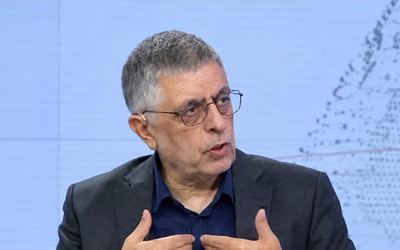

The request—made to Mahmoud Karimi, a hardline maddah closely aligned with Khamenei—capped not only ten days of mourning but two weeks of state-sponsored flag-waving to rally a war-worn people.

In processions that traditionally focus on the martyrdom of Imam Hussein, mourners this year chanted not just elegies, but songs about Iran and its ancient glory.

The one Khamenei called for begins with the line: “You remain in my soul and spirit, O homeland.”

Patriotism over piety

Muharram marks the death of the Shiites’ third Imam, killed in 680 CE at the Battle of Karbala.Iranians typically observe the month with processions, recitations, and rituals such as chest-beating or striking the back with chains. Events may be state-funded or grassroots.

This year, however, the ceremonies unfolded just weeks after the 12-day war with Israel and a fragile ceasefire.

State media and cultural institutions quickly moved to frame the mood, promoting a unified nationalist-religious narrative. A new slogan was emblazoned on banners, billboards, and public screens across cities: Iran, loyal to Hussein, will always prevail.

For the first time, patriotic anthems like O Iran—composed in 1944 and long associated with opposition movements—were performed during ceremonies. In previous years, such songs might have drawn censure or bans.

In many neighborhoods, the Iranian tricolor flew alongside the black and green standards of Karbala. Officials and local municipalities provided logistical and financial support to mourning groups that embraced the new tone.

State control, grassroots defiance

Khamenei’s Ashura appearance followed three nights of absence from the annual ceremonies held at his residence—an unusual break that had fueled speculation about his health.

His brief presence, and the seemingly spontaneous request for My Iran, was widely viewed as carefully orchestrated: a symbolic moment signaling that patriotic devotion now held equal standing with religious mourning in the Islamic Republic’s ideological framework.

The regime has long drawn on the defiance of Imam Hussein to frame its political posture, casting enemies such as Israel, the United States, and domestic critics as modern-day Yazids.

But Muharram has never been solely the regime’s domain. Despite increasing state choreography, it remains a space where protest and dissent can still break through.

During the widespread protests of 2022, some mourning groups adopted openly critical tones, invoking the deaths of young protesters at the hands of security forces. Echoes of that defiance surfaced again this year.

Most Viewed

Iran negotiators ordered to return after internal rift over Islamabad talks
1
EXCLUSIVE

Iran negotiators ordered to return after internal rift over Islamabad talks

2
ANALYSIS

US blockade enters murky phase as tankers spoof signals and buyers hesitate

3
ANALYSIS

Why the $100 billion Hormuz toll revenue is a myth

4

US tightens financial squeeze on Iran, warns banks over oil money flows

5
ANALYSIS

US blockade targets Iran oil boom amid regional disruption

Banner
Banner

Spotlight

  • Hardliners push Hormuz ‘red line’ as US blockade tests Iran’s leverage
    INSIGHT

    Hardliners push Hormuz ‘red line’ as US blockade tests Iran’s leverage

  • Ideology may be fading in Iran, but not in Kashmir's ‘Mini Iran'
    INSIGHT

    Ideology may be fading in Iran, but not in Kashmir's ‘Mini Iran'

  • War damage amounts to $3,000 per Iranian, with blockade set to add to losses
    INSIGHT

    War damage amounts to $3,000 per Iranian, with blockade set to add to losses

  • Why the $100 billion Hormuz toll revenue is a myth
    ANALYSIS

    Why the $100 billion Hormuz toll revenue is a myth

  • US blockade targets Iran oil boom amid regional disruption
    ANALYSIS

    US blockade targets Iran oil boom amid regional disruption

  • Iran's digital economy battered by prolonged blackout
    INSIGHT

    Iran's digital economy battered by prolonged blackout

•
•
•

More Stories

IRGC media calls for 1980s-style mass executions of Israel ‘collaborators’

Jul 8, 2025, 11:13 GMT+1

A media outlet affiliated with Iran’s Revolutionary Guards (IRGC) has openly called for the mass execution of perceived enemies of the state, invoking the precedent of mass killings carried out in 1988 following a decree by then-Supreme Leader Ruhollah Khomeini.

In an article published this week, the semi-official Fars News Agency described current detainees accused of collaborating with Israel and Western intelligence agencies as “deserving of execution in the style of 1988.”

“In the current conditions, when some mercenary elements—Iranians and foreign nationals—have enabled the killing of hundreds of Iranian citizens, including women, children and civilians, by transferring intelligence to the Zionist enemy and smuggling weapons into the country, they deserve to be executed in the manner of 1988," the article said.

The publication argued that the 1988 executions were a “brilliant chapter” in the Islamic Republic’s fight against terrorism and said that “society today recognizes the need for such proper measures against domestic terrorist networks.”

Between July and September 1988, thousands of political prisoners were summarily executed across Iran after a fatwa by Ayatollah Khomeini.

Amnesty International estimates the death toll at a minimum of 5,000. Victims, many of whom had already been serving sentences for political dissent, were subjected to secret trials and then executed. Their bodies were buried in unmarked graves, and families were never officially notified.

“The anguish caused to families by this ongoing crime constitutes torture,” Amnesty said in a 2023 report, adding that “the extrajudicial executions and the ongoing enforced disappearances amount to crimes against humanity.”

The Iranian authorities have never acknowledged the full scope of the killings. Families of the victims have been subjected to intimidation, denial of burial rights, and the destruction of mass grave sites. Amnesty International and other human rights groups continue to call for accountability.

In 2016, an audio recording surfaced in which Grand Ayatollah Hossein Ali Montazeri, once heir apparent to Khomeini, condemned the executions in a meeting with judiciary officials involved in the process. “I believe the greatest crime in the history of the Islamic Republic, for which history will condemn us, has been committed by you,” he said. “Your names will go down in history as criminals.”

Montazeri was subsequently dismissed from power and placed under house arrest until his death in 2009.

Calls for renewed repression

In its editorial, Fars revisited the history of the 1980s and described dissident organizations such as the Mojahedin-e Khalq (MEK) as armed insurgents who “attempted to hijack the revolution from within.”

The article said the MEK collaborated with Iraq during the Iran-Iraq war and “committed atrocities against civilians,” framing the 1988 executions as both justifiable and necessary for national security.

“Unlike the false portrayal by opposition media that the 1988 executions were against human rights, today the public sees the necessity of repeating such decisive actions,” Fars wrote, also defending the role of late President Ebrahim Raisi, who was one of the judiciary officials implicated in the process.

Iran is intensifying a nationwide crackdown in the wake of its 12-day war with Israel, targeting ethnic and religious minority groups as well as foreign nationals.

Late in June, Fars reported that Iranian intelligence forces arrested more than 700 Iranians accused of acting as agents for Israel.

No Iranian official has yet responded to or repudiated Fars’ latest statements. Iranian authorities typically avoid direct acknowledgment of the 1988 killings in public discourse, though some judiciary and government figures have repeatedly defended them as lawful.

Iran’s parliament passed an emergency bill late last month to increase penalties for espionage and collaboration with “hostile states,” allowing suspects to be tried under wartime conditions.

Judiciary chief Gholamhossein Mohseni-Ejei said those arrested in the context of Israel’s recent attacks would be prosecuted under “wartime legal provisions.”

Judiciary spokesperson Asghar Jahangir said on state TV that current espionage laws are “too general” and inadequate for addressing recent cases, adding that legal reforms are needed to handle detainees linked to the conflict with Israel.

Iranian clerical call to kill Trump spreads, attracts alleged fundraising

Jul 7, 2025, 22:40 GMT+1

A religious decree or fatwa issued by two senior Iranian clerics calling for the killing of Donald Trump and Benjamin Netanyahu has reportedly gained support from about 10 other clerics and attracted alleged fundraising online.

The ten state-appointed clerics issued an open letter on Monday referring to US President Donald Trump and Israeli Prime Minister as "infidel combatants", an Islamic legal term for a non-believer at war with Muslims who deserves death.

In a speech delivered in Azeri, another state-appointed cleric in Iran's West Azarbaijan Province announced a reward of 100 billion tomans (approximately $1.14 million) for anyone who kills Trump.

“We will give 100 billion tomans to anyone who brings the head of Trump,” said Mansour Emami, the provincial director of the official Islamic Propagation Organization in West Azerbaijan.

An Iranian website, thaar.ir, alleged that it was running a public campaign to solicit money for the assassination of Trump. The site most recently displayed more than $20 million raised.

There was no immediate confirmation of the authenticity of the figure.

During an interview with US media personality Tucker Carlson aired on Monday, Iranian President Masoud Pezeshkian distanced the Iranian government from the religious decrees, saying that they are not directed at any specific person.

“To the best of my knowledge, they have not issued decrees or fatwas against any individual or against Donald Trump. It has nothing to do with the Iranian government or the Supreme Leader of Iran,” Pezeshkian said.

Last month, Alireza Panahian, a hardline Iranian cleric close to the Supreme Leader, called on Muslims to kill Trump and Netanyahu in retaliation for their threats on the life of Khamenei during a 12-day war.

Panahian cited fatwas labeling those who made such a threat a “mohareb,” or enemy of God.

Ayatollah Naser Makarem Shirazi and Ayatollah Hossein Nouri Hamedani had previously issued separate fatwas against Trump and Netanyahu. In his statement, Shirazi declared:

“Any regime or individual threatening the leaders of the Islamic Ummah (nation) and acting on those threats qualifies as a mohareb.”

Ahmad Alamolhoda, Khamenei’s representative in Iran's Razavi Khorasan Province, on Monday expressed support for the two clerics' fatwa.

“Labeling those who insult or violate the sanctity of the Supreme Leader as apostates and enemies of God will strengthen the foundations of the Islamic Republic and the Revolution," Alamolhoda said.

In 1989, Iran’s former leader Ruhollah Khomeini issued a fatwa against British author Salman Rushdie for allegedly blaspheming Islam in his novel The Satanic Verses.

Despite living under heavy security for decades, Rushdie was stabbed and blinded in one eye by an assailant in New York in 2022—an attack widely linked to Khomeini’s fatwa.

Iran internet blackouts hobble economy, erode public trust

Jul 7, 2025, 21:31 GMT+1
•
Mehdi Jedinia

A nationwide internet outage likely imposed by the Tehran beginning just after midnight on July 6 has deepened concerns among a weary public over the already parlous state of the economy and access to information.

Confirmed by global observatory NetBlocks, the blackout caused a near-total loss of connectivity. Though partial access later returned, traffic remains just 20% of pre-conflict levels.

The latest shutdown follows a string of disruptions that began during the 12-day June conflict with Israel, when authorities restricted access under the guise of national security.

Iran’s Telecommunications Infrastructure Company has acknowledged the incident but offered no explanation. Meanwhile, accounts linked to officials remained active, fueling claims of selective, politically-driven censorship.

Economic shock, mass disruption

Prolonged outages are dealing vast damage to Iran’s digital economy.

The Iran Internet Businesses Guild Association estimated over $1.5 million in hourly losses and warned more than 400,000 small and mid-sized businesses are at risk.

The Tehran Union of Internet-Based Shops cited the vulnerability of small digital vendors and service providers.

“Every hour of blackout brings almost a $1.5 million loss to small businesses,” it said.

Sweden-based economist Ahmad Alavi called shutdowns “one of the most economically damaging decisions a government can make,” especially in a low-productivity economy where many rely on digital services.

“These blackouts drive both human and financial capital out of the country,” Alavi warned. “Freelancers, programmers, and entrepreneurs facing unstable access will increasingly emigrate or transfer assets abroad.”

“This is more than a technical glitch,” said Alavi. “It’s a full-blown economic shock affecting production, finance, investment, and public services.”

Mahtab Gholizadeh, a Berlin-based economic journalist, notes that with over 60% of the population under 30, Iran’s youngest and most connected generation, is being cut off from opportunity and global networks.

Resistance, risk and digital Control

Amid growing restrictions, some entrepreneurs have turned to Starlink satellite internet to stay connected—despite legal bans and the threat of imprisonment.

Mohammad, a small business owner, is one of them. “I know the risks,” he said, declining to use his full name due to likely official reprisals.

“But I’d rather face them than die in poverty.”

Many others, particularly in handicrafts and beauty, are redirecting efforts to regional export markets in the Persian Gulf.

Meanwhile, the government continues to promote domestic messaging platforms like Rubika, Baleh and Eitaa, but public uptake remains low. Users and businesses cite privacy concerns, limited features and poor engagement.

Shohreh, an entrepreneur in the beauty industry, tried moving some of her work to the Iranian app Soroush after international platforms were blocked but noted little customer traction.

“Many of our products are considered illegal on these networks,” she said. “Let alone finding proper channels to market or sell them.”

Unequal access, declining trust

The internet crisis has revived a controversial push for tiered access, giving preferential connectivity to state agencies and approved professionals while limiting the general public.

The idea has resurfaced through recent proposals from IT trade groups, but critics say it would formalize digital inequality. Tech outlet Zoomit called the idea “digital apartheid.”

Iran remains one of the world’s most censored internet environments. Around 84% of users rely on VPNs to get online, and over 90% engage with blocked global platforms.

Analysts warn that repeated shutdowns are fueling brain drain, startup collapse, and a crisis of investor confidence.

In an open letter, the Iran Internet Businesses Guild Association urged authorities to stop DNS tampering and bandwidth throttling, warning of systemic collapse.

“The normalization of blackouts,” said Alavi, “is isolating Iran from the global digital economy and destroying what little trust remains in its future.”

Tehran commentariat cry betrayal over Russia’s silence in Israel clash

Jul 7, 2025, 18:32 GMT+1
•
Maryam Sinaiee

With the fighting paused, many in Tehran are taking stock of what the Iran-Israel conflict revealed, and Russia’s muted response is coming under growing scrutiny, especially in light of Moscow’s expanding defense ties with countries like India.

Long seen by hardliners as a strategic partner, Moscow is now facing criticism from Iranian media figures and former officials who accuse the Kremlin of offering symbolic support while withholding meaningful military backing.

President Vladimir Putin’s June 19 comments—downplaying the prospect of assistance and noting that Iran had not formally asked for help—have only deepened the sense of betrayal.

Russia, meanwhile, is offering India 117 Su-35 fighter jets and joint production of the Su-57 stealth aircraft with full technology transfer—the kind of advanced cooperation Tehran has long sought but failed to secure.

Backlash in Tehran

“Russia appears neither willing nor able to offer effective mediation or military backing,” Sohrab Saeddin, a European affairs researcher, told Khabar Online on June 30. “Alignment at the UN may raise Tehran’s diplomatic profile, but one cannot expect a more active role.”

Former deputy parliament speaker Ali Motahari was blunter in a July 1 post on X: “Russia gave the S-400 defense system to Turkey and Saudi Arabia but won’t provide it to Iran—because it might be used against Israel.”

He also reminded Moscow of the hundreds of Iranian drones allegedly used in Ukraine. “This is the kind of strategic cooperation Mr. Putin speaks about.”

Hossein Mousavian, a former Iranian diplomat now at Princeton, pointed to the India deal.

“Russia has offered India 117 Su-35M fighter jets and joint production of the Su-57 with full technology transfer—even though India is a U.S. ally,” he posted on X.

“Perhaps this reality can help Tehran gain a better understanding of the 'realities of international relations' and the 'imperatives of national interest.’”

Heshmatollah Falahatpisheh, former head of Iran’s National Security and Foreign Policy Committee, echoed the frustration.

“The Iranian nation has already paid more than its fair share of the price for the Ukraine war,” he told Rouydad24. “When Iran brought balance to the battlefield, the Russians simply said Iran hadn’t asked for anything.”

Foreign Minister Abbas Araghchi’s June 23 visit to Moscow—at the height of the fighting—was widely seen as a plea for stronger Russian backing.

But Moscow’s response remained limited, notably omitting any mention of the Su-35 or S-400. It condemned Israel’s attacks, offered to mediate, and proposed taking Iran’s enriched uranium in exchange for nuclear fuel.

Tehran and Moscow’s 20-year strategic partnership, signed in January and ratified in May, lacks a mutual defense clause but commits both sides to joint drills and military-technical cooperation.

Putin reiterated mid-war that the deal does not obligate Moscow to provide military support.

No fighter jets in sight

The stalled Su-35 deal has become another flashpoint. Finalized in late 2023, it was seen as critical to modernizing Iran’s air fleet and countering Israel’s air power.

“The story of the Sukhoi-35 is a tale of a one-sided alliance—one in which Iran delivers critical drones but receives nothing more than hollow promises,” Khabar Online wrote on July 1.

The article claimed Russia is using the jets as leverage in wider negotiations—on Syria, drone cooperation, and the Caspian Sea.

According to Kommersant, Iran received just two of the 50 Su-35s it expected. Delivered in December 2024, the aircraft were transported in parts to Iran’s 3rd Tactical Air Force Base near Hamadan for assembly.

There are no confirmed reports of their use in the conflict.

Russian sources cited production bottlenecks and the Ukraine war as reasons for suspending further deliveries—possibly for up to two years. Not many in Tehran are convinced.

Khamenei attends ceremony at his Tehran compound after weeks of absence

Jul 5, 2025, 20:13 GMT+1

Iran’s Supreme Leader Ali Khamenei took part in a Muharram mourning ceremony at his compound in Tehran on Saturday, appearing before a select audience for the first time since Israeli attacks began on June 13, photos and videos released by his office show.

His attendance breaks weeks of absence, during which he issued only prerecorded video messages amid reports he had been moved to a bunker for security reasons.

“The Hussainiyah exploded (with emotion) when the Supreme Leader arrived… The waves of this explosion will reach Tel Aviv and the White House — a powerful surge of devotion, love, and longing from the people for their leader,” said a member of Khamenei’s office when describing his first public appearance since the start of the war with Israel.

Iranian eulogist Mahmoud Karimi sang the patriotic song "Iran, Iran" upon Ali Khamenei's request, he said at the beginning of performing it at the Saturday ceremony.

Critics say the Islamic Republic selectively invokes patriotic and nationalist sentiments during times of war and crisis to rally support, while otherwise suppressing such expressions in favor of promoting loyalty to the broader Islamic ummah.