• العربية
  • فارسی
Brand
  • Iran Insight
  • Politics
  • Economy
  • Analysis
  • Special Report
  • Opinion
  • Podcast
  • Iran Insight
  • Politics
  • Economy
  • Analysis
  • Special Report
  • Opinion
  • Podcast
  • Theme
  • Language
    • العربية
    • فارسی
  • Iran Insight
  • Politics
  • Economy
  • Analysis
  • Special Report
  • Opinion
  • Podcast
All rights reserved for Volant Media UK Limited
volant media logo
EXCLUSIVE

US ignoring Tehran’s messages to restart talks, Iranian officials say

Aug 31, 2025, 05:20 GMT+1Updated: 02:24 GMT+0
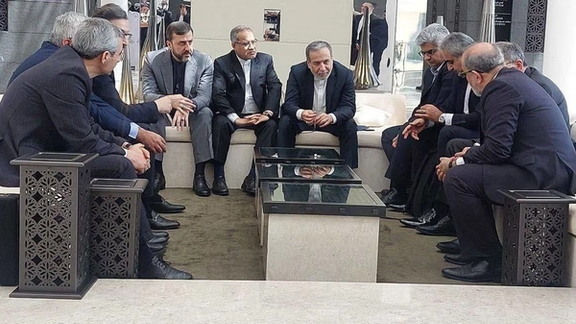
Iran's Foreign Minister Abbas Araghchi along with his deputies

Senior Iranian officials have admitted in private meetings that Washington ignored at least 15 messages from Iran seeking renewed negotiations, Iran International has learned, as Tehran scrambles to head off the reimposition of UN sanctions.

Deputy foreign minister for political affairs Majid Takht-Ravanchi told editors of Iranian print and online media in a private meeting Saturday that the White House had disregarded Tehran’s messages about resuming negotiations, according to information obtained by Iran International.

In a similar session last week, deputy foreign minister for legal affairs Kazem Gharibabadi revealed that Iran had sent messages to Washington 15 times through different channels but had received no reply.

Britain, France and Germany on Thursday triggered a 30-day process - the so-called 'snapback' mechanism - to reimpose UN sanctions on Iran over its nuclear program in a formal letter sent to the UN Security Council.

Resumption of talks with the US is one of the three preconditions set by the Europeans for delaying the snapback of UN sanctions on Iran.

During previous talks with the US brokered by Oman, Iran refused to accept limits on its uranium enrichment program. US special envoy Steve Witkoff presented proposals after several rounds, but they were all rejected as Supreme Leader Ali Khamenei insisted that enrichment inside Iran was a red line.

The Trump administration had set a 60-day deadline to secure a nuclear agreement with Iran. On day 61 or June 13, with four rounds of negotiations completed and a fifth looming, Israel launched a surprise military attack on Iran.

After the conflict, Washington declared that a deal was possible only if Iran agreed to “zero enrichment” on its soil, a condition Iranian officials continue to reject.

US in no rush for talks

President Trump told reporters in mid-July that the urgency to engage with Iran had vanished after US strikes.

“They would like to talk. I’m in no rush to talk because we obliterated their site,” Trump told reporters, implying he was content to let pressure build.

Iran's First Vice President Mohammad Reza Aref said on August 12 that Iran was ready for direct talks with the US “under the right conditions” to preserve mutual interests, but his remarks were quickly dismissed by Khamenei.

On August 24, the Supreme Leader again attacked advocates of direct negotiations, describing America’s enmity as “unsolvable.”

“Those who say, ‘Why don’t you negotiate directly with the United States and solve the issues,’ are superficial; because the reality is different," Khamenei said during a meeting with his supporters in Tehran.

"Given America’s true objective in its hostility toward Iran, these issues are unsolvable."

Most Viewed

Iran negotiators ordered to return after internal rift over Islamabad talks
1
EXCLUSIVE

Iran negotiators ordered to return after internal rift over Islamabad talks

2
ANALYSIS

US blockade enters murky phase as tankers spoof signals and buyers hesitate

3
ANALYSIS

Why the $100 billion Hormuz toll revenue is a myth

4

US tightens financial squeeze on Iran, warns banks over oil money flows

5
ANALYSIS

US blockade targets Iran oil boom amid regional disruption

Banner
Banner

Spotlight

  • Hardliners push Hormuz ‘red line’ as US blockade tests Iran’s leverage
    INSIGHT

    Hardliners push Hormuz ‘red line’ as US blockade tests Iran’s leverage

  • Ideology may be fading in Iran, but not in Kashmir's ‘Mini Iran'
    INSIGHT

    Ideology may be fading in Iran, but not in Kashmir's ‘Mini Iran'

  • War damage amounts to $3,000 per Iranian, with blockade set to add to losses
    INSIGHT

    War damage amounts to $3,000 per Iranian, with blockade set to add to losses

  • Why the $100 billion Hormuz toll revenue is a myth
    ANALYSIS

    Why the $100 billion Hormuz toll revenue is a myth

  • US blockade targets Iran oil boom amid regional disruption
    ANALYSIS

    US blockade targets Iran oil boom amid regional disruption

  • Iran's digital economy battered by prolonged blackout
    INSIGHT

    Iran's digital economy battered by prolonged blackout

  • Tehran downcast over US silence on softened nuclear stance

    Tehran downcast over US silence on softened nuclear stance

•
•
•

More Stories

Snapback and survival: sanctions gauntlet further imperils Tehran

Aug 29, 2025, 20:50 GMT+1
•
Shahram Kholdi

The sands of time fall swiftly through the glass, and with each passing day the Islamic Republic of Iran is borne closer to the fateful hour: 18 October 2025, when a 2015 nuclear deal finally expires.

What was once heralded as a diplomatic triumph—a landmark nuclear agreement that promised peace in our time—now stands battered, its legal scaffolding trembling beneath the weight of defiance, duplicity and exhaustion.

In these waning weeks, the world confronts a choice of historic consequence. Shall sanctions be restored, snapping back with the force of law? Will diplomacy, extended yet again, provide a further lease on life to a faltering compact? Or will events-military, political, or economic overtake deliberation and hurl the region into crisis?

To speak plainly: snapback is no illusion. Contrary to misreporting, there is no "30-day prerequisite" before the mechanism may be activated.

The Council requires no incubation period. Once a party files notification of "significant non-performance," the thirty-day clock begins. Unless a fresh resolution is passed, the sanctions of a bygone decade automatically return-immediately, inexorably and beyond veto.

Europe's gambit

The E3—Britain, France and Germany—have already pulled the lever. In their formal notice, they declared Iran to be in "significant non-performance" of its obligations. This, procedurally, is the point of no return.

Unless Moscow can secure nine votes for its draft, and unless Washington refrains from veto, the sanctions of yesteryear will rise again like specters.

For Europe, this is both an act of law and of frustration. Years of oscillation—inspectors expelled, enrichment concealed, commitments broken-have eroded the credibility of diplomacy.

The E3, once patient custodians of compromise, now stand as executioners of its failure.

Moscow's shield, Beijing's hedge

Earlier last week, before E3 notify the UN of their intention to "trigger the snapback à la UNSCR 2231", Russia and China had already stepped into the breach by a draft resolution to extend October 18, 2025, expiry date of UNSCR 2231.

Moscow's draft resolution, tabled before the Security Council, proposes a six-month extension of 2231 to April 2026, granting Tehran a stay of execution.

It is a tactical gambit: stall the clock, suspend deliberation and deny Europe the satisfaction of reimposed sanctions. For Russia, it is one more lever in its great game against the West, wielding Iran as both pawn and partner.

China, ever cautious, has lent its support. Beijing's foreign ministry denounces snapback and extols dialogue, yet behind closed doors its diplomats speak with candor.

If Moscow's extension fails, they admit, China may be resigned to the automatic return of sanctions. For all its rhetoric, Beijing is loath to be cast as breaker of the Council's law. In this careful hedging lies recognition: once triggered, snapback is a machine that runs of itself.

Khamenei's defiance

In Tehran, Supreme Leader Ayatollah Khamenei responded with thunder. In a speech days ago, he rejected outright the prospect of direct negotiations with the United States, branding the dispute "unsolvable."

He warned that Israel, ever the adversary, may seize the moment to again strike Iranian facilities. His words were defiance clothed as prophecy, meant to steel his people and to warn his foes.

Yet, however loud the thunder, the storm advances. Sanctions gnaw at Iran's economy. The rial buckles. Inflation devours. To millions of Iranians, Khamenei's words are less shield than sentence.

Even as the Leader railed, International Atomic Energy Agency inspectors returned to Iran for the first time in months, resuming limited work at Bushehr. It was no great opening: they were kept from Fordow, Natanz and other contested sites.

But it was something. Director General Rafael Grossi hailed the step as "an early indication of progress," though with Churchillian caution: "full cooperation," he warned, "remains a work in progress".

Iran presented the move as magnanimity; parliamentarians denounced it as betrayal. Yet the fact remains: Tehran, sensing peril, cracked open the door.

The transformation ultimatum

There is yet a more radical road. Under the hammer of snapback, with Moscow's shield broken and Beijing resigned, Khamenei may, like Khomeini before him, bow to survive.

He could proclaim a volte-face: accept spontaneous inspections anywhere in Iran; relocate enrichment to a consortium abroad—in the United Arab Emirates or Qatar—or cede it wholly to Russia.

The Leader could pledge compliance with the Financial Action Task Force and thereby grant external auditors full access to Tehran's banking system.

Khamenei might even agree to dismantle the Revolutionary Guards, curtail ballistic missiles and drones and to watch, powerless, as Lebanon advances toward the disarmament of Hezbollah and Iraq presses its own militias into submission.

Already Israeli strikes on Iran's allies in Yemen, with senior Houthi officials reported killed.

Were all this to unfold, Iran would face not mere concession, but transformation. A kleptocratic, hybrid theocracy would be stripped of its praetorian guard, its financial opacity and its regional claws.

History shows that regimes so hollowed seldom survive. This, then, would be snapback not as sanction, but as sentence.
Unite to overthrow Iran 'demon of tyranny', Nobel laureate Ebadi urges

Aug 29, 2025, 18:40 GMT+1
•
Negar Mojtahedi

Nobel Peace Prize laureate Shirin Ebadi told Eye for Iran that the Islamic Republic was not long for this world and that the Iranian people must rally together to uproot what she called a corrupt and violent system to win a brighter future.

"An overthrow must take place. I hope this overthrow will happen without a heavy price and in a short time," Ebadi said.

"To achieve that, there is no other way except for the people inside Iran to take to the streets ... It thrashes about to delay its fall, but it can't hold on for much longer. Day by day, we are moving closer to the end of the Islamic Republic."

Ebadi, 78, is an activist and lawyer who won the Nobel Peace Prize in 2003 for her human rights work, has been a longtime critic of the theocracy in power in Iran since the 1979 Islamic Revolution. She has lived in exile in London since 2009.

"The disputes that for many years they pointlessly had with each other over minor issues must be set aside, and they must form a coalition with each other and help so that an overthrow can happen," Ebadi said, referring to rifts in Iran's opposition.

"Then, at the ballot box, during the referendum, it will be determined what Iran's political system will be in the future. My message to the people has always been unity, because I know that unity is the key to our victory."

Centering human rights in talks

Iran's media and elections are tightly controlled by the conservative religious establishment, which has repeatedly deployed deadly force to quash street protests in recent decades.

Iran's adversaries are mostly concerned by Tehran's perceived military threat and disputed nuclear program.

Years of on-off negotiations ultimately failed to resolve those qualms and Israel launched a shock 12-day war on Iran in June which was capped off by US airstrikes on Iranian nuclear sites.

Still, Western powers have pressed Iran to return to negotiations aimed at definitively resolving the nuclear standoff - demands resisted by Tehran so far.

Ebadi argued that Western governments have consistently sidelined human rights in their negotiations with Iran — a failure she believes has emboldened Tehran’s crackdown on women, minorities and activists.

“Western governments, which claim to respect human rights, should raise the issue of rights violations in every negotiation and deal with the Islamic Republic’s leaders. Yet in these 46 years, we have seen the opposite,” Ebadi told Eye for Iran.

"If they deal or negotiate with a criminal government like Iran, they must also talk about human rights issues, and it must be at the top of the matters they ask the government to improve," she added.

  • Iran warns Europe against triggering 'snapback' in Geneva meeting

    Iran warns Europe against triggering 'snapback' in Geneva meeting

Repression

The cost of this approach, Ebadi argues, is borne by ordinary Iranians.

The Human Rights Activists News Agency (HRANA) reported that Iran executed at least 160 people in the past month alone, averaging one every five hours.

So far this year, at least 818 people — including 21 women — have been executed, part of what Amnesty International has called a sharp acceleration since June’s 12-day war with Israel. Citizens risk prison for even a short social media post.

  • Iran executed at least 160 people in past month, rights group says

    Iran executed at least 160 people in past month, rights group says

Iran also faces a deepening economic and environmental collapse.

Banks are effectively bankrupt, the rial continues to lose value, and water and electricity shortages have pushed millions further into poverty.

Tehran’s main reservoir, Karaj Dam, is down to just a few percent of its capacity, forcing authorities to declare public holidays in several provinces to conserve supplies.

In recent weeks, protests erupted in cities such as Sabzevar, Shahr-e Kord, and across Khuzestan province, reflecting anger in both Iran’s northeastern and southwestern regions. Demonstrators chanted, “Water, electricity, life — our basic right.”

Ebadi said the ruling system is not just ailing, but terminal.

"No way forward remains. No hope remains. All the signs show clearly that this government cannot continue," Ebadi asserted. "If we unite, hand in hand, we can achieve victory over the demon of tyranny that has coiled itself around Iran."

'No justice'

Ebadi’s own loss of faith in reform helps explain her sharp criticism of Western governments for treating nuclear talks as a substitute for real change.

Her first defining moment came in the revolution’s opening months, when Hassan Bani-Sadr — whose brother Abolhassan would become the Islamic Republic’s first president — told her to wear the veil “even if you don’t believe in it.” She shot back: “Why are you encouraging me to be a hypocrite? To lie?”

It was then, she says, that she realized what she had fought for was already turning against her.

For years she still hoped gradual reform might bring improvements. At times, negotiations with the West have opened space for private investment and modest changes in daily life — especially after a 2015 nuclear deal, when sanctions relief allowed foreign companies back into Iran and consumer goods reappeared in shops.

It was the 1999 Tehran University dormitory raid — when her legal client Ezzat Ebrahim-Nejad was killed — that convinced her reform was no longer possible.

“We expected Khatami and the reformist government to take the students’ side," said Ebadi. "But sadly, instead, many students were arrested, and no justice was served. That was when I thought, ‘There is no longer anything we can do.’”

After decades of setbacks, her message to Iranians remains one of unity. “I am not a monarchist, nor am I a republican. I am for Iran. My wish is to live in a homeland that is democratic and secular. Right now we all have one common demand: overthrow. So we must join hands to achieve it.”

You can watch the full episode of Eye for Iran on YouTube or listen on any major podcast platform like Spotify, Apple, Amazon Music and Castbox.

British couple detained in Iran taken to court without notice, family says

Aug 29, 2025, 08:44 GMT+1

A British couple detained in Iran since January were “suddenly whisked” into a courtroom in Tehran on Wednesday without prior notice or a lawyer of their choosing, according to a report by Sky News citing their family.

Lindsay and Craig Foreman, from East Sussex, were arrested during a motorcycle world tour and later charged with espionage—allegations they deny. Their son, Joe Bennett, said the couple were assigned a “state-appointed lawyer they only just met.”

“We cannot see how [this] could be considered to be a fair trial,” Bennett said, expressing alarm over the opaque process and lack of transparency.

Concerns grow over health and consular access

Craig Foreman, held at Evin Prison for the past 25 days, has no access to funds or hygiene supplies, according to his son.

The British ambassador had been scheduled to visit Craig, but the family says the meeting didn’t happen—possibly because he had already been taken to court. Meanwhile, Lindsay Foreman was seen by the ambassador and given essential items.

“The lack of transparency only deepens our concern,” said Bennett. “Craig has already lost weight, and now, with no access to food beyond the bare minimum, I can only guess at how he must be.”

Detained and tortured, source tells Iran International

In July, Iran International reported that the couple had been held in solitary confinement for months and subjected to torture by agents of Iran’s Ministry of Intelligence. A source familiar with the case said they were beaten, deprived of sleep, and threatened with execution during interrogations meant to extract confessions.

Despite these conditions, both have maintained their innocence.

Arrested in January while touring the country

The couple, both in their 50s, entered Iran from Armenia during a world motorcycle trip. They were arrested on January 4 near the city of Kerman and charged with spying. The UK government has denied the charges and repeatedly called for their release.

“We are deeply concerned by reports that two British nationals have been charged with espionage in Iran,” the Foreign Office has said. “We are providing them with consular assistance and remain in close contact with their family members.”

Detainees as bargaining chips

Iran has a long history of detaining foreign nationals—often dual citizens—in what rights groups and Western governments view as politically motivated actions aimed at securing diplomatic leverage or concessions.

Tehran has denied that its detentions are political in nature.

Iran moves to curb media reports that could fuel panic over UN sanctions

Aug 29, 2025, 08:14 GMT+1

Iran’s Ministry of Culture and Islamic Guidance has issued a confidential directive to domestic media, instructing outlets to limit coverage of the European move to trigger the UN snapback mechanism and avoid content that could cause public concern or market instability.

Confidential order restricts tone and content

The directive, sent to newsroom chiefs and editors, outlines six points aimed at controlling how the issue is reported. It calls on newsrooms to avoid “emotional,” “crisis-oriented,” or “provocative” headlines and urges editors to present the snapback as a manageable development. The stated goal is to preserve “psychological calm” in society.

Media are specifically told to refrain from publishing content that highlights economic risks, such as inflation, currency devaluation, or the potential impact on gold and foreign exchange markets. Such coverage, the ministry warns, could increase inflationary expectations or contribute to public anxiety.

Instructions call for emphasis on Iran’s resilience

Instead, the directive advises the use of regional experts and commentary that frames the snapback as a sign of European weakness or dependence on the United States. Media are encouraged to highlight Iran’s ability to withstand sanctions and emphasize the country’s “strength in facing pressure.”

The publication of reports that suggest a negative or uncertain outlook for the future is discouraged. Outlets are instructed to “avoid portraying a bleak future” and to focus instead on narratives of continuity and resistance.

Coverage of Western policy encouraged, not domestic impact

According to the directive, media should shift their focus toward criticizing Western governments and highlighting what it describes as contradictions and internal crises in Europe and the US.

The guidance advises against reporting that could fuel debate over the domestic implications of renewed UN sanctions or revive concerns over Iran’s access to oil revenues and currency reserves. No timeline was provided for how long these restrictions should remain in place.

Recent economic reporting limited after new warnings

The directive follows recent domestic reports warning that snapback sanctions could worsen inflation and further weaken the rial. Earlier this week, the Tehran Chamber of Commerce projected that the dollar could reach 1.65 million rials under pessimistic scenarios. That report was later downplayed under apparent pressure from security agencies.

As Iran International exclusively reported, members of the chamber’s international affairs team were questioned this week by the IRGC’s intelligence unit over the economic forecast, and senior officials were instructed not to speak publicly about it.

The Ministry of Culture has not officially commented on the new guidelines. Iranian state media and major news agencies have so far reported the snapback process using neutral language and limited economic analysis.

Part of broader restrictions on public discourse

The new instructions come amid heightened sensitivity within Iranian institutions over public reaction to international developments. The approach reflects a broader pattern of preemptive media control during major diplomatic or economic events.

Iranian media outlets operate under oversight from multiple government agencies, including the Ministry of Culture, the Supreme National Security Council, and intelligence bodies. Directives such as this one are typically circulated in private and not publicly acknowledged.

Iran’s rial falls further as threat of UN sanctions returns

Aug 28, 2025, 10:27 GMT+1

Iran’s currency weakened sharply on Thursday as European nations prepared to trigger the return of United Nations sanctions under the snapback mechanism, deepening economic pressure on the Islamic Republic and adding to uncertainty around its nuclear program.

The sharp drop extends a steady decline in the rial over recent weeks. Currency dealers quoted the dollar at around 1,030,000 rials on the open market, according to local reports, compared to 957,000 rials last week.

Reuters has reported that Britain, France and Germany could begin the snapback process as early as Thursday after Iran failed to resume talks or restore cooperation with the International Atomic Energy Agency. The three countries set a late August deadline earlier this month.

Markets react to snapback risk

The currency’s continued slide has heightened concerns among traders and the public, as sanctions could further restrict Iran’s access to global markets and increase pressure on imports, inflation, and employment.

Once triggered, the snapback process leads to the automatic reimposition of UN sanctions after 30 days unless the Security Council adopts a resolution to continue lifting them — a step that any permanent member can veto.

The measures would freeze Iranian overseas assets, ban arms deals with Tehran, and penalize missile development activities. They could also affect oil sales to China, one of Iran’s top customers.

Earlier this month, Iran International reported that Iran’s Intelligence Ministry has warned senior officials and companies to prepare for renewed economic disruptions. Confidential guidance cited risks of "severe currency fluctuations, reduced purchasing power, increased unemployment, layoffs, and heightened social discontent."

Business group warns of worst-case currency spike

Iran’s Chamber of Commerce this week published a report forecasting three scenarios for the economy in the event of snapback sanctions. In its most pessimistic case, the rial could fall to 1.65 million per dollar, with annual inflation reaching 90 percent by the end of the year. Economic growth was projected to remain negative under all scenarios.

Time running out

The current UN resolution allowing use of the snapback mechanism is set to expire on October 18. Russia, which will assume the rotating presidency of the UN Security Council that month, has floated proposals to extend the measure. After the resolution expires, any future effort to restore UN sanctions would likely face a veto from China or Russia.

Under the existing mechanism, any party to the 2015 nuclear deal can initiate snapback by notifying the Security Council of Iranian non-compliance. Sanctions would then be automatically reinstated after 30 days unless the Council votes to continue lifting them — a step that can be blocked by any permanent member.

In recent weeks, Iran has made only limited diplomatic efforts to prevent that outcome. Foreign Minister Abbas Araghchi said last week that talks alone were unlikely to avert further escalation, noting that negotiations had been ongoing when the June conflict with Israel erupted. “Sometimes war is inevitable,” he said in an interview with state media.

The IAEA, meanwhile, has called for inspections to resume “as soon as possible.” Inspectors were recently present to observe fuel replacement at the Bushehr nuclear reactor, operated with Russian support, but broader access to key enrichment and research sites remains suspended.