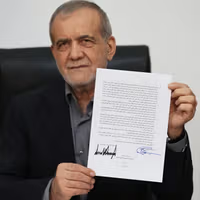
Iran's president Masoud Pezeshkian and his cabinet meeting journalists in Tehran, August 10, 2025
Tehran moderates are openly signaling readiness for a return to nuclear talks, hinting at accepting some restrictions on its activities but Washington appears unmoved.
“We stated to the (US) negotiating party that we are willing to build trust, but it seems as though they have pretended to be asleep,” Vice President Mohammad Reza Aref said on Tuesday—the clearest suggestion yet that reluctance may be coming from the United States.
“Even direct negotiations can happen,” he added, under balanced conditions. “The Islamic Republic’s approach to negotiations is in line with what the people want.”
The remarks followed Deputy Foreign Minister Majid Takhtravanchi’s statement a day earlier that Iran was prepared to limit its nuclear program if US sanctions were lifted.
There was no public response by Washington.
US Secretary of State Marco Rubio along with foreign ministers of France, Germany and Britain set an informal end-August deadline for a new nuclear deal, warning failure would mean triggering the so-called "snapback" of UN sanctions.
‘No rush’
But no response came from Washington. President Donald Trump told reporters in mid-July that the urgency to engage with Iran had vanished after US strikes in late June.
“They would like to talk. I’m in no rush to talk because we obliterated their site,” Trump told reporters mid July, implying he was content to let pressure build.
European officials have warned Tehran that unless it fully cooperates with the International Atomic Energy Agency (IAEA), the “trigger mechanism” for snapback could be activated, restoring UN sanctions this fall.
Red lines
Despite the conciliatory gestures, Iran’s red lines remain intact.
Takhtravanchi told Japan’s Kyodo News this week that Tehran would not relinquish what it called its right to uranium enrichment.
Officials also stressed that Monday’s visit by IAEA Deputy Director General Massimo Aparo was unrelated to inspections, and Tehran continues to bar IAEA chief Rafael Grossi, accusing him of complicity in the recent attacks.
Reformist daily Arman Melli called Takhtravanchi’s offer “a new prudent decision regarding the nuclear dossier,” noting Iran’s aim to avoid the trigger mechanism while securing sanctions relief to ease its deep financial crisis.
Hardline outlets, meanwhile, have expressed anger at the IAEA and the UN Security Council’s failure to condemn the strikes, and domestic critics warn that opening talks with Washington could be politically costly.
Divisions and outlook
While the Foreign Ministry and its diplomats remain cautious about re-engaging the West, the Presidential Office appears more eager to pursue direct negotiations.
Vahideh Karimi, political editor of Shargh, warned that the combination of Iran’s tentative flexibility and Washington’s hesitation could prolong the stalemate, calling Takhtravanchi’s proposal “realistic” but fragile.
She also pointed to Tehran’s missile program — repeatedly declared off-limits after the war with Israel — as a potential deal-breaker.
Others, like Ham Mihan columnist Majid Younesian, argue the balance of forces is shifting in Iran’s favor and that confrontation with the US and Europe must evolve.
“Change does not mean surrender, as hardliners claim. Not all problems need to be solved with guns, slogans, and provocations,” he wrote.
Iran's president Masoud Pezeshkian taking pictures at a meeting of his Cabinet with reporters, Tehran, Iran, August 10, 2025
Iran’s president is facing a storm of backlash after twice straying into politically fraught territory on live television, first by suggesting talks with Washington were preferable to war, then by downplaying the stakes of the Zangezur Corridor dispute.
“Do you want to fight?” he asked in an apparent address to Tehran’s hardliners. “Well, you did, but they hit us. If we rebuild the nuclear establishments, they are going to target them again. What can we do if we do not negotiate?”
Moments later, he sought to soften the remark: “Of course we will not do anything against the Supreme Leader’s will.”
But the attempted walk-back did little to blunt the reaction.
Kayhan, the hardline daily whose chief is appointed by supreme leader Ali Khamenei, called his comment a product of “ignorance.”
“Some of our officials are preoccupied by the war–negotiation dichotomy,” Kayhan wrote, even as the United States and Israel “begged Iran for a ceasefire.”
Mishap reloaded
Hours later, Pezeshkian added fuel to the fire when asked by a state TV reporter about the US-brokered Zangezur Corridor through Armenia’s Syunik region.
He said foreign minister Abbas Araghchi had assured him it had “nothing to do with Iran’s interests,” contradicting — among others — the Revolutionary Guards and Khamenei’s decade-old assertion that the project was detrimental to Armenia and that Tehran would remain firm in opposing it.
The comment was immediately seized upon by political rivals. Aladdin Boroujerdi, an influential hardline MP, and Khamenei’s chief adviser Ali Akbar Velayati had already made clear their opposition to the corridor.
By appearing unaware of that stance, Pezeshkian handed critics an opening to question his political capacity and grasp of state priorities.
Ultraconservative outlets accused him of echoing US president Donald Trump’s threats against Iran and undermining the country’s right to enrich uranium.
‘Making war more likely’
Vatan Emrooz branded his stance “withdrawal and surrender,” while Javan— affiliated with the Revolutionary Guards—criticized him for defending his positions as “coordinated with Khamenei” rather than engaging critics directly.
On social media, hardline propagandist Ali Akbar Raefipour dismissed the remarks as “fallacy, nonsense, and paradoxical.”
US-educated ultraconservative academic Foad Izadi argued that Pezeshkian’s comments made renewed strikes on Iran more likely. “US officials will think another attack on Iran will not be costly,” he posted on X.
Not all reactions were hostile, however.
Some supporters argued his remarks reflected a realistic approach in a tense period, pointing to the recent reshuffle that saw veteran conservative Ali Larijani return to Iran’s national security council as one of the two supreme leader representatives.
“Possibly, Larijani has got Khamenei’s full backing for negotiations with Washington, and Pezeshkian is trying to make the idea of negotiations less costly in the political circles inside Iran,” reformist outlet Rouydad24 quoted economist Sadegh Alhosseini as saying on Monday.
Iranian people shop at the Tehran Bazaar in Tehran, Iran, March 26, 2025
A vast majority of Iranians are dissatisfied with the government's economic policies, according to a poll by Iran's leading economic newspaper Donya-ye Eqtesad, as costs of living soar and the value of the Iranian currency slips.
“Of respondents, 89% rated their agreement with the government’s economic policies as ‘low’ or ‘very low.’ 72% expressed dissatisfaction or strong dissatisfaction with government policies,” according to the poll results published on Monday.
The poll also indicated that the economy is the top priority for 53% of respondents, while 36% prioritized foreign policy.
The poll consisted of three questions, conducted via the paper’s Telegram channel with an average of 2,130 respondents per question.
Sanctions, corruption and economic mismanagement have contributed to widespread economic hardship and market instability as Iran's currency the rial has lost over 90% of its value since US sanctions were reimposed in 2018.
Tehran faces another challenge from European countries Germany, France and the United Kingdom who may be poised to trigger United Nations sanctions per the so-called the snapback mechanism.
Snapback refers to a clause in UN Security Council Resolution 2231, which endorsed the a 2015 deal on Iran's disputed nuclear program dubbed the Joint Comprehensive Plan of Action (JCPOA).
Under Resolution 2231, any party to the accord can file a complaint accusing Iran of non-compliance. If no agreement is reached within 30 days to maintain sanctions relief, all previous UN sanctions would automatically “snap back,” including arms embargoes, cargo inspections and missile restrictions.
Iran’s Ministry of Intelligence issued secret guidance on Monday, warning ministries and major companies to prepare for the likely return of punishing United Nations sanctions, documents reviewed by Iran International show.
Iran’s state-run English-language newspaper Tehran Times reported on August 8 that Tehran and Washington may start Norway-mediated indirect talks in August, covering Iran’s nuclear program and compensation demands over its June war with Israel and the United States.
Iran’s hardliners have vowed retaliation against a US-brokered deal last week which would link two parts of Azerbaijan via a corridor through Armenia, while President Masoud Pezeshkian’s government has so far offered only a muted response.
The planned route — formally named the “Trump Route for International Peace and Prosperity” — will run through Armenia’s Syunik region, linking Azerbaijan to its Nakhchivan exclave and on to Turkey and Europe.
By bypassing Iranian territory, it undercuts Tehran’s land link between Azerbaijan and Europe and gives Washington a new foothold in the South Caucasus.
‘Graveyard for US allies’
“This passage will not become a gateway for Trump’s mercenaries — it will become their graveyard,” Ali Akbar Velayati, senior adviser to supreme leader Ali Khamenei, told the Revolutionary Guards-linked Tasnim, warning about a potential NATO presence in the region.
Ali Bagheri-Kani, a member of the Foreign Ministry’s Strategic Council, told state television Iran would not remain silent “whether Russia joined in the action or not.”
The editor of the Iranian Kayhan newspaper who is appointed by Iran's Supreme Leader labeled the Baku–Yerevan deal a betrayal.
“(Tehran) must use the levers at its disposal to confront them,” Hossein Shariatmadari wrote in an editorial.
“As a first step, it can ban the passage of US and Israeli vessels through the Strait of Hormuz.”
Cautious government line
Tehran’s official position, outlined in an August 9 Foreign Ministry statement, welcomed the peace agreement between Armenia and Azerbaijan without mentioning the Zangezur Corridor.
It warned of “any form of foreign intervention … that could undermine the security and lasting stability of the region” and reiterated support for regional initiatives such as the 3+3 mechanism with Armenia, Azerbaijan, Georgia, Iran, Turkey and Russia.
It remains the government’s only reaction so far.
Voices in-between
“If the intention is diplomacy, then things should not have reached this point in the first place,” prominent reformist journalist Ahmad Zeydabadi wrote on his Telegram channel. “But if the intention is a military solution, it is impossible to enter into conflict at every point with different parties.”
Zeydabadi also questioned claims the corridor would remove Iran’s control over the Iran–Armenia border or block access to Armenia.
Caucasus expert Ehsan Movahedian said the gap between the administration’s caution and the aggressive line put out by the supreme leader's adviser “(speaks) volumes, including why we have fallen behind in developments in the Caucasus!”
Iran should seek a role in the American consortium with 99-year development rights over the corridor, he suggested.
But economist Sadegh Alhosseini challenged the bleak takes.
“This corridor is harmful first to Armenia and then to Russia, while the damage to Iran is considerably less than to those two,” he posted on X.
“The extent of the harm has been greatly exaggerated. Not every regional development is designed for the geopolitical strangulation of Iran! Iran is not the center of the world, friends!”
Iran's Deputy Foreign Minister Kazem Gharibabadi speaking at the United Nations in New York, United States on July 23, 2025.
Iran on Monday criticized the International Atomic Energy Agency (IAEA) for what it called a failure to act over Israeli and US attacks in June after talks in Tehran with the UN nuclear watchdog’s deputy director general earlier in the day.
“The Islamic Republic expressed its objection to the failure of the agency to fulfill its responsibilities regarding the Israeli and US attack and raised its demands for correcting the agency’s improper processes,” deputy foreign minister Kazem Gharibabadi said.
Gharibabadi's remarks came following a meeting with IAEA deputy director general Massimo Aparo, who was in Tehran for a brief trip on Monday. The visit marked the highest-level meeting between the IAEA and Iran since the attacks on Iranian nuclear sites badly frayed ties.
Iran's foreign minister Abbas Araghchi had stressed earlier that the visit would not involve nuclear inspections but rather dialogue with the agency.
In June, Iran’s parliament approved a bill to suspend the country’s cooperation with the IAEA, a day after a ceasefire with Israel.
The bill, passed with 221 votes in favor, none against, and one abstention out of 223 members present, and bars the UN nuclear watchdog’s inspectors from accessing Iran’s nuclear facilities.
At the time, Iran also accused IAEA chief Rafael Grossi of bias and failing to condemn the attacks.
On July 4, Grossi said that the agency's team of inspectors had departed Iran to return to its headquarters in Vienna after the new law barred cooperation with the IAEA.
Israel launched a surprise military campaign on June 13 targeting military and nuclear sites, killing hundreds of military personnel, nuclear scientists and civilians.
Iran responded with missile strikes that killed 31 civilians and one off-duty soldier, according to official figures published by the Israeli government.
The Islamic Republic says 1,062 people were also killed by Israel during the 12-day conflict, including 786 military personnel and 276 civilians.
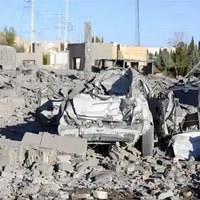
On June 22, the US carried out airstrikes on Iran’s key nuclear sites at Fordow, Natanz, and Isfahan.
The full extent of the damage remains unclear but President Donald Trump has repeatedly said that the strikes "obliterated" the country's nuclear program.
Sun setting over an offshore oil rig in the Persian Gulf
Iran’s Ministry of Intelligence issued secret guidance warning ministries and major companies to prepare for the likely return of punishing United Nations sanctions, documents reviewed by Iran International show.
The Intelligence Ministry said that the return of so-called snapback sanctions will include a ban on arms sales, freezing of assets and foreign currency accounts of companies abroad.
“Re-sanctioning of legal and natural persons active in industries such as oil, petrochemicals, banking, shipping, insurance and sensitive technologies will be activated,” the document said.
Potential fallout could roil markets and exacerbate unemployment and deepen popular discontent, the ministry added.
“Severe currency fluctuations, reduced purchasing power, increased unemployment, layoffs and heightened social discontent are to be expected,” the Intelligence Ministry said.
The snapback mechanism is part of UN Security Council Resolution 2231, which endorsed a 2015 deal over Iran's disputed nuclear program called the Joint Comprehensive Plan of Action (JCPOA).
Under Resolution 2231, any party to the accord can file a complaint accusing Iran of non-compliance. If no agreement is reached within 30 days to maintain sanctions relief, all previous UN sanctions would automatically “snap back,” including arms embargoes, cargo inspections and missile restrictions.
Iran’s Intelligence Ministry also pointed to potential alternative partners for the Islamic Republic to evade the sanctions.
“Identify alternative suppliers in countries like China, Russia, Iraq, etc., which will be less affected by sanctions,” the statement said.
The guidance also warned of renewed threats to national security including cyberattacks on critical infrastructure.
“Increased targeted cyberattacks on economic infrastructure, focusing on supply chains, automation, and financial management, as well as efforts by foreign intelligence services to infiltrate through third parties, contractors, or organizational applications, will be some of the threats,” the statement said.
France, the United Kingdom and Germany told Iran they would restore UN sanctions unless it reopened talks on its nuclear program immediately and produced concrete results by the end of August.
Iranian diplomates last met representatives of the three European countries in Istanbul on July 25.
Iran’s Foreign Ministry spokesman Esmail Baghaei described the meeting with Britain, France and Germany as a “test of realism” for the E3 powers, calling it a chance for them to correct past positions.