• العربية
  • فارسی
Brand
  • Iran Insight
  • Politics
  • Economy
  • Analysis
  • Special Report
  • Opinion
  • Podcast
  • Iran Insight
  • Politics
  • Economy
  • Analysis
  • Special Report
  • Opinion
  • Podcast
  • Theme
  • Language
    • العربية
    • فارسی
  • Iran Insight
  • Politics
  • Economy
  • Analysis
  • Special Report
  • Opinion
  • Podcast
All rights reserved for Volant Media UK Limited
volant media logo

Washington calls Iran’s war compensation demand 'ridiculous'
Aug 1, 2025, 07:56 GMT+1
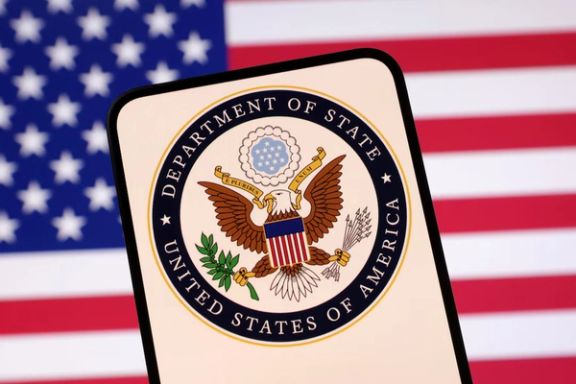
United States Department of State logo and US flag are seen in an illustration.

The United States dismissed Iran’s demand for financial compensation over the June strikes on its nuclear sites, calling it "ridiculous" and urging Tehran to end destabilizing actions.

“Any demands for financial compensation from the United States to the Iranian regime are ridiculous,” Principal Deputy Spokesperson Tommy Pigott said at a press briefing in Washington on Thursday. “If the Iranian regime really wanted to save money, they would stop funding terrorist death squads, stop oppressing their own people, and stop wasting money on a nuclear program that isolates them further.”

The comments came after Iranian Foreign Minister Abbas Araghchi told the Financial Times that Tehran would not return to nuclear negotiations unless Washington accepted responsibility for the attacks and offered compensation.

Ball is in Iran’s court, US says

Pigott said the United States remains open to diplomacy but warned that Tehran has limited time. “Iran has a short window of opportunity, but the ball is in Iran’s court,” he said. “We’re waiting to see what they do.”

Araghchi had said talks with the US could not proceed without “confidence-building measures,” including financial redress and guarantees against future strikes. He also confirmed that a third enrichment site near Isfahan was hit during the war, the first time Tehran has publicly acknowledged the attack.

Talks remain on hold as tensions linger

The United States and Israel launched strikes on Iran’s nuclear sites at Fordow, Natanz, and Isfahan days before a ceasefire in June, citing threats from Tehran’s nuclear escalation. Iran suspended cooperation with the International Atomic Energy Agency shortly after, though technical talks with the IAEA are expected in the coming weeks.

Araghchi said Iran and the US exchanged messages before, during and after the war but added that the “road to negotiation is narrow.” He also warned that any European move to restore UN sanctions under the 2015 nuclear deal would end Iran’s talks with the UK, France and Germany.

“With the Europeans, there is no reason right now to negotiate,” he said. “They cannot lift sanctions, they cannot do anything.”


Most Viewed

Iran negotiators ordered to return after internal rift over Islamabad talks
1
EXCLUSIVE

Iran negotiators ordered to return after internal rift over Islamabad talks

2
INSIGHT

Iran's digital economy battered by prolonged blackout

3
ANALYSIS

US blockade enters murky phase as tankers spoof signals and buyers hesitate

4
ANALYSIS

Why the $100 billion Hormuz toll revenue is a myth

5

US tightens financial squeeze on Iran, warns banks over oil money flows

Banner
Banner

Spotlight

  • Hardliners push Hormuz ‘red line’ as US blockade tests Iran’s leverage
    INSIGHT

    Hardliners push Hormuz ‘red line’ as US blockade tests Iran’s leverage

  • Ideology may be fading in Iran, but not in Kashmir's ‘Mini Iran'
    INSIGHT

    Ideology may be fading in Iran, but not in Kashmir's ‘Mini Iran'

  • War damage amounts to $3,000 per Iranian, with blockade set to add to losses
    INSIGHT

    War damage amounts to $3,000 per Iranian, with blockade set to add to losses

  • Why the $100 billion Hormuz toll revenue is a myth
    ANALYSIS

    Why the $100 billion Hormuz toll revenue is a myth

  • US blockade targets Iran oil boom amid regional disruption
    ANALYSIS

    US blockade targets Iran oil boom amid regional disruption

  • Iran's digital economy battered by prolonged blackout
    INSIGHT

    Iran's digital economy battered by prolonged blackout

•
•
•

More Stories

Tehran rejects Western warnings on Iranian intelligence threats as smear campaign

Aug 1, 2025, 07:15 GMT+1

Iran rejected a joint statement by the United States and thirteen allied governments that said Tehran has engaged in plots targeting individuals in Europe and North America, the Iranian foreign ministry said on Friday.

“This is a clear fabrication and a desperate move to divert attention,” Iranian foreign ministry spokesman Esmail Baghaei said in remarks carried by state media. “These baseless narratives are part of a broader Iranophobia campaign designed to justify hostile policies toward Iran.”

The US and countries including France, Germany, the United Kingdom and Canada issued a statement this week warning that Iranian intelligence services are cooperating with international criminal networks to surveil, intimidate and potentially harm journalists, activists and political figures living abroad.

In response, Baghaei said the countries involved “must be held accountable for their open support of violent and terrorist groups who have committed acts of bloodshed against the Iranian people.” He added, “Instead of answering for their illegal behavior, they resort to media campaigns based on lies.”

Western concerns grow after publicized incidents

The Western statement followed a string of recent warnings from European and US authorities. The UK’s counter terrorism police said Iran is among the most active foreign states involved in plots to harm people on British soil. Officials in London said the Islamic Republic uses criminal intermediaries and targets vulnerable individuals to carry out surveillance or attacks.

“We are increasingly seeing these three states — Iran, Russia and China — undertaking threat-to-life operations in the United Kingdom,” said Dominic Murphy, head of London’s Counter Terrorism Command, earlier this month.

Belgian lawmaker Darya Safai said this week that local police told her about a plot to abduct her via Turkey, which she linked to her calls to label Iran’s Revolutionary Guards a terrorist group.

A pattern of pressure and denials

Western governments say Iran’s operations abroad are growing more frequent and bold. A report by the UK Parliament’s Intelligence and Security Committee this month said Iran was behind at least 15 attempted assassinations or kidnappings on British soil since 2022.

Iran denies involvement in such operations and frequently calls international criticism part of a politically motivated campaign.

China continues to import Iranian oil using 'dark fleet' – CBS

Jul 31, 2025, 23:12 GMT+1

China is continuing to buy Iranian oil in defiance of US sanctions by using a clandestine maritime network known as the “dark fleet,” according to a CBS News investigation.

The report reveals how Iranian oil is transferred to ships bound for China through covert ship-to-ship transfers in international waters near Malaysia’s Riau archipelago, often with transponders turned off and identifying details concealed.

During a single day in the area, CBS recorded 12 such transfers—an unprecedented number that analysts say signals an expansion of the trade. China is believed to purchase up to 90% of Iran’s crude exports.

The report comes a day after the US Treasury announced sweeping new sanctions on what it described as a “shipping empire” allegedly controlled by Hossein Shamkhani, son of a senior adviser to Iran’s Supreme Leader.

The action, the largest of its kind since 2018, targeted more than 50 individuals and entities and identified 50 vessels.

CBS quoted former US Navy officer Charlie Brown, now an adviser to United Against Nuclear Iran, as saying the location near the Riau archipelago is the dark fleet’s “parking central.”

“As long as there’s a supply, there will be a demand for this discounted oil,” Brown said. “And both sides are willing to take the risk.”

Despite multiple rounds of US sanctions, smaller Chinese refineries—known as “teapots”—continue to buy Iranian crude.

Meanwhile, European powers are weighing whether to trigger the snapback of UN sanctions on Iran, which had been lifted under the 2015 nuclear deal.

It remains unclear how such a move would affect China’s energy trade with Iran or broader sanctions enforcement.

US sanctions Iranian national, foreign firms over drone program support

Jul 31, 2025, 20:23 GMT+1

The United States on Thursday imposed sanctions on an Iranian national and five companies in Iran, China, Hong Kong and Taiwan for allegedly supplying technology to Iran’s military drone program, the Treasury Department announced.

“Iran continues to pursue the development of asymmetric weapons capabilities, including unmanned aerial vehicles, to carry out attacks on the United States, our servicemembers and our partners and allies in the region,” said Under Secretary of the Treasury for Terrorism and Financial Intelligence John K. Hurley.

“We will continue to put America first by disrupting Tehran’s ability to further its destabilizing agenda.”

The sanctions target Javad Alizadeh Hoshyar, the CEO of Iran-based Control Afzar Tabriz Co., along with affiliated companies that the Treasury says procured sensitive manufacturing equipment for the Iran Aircraft Manufacturing Industrial Company (HESA).

HESA, a state-owned entity under Iran’s Ministry of Defense and Armed Forces Logistics (MODAFL), produces military aircraft and Ababil-series drones used by the Islamic Revolutionary Guard Corps (IRGC).

Under Hoshyar’s direction, Control Afzar Tabriz Co. allegedly acquired computer numerical control (CNC) machines and routed shipments through foreign intermediaries—including Clifton Trading in Hong Kong, Mecatron and Joemars in Taiwan, and Changzhou Joemars in China—to evade export controls and mask HESA’s involvement, according to the Treasury.

The designations follow another round of sanctions a day earlier against a global shipping and smuggling network allegedly controlled by Mohammad Hossein Shamkhani, the son of Ali Shamkhani, Iran's former national security chief and an adviser to supreme leader Ali Khamenei.

More than 50 individuals and entities were designated on Wednesday, and over 50 vessels identified, in what the US Treasury called its largest Iran-related action since 2018.

US, Europe condemn Iranian intelligence threats on Western soil

Jul 31, 2025, 16:34 GMT+1

The United States and thirteen allied countries have accused Iran of plotting to kill, kidnap and intimidate individuals in Europe and North America, citing violations of sovereignty and links to international criminal networks.

“These services are increasingly collaborating with international criminal organizations to target journalists, dissidents, Jewish citizens, and current and former officials,” the US State Department said in a joint statement with European countries.

They included the United Kingdom, Albania, Austria, Belgium, Canada, Czechia, Denmark, Finland, France, Germany, the Netherlands, Spain and Sweden.

The governments called on Iranian authorities to immediately halt the activities and pledged to work together to prevent further threats.

On Monday, a Belgian lawmaker of Iranian descent, Darya Safai said the European country's police warned her of an Iranian plot to abduct her via Turkey after she backed labeling the Revolutionary Guards a terrorist group.

Earlier this month, British counter terrorism police said Iran alongside Russia and China is behind a growing number of life-threatening operations on UK soil including assassination and kidnapping plots carried out by criminal proxies.

Additionally, the European Union sanctioned an Iran-linked network over their alleged role in assassination plots and enforced disappearances of dissidents abroad, including on European soil.

A new UK parliamentary report this week classed Iran is one of the most aggressive state actors targeting individuals in the United Kingdom.

Since January 2022, there have been at least 15 attempts at murder or kidnap against British nationals or UK-based individuals, according to a report by UK Parliament’s Intelligence and Security Committee (ISC) this month.

Iran has previously been accused of involvement in the kidnapping and killing of foreign nationals abroad.

In 2020, German-Iranian dissident Jamshid Sharmahd was kidnapped by Iranian operatives from Dubai and forcibly taken to Iran via Oman. He was sentenced to death and executed in what Amnesty called a "grossly unfair trial" in 2023.

Iran also abducted dissident journalist Rouhollah Zam from Iraq after luring him to leave Paris for the Arab country in September 2019. He was later sentenced to death and executed in Iran in 2021.


Iran steps up burning of hazardous fuels as energy crisis persists

Jul 31, 2025, 15:27 GMT+1

Iran has stepped up the toxic burning of fuel oil for power generation amid electricity shortages, local media reported Thursday, in a move which is set to further pollute air quality but may do little to ease blackouts.

Tejarat News wrote officials last summer “imposed power outages on citizens under the pretext of ending fuel oil use,” though the practice continued behind the scenes.

“Now it’s clear that mazut never left the government’s agenda—not even last year,” it added.

All major power plants ran on mazut in 2024, Saeed Tavakoli, managing director of the National Iranian Gas Company confirmed Tuesday.

“All power plants across the country used fuel oil at full capacity last year,” he told reporters.

“Despite the president’s emphasis on environmental concerns, this was one of his administration’s adopted strategies.”

“Though the president and his deputy stress environmental protection, when there is an energy imbalance in the country, fuel oil is one of the available sources. In last year’s exceptional conditions, all mazut-fired plants were operational,” Tavakoli added.

“People must now endure pollution, blackouts, and disease at the same time,” Tejarat News warned.

Sanctions, age and mismanagement have taxed Iran's energy infrastructure, and the country has long faced blackouts especially in summer months when water and electricity demand surge.

The economic daily criticized the Pezeshkian administration for what it called a retreat from earlier pledges, adding: “Officials speak of environmental protection and renewable energy, but these same officials chose one of the most harmful fuels for humans and nature last winter.”

In November 2024, the government had ordered a halt to fuel oil use in cities including Arak, Isfahan, and Karaj due to worsening air pollution. That ban has since been quietly revoked.

“The state has now paved the way again for fuel oil use,” Tejarat News said. “But even this return failed to stop the blackouts.”

“Fuel oil burning is no longer an emergency fix—it is now a systematic, institutionalized policy that symbolizes the collapse of energy planning and the state’s neglect of public health and the environment,” it added.