• العربية
  • فارسی
Brand
  • Iran Insight
  • Politics
  • Economy
  • Analysis
  • Special Report
  • Opinion
  • Podcast
  • Iran Insight
  • Politics
  • Economy
  • Analysis
  • Special Report
  • Opinion
  • Podcast
  • Theme
  • Language
    • العربية
    • فارسی
  • Iran Insight
  • Politics
  • Economy
  • Analysis
  • Special Report
  • Opinion
  • Podcast
All rights reserved for Volant Media UK Limited
volant media logo
VOICES FROM IRAN

Iranians feel the pain as medicine market reels from economic pressure
Jul 30, 2025, 15:53 GMT+1Updated: 05:54 GMT+0
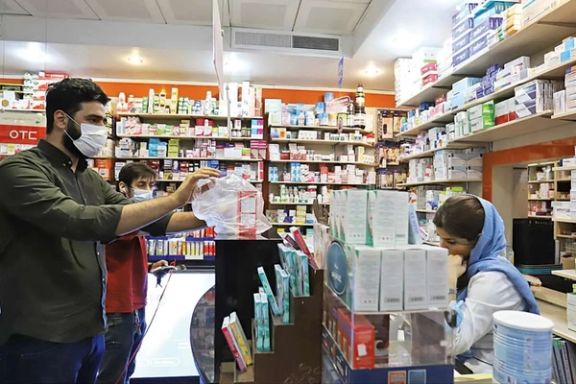
A man takes his medicine at the till of a pharmacy in Tehran

Shortages and price hikes have gripped Iran's medicine market, deepening frustration and confusion among Iranians seeking drugs, hygiene products and basic medical procedures.

In an open submission hotline to Iran International, people inside the country shared their experiences of hardship.

“I wish I could talk in depth about medicine prices, but since there’s no medicine to find, any such talk is useless,” one respondent said.

Another highlighted the difficulties women face in the market for hygiene products and supplements.

“Menstrual pads are hard to find, and prices are very high. A pack of magnesium pills for strengthening hair, nails and skin, even an Iranian brand, costs 570,000 tomans ($13),” she said.

'More hellish by the day'

Water and electricity shortages and outages have hit Iran in recent weeks, hitting daily life and harming health services.

“Iran’s medicine and treatment situation is a disaster as big as water shortages and other crises. Overall, Iran is becoming more hellish daily in every way,” another message said.

Some respondents said they were bypassing Iran’s market to get medicine from abroad.

“I bought thyroid pills for myself from Turkey for a year. The money I paid at the free exchange rate equals buying pills in Iran for 4 months. Plus, the ones from Turkey are genuine German, while those in Iran are terrible, have no effect, and expire in two to three months," one contributor said.

“It’s been days without medicine," another said. "I have no money. Borrowed today, got half—infinitely expensive. I don’t know what to do.”

Hard to afford

Some responses indicate that with rising prices, insurance companies are dropping coverage.

“Last year, a respiratory spray cost 500,000 tomans ($ 6), and insurance covered 85%. Now it’s 3 million tomans ($ 71 ), and insurance doesn’t cover it anymore," one said through a message.

"The asthma spray I used to get with insurance for 100,000 tomans a few months ago. Yesterday, one oral spray 400,000 ($ 9),"another respondent added.

The increasing prominence of the black market and the inflow of expired medicines with no quality control was also an oft-cited concern.

“Drug prices have broken the backs of people, especially the middle, lower-middle, and poor classes," a respondent said. "Meds are either unaffordable or expensive, unavailable, or, if found, are either expired or fake, especially in the black market where addicts, thieves, and dealers sell.”

Iranians, including children, dependent on medicines now face steep price hikes.

“I used to buy my kid’s medicine for 450,000 tomans ($ 10); now it’s 870,000 tomans ($ 20),” one said.

"I have diabetes. In the last five months, insulin was distributed only once," a respondent said. "It can't be obtained from the market at all, even at ten times the cost."

Most Viewed

Iran negotiators ordered to return after internal rift over Islamabad talks
1
EXCLUSIVE

Iran negotiators ordered to return after internal rift over Islamabad talks

2
ANALYSIS

US blockade enters murky phase as tankers spoof signals and buyers hesitate

3
ANALYSIS

Why the $100 billion Hormuz toll revenue is a myth

4

US tightens financial squeeze on Iran, warns banks over oil money flows

5
ANALYSIS

US blockade targets Iran oil boom amid regional disruption

Banner
Banner

Spotlight

  • Hardliners push Hormuz ‘red line’ as US blockade tests Iran’s leverage
    INSIGHT

    Hardliners push Hormuz ‘red line’ as US blockade tests Iran’s leverage

  • Ideology may be fading in Iran, but not in Kashmir's ‘Mini Iran'
    INSIGHT

    Ideology may be fading in Iran, but not in Kashmir's ‘Mini Iran'

  • War damage amounts to $3,000 per Iranian, with blockade set to add to losses
    INSIGHT

    War damage amounts to $3,000 per Iranian, with blockade set to add to losses

  • Why the $100 billion Hormuz toll revenue is a myth
    ANALYSIS

    Why the $100 billion Hormuz toll revenue is a myth

  • US blockade targets Iran oil boom amid regional disruption
    ANALYSIS

    US blockade targets Iran oil boom amid regional disruption

  • Iran's digital economy battered by prolonged blackout
    INSIGHT

    Iran's digital economy battered by prolonged blackout

•
•
•

More Stories

Iran sees steep bread price hikes as inflation bites

Jul 30, 2025, 12:10 GMT+1

Bread prices have surged nationwide in Iran, with Tehran registering hikes of up to 50 percent, state media reported Wednesday, as inflation continues to squeeze household budgets and frustrate bakers.

In the capital, the price of Barbari—a widely consumed semi-flat bread—rose 31 percent to 46,000 rials (about $0.05), while the popular flat bread Taftoon jumped 52 percent to 20,000 rials ($0.02), and Lavash climbed 39 percent to 15,500 rials ($0.017).

Sangak, another staple, was set at 76,000 rials ($0.085), with a 20,000 rial ($0.022) surcharge for sesame toppings.

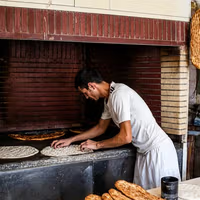
A Barbari bakery in Iran (Undated)
100%
A Barbari bakery in Iran

“The price of Barbari should have increased by at least 52 percent,” said Amir Karamlou, spokesman for Tehran’s traditional bakers’ union, adding that the current hike in the capital falls short of what was approved for other provincial capitals.

Reports from IRGC-linked Fars News highlighted a growing gap between official rates and prices charged by bakeries, which, while struggling to make ends meet, are keeping prices higher than those stipulated by the government.

The hike follows protests in recent months by bakers over cuts to subsidized flour. Some told Iran International they had already been forced to sell Sangak at 100,000 to 200,000 rials ($0.11- $0.22), citing flour shortages and black-market pricing.

Meanwhile, some provinces have yet to formally implement the government's increases, Mehr News reported, citing disputes over pricing authority and scope.

A Taftoon Bakery in Iran (Undated)
100%
A Taftoon Bakery in Iran

However, with the minimum monthly wage now worth just $120, well below the estimated $400 needed for basic living, the pressure on consumers continues to mount.

At least one third of the country now lives below the poverty line as the country's floundering economy continues to make life in the country ever more difficult.

Iran’s year-on-year inflation rate rose to 41.2% in July, marking the highest level in two years, according to the country’s Statistical Center. The 41.2% figure means households paid over 40% more for the same basket of goods and services compared to July last year.

The figure reflects an increase from 39.4% in June and comes amid a broader surge in prices for essential goods and food items.

The latest consumer price index report, released this week, showed that annual, monthly, and point-to-point inflation all climbed in the fourth month of the Iranian calendar year,which ended on July 22.

Tehran’s Karaj reservoir at lowest in 64 years as water outages worsen

Jul 30, 2025, 11:30 GMT+1

Karaj Dam, which supplies around 25% of Tehran’s drinking water, has dropped to its lowest level in 64 years, exacerbating widespread water outages across the Iranian capital.

Residents in various districts describe inconsistent access, with high-rise buildings experiencing more severe cuts.

Authorities have advised installing pumps and storage tanks, but many complain water pressure is too low to make them effective. Power cuts also complicate the situation.


  • ‘Failure at every level’: Iranians pan weekly holiday plan amid energy crisis

    ‘Failure at every level’: Iranians pan weekly holiday plan amid energy crisis

  • No light, no water, no plan: you cry if you don't laugh in Iran's summer

    No light, no water, no plan: you cry if you don't laugh in Iran's summer

Field observations by Shargh newspaper show that Karaj Dam, normally holding up to 180 million cubic meters, now stores only around 60 million — one-third of its capacity. Of that, only a fraction is usable, as sediment and “dead water” account for an estimated 15% of the volume. Dam managers confirm a 45-meter drop in reservoir height from full capacity.

Mohammad Ali Moallem, the director of Karaj Dam, told Shargh that the reservoir has dropped to its lowest level in 64 years.

Authorities attribute the crisis to reduced rainfall, with Tehran province receiving just 185 mm this year — placing it among the top five water-stressed regions in the country.

Officials in Tehran blame drought and public overuse for Iran’s worst water shortage in living memory.

National figures show just 9.5% of Iran’s water goes to households and commerce, while agriculture consumes 86.5%, often with inefficient practices and low economic returns. Internal migration and aging infrastructure have further strained Tehran’s water system, making it the second most water-poor province after Sistan-Baluchistan.

In the capital Tehran, officials have attempted to curb consumption through emergency measures, including repeated water and electricity outages and temporary office closures on certain days.

An Iranian government plan to close workplaces and schools one day a week in response to worsening electricity and water shortages has sparked widespread criticism, with many citizens warning it will only deepen daily hardships.

The Islamic Revolutionary Guard Corps (IRGC) has built over 60 dams in recent decades. More than half are now empty, with hydropower generation operating at just one-third of its nominal capacity.

The United States on Tuesday criticized Iran’s leadership over the ongoing nationwide crisis.

Tehran moderates urge US talks to avert collapse, hardliners cry betrayal

Jul 29, 2025, 22:03 GMT+1
•
Behrouz Turani

A reformist call for renewed talks with the United States as a way out of Iran’s post-war troubles has laid bare deep divisions within the Islamic Republic, with hardliners accusing the letter’s authors of treason and appeasement.

In their public letter to President Masoud Pezeshkian, published July 28 in multiple outlets, the Reform Front warned that the ceasefire with Israel is fragile and a return of UN sanctions is imminent, urging a fundamental rethink of foreign policy.

“A comprehensive development strategy instead of a strategy of survival and confrontation requires negotiations with the United States and European governments to resolve mutual issues, lift sanctions, and obtain necessary security guarantees,” the letter read.

It warned that unless such a path is taken, Iran faces either a renewed war that would devastate the country’s vital infrastructure, or a prolonged state of neither war nor peace, marked by total isolation that would erode the Iran's capacity to function.

“Minor and piecemeal reforms will not solve the country’s problems,” the authors said. “Today, the nation needs bold and difficult choices.”

Mounting hardship, muted leadership

The call comes amid growing economic hardship, with chronic water and electricity outages fueling public anger and hampering an already strained economy.

The Reform Front accused Pezeshkian of failing to stand up to hardliner overreach, including the recent act of parliament requiring the administration to suspend cooperation with the International Atomic Energy Agency (IAEA).

“The president has remained silent in the face of a war-mongering foreign policy and the state broadcaster’s continuous attacks against his own government,” they wrote.

Hardline backlash was swift and scathing.

‘Discredited losers’

Javan, affiliated with the Revolutionary Guards, called the letter an echo of demands by the Islamic Republic’s opposition. Conservative commentator and former Javan chief Abdollah Ganji rejected the moderates’ advice as “a call for surrender” in daily Hamshahri.

But the harshest attack—as usual—came from Kayhan, whose editor-in-chief is appointed by Supreme Leader Ali Khamenei.

“What’s striking is that they don’t dare say … what exactly should be done now for these discredited political losers to consider it a ‘revision of policies’ or a ‘correct decision,’” read a Monday editorial.

“Should we hand over our defensive deterrent? Completely shut down the nuclear program? Release the arrested spies and traitors so they can commit more acts of treason?"

"If the CIA and Mossad had commissioned people to translate their unmet demands into Persian, would it have looked any different from this letter?” the editorial asked.

Iran using phone service cuts to silence dissent, users say

Jul 29, 2025, 21:53 GMT+1

Iranian social media users have reported facing disconnection of their phone SIM cards and receiving what appear to be official conditions for regaining access including posting praise of the ruling system on social media.

Some users said that when requesting reasons for losing services from providers, they were advised to contact the Islamic Revolutionary Guard Corps Cyber Command or the Cybercrime Prosecution Office of the General Prosecutor's Office.

Upon contacting the offices, users received written instructions to verify their identity, sign a pledge not to criticize the state and post twenty messages of praise for the Islamic Republic on social media, Human Rights Activists News Agency (HRANA) reported on Tuesday.

The disconnection of SIM card services was implemented without prior warning or judicial order, it added.

One user shared a message from the Prosecutor’s Office identifying the service disruption and required actions.

“Your hostile and malicious activities on social media, contrary to the country's laws and interests, have been monitored and identified by the intelligent AI systems of the prosecutor's office. Accordingly, your internet account and SIM card services have been restricted or blocked,” the message to users read.

“To lift the restrictions and blocks, you are required to write the following pledge on a piece of paper, sign it, and provide your fingerprint. Additionally, you must publish at least twenty posts with positive content supporting the Islamic Republic of Iran on social media. These posts must not be shared simultaneously,” the message adds.

The pledge says that the "offending" individual accepts they will face legal prosecution if they repeat "malicious" activities, adding that all activities of such users will be under “constant AI monitoring,” HRANA said.

The report indicated the phenomenon was not new but appears to be becoming more widespread.

“They disconnect SIM cards with no due process, then force people to sign the pledge and remove content they don’t like," Iranian lawyer Mohsen Borhani warned this month on X. "Sadly, this is all illegal, but it’s becoming a common practice."

US blames Tehran for deepening Iran water crisis

Jul 29, 2025, 17:15 GMT+1

The United States on Tuesday criticized Iran’s leadership over the ongoing nationwide water crisis, which have affected millions across the country, blaming it on mismanagement, corruption and neglect.

"Days without water in the scorching heat of July. There's no access to water for drinking, bathing, washing or cooling homes," the US State Department said in a post on its Persian X account, referring to the ongoing water crisis in Iran.

"The people of Iran continue to suffer the real consequences of the regime's greed, corruption, and mismanagement of water resources," the State Department said in the post accompanied by an image captioned, "Iranian people deserve better than this."

Officials in Tehran blame drought and public overuse for Iran’s worst water shortage in living memory.

Despite a UN “red warning” 25 years ago, Iran expanded hydropower rather than wastewater treatment. 80% of untreated wastewater is dumped into rivers, deserts and underground wells, contaminating key water sources.

Amid an unprecedented heatwave in Iran, many natural and engineered water reservoirs across the country particularly in Tehran, Alborz and Fars provinces are nearly depleted.

In the capital Tehran, officials have attempted to curb consumption through emergency measures, including repeated water and electricity outages and temporary office closures on certain days.

The Islamic Revolutionary Guard Corps (IRGC) has built over 60 dams in recent decades. More than half are now empty, with hydropower generation operating at just one-third of its nominal capacity.