• العربية
  • فارسی
Brand
  • Iran Insight
  • Politics
  • Economy
  • Analysis
  • Special Report
  • Opinion
  • Podcast
  • Iran Insight
  • Politics
  • Economy
  • Analysis
  • Special Report
  • Opinion
  • Podcast
  • Theme
  • Language
    • العربية
    • فارسی
  • Iran Insight
  • Politics
  • Economy
  • Analysis
  • Special Report
  • Opinion
  • Podcast
All rights reserved for Volant Media UK Limited
volant media logo

Iranian bakers hold nationwide protests amid blackouts, soaring costs

May 17, 2025, 19:58 GMT+1Updated: 08:13 GMT+0
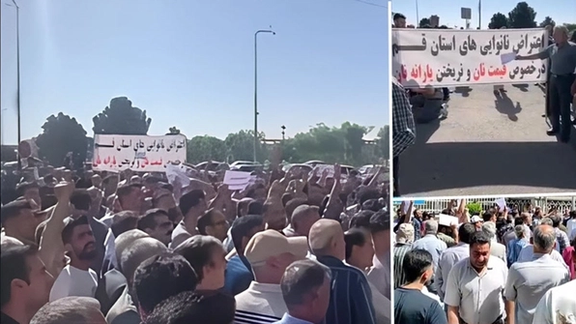
Image shared on social media shows bakers protest in Qom, Mashhad, and Isfahan on May 17, 2025.

Bakery workers staged coordinated protests across multiple Iranian cities on Saturday, calling for urgent government intervention amid soaring operational costs and unpaid subsidies.

Demonstrations were reported in Isfahan, Ahvaz, Birjand, Kermanshah, Qom, Shahinshahr and Mashhad, where bakers voiced frustration over the economic strain threatening their businesses and livelihoods.

Protesters held banners reading, “We are bakers, not slaves. Hear our voice,” and chanted, “Enough with the promises, our tables are empty.”

Footage verified by Iran International showed bakers in Mashhad returning their card readers in protest. In Qom, one baker said he had ceased baking for days, citing nearly a month of uncompensated labor: “I worked 27 days for nothing. The old saying goes, whether it’s a donkey or a fool, it’s still working.”

Bakers cite the failure of the government’s integrated system, delays in promised subsidies under President Masoud Pezeshkian’s administration, and steep rises in fuel, insurance, and raw material costs.

Some complained of repeated power outages that destroyed large batches of dough. One video showed a baker smearing spoiled dough on his face in protest over the blackouts.

The protests follow weeks of similar actions outside governorate and municipal offices. In several rallies, demonstrators chanted for the resignation of what they called “incompetent officials.”

On May 7, Gilan governor Hadi Haghshenas acknowledged that current bread prices were unsustainable for producers. “Given the increase in labor wages and utility costs, a price adjustment is reasonable,” he said, adding that a working group would soon finalize a decision on revised rates.

The unrest underscores deepening tensions over basic commodities in Iran, where inflation and subsidy mismanagement continue to fuel economic discontent. Bakers say that without immediate relief, Iran’s most essential staple may soon be priced—or simply unavailable—beyond the reach of ordinary households.

Most Viewed

Iran negotiators ordered to return after internal rift over Islamabad talks
1
EXCLUSIVE

Iran negotiators ordered to return after internal rift over Islamabad talks

2
ANALYSIS

US blockade enters murky phase as tankers spoof signals and buyers hesitate

3
ANALYSIS

Why the $100 billion Hormuz toll revenue is a myth

4

US tightens financial squeeze on Iran, warns banks over oil money flows

5
ANALYSIS

US blockade targets Iran oil boom amid regional disruption

Banner
Banner

Spotlight

  • Hardliners push Hormuz ‘red line’ as US blockade tests Iran’s leverage
    INSIGHT

    Hardliners push Hormuz ‘red line’ as US blockade tests Iran’s leverage

  • Ideology may be fading in Iran, but not in Kashmir's ‘Mini Iran'
    INSIGHT

    Ideology may be fading in Iran, but not in Kashmir's ‘Mini Iran'

  • War damage amounts to $3,000 per Iranian, with blockade set to add to losses
    INSIGHT

    War damage amounts to $3,000 per Iranian, with blockade set to add to losses

  • Why the $100 billion Hormuz toll revenue is a myth
    ANALYSIS

    Why the $100 billion Hormuz toll revenue is a myth

  • US blockade targets Iran oil boom amid regional disruption
    ANALYSIS

    US blockade targets Iran oil boom amid regional disruption

  • Iran's digital economy battered by prolonged blackout
    INSIGHT

    Iran's digital economy battered by prolonged blackout

•
•
•

More Stories

Iran hijab policy mutates with citizen policing, electronic enforcement

May 17, 2025, 18:18 GMT+1
•
Negar Mojtahedi

Hjiab enforcement in Iran is evolving in strange new ways, Gissou Nia, an international human rights lawyer and director of the Strategic Litigation Project at the Atlantic Council think tank, told the Eye of Iran podcast.

Even after a stringent new bill on the subject stalled in parliament last year, authorities are looking for age-old and high-tech ways to police women's appearance.

The law was delayed due to significant public opposition and the authorities' likely reluctance to confront more protests like the nationwide Woman, Life, Freedom movement in 2022 which it suppressed using deadly force.

But far from being thwarted, the theocracy's enforcement apparatus is evolving in subtle but palpable ways.

An official push for citizen-led policing is empowering individuals to report on women deemed in violation of the state's morality codes. The law envisions business owners facing heavy fines or even closure if patrons of their establishments are reported and found non-compliant.

"That's economically prohibitive, especially in an environment where the economy is doing so poorly due to mismanagement, corruption, global isolation from the financial system and all things," Nia said.

"It really weaponizes people against one another. And it does it around financial incentives, which is very destructive because people need to live," she added. "It's very sinister when people are turned against one another and that really decays the fabric of a society."

The tattling has moved into cutting-edge technology, Nia added, with people being able to report women not wearing hijab inside their cars via an app.

"The other thing that was happening with cars is that there was an app that the regime put out and basically you could report if you saw a hijabless woman in a car," Nia said. "In terms of tech, nobody wants Big Brother watching them."

The official Nazer, or watcher, app allows people who are generally already registered as collaborating with the police or paramilitary basij forces to register and report alleged morality transgressions.

Nuclear deal, women's rights

Protesters and backers of Iran's 2022 protests remain skeptical about the prospect of a nuclear deal between Tehran and Washington, Nia said.

"When we see the victims and survivors of Woman Life Freedom - people who paid the ultimate price to really exercise their rights on the streets, many of them are not keen on the deal."

"They very explicitly believe that this is the wrong direction, that this will extend a lifeline to the regime, and they're wondering why they made those sacrifices," she added.

The standoff over Iran's disputed nuclear program has long usurped the human rights situation in the country in the minds of foreign governments and news organizations, Nia lamented, pushing the prospect of meaningful change ever farther away.

"Once the sort of headiness of the Woman Life Freedom Movement and the desire of governments to engage faded after a three-month intense period, six months total ... then there wasn't a view towards a long-term strategy," she said.

"The attention economy is tight."
Iran confirms singer’s death sentence, hints at possible reversal amid outcry

May 17, 2025, 17:47 GMT+1

Iran’s judiciary has upheld the death sentence of underground singer Amir Hossein Maghsoudloo, known as Tataloo, while confirming that formal appeals are under review and could delay or halt the execution.

Judiciary spokesman Asghar Jahangir said on Saturday that the Supreme Court has validated the ruling for insulting the Prophet of Islam, making it executable.

“Given the petitions filed by defense lawyers, including a request for clemency and repentance, the sentence may be suspended pending review,” he said.

Following backlash from social media users and celebrities over his death sentence, Iran's Judiciary chief agreed to review the death sentence against the controversial underground singer under Article 477, which allows for a case to be reexamined if the verdict contradicts Islamic law, Tataloo's lawyer Majid Naghshi told Fars News Agency.

“It’s a one-time legal procedure,” Naghshi said. “This is a step forward, though no final decision has been issued.”

Tataloo was initially acquitted of blasphemy charges, but a Tehran prosecutor challenged the verdict. A parallel court issued the death sentence after a retrial, and the Supreme Court later confirmed it.

Tataloo is simultaneously serving a 10-year sentence for “encouraging corruption and vice” in Tehran’s Fashafuyeh prison. According to judiciary-linked outlets, the charges stem from his social media activity, which allegedly promoted immoral behavior, gambling, and sexual content.

The 37-year-old artist was once courted by state-linked figures: he performed a pro-nuclear anthem in 2015 and appeared alongside presidential candidate Ebrahim Raisi in 2017.

However, he was later cast out as a corrupting influence. He relocated to Istanbul in 2018, where his online conduct drew criticism, including posts inviting underage girls to join a “Sultan’s Palace.” Instagram removed his account in 2019 for misogynistic content and promoting child marriage.

He was arrested by Turkish police in December 2023 after Iran’s consulate in Istanbul accused him of harassment. He was later extradited and detained at the Bazargan border.

Tataloo’s case has galvanized a wide range of Iranian public figures. Rapper Toomaj Salehi, footballer Mehdi Taremi, actress Sahar Ghoreishi and bodybuilder Hadi Choopan all condemned the sentence.

His legal team maintains that the execution order followed “extralegal severity” and that the original acquittal was improperly reversed. The final ruling now hinges on whether the judiciary finds the current sentence incompatible with Sharia.

No light, no water, no plan: you cry if you don't laugh in Iran's summer

May 17, 2025, 11:55 GMT+1
•
Tehran Insider

My sister sent me a satirical video last night: someone joking that instead of adjusting the clocks for daylight saving, Iran's government is dragging 85 million people back and forth. It hit a nerve.

She and her husband both work in the public sector. They now have to work from 6 a.m. to 1 p.m. as the government forces offices to shut down during peak heat hours to curb electricity use.“The people making these decisions think everyone owns a car or can afford rideshare every day,” she said. “Most of us rely on buses. Not everyone lives within 30 minutes of work. For us, the commute is at least an hour. It’s exhausting.”

To be at work by 6, they wake at 4:30. The metro is too far, so they rely on buses, which now begin service only slightly earlier—at 5:30 a.m. Their children’s school hasn’t changed its start time to match, and nurseries don’t open before 7:30, leaving working parents stuck in the dark—literally and figuratively.

From 1991 to 2022, Iran observed daylight saving time. But then the conservative-led parliament repealed the law, claiming it caused confusion and disrupted the economy. The government tried to reverse course with an urgent bill, but parliament blocked it.So we are stuck with fixed clocks—just as we are with the incompetent bunch ruling, and ruining, our country.

Blackouts are now a daily affair. They’ve hit businesses, factories, homes—even as the Supreme Leader declared this the “Year of Investment for Production.”Images of producers burning heaps of spoiled eggs due to outages have gone viral, along with photos of diesel generators lined up outside homes and shops.

“You cry if you don’t laugh,” my sister says. “Most people who post or see these images on social media are raging inside.”

The minor schedule tweaks in cities like Tehran haven’t helped much, and conditions are even worse in smaller towns. Many schools still refuse to shift their hours, creating logistical nightmares for parents juggling long commutes and childcare.

Then there’s the water crisis.We live in a four-story building where water pressure has dropped so much that the upper floors barely receive any.Officials now warn that by summer 2025, apartments above the second floor will face complete water cuts unless they install electric pumps. But with power outages so frequent, even that solution is flawed.

In practice, this means residents on lower floors get by, while those higher up are left dry. Once again, the burden has shifted to the public.

More than 40 cities across Iran are under water stress, according to official figures. Millions are affected—and occasionally insulted by clerics pontificating about the link between drought and sin.

“The government can’t be blamed for lack of rain,” my brother-in-law interjects as he walks past the sofa my sister and I are slumped on.

“To be fair, it can’t be blamed for worn-out infrastructure either, or for sanctions, or the failure to coordinate and communicate basic schedules. It has just one job: to make your lives miserable. And that it’s performed to perfection if your faces lit by your phones’ glow are any measure.”

Khamenei says US pushing failed regional model, calls Trump’s rhetoric ‘shameful’

May 17, 2025, 10:47 GMT+1

Iran’s Supreme Leader Ali Khamenei on Saturday accused the United States of trying to impose a failed regional order based on Arab dependence on American military support, warning that it would not last.

“This failed model, where Arab states are told they can’t survive ten days without US support, is being imposed again,” Khamenei said. “But it will collapse, and America will leave this region.”

Khamenei said Washington was promoting a security structure that keeps regional countries reliant on foreign protection. “The US wants these countries unable to function without it — that’s the message in their behavior and their proposals,” he said.

He also accused the United States of fueling instability and violence. “The US has used its power to massacre in Gaza, to stoke war wherever possible, and to arm its mercenaries,” he said, describing Israel as “a malignant cancer that must and will be uprooted.”

Khamenei says Trump’s rhetoric ‘shames America’

Khamenei also condemned US President Donald Trump’s remarks during his recent visit to the region.

“Some of what the US president said during this trip doesn’t even merit a reply,” he said in a meeting with teachers in Tehran. “The level of discourse is so low it brings shame to the speaker and to the American nation.”

Trump, during a regional tour that included Saudi Arabia, the United Arab Emirates and Qatar, called for a tougher nuclear agreement with Iran and accused its leadership of spreading instability.

Speaking Tuesday in Riyadh, he said, “The biggest and most destructive of these forces is the regime in Iran, which has caused unthinkable suffering in Syria, Lebanon, Gaza, Iraq, Yemen and beyond.”

Trump also mocked Iran’s economic and environmental problems, contrasting its decline with the development of its Persian Gulf neighbors.

“While you have been constructing the world's tallest skyscrapers in Jeddah and Dubai, Tehran's 1979 landmarks are collapsing into rubble,” he said. “[Iran’s] corrupt water mafia… causes droughts and empty riverbeds. They get rich.”

Iran says it seeks dialogue but will not yield on nuclear rights

May 17, 2025, 09:58 GMT+1

Iranian President Masoud Pezeshkian said on Saturday that Iran is open to negotiations but will not retreat in the face of threats, while Foreign Minister Abbas Araghchi ruled out any compromise over enriching uranium.

“We are not seeking war. We believe in negotiations and dialogue,” Pezeshkian said at a military ceremony in Tehran. “But we are not afraid of threats and we will never retreat from our legal rights.”

Pezeshkian criticized US President Donald Trump for sending what he called contradictory messages. “He talks of peace while threatening us with advanced weapons. No one but him believes these contradictions,” Pezeshkian said.

The president added that Iran would stand firm. “They assassinate our scientists and accuse us of terrorism. But we are the victims of terror,” he said. “They should not expect us to give up our military and nuclear achievements under pressure.”

Separately, Foreign Minister Abbas Araghchi said Iran remains committed to peaceful nuclear development under the Non-Proliferation Treaty but will not negotiate away its right to enrichment.

“Iran is ready to build trust about the peaceful nature of its program, but cannot compromise on the legal and inalienable right to enrichment,” Araghchi said at a meeting with the Pugwash Conferences on Science and World Affairs. He added that Iran had “paid a heavy price” to preserve this right and would not accept restrictions as a long-standing NPT signatory.

Araghchi also criticized what he called inconsistent messages from US officials, saying they had complicated negotiations and undermined trust. “The Americans change their positions frequently and face pressure from war-driven lobbies,” he said. “This is their internal issue, but Iran will stay focused on its lawful and principled position.”