• العربية
  • فارسی
Brand
  • Iran Insight
  • Politics
  • Economy
  • Analysis
  • Special Report
  • Opinion
  • Podcast
  • Iran Insight
  • Politics
  • Economy
  • Analysis
  • Special Report
  • Opinion
  • Podcast
  • Theme
  • Language
    • العربية
    • فارسی
  • Iran Insight
  • Politics
  • Economy
  • Analysis
  • Special Report
  • Opinion
  • Podcast
All rights reserved for Volant Media UK Limited
volant media logo

Iran did not remove 60% enriched uranium from struck nuclear sites - Reuters

Jul 10, 2025, 08:57 GMT+1Updated: 07:52 GMT+0
A satellite view shows an overview of Fordow underground complex, after the US struck the underground nuclear facility, near Qom, Iran June 22, 2025.

Iran did not move its highly enriched uranium stockpile before US airstrikes last month hit its key nuclear sites at Fordo, Natanz, and Isfahan, an Israeli official told Reuters.

A senior Israeli official told Reuters the stockpile — estimated at 400 kilograms enriched to 60 percent — “was not removed and has not been moved since,” suggesting Iran made no attempt to safeguard the material before or after the strikes.

The official, who was not named, added that Iran may still be able to access the stockpile at Isfahan, but moving it would be very difficult.

“The Iranians might still be able to gain access to Isfahan but it would be hard to remove any of the material there,” wrote Reuters, citing the official.

The International Atomic Energy Agency (IAEA) had assessed before the war that most of the 60 percent enriched uranium was being stored at the Isfahan site.

Satellite imagery taken before US strikes on three key Iranian nuclear sites showed “unusual” activity near the entrance to Iran’s Fordow enrichment facility.16 cargo trucks were seen Thursday on the access road to the tunnel entrance, but by Friday most had relocated to an area about one kilometer northwest, Maxar Technologies said.

International Atomic Energy Agency (IAEA) inspectors have not publicly confirmed the condition of the stockpile since the strikes, and Iran has not allowed independent verification of the facilities since the war began.

The IAEA said on Friday that its team of inspectors had safely departed Iran to return to its headquarters in Vienna, after a new law barred cooperation with the UN body.

Tehran has accused the IAEA of sharing sensitive data with Israel and the US, and of failing to condemn last month’s airstrikes on Iranian nuclear sites.

While Iran has denied ending cooperation entirely, Foreign Minister Abbas Araghchi said coordination with the agency would now be managed through Iran’s Supreme National Security Council.

Israel must prevent Iran from restoring its prewar capabilities, Israeli Defense Minister Israel Katz said on Wednesday.

“We need to formulate an enforcement program to prevent Iran from reviving the capabilities it had before,” Katz said. “The Iranians will try in every possible way to learn their lessons and recover. The enemy is learning and preparing — and our challenge is to step up our abilities so that we are not taken by surprise.”

US President Donald Trump says the airstrikes obliterated the sites, but nuclear experts have expressed caution over the full extent of the damage, raising the possibility that some nuclear assets may have been hidden.

France’s top intelligence official, Nicolas Lerner, said Tuesday that the strikes had “very seriously affected” all stages of Iran’s nuclear program but acknowledged, a small part of Iran’s highly-enriched uranium stockpile had been destroyed, but the rest remained in the hands of the authorities.

"Today we have indications (on where it is), but we cannot say with certainty as long as the IAEA does not restart its work. It's very important. We won't have the capacity to trace it (the stocks)," Lerner said.

Most Viewed

Iran negotiators ordered to return after internal rift over Islamabad talks
1
EXCLUSIVE

Iran negotiators ordered to return after internal rift over Islamabad talks

2
ANALYSIS

US blockade enters murky phase as tankers spoof signals and buyers hesitate

3
ANALYSIS

Why the $100 billion Hormuz toll revenue is a myth

4

US tightens financial squeeze on Iran, warns banks over oil money flows

5
ANALYSIS

US blockade targets Iran oil boom amid regional disruption

Banner
Banner

Spotlight

  • Hardliners push Hormuz ‘red line’ as US blockade tests Iran’s leverage
    INSIGHT

    Hardliners push Hormuz ‘red line’ as US blockade tests Iran’s leverage

  • Ideology may be fading in Iran, but not in Kashmir's ‘Mini Iran'
    INSIGHT

    Ideology may be fading in Iran, but not in Kashmir's ‘Mini Iran'

  • War damage amounts to $3,000 per Iranian, with blockade set to add to losses
    INSIGHT

    War damage amounts to $3,000 per Iranian, with blockade set to add to losses

  • Why the $100 billion Hormuz toll revenue is a myth
    ANALYSIS

    Why the $100 billion Hormuz toll revenue is a myth

  • US blockade targets Iran oil boom amid regional disruption
    ANALYSIS

    US blockade targets Iran oil boom amid regional disruption

  • Iran's digital economy battered by prolonged blackout
    INSIGHT

    Iran's digital economy battered by prolonged blackout

•
•
•

More Stories

Netanyahu says Tehran incapable of peace with Israel, US

Jul 9, 2025, 18:53 GMT+1

Israeli Prime Minister Benjamin Netanyahu on Wednesday said Tehran was implacably opposed to the the United States and Israel and could not be coaxed into a deal in which it abandons nuclear and military ambitions.

The comments suggested the Israeli premier, in Washington on a visit to meet President Donald Trump, remained deeply suspicious of any further US diplomacy with Tehran.

“A good deal with Iran means they stop all nuclear activity, all enrichment. They would stop building these ballistic missiles, which are against international treaties. They would also dismantle the terror axis," Netanyahu told Fox News in an interview which aired on Wednesday.

"That would be a good deal — but I think that’s not the regime we’re dealing with.”

“That regime has a built-in DNA, and that DNA says: ‘No America, no Israel,'" Netanyahu added.

"They want to get past Israel to reach America. They are developing long-range ballistic missiles with nuclear warheads to threaten you and every American. And that is what has been stopped.”

Tehran was dealt heavy military blows in a 12-day war with Israel which was capped by US military strikes on three nuclear sites in Iran.

US forces targeted Iran’s nuclear sites at Fordow, Natanz, and Isfahan using bunker-buster bombs and Tomahawk cruise missiles on June 22, in a mission Trump said "obliterated" Iran's program.

Netanyahu, without citing evidence, said Iran had accelerated its nuclear program after Israel took military action against Hezbollah in Lebanon.

“They did that after we crushed Hezbollah and got rid of Nasrallah. The Iranian axis in the Middle East was broken. What did they have left? They rushed to nuclear weapons. That is one cancerous growth that could kill us,” Netanyahu said.

Israel killed hundreds of the Hezbollah fighters and leaders in a conflict which reach a crescendo late last year. A truce left Iran's old ally much depleted.

When asked how close Iran is to building a nuclear weapon, Netanyahu said: “About one year”.

Iranian official says Trump could face drone attack at Mar-a-Lago

Jul 9, 2025, 09:49 GMT+1

An Iranian official said Donald Trump could face a drone attack while sunbathing at his Florida mansion, in the latest threat to his life after Iran was worsted in a 12-day war with Israel backed by the United States.

“Trump has done something so that he can no longer sunbathe in Mar-a-Lago," Mohammad-Javad Larijani, a former senior advisor to Iran’s Supreme Leader, said in an interview with state TV that has recently gone viral on social media.

"As he lies there with his stomach to the sun, a small drone might hit him in the navel. It’s very simple,” added Larijani, whose two brothers are among the Islamic Republic’s most powerful political figures.

Javad Larijani
100%
Javad Larijani

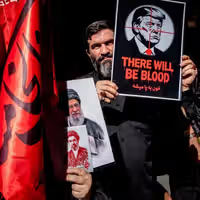
Iranian clerics have called on Muslims to kill Trump and Israeli Prime Minister Benjamin Netanyahu in retaliation for their threats on the life of Iranian Supreme Leader Ali Khamenei during the conflict.

US forces attacked three Iranian nuclear sites in a bid to disable Tehran's disputed program days after Trump said Washington was well aware of where Khamenei was sheltering during the war.

Larijani's comments came after an online platform calling itself "blood pact" began raising funds for what it calls “retribution against those who mock and threaten the Supreme Leader Ali Khamenei.” The site says to have collected over $40 million to date.

It was not immediately possible to verify the authenticity of the figure.

Bounty for Trump’s head

“We pledge to award the bounty to anyone who can bring the enemies of God and those who threaten the life of Ali Khamenei to justice,” a statement on the site said.

The campaign's stated aim is to raise $100 million for the killing of Donald Trump. It remains unclear who operates the site.

However, Fars News Agency, affiliated with the Revolutionary Guards, reported the launch of the Blood Pact initiative and called on religious groups in Iran and abroad to rally in front of Western embassies and central squares to express support for Khamenei.

The outlet also urged the application of “Islamic rulings on moharebeh” against both Trump and Israeli Prime Minister Benjamin Netanyahu.

In the Iranian legal system, moharebeh—literally “waging war against God”—is punishable by death.

President Masoud Pezeshkian sought to distance his government from the campaign, telling US commentator Tucker Carlson on Monday that “the fatwa of warfare has nothing to do with the Iranian government or the Supreme Leader.”

But Kayhan newspaper, overseen by a representative of Khamenei, dismissed the president's remark.

“This is not an academic opinion. It is a clear religious ruling in defense of faith, sanctities and especially the guardianship of the jurist,” it wrote in a Tuesday editorial, referring to Iran's system of clerical rule.

Any future “fire-starter” would face retaliation, the newspaper added concluding that “The Islamic Republic will drown Israel in blood.”

Former lawmaker Gholamali Jafarzadeh Imenabadi earlier condemned Kayhan’s position, saying: “I can’t believe Kayhan’s editor-in-chief Hossein Shariatmadari is Iranian ... saying Trump should be assassinated will bring the cost down on the people.”

In response, Kayhan wrote: “Today, avenging Trump is nearly a national demand. It is Imenabadi’s words that are out of step with Iranian values."

Trump has been a target for assassination threats since he ordered the 2020 killing of Islamic Revolutionary Guard Corps (IRGC) General Qassem Soleimani in Iraq.

Last year, US law enforcement accused the IRGC of organizing a plot to kill Trump in retaliation for his order to assassinate Soleimani.

A win for Tehran: experts assess Carlson's Iran interview

Jul 8, 2025, 20:00 GMT+1
•
Negar Mojtahedi

Tucker Carlson's interview with Iran’s president Masoud Pezeshkian was all Tehran could wish for, experts told Iran International: a global stage, no pushback, and a direct line to Donald Trump’s base.

“This was a major victory for Iranian information warfare operations,” said Marcus Kolga, a leading expert on foreign disinformation. “Whether intentionally or not, Carlson is acting as a significant conduit and amplifier for Iranian government information operations.”

The interview was recorded remotely, unlike the one Carlson did with Russia's president Vladimir Putin in February 2024.

"(Carlson) offers Pezeshkian and the Iranian regime a platform—without context or pushback—allowing Tehran to shape the record to Carlson’s viewers and listeners unopposed,” Kolga added.

A moment highlighted by many critics was when Pezeshkian asserted that Israel had tried to assassinate him without offering any evidence.

“He was trying to... put forward the message that this is Israel tricking America into getting involved in this. This really isn't America's war. Iran and America, we have nothing to fight about.” director of the Yorktown Institute's Turan Research Center Joseph Epstein said.

Epstein argued the interview fit Carlson’s broader pattern of offering authoritarian figures a platform to rewrite narratives without scrutiny—an approach that often blurs the line between journalistic curiosity and ideological alignment.

MAGA :' forever wars'

That alignment, analysts say, extended deep into the language Pezeshkian used.

From “forever wars” to calls for dialogue, his remarks were crafted to appeal to Trump-aligned isolationists and feed growing calls for US disengagement from the Middle East.

The use of such language is no accident, said Holly Dagres, a senior fellow at the Washington Institute, who has long studied Iranian strategic messaging.

“One of the main goals of the Islamic Republic is to get the US out of the Middle East... and when you're pushing this isolationist rhetoric or America First, you're basically saying America needs to get out," Dagres told Iran International.

Dagres noted that Pezeshkian’s emphasis on business cooperation with the US and his softened tone on slogans like “Death to America” appeared to be an overture to Trump himself, even if the message didn’t land as clearly in today’s post-war political climate.

The interview was praised by Iran's moderates, but hardline voices slammed the president's for what they called 'appeasement'.

"A lot of conservatives condemned it because (they said) the US just bombed us. Why are you making these appeals to them?”

The messaging, several experts said, fits into a broader long-term goal: undermining the US-Israeli alliance.

“He used this as an opportunity to weaken and to increase America's skepticism of support for Israel,” said Casey Babb, senior fellow at the Macdonald-Laurier Institute. “In 50 years or 100 years, if America and Israel are not aligned the same way they are right now, Israel could be in a very precarious situation.”

Carlson, Babb said, handed that message a valuable platform by failing to press Pezeshkian on Iran’s human rights record, nuclear activities, or assassination plots.

“There were definitely softball questions with no follow-up,” said Dagres. “Carlson didn’t challenge Pezeshkian on well-documented plots to target American officials or on the regime’s broader ambitions.”

“In failing to counter these narratives,” Kolga said, “Carlson becomes a conduit for regime propaganda—allowing this high-profile ‘conversation’ to turn into a successful Iranian strategic disinformation operation.”


US says strikes on Iran established deterrence as world watched

Jul 8, 2025, 18:17 GMT+1

The US President and Secretary of Defense said the military operation targeting three nuclear sites in Iran sent a strong message to the world, including US adversaries.

"Our so-called enemies were watching. They watched every minute of it," Trump said at a televised Cabinet meeting on Tuesday.

"It was a perfect military performance, the likes of which we haven't seen in a long time," he added recalling the operation codenamed Midnight Hammer.

“What was demonstrated on the world stage was American military might and capability,” Pete Hegseth said in his brief before the president spoke.

“It was not just Fordow and Isfahan and Natanz, but the whole world took notice of that.”

The June 22 strikes targeted Iran's three key nuclear sites with bunker-buster bombs. It was hailed "perfect" by the Trump administration but questioned by some Democratic lawmakers citing an early intelligence assessment.

Trump rejected doubts about the strikes' impact, praising the pilots and others involved.

“Those machines flew for 37 straight hours. They didn’t stop. They went skedaddle... They dropped the bombs, and somebody said skedaddle... And every bomb hit its mark—and hit it incredibly,” he said

"They were right in the most dangerous airspace in the world…and they went right through…by the time they (Iran) found out they were there, they were already gone. That was the word, skedaddle, get the hell out of here," he added.

UN nuclear chief says military force cannot end Iran nuclear standoff

Jul 7, 2025, 21:17 GMT+1

The head of the International Atomic Energy Agency (IAEA) said on Monday that only a negotiated solution can end the international standoff over Iran's nuclear program, as the diplomatic outlook following a 12-day war remains unclear.

“The solution cannot be military, as it is impossible to completely destroy the potential of such an important country with a technological and industrial base,” said IAEA Director General Rafael Grossi at a press conference in Warsaw on Monday.

Grossi emphasized that any lasting solution must include a robust verification mechanism.

“In each of the possible scenarios, a diplomatic agreement must be reached. The appropriate systemic verification should be part of such an agreement, and the necessary structure should be in place,” Grossi said.

“Otherwise, we will be dealing with a very fragile agreement,” he added.

Tehran has accused the IAEA of sharing sensitive information with Israel and the United States and of failing to condemn last month’s airstrikes on Iranian nuclear facilities.

IAEA inspectors remained in Tehran throughout the 12-day conflict between Iran and Israel but left the country last week.

Grossi said he remains hopeful about resuming cooperation with Iran soon, adding that talks are ongoing through intermediaries.