• العربية
  • فارسی
Brand
  • Iran Insight
  • Politics
  • Economy
  • Analysis
  • Special Report
  • Opinion
  • Podcast
  • Iran Insight
  • Politics
  • Economy
  • Analysis
  • Special Report
  • Opinion
  • Podcast
  • Theme
  • Language
    • العربية
    • فارسی
  • Iran Insight
  • Politics
  • Economy
  • Analysis
  • Special Report
  • Opinion
  • Podcast
All rights reserved for Volant Media UK Limited
volant media logo

Iranian clerical call to kill Trump spreads, attracts alleged fundraising

Jul 7, 2025, 22:40 GMT+1Updated: 07:53 GMT+0
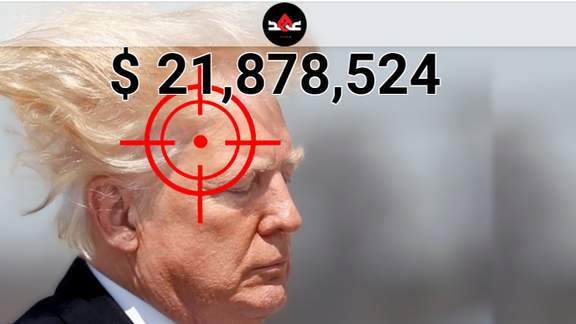
A screen grab from Iranian website, thaar.ir, which alleged that it was running a public campaign to solicit money for the assassination of Trump.

A religious decree or fatwa issued by two senior Iranian clerics calling for the killing of Donald Trump and Benjamin Netanyahu has reportedly gained support from about 10 other clerics and attracted alleged fundraising online.

The ten state-appointed clerics issued an open letter on Monday referring to US President Donald Trump and Israeli Prime Minister as "infidel combatants", an Islamic legal term for a non-believer at war with Muslims who deserves death.

In a speech delivered in Azeri, another state-appointed cleric in Iran's West Azarbaijan Province announced a reward of 100 billion tomans (approximately $1.14 million) for anyone who kills Trump.

“We will give 100 billion tomans to anyone who brings the head of Trump,” said Mansour Emami, the provincial director of the official Islamic Propagation Organization in West Azerbaijan.

An Iranian website, thaar.ir, alleged that it was running a public campaign to solicit money for the assassination of Trump. The site most recently displayed more than $20 million raised.

There was no immediate confirmation of the authenticity of the figure.

During an interview with US media personality Tucker Carlson aired on Monday, Iranian President Masoud Pezeshkian distanced the Iranian government from the religious decrees, saying that they are not directed at any specific person.

“To the best of my knowledge, they have not issued decrees or fatwas against any individual or against Donald Trump. It has nothing to do with the Iranian government or the Supreme Leader of Iran,” Pezeshkian said.

Last month, Alireza Panahian, a hardline Iranian cleric close to the Supreme Leader, called on Muslims to kill Trump and Netanyahu in retaliation for their threats on the life of Khamenei during a 12-day war.

Panahian cited fatwas labeling those who made such a threat a “mohareb,” or enemy of God.

Ayatollah Naser Makarem Shirazi and Ayatollah Hossein Nouri Hamedani had previously issued separate fatwas against Trump and Netanyahu. In his statement, Shirazi declared:

“Any regime or individual threatening the leaders of the Islamic Ummah (nation) and acting on those threats qualifies as a mohareb.”

Ahmad Alamolhoda, Khamenei’s representative in Iran's Razavi Khorasan Province, on Monday expressed support for the two clerics' fatwa.

“Labeling those who insult or violate the sanctity of the Supreme Leader as apostates and enemies of God will strengthen the foundations of the Islamic Republic and the Revolution," Alamolhoda said.

In 1989, Iran’s former leader Ruhollah Khomeini issued a fatwa against British author Salman Rushdie for allegedly blaspheming Islam in his novel The Satanic Verses.

Despite living under heavy security for decades, Rushdie was stabbed and blinded in one eye by an assailant in New York in 2022—an attack widely linked to Khomeini’s fatwa.

Most Viewed

Iran negotiators ordered to return after internal rift over Islamabad talks
1
EXCLUSIVE

Iran negotiators ordered to return after internal rift over Islamabad talks

2
ANALYSIS

US blockade enters murky phase as tankers spoof signals and buyers hesitate

3
ANALYSIS

Why the $100 billion Hormuz toll revenue is a myth

4

US tightens financial squeeze on Iran, warns banks over oil money flows

5
ANALYSIS

US blockade targets Iran oil boom amid regional disruption

Banner
Banner

Spotlight

  • Hardliners push Hormuz ‘red line’ as US blockade tests Iran’s leverage
    INSIGHT

    Hardliners push Hormuz ‘red line’ as US blockade tests Iran’s leverage

  • Ideology may be fading in Iran, but not in Kashmir's ‘Mini Iran'
    INSIGHT

    Ideology may be fading in Iran, but not in Kashmir's ‘Mini Iran'

  • War damage amounts to $3,000 per Iranian, with blockade set to add to losses
    INSIGHT

    War damage amounts to $3,000 per Iranian, with blockade set to add to losses

  • Why the $100 billion Hormuz toll revenue is a myth
    ANALYSIS

    Why the $100 billion Hormuz toll revenue is a myth

  • US blockade targets Iran oil boom amid regional disruption
    ANALYSIS

    US blockade targets Iran oil boom amid regional disruption

  • Iran's digital economy battered by prolonged blackout
    INSIGHT

    Iran's digital economy battered by prolonged blackout

•
•
•

More Stories

Iran internet blackouts hobble economy, erode public trust

Jul 7, 2025, 21:31 GMT+1
•
Mehdi Jedinia

A nationwide internet outage likely imposed by the Tehran beginning just after midnight on July 6 has deepened concerns among a weary public over the already parlous state of the economy and access to information.

Confirmed by global observatory NetBlocks, the blackout caused a near-total loss of connectivity. Though partial access later returned, traffic remains just 20% of pre-conflict levels.

The latest shutdown follows a string of disruptions that began during the 12-day June conflict with Israel, when authorities restricted access under the guise of national security.

Iran’s Telecommunications Infrastructure Company has acknowledged the incident but offered no explanation. Meanwhile, accounts linked to officials remained active, fueling claims of selective, politically-driven censorship.

Economic shock, mass disruption

Prolonged outages are dealing vast damage to Iran’s digital economy.

The Iran Internet Businesses Guild Association estimated over $1.5 million in hourly losses and warned more than 400,000 small and mid-sized businesses are at risk.

The Tehran Union of Internet-Based Shops cited the vulnerability of small digital vendors and service providers.

“Every hour of blackout brings almost a $1.5 million loss to small businesses,” it said.

Sweden-based economist Ahmad Alavi called shutdowns “one of the most economically damaging decisions a government can make,” especially in a low-productivity economy where many rely on digital services.

“These blackouts drive both human and financial capital out of the country,” Alavi warned. “Freelancers, programmers, and entrepreneurs facing unstable access will increasingly emigrate or transfer assets abroad.”

“This is more than a technical glitch,” said Alavi. “It’s a full-blown economic shock affecting production, finance, investment, and public services.”

Mahtab Gholizadeh, a Berlin-based economic journalist, notes that with over 60% of the population under 30, Iran’s youngest and most connected generation, is being cut off from opportunity and global networks.

Resistance, risk and digital Control

Amid growing restrictions, some entrepreneurs have turned to Starlink satellite internet to stay connected—despite legal bans and the threat of imprisonment.

Mohammad, a small business owner, is one of them. “I know the risks,” he said, declining to use his full name due to likely official reprisals.

“But I’d rather face them than die in poverty.”

Many others, particularly in handicrafts and beauty, are redirecting efforts to regional export markets in the Persian Gulf.

Meanwhile, the government continues to promote domestic messaging platforms like Rubika, Baleh and Eitaa, but public uptake remains low. Users and businesses cite privacy concerns, limited features and poor engagement.

Shohreh, an entrepreneur in the beauty industry, tried moving some of her work to the Iranian app Soroush after international platforms were blocked but noted little customer traction.

“Many of our products are considered illegal on these networks,” she said. “Let alone finding proper channels to market or sell them.”

Unequal access, declining trust

The internet crisis has revived a controversial push for tiered access, giving preferential connectivity to state agencies and approved professionals while limiting the general public.

The idea has resurfaced through recent proposals from IT trade groups, but critics say it would formalize digital inequality. Tech outlet Zoomit called the idea “digital apartheid.”

Iran remains one of the world’s most censored internet environments. Around 84% of users rely on VPNs to get online, and over 90% engage with blocked global platforms.

Analysts warn that repeated shutdowns are fueling brain drain, startup collapse, and a crisis of investor confidence.

In an open letter, the Iran Internet Businesses Guild Association urged authorities to stop DNS tampering and bandwidth throttling, warning of systemic collapse.

“The normalization of blackouts,” said Alavi, “is isolating Iran from the global digital economy and destroying what little trust remains in its future.”
Tehran commentariat cry betrayal over Russia’s silence in Israel clash

Jul 7, 2025, 18:32 GMT+1
•
Maryam Sinaiee

With the fighting paused, many in Tehran are taking stock of what the Iran-Israel conflict revealed, and Russia’s muted response is coming under growing scrutiny, especially in light of Moscow’s expanding defense ties with countries like India.

Long seen by hardliners as a strategic partner, Moscow is now facing criticism from Iranian media figures and former officials who accuse the Kremlin of offering symbolic support while withholding meaningful military backing.

President Vladimir Putin’s June 19 comments—downplaying the prospect of assistance and noting that Iran had not formally asked for help—have only deepened the sense of betrayal.

Russia, meanwhile, is offering India 117 Su-35 fighter jets and joint production of the Su-57 stealth aircraft with full technology transfer—the kind of advanced cooperation Tehran has long sought but failed to secure.

Backlash in Tehran

“Russia appears neither willing nor able to offer effective mediation or military backing,” Sohrab Saeddin, a European affairs researcher, told Khabar Online on June 30. “Alignment at the UN may raise Tehran’s diplomatic profile, but one cannot expect a more active role.”

Former deputy parliament speaker Ali Motahari was blunter in a July 1 post on X: “Russia gave the S-400 defense system to Turkey and Saudi Arabia but won’t provide it to Iran—because it might be used against Israel.”

He also reminded Moscow of the hundreds of Iranian drones allegedly used in Ukraine. “This is the kind of strategic cooperation Mr. Putin speaks about.”

Hossein Mousavian, a former Iranian diplomat now at Princeton, pointed to the India deal.

“Russia has offered India 117 Su-35M fighter jets and joint production of the Su-57 with full technology transfer—even though India is a U.S. ally,” he posted on X.

“Perhaps this reality can help Tehran gain a better understanding of the 'realities of international relations' and the 'imperatives of national interest.’”

Heshmatollah Falahatpisheh, former head of Iran’s National Security and Foreign Policy Committee, echoed the frustration.

“The Iranian nation has already paid more than its fair share of the price for the Ukraine war,” he told Rouydad24. “When Iran brought balance to the battlefield, the Russians simply said Iran hadn’t asked for anything.”

Foreign Minister Abbas Araghchi’s June 23 visit to Moscow—at the height of the fighting—was widely seen as a plea for stronger Russian backing.

But Moscow’s response remained limited, notably omitting any mention of the Su-35 or S-400. It condemned Israel’s attacks, offered to mediate, and proposed taking Iran’s enriched uranium in exchange for nuclear fuel.

Tehran and Moscow’s 20-year strategic partnership, signed in January and ratified in May, lacks a mutual defense clause but commits both sides to joint drills and military-technical cooperation.

Putin reiterated mid-war that the deal does not obligate Moscow to provide military support.

No fighter jets in sight

The stalled Su-35 deal has become another flashpoint. Finalized in late 2023, it was seen as critical to modernizing Iran’s air fleet and countering Israel’s air power.

“The story of the Sukhoi-35 is a tale of a one-sided alliance—one in which Iran delivers critical drones but receives nothing more than hollow promises,” Khabar Online wrote on July 1.

The article claimed Russia is using the jets as leverage in wider negotiations—on Syria, drone cooperation, and the Caspian Sea.

According to Kommersant, Iran received just two of the 50 Su-35s it expected. Delivered in December 2024, the aircraft were transported in parts to Iran’s 3rd Tactical Air Force Base near Hamadan for assembly.

There are no confirmed reports of their use in the conflict.

Russian sources cited production bottlenecks and the Ukraine war as reasons for suspending further deliveries—possibly for up to two years. Not many in Tehran are convinced.

Bolton seeks sequel to Iran-Israel war: 'Surrender of the Ayatollahs'

Jul 4, 2025, 22:20 GMT+1
•
Negar Mojtahedi

Former US national security advisor and veteran Iran hawk John Bolton hopes a White House meeting between Donald Trump and Benjamin Netanyahu will pave the way for Tehran's downfall.

“I think here's where they should discuss the terms of, in effect, the surrender of the Ayatollahs,” Bolton said, calling for sustained pressure to build on military successes in a 12-day Israel-Iran war to pave the way for the collapse of Iran's theocracy.

Trump is due to receive Netanyahu on Monday in their first meeting since US and Israeli strikes targeted Iran’s nuclear facilities, missile infrastructure and command centers, killing as many up to 1,200 Iranians. 24 Israelis were killed in Iranian attacks.

Netanyahu has said he will also meet Secretary of State Marco Rubio, Defense Secretary Pete Hegseth, Commerce Secretary Howard Lutnick, and Trump’s Middle East envoy Steve Witkoff.

A weakened Islamic Republic

Bolton argued that the strikes which crippled key military sites and killed senior commanders of Iran’s Islamic Revolutionary Guard Corps (IRGC), have pushed the Islamic Republic's leadership to the brink.

“The aerial strikes are really a substantial destabilizing factor,” he said. “They demonstrate beyond a doubt the Ayatollahs are no longer able to defend their own country. They can be pushed about at will.”

The Islamic Republic, Bolton argued, is at its most vulnerable point since the 1979 revolution, weakened not just militarily but also internally, citing longstanding discontent, particularly among youth, women, and ethnic minorities.

“We're within sight of it, which is why it would be such a tragedy to let up now and let it slip between our fingers,” said Bolton.

There have been few significant protests during or after the conflict.

Ceasefire 'mistake'

Although Bolton praised the initial decision to strike Iran’s nuclear program, he criticized the subsequent US-brokered ceasefire as “a mistake.”

“Our military knows that you don't know exactly how much damage has been done in the first hours after an attack,” he said. “We were in complete control of the skies ... (and) that gave us time ... to decide where additional attacks might be necessary.”

Instead, Bolton said the ceasefire gave Iran breathing room at a critical moment. He attributes that decision, in part, to Trump’s desire to appear as a global dealmaker.

“Trump wants a Nobel Peace Prize and I think he believes that after a very successful US military strike that he could broker it,” said Bolton. “It's always in personal terms for Trump. It's not about American national security interests or Israel or Iran, it's about what makes him look best.”

The president and Bolton spectacularly fell out in public and Trump has repeatedly insulted his ex-subordinate and pulled his government security detail.

Bolton accused the administration of prioritizing loyalty and optics over expertise, pointing to Trump’s appointment of real estate developer Steve Witkoff as Iran envoy.

“Trump's negotiator, Steve Witkoff… has no concept what he's dealing with when he negotiates with the Ayatollahs, no knowledge of nuclear weapons or the risk of nuclear proliferation,” said Bolton.

Critics have raised concerns about 900 pounds of uranium enriched to 60 percent that remains unaccounted for. Bolton said strikes on Esfahan and other sites likely destroyed key elements required to turn that material into a weapon.

“They may have a lot of partially enriched uranium hexafluoride gas,” he said, “but it's a long way to go from that to actually making a nuclear weapon.”

Advocacy group calls for Khamenei sanctions over clerics' Trump threats

Jul 4, 2025, 17:10 GMT+1

US advocacy group United Against Nuclear Iran (UANI) on Friday called on the United States to sanction Iran's Supreme Leader Ali Khamenei over fatwas from senior clerics which appear to call for the death of US President Donald Trump.

During a 12-day Iran-Israel war last month, Trump said Washington was aware of Khamenei's hiding place and mooted potentially green lighting the killing of Iran's head of state.

Days after the conflict ended, two top Shi'ite clerics Ayatollah Naser Makarem Shirazi and Ayatollah Hossein Nouri Hamedani issued religious decrees or fatwas condemning to death those who would threaten the Supreme Leader. The fatwas were cited by Alireza Panahian, a cleric close to Khamenei, to repeat the call for killing Trump.

“The Iranian regime’s medieval and barbaric threats against the US president and others cannot be ignored – and must not go unanswered,” UANI said in a written statement.

UANI called on the US government to put sanctions on the Iranian leader and his son and all who ordered or repeated such a religious decree.

Shirazi said in his statement: “Any regime or individual threatening the leaders of the Islamic nation and acting on those threats qualifies as a mohareb (enemy of God).”

In Shi'ite jurisprudence, the declaration of mohareb and the issuance of a fatwa make it religiously obligatory for devout Muslims to act.

“These calls are incitements to homegrown terrorist attacks and pose a serious threat to the president and US nationals—they should be treated accordingly,” UANI's statement said.

UN nuclear inspectors quit Iran after cooperation severed

Jul 4, 2025, 13:17 GMT+1

The International Atomic Energy Agency said on Friday that its team of inspectors had safely departed Iran to return to its headquarters in Vienna, after a new law barred cooperation with the UN body.

In a statement on X, the agency said Director General Rafael Grossi had “reiterated the crucial importance” of holding talks with Iranian authorities to resume the IAEA’s “indispensable” monitoring and verification work “as soon as possible.”

The inspectors had remained in Tehran throughout the 12-day conflict between Iran and Israel.

The announcement follows a report by the Wall Street Journal that the inspectors were pulled out over safety concerns and transported by road to Armenia in a departure coordinated with Iranian authorities.

Citing sources familiar with the matter, the newspaper reported that the agency had been trying to arrange the exit for several days and chose ground transport to reduce visibility and risk.

The move comes after weeks of rising tensions between Tehran and the UN nuclear watchdog. On Wednesday, Iranian President Masoud Pezeshkian enacted a law requiring the suspension of cooperation under the Nuclear Non-Proliferation Treaty’s safeguards agreement unless Iran’s demands for security guarantees are met.

Tehran has accused the IAEA of sharing sensitive data with Israel and the US, and of failing to condemn last month’s airstrikes on Iranian nuclear sites.

While Iran has denied ending cooperation entirely, Foreign Minister Abbas Araghchi said coordination with the agency would now be managed through Iran’s Supreme National Security Council.

This is while hardline Iranian media have called for Grossi's arrest and execution, and a senior judiciary official said Grossi could face trial in absentia for “deceptive actions.”

It remains unclear when or whether IAEA inspectors will return. WSJ reporter Laurence Norman said there is “no reason to feel confident” they will be back in Tehran anytime soon, adding that it could be years before monitoring operations resume.