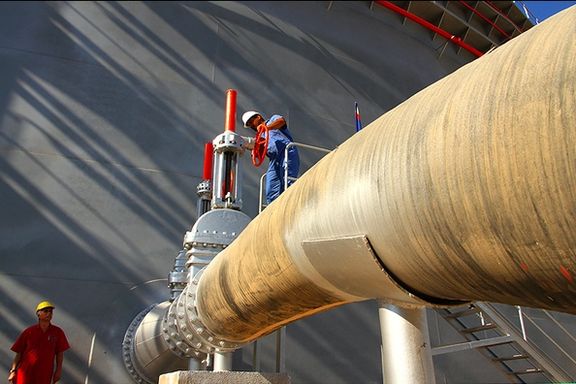
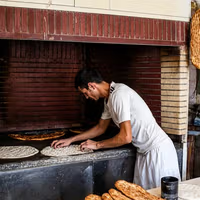
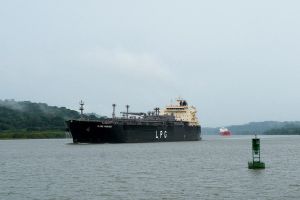
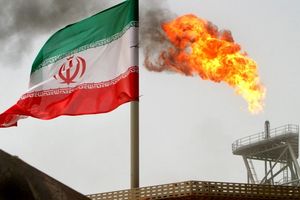
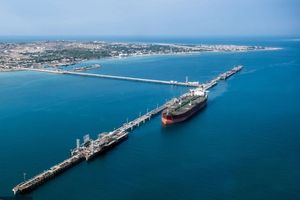
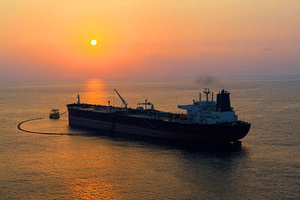
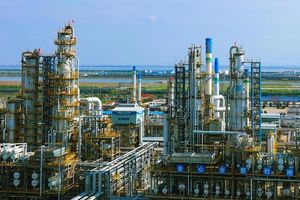
Workers service oil industry infrastructure in Iran
Iran’s ambition to serve as a regional energy hub is faltering, with key neighbors losing confidence in Tehran’s ability to fulfil its commitments and shifting to alternative suppliers.
Turkey, long a major customer, imported over 5 billion cubic meters of liquefied natural gas (LNG) from the United States in the first quarter of 2025, according to Turkey’s Energy Market Regulatory Authority (EMRA).
That’s nearly the same volume as in all of 2024—which itself marked a 38% jump from 2023. The United States is now Turkey’s second-largest gas supplier after Russia, displacing Iran.
Meanwhile, Iran is grappling with year-round gas deficits. Last winter, domestic shortages roughly equaled Turkey’s daily seasonal demand.
EMRA data shows that Iran’s winter deliveries to Turkey have halved over the past two years, failing to meet the agreed quota in every month of the cold season.
A 25-year agreement between Tehran and Ankara expires next year. Despite repeated offers to renew, Turkey has shown little interest, bolstering its energy ties with Russia, Azerbaijan, and the US.
In March, Ankara began importing gas from Turkmenistan through swap deals via Iran—further reducing direct reliance on Iranian supply.
Iraq and Syria: shrinking markets
Iraq, Iran’s only remaining major gas customer, has also reported a sharp drop in supply.
Reduced deliveries from Iran have cut electricity production by 3,000 megawatts, according to Iraqi officials, just as summer demand peaks. Iran now supplies only 3% of Iraq’s electricity needs, down from 10% just a few years ago.
Turkey has stepped into the void, doubling its electricity exports to Iraq in 2025 and now supplying more than twice the volume Iran provides.
Tehran earns an estimated $5.5 billion annually from electricity and gas exports. Yet the strategy of converting regional political leverage into economic gains appears to be unraveling.
For years, Iran spent tens of billions of dollars supporting armed groups in Iraq, Syria and Lebanon, hoping to convert influence into energy contracts and infrastructure projects. But the hard-gained influence all but vaporised with Israeli strikes and the fall of Bashar al-Assad in Syria.
Syria, once a central partner in Tehran’s ambitions, has effectively cut ties. Iraq plans to end reliance on Iranian gas within two years.
Lost Ground
From 2012 to 2023, Iran sent more than 300 million barrels of free crude oil to Syria—worth $23 billion, according to energy analytics firm Kpler— in hopes of securing energy and industrial dominance in postwar reconstruction.
Last week, Syria’s interim government signed a $7 billion deal with Qatari, Turkish and US firms to build 6,000 megawatts of new generation capacity.
Turkey will supply 2 billion cubic meters of gas annually, while Qatar began gas shipments via Jordan in March, bypassing Iran entirely.
Even before Assad’s fall, Iran lagged behind. Turkey exported 15 times more goods to Syria than Iran. Today, Iran’s trade has all but stopped, while Turkish exports to Syria topped $1 billion in the first four months of 2025 — a 32% increase over the same period last year.
Economy professor Ali Madanizadeh, tapped to be Iran's next economy minister
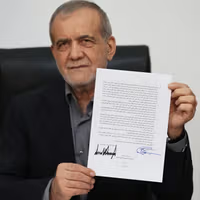
Iran has been without an economy minister since March—and may remain so even longer—as President Massoud Pezeshkian’s nominee faces mounting opposition from hardliners inside and outside parliament.
The moderate president has struggled for nearly three months to name a replacement after his previous minister was impeached, drawing criticism from rivals for indecision.
Now, his choice Ali Madanizadeh, a prominent academic with degrees from Stanford and the University of Chicago—is under intense scrutiny, with opponents questioning his qualifications and ideological loyalties.
“I am not saying he is an infiltrator, but he received a scholarship from a Western influence network that recruits elite students, indoctrinating them before placing them in key positions in Iran to serve Western interests,” MP Hossein Samsami told parliament.
Another lawmaker, Sara Fallahi, argued that Madanizadeh is unfit for office because his child was born in the United States.
Madanizadeh, 43, currently serves as dean of the Faculty of Economics at Iran’s top technical school, Sharif University of Technology, where he obtained his first degree before going to the U.S. for advanced studies.
He has also advised Iran’s Central Bank and the Planning and Budget Organization.
Ultraconservatives, particularly the Paydari Party, have led the charge against Madanizadeh—just as they did in the impeachment of the former economy minister and the push to oust Pezeshkian’s transport minister over the port blast in southern Iran in late April.
MP Amir Hossein Sabeti claimed—without naming Madanizadeh—that the nominee “lacks managerial experience” and is no different from the minister they removed.
The moderate news site Khabar Online on Tuesday framed the criticisms as political revenge for Pezeshkian’s defeat of Paydari’s preferred candidate, Saeed Jalili, in the 2024 election.
Moderates push back
Although parliament initially approved all of Pezeshkian’s cabinet picks, that backing has eroded.
Pezeshkian’s allies have defended the nomination.
Moderate MP Alireza Novin called the criticisms “unethical behavior” that denies Madanizadeh a chance to prove his qualifications.
Renowned sociologist Mohammad Fazeli said hardliners “routinely brand political and academic elites as infiltrators to deprive the system of capable individuals.”
Shadow of supreme power
In the debates surrounding the impeachment of former economy minister Abdolnasser Hemmati, his supporters argued that Iran’s economic failings are structural and often rooted in decisions not made by the administration.
What most mean by that—but do not say—is that the one ultimately responsible is Supreme Leader Ali Khamenei.
Khamenei has long promoted his concept of a “resistance economy,” a loosely defined model grounded in anti-Americanism, self-sufficiency and ideological discipline.
While he frequently calls for higher productivity, critics argue that Tehran’s foreign policy—set and directed by Khamenei—has led to sanctions and international isolation that make such goals unachievable.
Supreme Leader Ali Khamenei’s latest speech was his clearest stance yet ahead of a possible war scenario, said the international relations expert and security analyst Shahin Modarres.
“Given the substance of these remarks, the Trump administration is likely concerned and may push for a final round of negotiations in the coming weeks,” Modarres told Iran International TV.
If talks fail, he said, the US would swiftly move to impose severe economic pressure on Iran through snapback mechanisms or fresh international sanctions.
“Israel’s role will then become more pronounced,” Modarres added, pointing to the likelihood of at least a limited military strike on Iran’s nuclear sites to force Tehran back to the table.
Modarres said broader attacks on Iran’s military and nuclear infrastructure would also remain on the table.
“We now face a narrowing window,” he said. “The question is whether either side is willing to step back from its maximalist position—or whether we are entering an extremely tense and dangerous phase.”
Israeli officials have not issued a formal response to Ali Khamenei’s latest remarks, but private assessments see the speech as a serious escalation, Middle East analyst Menashe Amir told Iran International TV.
“In private conversations I’ve had with informed individuals, the conclusion was that we are one step closer to war,” Amir said.
According to Amir, those consulted described Khamenei’s address as his most forceful to date, resolving long-standing doubts.
In his speech, the Supreme Leader said that the Islamic Republic will under no circumstances give up uranium enrichment.
Iran’s crude oil shipments to China fell sharply in May as tighter US sanctions and seasonal refinery maintenance weighed on flows, Bloomberg reported on Wednesday, citing preliminary ship-tracking data and market analysts.
According to data from Vortexa Ltd., Iran exported just over 1.1 million barrels per day (bpd) of crude and condensate to China last month, marking a drop of roughly 20% compared to the same period a year earlier.
The figures, based on shipping movements, remain subject to revision due to a growing number of tankers switching off their tracking systems in an effort to avoid detection.
“The tightening US sanctions are straining the supply chain and raising concerns about the reliability of shipments,” said Emma Li, senior market analyst at Vortexa. “At the same time, refinery demand in China has weakened, largely due to delayed seasonal maintenance, which now appears likely to extend through July.”
Independent Chinese refiners, known as teapots, are Iran’s primary customers, drawn by steep discounts on sanctioned barrels. But the facilities—mostly concentrated in Shandong province—are currently operating near record-low rates, Li noted. Many refiners had already stockpiled Iranian oil earlier this year, reducing the need for additional purchases in May.
Lower prices of competing crude from Russia, including Sokol and Novy Port grades, have also edged out Iranian supplies in the Chinese spot market.
Impact of sanctions and port restrictions
The decline follows months of escalating US pressure on Iran’s oil exports. Since early 2025, Washington has sanctioned dozens of tankers and companies involved in the trade, particularly targeting Iran’s so-called “shadow fleet.”
The latest round of sanctions, imposed in May, included Hebei Xinhai Chemical Group Co.—a Chinese independent refiner alleged to have received hundreds of millions of dollars’ worth of Iranian crude—as well as several port operators in Shandong and seven vessels used to disguise Iranian shipments.
“The United States remains resolved to intensify pressure on all elements of Iran’s oil supply chain,” said Treasury Secretary Scott Bessent in a statement at the time.
The sanctions have disrupted, but not halted, Iran’s crude flows to China. According to Bloomberg, many shipments now occur in “dark mode,” with vessels turning off their transponders and conducting ship-to-ship transfers off Malaysia to obscure the oil’s origin.
However, sanctions have pushed freight costs sharply higher, with chartering rates for non-sanctioned supertankers reaching up to $6 million—an increase of 50% over the past year.
Shandong Port Group has reportedly advised local operators to avoid dealings with blacklisted tankers, further complicating logistics for Iranian crude.
Earlier cracks in the trade
China’s imports of Iranian oil began declining steeply in January after authorities barred sanctioned tankers from entering Shandong ports, which handle around 90% of Iranian cargoes.
According to Kpler data, Iranian oil deliveries to China dropped below 850,000 bpd in January, compared to over 1.8 million bpd in October 2024.
At the same time, Iran’s floating oil reserves have surged to 35 million barrels, underscoring the widening gap between official shipment figures and actual deliveries.
Despite sporadic rebounds—such as a brief rise in April driven by a backlog of delayed cargoes—the overall trend has been downward.
As US sanctions intensify and China takes further precautions, Iran’s reliance on its shrinking pool of buyers could deepen, while Tehran says its energy exports remain stable.
A carpenter works following a power outage at a carpentry workshop in Tehran, Iran, June 1, 2025.
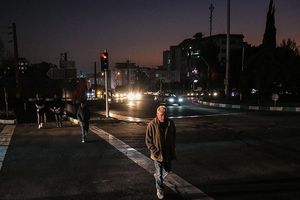
Rolling power cuts across Iran continue to mar daily life and livelihoods, according to firsthand accounts by everyday people submitted to Iran International.
From scorched household appliances to destroyed crops and collapsing businesses, Iranians describe a national infrastructure crisis they say is pushing them into ruin.
Below are excerpts from voice messages sent to Iran International’s platform for citizen testimonies.
'How are we supposed to survive?'
A farmer from Semnan province in northeastern Iran sent a passionate voice message describing how repeated blackouts have destroyed his equipment and ruined his harvests.
“My irrigation pump has burned out twice,” he said. “Where am I supposed to find 800 million tomans ($9,670)? I’m a village farmer. We’re being crushed.”
The average monthly income in Iran is about $150.
He said blackouts come every five or six hours, killing crops and rendering farming impossible. “They’ve destroyed agriculture, the backbone of our economy. They’ve turned the clock back 1,400 years.”
Expressing broader political anger, he added, “As long as we sit and do nothing, they’ll keep dragging us backward—to the Qajar era, even the Safavid. They aren’t here to help us. They’re here to humiliate us.”
Businesses collapsing: 'I had to buy used fridges again'
A small supermarket owner shared how frequent power cuts ruined expensive appliances—even with surge protectors.
“My dairy fridge and ice cream freezer burned out. I had to replace them with second-hand ones,” he said.
Even those whose businesses are not directly affected by outages expressed sorrow. “I don’t work with electricity, but when I see shopkeepers sitting helplessly outside their stores, it breaks my heart,” one person said. “When will we wake up?”
Shoemakers work following a power outage at a shoe workshop in Tehran, Iran, June 3, 2025.
'God help the sick': Medical risks from power loss
Another voice message warned of life-threatening consequences from blackouts.
“Our bread dough spoils. Appliances burn out. But the real danger is for families who rely on oxygen machines,” the speaker said. “When the power cuts, they might lose a loved one.”
She called the blackouts a clear sign of state failure: “These blackouts prove the regime’s total incompetence. Only real change can fix this. God willing, the people will rise.”
Wrecked appliances
Many described a constant cycle of broken appliances and unbearable heat.
“I burn out a cooler motor every week,” said one angry resident.
Others reported fridges and air conditioners failing due to voltage spikes. “This isn’t just about heat. It’s engineered poverty. Engineered unemployment. Engineered misery,” another added.
A voice message captured the mood in one bitter list: “No jobs. No water. No power. No future. Even morality is breaking down. And it’s all by design.”
Priorities
Multiple speakers criticized the government’s priorities—pursuing military ambitions while ordinary Iranians suffer without basic utilities.
“They’ve been chasing nuclear power for 30 years,” one man said. “But they can’t provide a single kilowatt of electricity for the people.”
The comments come as Iran and the United States remain locked in faltering nuclear negotiations, with apparent mixed signals from Washington fueling uncertainty in Tehran.
He praised Iran’s truck drivers for their recent strikes and urged others to resist. “We have to stop watching each other suffer in silence. This is a war. And it’s being waged against us.”
Truck drivers are now on the 13th day of a nationwide strike, with actions reported in over 150 cities and towns despite growing government pressure.