• العربية
  • فارسی
Brand
  • Iran Insight
  • Politics
  • Economy
  • Analysis
  • Special Report
  • Opinion
  • Podcast
  • Iran Insight
  • Politics
  • Economy
  • Analysis
  • Special Report
  • Opinion
  • Podcast
  • Theme
  • Language
    • العربية
    • فارسی
  • Iran Insight
  • Politics
  • Economy
  • Analysis
  • Special Report
  • Opinion
  • Podcast
All rights reserved for Volant Media UK Limited
volant media logo

US sanctions Chinese refinery, operators for handling Iranian oil

May 8, 2025, 16:48 GMT+1Updated: 08:15 GMT+0
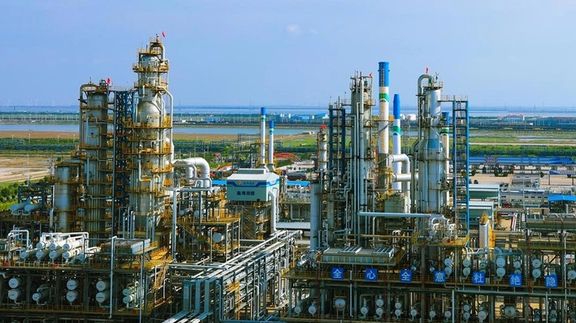
Image of an oil refinery published on Xinhai Holdings website

The United States on Tuesday imposed fresh sanctions on another Chinese refinery and multiple logistics firms for facilitating the sale and shipment of Iranian oil, expanding its efforts to squeeze Tehran’s revenues.

The measure targets Hebei Xinhai Chemical Group Co., an independent refinery Washington asserts has received hundreds of millions of dollars’ worth of Iranian crude, some linked to the Islamic Revolutionary Guard Corps (IRGC).

Three Chinese port operators in Shandong province were also sanctioned for managing terminals that received sanctioned shipments from Iran’s shadow fleet, vessels used to hide the origin of shipments.

“The United States remains resolved to intensify pressure on all elements of Iran’s oil supply chain to prevent the regime from generating revenue to further its destabilizing agenda,” treasury secretary Scott Bessent said in a statement released on the website of the treasury's Office of Foreign Assets Control (OFAC).

Seven vessels and the companies that own them were also sanctioned, according to OFAC citing their role in transferring Iranian petroleum to China. Among those were tankers flagged in Panama and Hong Kong.

Two Indian ship captains were also designated for years-long involvement in steering sanctioned tankers carrying Iranian oil, the US treasury said.

The sanctions fall under executive orders by US president Donald Trump as part of his so-called maximum pressure campaign on Iran alongside the ongoing diplomatic push to resolve the standoff with Tehran over its nuclear program.

"We're trying to work on Iran to get that solved without having to get into any bombing," Trump said in his latest statement on Iran on Thursday.

"As we say, big bombing. I don't want to do that. I want them to be very successful," he added.

Most Viewed

Iran negotiators ordered to return after internal rift over Islamabad talks
1
EXCLUSIVE

Iran negotiators ordered to return after internal rift over Islamabad talks

2
ANALYSIS

US blockade enters murky phase as tankers spoof signals and buyers hesitate

3
ANALYSIS

Why the $100 billion Hormuz toll revenue is a myth

4

US tightens financial squeeze on Iran, warns banks over oil money flows

5
INSIGHT

Ideology may be fading in Iran, but not in Kashmir's ‘Mini Iran'

Banner
Banner

Spotlight

  • Hardliners push Hormuz ‘red line’ as US blockade tests Iran’s leverage
    INSIGHT

    Hardliners push Hormuz ‘red line’ as US blockade tests Iran’s leverage

  • Ideology may be fading in Iran, but not in Kashmir's ‘Mini Iran'
    INSIGHT

    Ideology may be fading in Iran, but not in Kashmir's ‘Mini Iran'

  • War damage amounts to $3,000 per Iranian, with blockade set to add to losses
    INSIGHT

    War damage amounts to $3,000 per Iranian, with blockade set to add to losses

  • Why the $100 billion Hormuz toll revenue is a myth
    ANALYSIS

    Why the $100 billion Hormuz toll revenue is a myth

  • US blockade targets Iran oil boom amid regional disruption
    ANALYSIS

    US blockade targets Iran oil boom amid regional disruption

  • Iran's digital economy battered by prolonged blackout
    INSIGHT

    Iran's digital economy battered by prolonged blackout

•
•
•

More Stories

Panama key to Iran's sanctions-busting oil fleet, watchdog says

May 8, 2025, 11:24 GMT+1

A US-based watchdog group on Thursday accused Panama of playing a key role in enabling sanctions evasion by Iranian oil tankers while Tehran’s oil ministry announced a significant rise in crude exports.

The organization United Against Nuclear Iran (UANI) said 17% of a fleet of vessels it suspects of smuggling sanctioned Iranian oil are currently flying the Panamanian flag.

In a statement, UANI described Panama’s maritime registry as the “most commonly used national registry among this shadow fleet,” citing tactics such as flag-hopping, fake ownership records, and manipulation of automatic identification systems (AIS).

“Panama has long been the flag of choice for sanctions violators and oil smugglers,” said UANI CEO Mark D. Wallace. “We’ve repeatedly provided the AMP [Panama Maritime Authority] with names, evidence, and warnings. Their lack of consistent, proactive enforcement continues to undermine global sanctions compliance.”

UANI’s tanker tracker lists 542 foreign-flagged vessels suspected of involvement in sanctioned oil shipments from Iran.

Following mounting pressure, Panama in March deregistered 107 vessels and is currently reviewing 18 more, acting under Executive Decree No. 512, which allows authorities to remove ships owned by sanctioned entities from its registry.

The allegations come as Iranian officials publicly celebrate rising energy production and oil exports.

Oil Minister Mohsen Paknejad, speaking during the inauguration of Iran’s 29th Oil, Gas, Refining and Petrochemical Exhibition in Tehran, said the country has boosted oil output by 150,000 barrels per day under the current administration, with daily gas production up 30 million cubic meters and petroleum refining capacity growing by 180,000 barrels per day.

Paknejad added that gasoline and diesel output has increased by 7 million and 8 million liters per day, respectively, despite what he called intensifying sanctions. “Oil exports are continuing at the highest possible level,” he said.

He added that Iran plans to complete over 30 major oil and gas projects by March 2026, representing $10 billion in investment, which he said will further raise daily oil production by 250,000 barrels and gas by 30 million cubic meters.

He also said Iran needs over $20 billion in annual funding to maintain and expand production, adding that the ministry is pursuing innovative financing tools and encouraging greater private sector participation to meet these goals.

While Iran has not publicly addressed the UANI report, it has consistently rejected the legality of unilateral US sanctions and insists that its energy exports comply with international law.

The Panama Maritime Authority has not yet responded to the latest allegations. However, officials have previously defended their compliance with international norms, citing recent regulatory changes intended to strengthen enforcement.

In spite of sanctions, Iran's oil sales have continued to grow in recent years.

In October, the Energy Information Agency (EIA) in the US reported that Iran's oil sales reached $144 billion in the first three years of the Biden administration, $100 billion more than what Tehran exported in the last two years of the Trump administration when the oil sanctions were in effect.

In March, the US seized multiple Iranian oil tankers in the Persian Gulf which were using forged Iraqi documents.

Speaking on state television, Iraq's Oil Minister Hayan Abdel-Ghani said: "We received some verbal inquiries about oil tankers being detained in the Persian Gulf by US naval forces carrying Iraqi shipping manifests.

"It turned out that these tankers were Iranian ... and were using forged Iraqi documents. We explained this to the relevant authorities with complete transparency and they also confirmed this."

US VP suggests some leeway on Iran nuclear enrichment

May 7, 2025, 16:39 GMT+1

US Vice President J.D. Vance said on Wednesday that Iran must not be allowed to enrich uranium to levels that would enable it to develop nuclear weapons—remarks that may be seen as an apparent nod to Iran’s insistence on maintaining low-level enrichment.

"They can have civil nuclear power. OK, we don't mind that, but... no one right now has a civil nuclear program with their entire enrichment infrastructure that can enrich to the 90-plus percent needed to get to fissile material and a nuclear weapon," Vance said at the Munich Security Conference in Washington DC.

Vance said the Trump administration has no problem with Iran having nuclear power.

"We're fine with that. But you can't have the kind of enrichment program that allows you to get to a nuclear weapon, and that's where we draw the line," he said.

The United States and Iran appear to be on a collision course over whether Tehran should be allowed to enrich uranium in any nuclear deal between the two arch-foes, potentially endangering talks headed for a fourth round this weekend.

Last month, US Secretary of State Marco Rubio said "there’s a pathway to a civil, peaceful nuclear program if they want one, but if they insist on enriching, then they will be the only country in the world that doesn’t have a 'weapons program,' quote-unquote, but is enriching. And so I think that’s problematic."

The UN nuclear watchdog said last month that Iran is only non-nuclear armed state enriching uranium to 60%. Several countries which do not possess nuclear weapons, including Japan, Brazil, Germany and the Netherlands, enrich uranium at lower levels.

In his Wednesday remarks, Vance said his country is seeking a deal with Iran that would not only completely eliminate the possibility of it acquiring a nuclear weapon but also pave the way for Tehran’s return to the global economy.

"We think that there is a deal here that would reintegrate Iran into the global economy. That would be really good for the Iranian people, but would result in the complete cessation of any chance that they could get a nuclear weapon,"

"That's what we're negotiating towards."

Vance said the Trump administration has been "very happy by how the Iranians have responded to some of the points that we have made" in the Omani-mediated talks.

"Without prejudging the negotiations, I will say so far so good... We've been very happy that some of the intermediaries and some of the folks who are in the room, the role that they've played, the Omanis in particular, have played a very positive role, and we're very grateful to that."

He said "so far we're on the right pathway. But this is going to end somewhere. And it will end either in Iran eliminating their nuclear program, their nuclear weapons program."

Iran rebukes Trump’s reported plan to rename Persian Gulf in official US usage

May 7, 2025, 07:29 GMT+1

President Donald Trump plans to announce that the US will begin officially referring to the Persian Gulf as the “Arabian Gulf,” the Associated Press reported — a move condemned by Iran as a politically motivated affront to its national identity and historical legacy.

The move, which comes amid a broader effort to deepen ties with Persian Gulf Arab states, marks a break with long-standing international convention, prompting sharp rebuke from Iran, which shares the longest coastline along the body of water.

Foreign Minister Abbas Araghchi called the reported decision politically motivated and historically inaccurate, saying, “The name Persian Gulf, like many geographical designations, is deeply rooted in human history.”

"Politically motivated attempts to alter the historically established name of the Persian Gulf are indicative of hostile intent toward Iran and its people, and are firmly condemned. Such biased actions are an affront to all Iranians, regardless of their background or place of residence,” Iran's top diplomat said on X.

Two US officials familiar with the matter, who spoke on condition of anonymity, said the announcement would be made while Trump visits Riyadh as part of a regional tour that includes Qatar and the United Arab Emirates—countries that have long pushed for the geographic name change.

“The president is expected to unveil what he calls a ‘historic reorientation’ of US nomenclature to better reflect regional alliances,” one of the officials said.

Trump himself teased a major announcement during a meeting at the White House on Tuesday. “It’ll be one of the most important announcements that have been made in many years about a certain subject, a very important subject,” he said.

Known globally as the Persian Gulf since at least the 16th century, the name of the inland sea has become a politically and culturally charged issue. Arab states often use “Arabian Gulf” in official documents and maps, while Iran considers the historical term a matter of national identity.

“The Persian Gulf is not just a name. It is part of who we are,” an Iranian diplomat in Tehran said on condition of anonymity. “Changing it under pressure from petrodollars will not erase thousands of years of history.”

In 2017, during Trump's first administration, his first reference to what he called the "Arabian Gulf" led to public backlash from Tehran.

The Iranian foreign minister at the time, Mohammad Javad Zarif, said: “Everyone knew Trump’s friendship was for sale to the highest bidder. We now know that his geography is, too.”

Iran’s then-president, Hassan Rouhani, also criticized the phrasing, saying Trump should “study geography.”

The US military has unilaterally used “Arabian Gulf” in communications for years, but the White House’s official adoption of the term would represent a new level of endorsement, likely increasing tensions with Tehran.

Under international maritime law, the designation of sea names is handled by the International Hydrographic Organization (IHO), which currently recognizes the body of water as the “Persian Gulf.” The United Nations and most world maps do the same.

While Trump can direct US federal agencies to use a different name, he cannot enforce the change globally. Congressional legislation would be required to make the shift permanent in US law, and a future administration could easily reverse it.

“Trump can rename it on White House letterhead, but that won’t change global consensus,” said Lisa Barry, a professor of international law at Georgetown University.

The renaming announcement is part of a broader push to align more closely with Persian Gulf Arab monarchies as Trump seeks increased investment from the region and backing for his policies on Iran and Israel.

The announcement also follows a controversial decision earlier this year to rename the Gulf of Mexico as the “Gulf of America” in US government usage—a move that led to a legal battle with the Associated Press.

A federal judge ultimately ruled that the AP could not be denied access to government events for refusing to adopt the administration’s preferred terminology, citing First Amendment protections.

The inland sea in question spans about 251,000 square kilometers (97,000 square miles) and borders eight nations: Iran, Iraq, Kuwait, Saudi Arabia, Bahrain, Qatar, the UAE, and Oman. Iran alone accounts for more than 1,600 kilometers (1,000 miles) of its coastline.

Trump is scheduled to travel to Saudi Arabia, Qatar, and the UAE from May 13 to 16. The announcement is expected to be made during a keynote speech in Riyadh, though officials said the precise timing remains fluid.
Turkish bank takes Iran sanctions case to US Supreme Court

May 6, 2025, 08:07 GMT+1

Turkey's state-owned Halkbank has asked the US Supreme Court to review a lower court decision that allows it to be prosecuted for allegedly helping Iran evade American sanctions, a lawyer for the bank said on Monday.

The Supreme Court had set a Monday deadline for Halkbank to file a petition appealing the October 2024 ruling by the 2nd US Circuit Court of Appeals in Manhattan, which cleared the way for the prosecution.

In a letter to the appeals court, Halkbank's lawyer Robert Cary confirmed the petition had been filed, though it was not immediately available on the Supreme Court's website.

Halkbank has pleaded not guilty to charges of fraud, money laundering, and conspiracy, accused of using money servicers and front companies in Iran, Turkey, and the United Arab Emirates to circumvent US sanctions.

US prosecutors allege that Halkbank facilitated the secret transfer of $20 billion in restricted Iranian funds, converted oil revenue into gold and cash for Iranian interests, and fabricated documentation for food shipments to justify oil proceeds transfers.

The case, initiated in 2019, has strained relations between the US and Turkey, with Turkish President Tayyip Erdogan denouncing it as an "unlawful, ugly" step.

However, both Erdogan and US President Donald Trump reported a productive phone call on Monday, with mutual invitations to visit their respective countries.

It is Halkbank's second appeal to the Supreme Court. In 2023, the court ruled that while the Foreign Sovereign Immunities Act of 1976 shields foreign countries from civil liability, it does not extend to criminal cases.

The Supreme Court then instructed the 2nd Circuit to further examine whether common law immunity protected Halkbank, leading to the October ruling that the bank could be prosecuted.

Trump maintains his so-called maximum pressure campaign against Iran, threatening secondary sanctions and targeting those aiding sanctions evasion, while indirect nuclear talks between the US and Iran continue.

China’s plastic makers may lose Iranian methanol - Bloomberg

May 6, 2025, 08:05 GMT+1

Iranian methanol exports to China could come under US scrutiny after Washington warned of secondary sanctions on Iranian oil and petrochemicals buyers while nuclear talks continue, Bloomberg reported on Tuesday.

About 40% of China’s methanol imports — some 5.2 million tons in 2024 — came from Iran, data from shipping analytics firm Kpler shows.

Methanol, used to produce plastics, is a key feedstock for China’s methanol-to-olefin (MTO) plants, which are major buyers of Iranian cargoes, according to ICIS, a global market intelligence firm.

"Iranian methanol is almost the only efficient way for coastal MTO units to get enough supply," said Ann Sun, senior analyst at ICIS.

US President Donald Trump last week said countries or firms that buy Iranian oil or petrochemicals could face immediate sanctions. The US has already targeted Iranian energy exports and Chinese refineries allegedly involved in such trade.

Although some Iranian methanol reaches China via third countries like the UAE or Oman, further sanctions could disrupt flows.

The latest move by Trump comes as he is squeezing Iran amid ongoing indirect nuclear talks between the US and Iran. They have now passed the third stage and are awaiting the fourth round in Oman.

Iran says that lifting sanctions is a priority in the nuclear talks.