• العربية
  • فارسی
Brand
  • Iran Insight
  • Politics
  • Economy
  • Analysis
  • Special Report
  • Opinion
  • Podcast
  • Iran Insight
  • Politics
  • Economy
  • Analysis
  • Special Report
  • Opinion
  • Podcast
  • Theme
  • Language
    • العربية
    • فارسی
  • Iran Insight
  • Politics
  • Economy
  • Analysis
  • Special Report
  • Opinion
  • Podcast
All rights reserved for Volant Media UK Limited
volant media logo

Iran inches toward nuclear weapons capability, IAEA chief warns

Apr 22, 2025, 21:10 GMT+1Updated: 08:36 GMT+0
International Atomic Energy Agency Director General Rafael M. Grossi speaks at the Council on Foreign Relations on April 22, 2025.

Iran has enough enriched uranium to produce several nuclear warheads and could do so within months, International Atomic Energy Agency Director General Rafael Grossi said Tuesday at the Council on Foreign Relations.

“Iran is not far from having a nuclear problem. They don’t have it, we know it,” Grossi said. “But the material for it already, it’s already there. To make a few warheads.”

He added that Iran had previously “conducted research and even testing some of the necessary elements for (a) nuclear device,” and that the IAEA lacks “full confidence that they have disappeared completely.”

While stressing the technical distinction between capability and possession, Grossi warned that the timeline is narrowing: “It would be a matter of months, not years."

The IAEA continues inspections in Iran, but Grossi described the current level of access as falling short. “I would say insufficient ... degree of visibility as we see it necessary.”

Talks between the US and Iran are ongoing, with Grossi calling the moment “fraught with opportunity, but of course pretty sensitive, if not dangerous.”

He referred to the unprecedented nature of the engagement, saying, “We see Iran and the United States talking directly in a way that had never happened before.”

Grossi said the IAEA lacks adequate visibility and called the current US-Iran talks “a moment of huge, huge, huge responsibility for everybody.”

Key technical issues, including uranium enrichment and potential weaponization, are central to the discussions. “It is obvious ... that the enrichment chapter is a very big chapter...and the weaponization chapter is another very important part of that conversation,” said the IAEA chief.

Grossi said China had expressed clear opposition to a nuclear-armed Iran during his recent meetings in Beijing, which he called, "a very firm commitment ... that we should not have an Iran armed with nuclear weapons.”

He concluded that verifying any future agreement would remain the IAEA’s domain. “We are the ones that are able—the only ones that are able—to say Iran has so much of this, so much of that.”

Grossi visited Tehran last week and held talks with senior Iranian officials ahead of the second round of US-Iran diplomacy in Rome.

US President Donald Trump has threatened to bomb Iran if the negotiations fail.

Most Viewed

Iran negotiators ordered to return after internal rift over Islamabad talks
1
EXCLUSIVE

Iran negotiators ordered to return after internal rift over Islamabad talks

2
ANALYSIS

US blockade enters murky phase as tankers spoof signals and buyers hesitate

3
ANALYSIS

Why the $100 billion Hormuz toll revenue is a myth

4

US tightens financial squeeze on Iran, warns banks over oil money flows

5
ANALYSIS

US blockade targets Iran oil boom amid regional disruption

Banner
Banner

Spotlight

  • Hardliners push Hormuz ‘red line’ as US blockade tests Iran’s leverage
    INSIGHT

    Hardliners push Hormuz ‘red line’ as US blockade tests Iran’s leverage

  • Ideology may be fading in Iran, but not in Kashmir's ‘Mini Iran'
    INSIGHT

    Ideology may be fading in Iran, but not in Kashmir's ‘Mini Iran'

  • War damage amounts to $3,000 per Iranian, with blockade set to add to losses
    INSIGHT

    War damage amounts to $3,000 per Iranian, with blockade set to add to losses

  • Why the $100 billion Hormuz toll revenue is a myth
    ANALYSIS

    Why the $100 billion Hormuz toll revenue is a myth

  • US blockade targets Iran oil boom amid regional disruption
    ANALYSIS

    US blockade targets Iran oil boom amid regional disruption

  • Iran's digital economy battered by prolonged blackout
    INSIGHT

    Iran's digital economy battered by prolonged blackout

•
•
•

More Stories

Debates simmer in Washington over Trump’s approach to Iran nuclear talks

Apr 22, 2025, 20:10 GMT+1
•
Negar Mojtahedi

Debate is growing in Washington over talks with Iran, with hawkish Republicans urging against appeasing Iran's theocratic rulers but some observers saying the mercurial president might have a historic shot at clinching a deal with Tehran.

The debate has exposed unexpected fractures: US President Donald Trump’s own allies are split, while some longtime democratic critics of the president have cautiously praised his approach—highlighting the unpredictability of the current diplomatic moment.

Robert Malley, the former Biden administration Iran envoy who was sidelined for allegedly mishandling classified information, told The Free Beacon he is “optimistic” about Trump’s upcoming nuclear talks with Iran.

Meanwhile, traditional opponents of diplomacy with Iran are sounding alarms. Republican Senator Ted Cruz posted on X that “anyone urging Trump to enter into another Obama Iran deal is giving the President terrible advice,” calling for unified support behind the idea that Iran must never be allowed to obtain a nuclear weapon.

Other hawkish GOP lawmakers have echoed that sentiment. In recent days, a group of Republican members of Congress sent a letter to Trump, urging him to pursue a Libya-style full dismantlement of Iran’s nuclear program—an approach that would go far beyond the terms of the original JCPOA.

Trump's former United Nations ambassador Nikki Haley posted online that she had previously raised alarm bells over Tulsi Gabbard, the director of national intelligence: “There is no room for Iranian sympathizers in the national security team of the US.”

Confusion

But the rift may be rooted in Trump himself, says Greg Brew, an Iran analyst with the Eurasia Group.

“The fact that it is Trump who is sort of leading the charge to get a new deal with Iran when he himself departed the original JCPOA in 2018, called it the worst deal in history," Brew said, referring to an original 2015 nuclear deal with Iran.

"Making this even more confusing, there is a decent chance that he himself favors the return to a deal that would look very similar to the JCPOA,”

Speaking on Fox news earlier this month, Trump's envoy Steve Witkoff seemed to suggest that a nuclear deal would permit Tehran to enrich uranium. A day later he appeared to walk back his comments and hardened his stance.

"A deal with Iran will only be completed if it is a Trump deal," Witkoff's official account on X quoted him as saying, adding that Iran must eliminate its nuclear enrichment.

Brew added the Trump team's ambiguous messaging is throwing both parties off balance.

“You have allies of Trump who hate the idea of diplomacy with Iran, who strongly back a military solution, perhaps even regime change of the Islamic Republic," Brew added. "Trump himself has said on numerous occasions that he's not interested in regime change, that he wants Iran to be successful, which is sort of throwing these groups into confusion."

Transformed political climate

Alex Vatanka, founding director of the Iran Program at the Middle East Institute, told Iran International that the political landscape in 2025 is very different from when the JCPOA was first negotiated in 2015.

“The Republicans are in the majority and it's a Republican party that really doesn't want to say no to President Trump,” said Vatanka. “He probably has the best shot that I can think of any president in the last many years, if not decades.”

Vatanka noted that those with Trump’s ear right now are pushing for diplomacy, not confrontation.

“Right now, obviously with these ongoing talks, it's the folks who are arguing for diplomacy that seem to have the ear of President Donald J. Trump.”

As negotiations inch forward, Trump’s own political calculus—and how he chooses to navigate the diverse viewpoints on his home front—may determine whether US diplomacy succeeds or collapses under the weight of its own contradictions.
Khamenei vows US talks won’t derail China ties in message to Xi, source says

Apr 22, 2025, 17:30 GMT+1

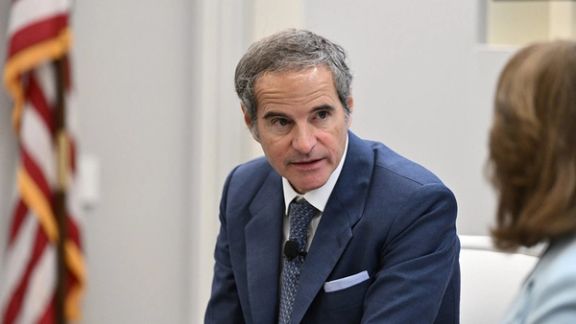
Iran's Supreme Leader has sent a direct message to his Chinese counterpart vowing a steady commitment to their strategic partnership no matter the outcome of ongoing nuclear talks with the US, a source familiar with the matter told Iran International.

Foreign Minister Abbas Araghchi is traveling to Beijing on Tuesday with Ali Khamenei’s letter to Xi Jinping, a diplomatic source familiar with the message told Iran International.

The move comes days before Araghchi is expected to hold a third round of talks with US envoy Steve Witkoff.

“In his message to Xi, the Supreme Leader emphasized that the Islamic Republic remains fully committed to the 25-year cooperation agreement with China,” the source added.

“He added that Iran’s ‘Look to the East’ policy is a foundational pillar of its foreign relations and will not be altered by any rapprochement with Washington.”

The outreach comes as Iran’s role in China’s Belt and Road Initiative (BRI) has remained marginal.

Despite close political ties and a comprehensive strategic agreement signed, Chinese investments in Iran have lagged far behind expectations. Only two major deals were struck between 2013 and 2023, with one later annulled following the US exit from a 2015 nuclear deal.

Iran and the United States this month engaged in two rounds of nuclear negotiations, first in Muscat and then in Rome, mediated by Oman. The initial talks in Muscat were described as "positive and constructive," with both sides agreeing to continue discussions the following week.

A third round of talks is slated for Saturday, as the two sides approach a 60-day deadline set by the US president for achieving a deal on Tehran's disputed nuclear program.

In late March, Trump threatened to bomb Iran and impose secondary sanctions if no nuclear deal is reached with Tehran.

Post-2015 opening to West 'won't be repeated’

According to the same diplomatic source, Khamenei’s message also referenced Iran’s cautious opening up to diplomacy and economic cooperation with the West following a 2015 nuclear agreement, telling Xi that such a change in orientation would not be repeated.

“The message was meant to reassure China that any agreement with the US is solely intended to reduce tensions,” the source said.

In his weekly press briefing on Monday, Iran's Foreign ministry spokesman Esmail Baghaei said Tehran continues to coordinate with allies, adding, “It is natural that we will brief China on the latest in the Iran-US talks.”

Iran's former Foreign Minister Mohammad Javad Zarif and China's Foreign Minister Wang Yi bump elbows during the signing ceremony of a 25-year cooperation agreement, in Tehran, Iran March 27, 2021.
100%
Iran's former Foreign Minister Mohammad Javad Zarif and China's Foreign Minister Wang Yi bump elbows during the signing ceremony of a 25-year cooperation agreement, in Tehran, Iran March 27, 2021.

Araghchi’s trip to Beijing mirrors a recent effort in which Iran’s foreign minister delivered a similar message from Khamenei to Russian President Vladimir Putin ahead of earlier talks in Italy.

Though China remains Iran’s top trading partner, Chinese firms have signed far more lucrative contracts with Saudi Arabia and the UAE in recent years.

Since taking office, the Trump administration has escalated pressure on Iran by targeting Chinese teapot refineries—independent processors of Iranian crude that have served as a vital economic conduit for Tehran under sanctions.

Iranian state TV apologizes after satirical show mocked Saudi minister

Apr 22, 2025, 14:11 GMT+1

One of Iran's state television channels, Nasim TV, has apologized for a satirical program that mocked a Saudi Arabian official, saying the incident was a negligent mistake and that disciplinary action has been taken against those responsible.

The Tasnim news agency reported that a video circulating online showed actor Mohsen Afshani seemingly making fun of the Saudi foreign minister through what appeared to be digitally altered content.

The timing of the broadcast, just a week after the Saudi defense minister's trip to Iran, drew widespread criticism online and in some media outlets, raising questions about potential efforts to undermine the improving bilateral relations and the government's foreign policy objectives, including ongoing talks with the United States.

While Nasim TV did not name the program in its statement, it acknowledged that "some political policy lines regarding neighboring countries were inadvertently disregarded" in a recorded satirical show.

The network assured the public that those responsible for the lapse would face disciplinary measures.

The Financial Times, citing analysts close to the Saudi leadership, reported last week that Saudi Arabia’s defense minister used a high-level visit to Tehran to signal Riyadh’s opposition to military confrontation with Iran.

“Saudi is clearly sending a message to Tehran that it will not be a conduit in any fashion towards an attack on Iran,” said Ali Shihabi, a Saudi commentator close to the royal court. “The kingdom supports President [Donald] Trump’s efforts to find a diplomatic solution to the nuclear crisis, and doesn’t want a war.”

Prince Khalid bin Salman’s visit took place just days before Iran resumed nuclear talks with the United States. Bin Salman is the highest-ranking Saudi royal to visit Iran in decades and includes the kingdom’s ambassador to Yemen.

Saudi and Iran only resumed diplomatic ties in 2023 after a seven-year hiatus following an attack on the Saudi embassy in Tehran which drove a wedge between the two powers.

Iran nuclear chief says facilities safe in face of military threats

Apr 22, 2025, 10:58 GMT+1

The head of Iran’s Atomic Energy Organization said Tuesday that the country's nuclear sites are protected against threats, just weeks after US President Donald Trump threatened to bomb Iran if it did not agree to a new nuclear deal.

“Good measures have been considered, and effective steps have been taken to fortify them," Mohammad Eslami said, speaking at an event marking the anniversary of the establishment of Iran's Islamic Revolutionary Guard Corps (IRGC).

Last month, US President Donald Trump warned of bombing Iran if Tehran failed to reach a deal over its nuclear program, vowing to quash Iran's ability to build nuclear weapons. Israel has also repeatedly threatened to bomb Iran’s nuclear sites.

Eslami said effort to fortify the facilities are ongoing. "Extensive efforts have been made in recent years, and many vulnerabilities have been addressed. The current safety conditions are not comparable to the past,” Eslami added.

According to Axios, in addition to extensive damage to air defense systems, the Israeli air attack on Iran last October destroyed an active top secret nuclear weapons research facility in Parchin.

Amid a national energy crisis, Tehran emphasizes on the importance of its nuclear program, with Eslami pointing to the Bushehr power plant as a key example of nuclear energy's value.

He said that Iran spent $1.87 billion on the Bushehr plant, which has led to $8 billion in fuel savings.

"Electricity produced from nuclear power plants can effectively reduce the total cost of electricity production and return energy subsidies directly or indirectly to people's tables," Eslami said.

However, he acknowledged that nuclear power currently makes up a small fraction of Iran’s energy mix, limiting its impact on average electricity prices. “We are still in the early stages of broad nuclear electricity use, and its share in the national energy basket is very low,” he added.

Nuclear cooperation gives Russia key role in US talks, Tehran says

Apr 22, 2025, 09:31 GMT+1

Iran said on Tuesday that Russia’s position as a permanent member of the UN Security Council, coupled with its close nuclear cooperation with Tehran, positions Moscow as a key player in efforts to reach a nuclear deal with the US.

“Russia’s role as a permanent Security Council member is important, and the nuclear cooperation between Iran and Russia naturally gives it a key part to play,” government spokeswoman Fatemeh Mohajerani said on Monday, according to Iranian media.

The remarks come as speculation grows over Russia’s potential role in Iran-US talks.

According to a Guardian report published Sunday, Russia could play a central role in any future nuclear deal, with Moscow being considered not only as a potential destination for Iran’s stockpile of highly enriched uranium, but also as a possible arbiter in the event of breaches to the agreement.

The report said that one option under discussion would allow Russia to "return the handed-over stockpile of highly enriched uranium to Tehran" if the US were to violate the deal, ensuring Iran is not penalized for American non-compliance.

Mohajerani said Iran is “hopeful the good management we’re seeing from that side [the US] will help move things in a positive direction,” but emphasized that Tehran will not accept prolonged negotiations.

“We do not welcome exhausting, lengthy negotiations. A good agreement that protects our national interests is possible in the short term," she added.

Reiterating the importance of sanctions relief, she said, “Lifting sanctions should have a real impact on people’s lives".

Only Sunday, she told the state news agency, “In the continuation of the negotiation path, we will welcome any practical initiative aimed at lifting sanctions".

Not only is Iran under sanctions for its nuclear program, but since the 2022 uprising, has been sanctioned for human rights abuses in addition to sanctions for its support of Russia's war on Ukraine.

Saudi Defense Minister Prince Khalid bin Salman and Iran's Supreme Leader Ali Khamenei
100%
Saudi Defense Minister Prince Khalid bin Salman and Iran's Supreme Leader Ali Khamenei

Saudi visit 'beyond ordinary,' signals deeper ties

Highlighting the country's strengthening ties with its Arab neighbors, Mohajerani described the recent visit of Saudi Arabia’s defense minister to Tehran as a significant and strategic development.

“This visit went beyond a routine trip,” she said. “It carried a message from the Saudi King and included important talks. It reflects Saudi Arabia’s resolve to deepen cooperation with Iran.”

The two nations had cut diplomatic ties between 2016 and 2023 after an attack on the Saudi embassy in Tehran, but today, Iran views Saudi Arabia as a critical regional partner, she said.

Strengthening ties with neighbors—especially Muslim countries—is a priority under the Pezeshkian administration's foreign policy.

It has also seen growing ties with the United Arab Emirates, which also cut diplomatic relations in the wake of the Saudi embassy incident, until reinstating them in 2022.