• العربية
  • فارسی
Brand
  • Iran Insight
  • Politics
  • Economy
  • Analysis
  • Special Report
  • Opinion
  • Podcast
  • Iran Insight
  • Politics
  • Economy
  • Analysis
  • Special Report
  • Opinion
  • Podcast
  • Theme
  • Language
    • العربية
    • فارسی
  • Iran Insight
  • Politics
  • Economy
  • Analysis
  • Special Report
  • Opinion
  • Podcast
All rights reserved for Volant Media UK Limited
volant media logo

IAEA’s Grossi presses for role in Iran-US Talks, urges full verification

Apr 17, 2025, 13:08 GMT+1Updated: 08:38 GMT+0
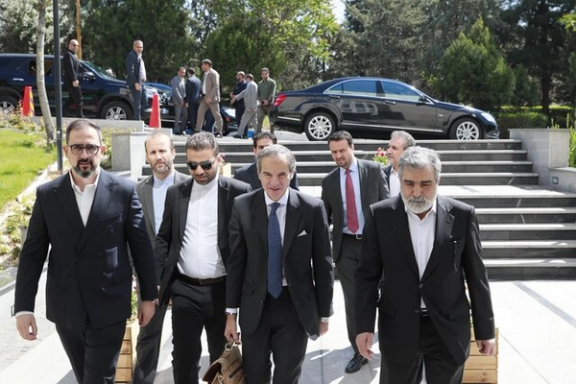
IAEA Chief Rafael Grossi enters Iran's Atomic Energy Agency on April 17, 2025.

The UN watchdog must be part of nuclear negotiations between Iran and the United States, said International Atomic Energy Agency chief Rafael Grossi, calling its involvement essential to any future deal’s credibility.

Grossi spoke during his visit to Tehran on Thursday, following talks with senior Iranian officials ahead of a new round of US-Iran diplomacy expected to continue in Rome.

US President Donald Trump has threatened to bomb Iran if the negotiations fail.

“I am also in contact with the American negotiator to see how the agency can be a bridge between Iran and the US, and help achieve a positive outcome in the negotiations,” Grossi said. He added that IAEA verification would be required for any agreement to be considered valid.

Grossi has been invited to Rome for the occasion of the second round of Iran-US talks, Reuters reported citing a diplomatic source. However, Iran's deputy FM says it's too soon to engage the IAEA in the talks.

In February, the agency warned that Iran was enriching uranium to near weapons-grade levels, calling the situation “of serious concern.” Tehran has consistently denied seeking nuclear arms.

Iranian Foreign Minister Abbas Araghchi and nuclear chief Mohammad Eslami met Grossi during his trip.

“Had useful discussion with visiting IAEA chief Grossi,” Abbas Araghchi wrote in a post on X. “In the coming months, the Agency can play a crucial role in peaceful settlement of the Iranian nuclear file.”

Araghchi also warned of potential domestic spoilers in the process, adding: “We need a Director General of Peace.”

The agency’s position has gained traction with US officials, who have made broader inspections a central demand.

On Monday, Trump's Envoy Steve Witkoff said in an interview with Fox News that “This is going to be much about verification on the enrichment program, and then ultimately verification on weaponization. That includes missiles—the type of missiles that they have stockpiled there—and it includes the trigger for a bomb.”

If Iran's uranium enrichment is curtailed or banned altogether, strict monitoring would become necessary. Witkoff also mentioned Iran's ballistic missile program as part of any potential nuclear weaponization and urged inspections.

Most Viewed

Iran negotiators ordered to return after internal rift over Islamabad talks
1
EXCLUSIVE

Iran negotiators ordered to return after internal rift over Islamabad talks

2
ANALYSIS

US blockade enters murky phase as tankers spoof signals and buyers hesitate

3
ANALYSIS

Why the $100 billion Hormuz toll revenue is a myth

4

US tightens financial squeeze on Iran, warns banks over oil money flows

5
ANALYSIS

US blockade targets Iran oil boom amid regional disruption

Banner
Banner

Spotlight

  • Hardliners push Hormuz ‘red line’ as US blockade tests Iran’s leverage
    INSIGHT

    Hardliners push Hormuz ‘red line’ as US blockade tests Iran’s leverage

  • Ideology may be fading in Iran, but not in Kashmir's ‘Mini Iran'
    INSIGHT

    Ideology may be fading in Iran, but not in Kashmir's ‘Mini Iran'

  • War damage amounts to $3,000 per Iranian, with blockade set to add to losses
    INSIGHT

    War damage amounts to $3,000 per Iranian, with blockade set to add to losses

  • Why the $100 billion Hormuz toll revenue is a myth
    ANALYSIS

    Why the $100 billion Hormuz toll revenue is a myth

  • US blockade targets Iran oil boom amid regional disruption
    ANALYSIS

    US blockade targets Iran oil boom amid regional disruption

  • Iran's digital economy battered by prolonged blackout
    INSIGHT

    Iran's digital economy battered by prolonged blackout

•
•
•

More Stories

Why Iran prefers Oman’s mediation and Muscat as venue for US talks

Apr 17, 2025, 12:25 GMT+1
•
Maryam Sinaiee

Tehran has reluctantly agreed to hold the upcoming talks with the United States in Rome rather than Muscat. However, it insists that Oman will continue to play its central mediating role, even as negotiations move to Italy.

In a live televised interview on Wednesday evening, Iran's Deputy Foreign Minister Kazem Gharibabadi downplayed the significance of the venue change. “We should not waste our time on the location and timing of the talks,” he said. “We agreed to multiple changes in the location. It’s not an important issue.”

However, Gharibabadi stressed that Oman would continue to facilitate and mediate the negotiation in the Italian capital.

Oman’s role as mediator and preferred host

Oman has long served as a discreet and trusted intermediary between Tehran and Washington. Its role dates back to the early 2010s, when Muscat hosted secret backchannel talks that ultimately led to the 2015 nuclear deal (JCPOA). The United States also sees Oman as a discreet and stable mediator with a history of hosting secret talks with Tehran.

Oman played a crucial, behind-the-scenes role in facilitating the September 2023 exchange of five American detainees in Iran, widely regarded as hostages, and several Iranians held in the US who were accused or convicted of sanctions violations. The deal, brokered with Qatar’s involvement, included the transfer of around $6 billion in frozen Iranian funds from South Korea to accounts in Qatar that have not been released to Iran yet.

Geographic proximity—just a two-hour flight from Tehran—and Oman’s low media profile also make it attractive to Iran. In contrast, European capitals like Vienna or Geneva pose higher risks of media exposure, diplomatic interference, and intelligence surveillance.

Additionally, holding talks in Muscat sends a domestic political signal: resistance to Western pressure, particularly from European countries aligned with Washington on contentious issues like Iran’s missile program, regional policies, and sanctions.

Tehran’s concerns over security risks in European capitals

Tehran’s reluctance to hold talks in Europe also stems from security concerns, particularly fears of espionage and surveillance. Iranian officials remain wary of cyber-espionage in European cities, where Western and Israeli intelligence agencies are believed to be more active.

They are especially concerned about the heightened risk of electronic surveillance targeting the Iranian delegation in hotels, diplomatic sites, and transportation hubs, as well as the possible interception of sensitive communications.

Cyber-espionage during JCPOA talks

In March 2015, senior US officials told the Wall Street Journal that American negotiators in the talks in Austria and Switzerland had been briefed about the threat of Israeli eavesdropping during the nuclear talks that led to the conclusion of the 2015 nuclear deal (JCPOA). There were media reports that then US Secretary of State John Kerry and Iran's top negotiator Mohammad-Javad Zarif took walks outside the venue of talks to discuss important issues to avoid eavesdropping.

A few days ahead of the final round of the talks in Vienna in June of the same year, the cybersecurity company Kaspersky reported finding a variant of the Stuxnet virus in the networks of three hotels that hosted the negotiations. The company’s report said infected computers could be used to control cameras, microphones, and phone systems at these hotels to spy on the talks and delegations. Symantec, another security company, confirmed Kaspersky’s findings. 

“The disastrous history of Israel spying on its allies and the incompetence of Western surveillance agencies is a major concern for the Iranian delegation,” said an article titled “What Makes the Decision on Venue of Nuclear Talks Complicated” published by Fararu on Thursday.

The article added that preventing leaks from European diplomats and shielding the process from Israeli or other cyber sabotage likely explains Tehran’s insistence on having the Omani embassy in Rome serve as the host, even if the physical location is no longer Muscat.

Dissident protests possible in European capitals

Another factor influencing Tehran’s preference is the visibility of exiled Iranian dissident groups in Europe, including the Mujahedin-e Khalq (MEK) and monarchist factions. These groups often mobilize large crowds to protest outside the venue of talks, creating negative optics and media coverage that Iranian officials find politically damaging.

Such protests are far less likely to occur in Oman, where dissident groups have limited reach and the government maintains tighter control over public demonstrations.
Iran's conservative media warn against overreliance on US talks

Apr 17, 2025, 10:56 GMT+1

Tehran media outlets controlled by hardliners warned the government on Thursday not to place hope in the outcome of renewed talks with the United States, set to resume in Rome on Saturday.

The commentaries follow five days of speculation over the venue for the second round of talks, along with a considerable degree of public negotiations in which both sides voiced at times contradictory positions.

Kayhan, a daily overseen by Supreme Leader Ali Khamenei’s office, warned that portraying negotiations as the solution to Iran’s economic problems is both misleading and dangerous. This view aligns with Khamenei’s longstanding position since 2018, when President Donald Trump withdrew from the JCPOA nuclear deal and reimposed sanctions. At the time, Khamenei rejected negotiations with Trump and insisted that Iran could endure the pressure without making concessions.

“A tainted and mission-driven current inside the country promotes the idea that 100 percent of our economic troubles stem from sanctions, and that negotiations are the only way to remove them,” the paper wrote.

“This viewpoint was already tested during the JCPOA and yielded nothing but ‘sheer loss’.”

Kayhan did not reject talks outright but insisted they should remain limited.

“We must not abandon negotiations altogether,” the editorial continued. “But we must not put all our eggs in that basket either. At most, 30 percent of our economic problems are due to sanctions, and negotiations should be treated as just one of several tools—not the only one.”

Calling for a wartime posture across government institutions, Kayhan urged officials to invest in domestic capabilities.

“When the enemy, led by the US, threatened us with gasoline sanctions, we could have negotiated,” the paper wrote. “But what proved durable and reliable was relying on domestic capabilities… In the end, the gasoline sanctions were rendered ineffective through trust in revolutionary youth and round-the-clock efforts.”

Javan, a publication linked to the Revolutionary Guard, echoed the skepticism, warning against polarizing discourse.

“Extreme optimism or pessimism about talks risks fueling a false political dichotomy in foreign policy,” the paper wrote.

“A realistic approach strengthens the negotiating team’s resolve, avoids sending weak signals to the opponent, and builds the dignity and prudence necessary for successful diplomacy,” Javan concluded.

Iran and the US held the first round of nuclear talks in Muscat last Saturday, with both sides calling the exchange constructive. But remarks by the US representative—who initially said Iran could retain limited enrichment but later demanded a complete halt to nuclear activity—have heightened tensions.

Influential commentator, hawkish senators urge hard US line on Iran

Apr 16, 2025, 16:30 GMT+1

Two Republican US senators publicly endorsed a right-wing commentator close to Donald Trump who argued against what he called appeasement of Iran and appeared to criticize the president's advisors amid ongoing nuclear talks with Tehran.

Talk show host Mark Levin argued against "another diplomatic solution with an Islamist-Nazi Regime," in a lengthy post on X.

"I’ve great faith in President Trump. Not in some of those trying to pressure him to appease the Iranians, and who none of us voted for and who most Americans know nothing about," in an apparent reference to Trump's advisors.

"I support the President completely when he says no nukes for Iran, I know he means it. We should immediately rally around him and his declaration and let him know we agree. No nukes for Iran. No “peace in our time” phony declarations being urged on him. Either Iran provably and immediately dismantles its development of nuclear weapons or we will do it for them," he added.

Quoting the post, Texas senator Ted Cruz said: "The great @marklevinshow is exactly right. Anyone urging Trump to enter into another Obama Iran deal is giving the President terrible advice."

"@realDonaldTrump is entirely correct when he says Iran will NEVER be allowed to have nukes. His team should be 100% unified behind that," he added.

Another outspoken critic of Tehran, Arkansas senator Tom Cotton, said: "This is correct ... As President Trump said, the only solution is Iran completely dismantling its program, or we should do it for them."

"Allowing this maniacal terrorist regime to threaten America and the world with a nuclear weapon is unacceptable. Those who minimize the risk of this regime are dead wrong."

Iranian hardliners raise stakes ahead of new round of US talks, IAEA visit

Apr 16, 2025, 10:37 GMT+1

An Iranian conservative daily warned Tuesday that the country could expel international nuclear inspectors and relocate its enriched uranium if military threats intensify, injecting new tension into Tehran-Washington relations.

The warning came just hours before Rafael Grossi, the director of the International Atomic Energy Agency (IAEA) was due to arrive in Tehran.

“If a serious military threat emerges, Iran will expel the inspectors, cut their access, and move nuclear materials to locations beyond reach,” Farhikhtegan wrote.

It accused the IAEA of political bias and said Grossi’s previous visits had yielded cooperation only from Iran. “Despite Iran’s compliance, the agency has published reports that fuel anti-Iran resolutions,” it added.

Grossi’s visit coincides with the anticipated second round of negotiations between Iranian and US officials. While details of the agenda remain unclear, the talks have stirred strong opposition across Iran’s ultraconservative press, particularly following mixed signals from Washington.

After the first round of negotiations in Oman on Saturday, US envoy Steve Witkoff said Monday that Iran might be allowed to continue low-level enrichment under a deal resembling the original JCPOA. But on Tuesday, he tweeted that “Iran must stop and eliminate its nuclear enrichment and weaponization program.”

“A deal with Iran will only be completed if it is a Trump deal," the special envoy said.

The hardline daily Kayhan, overseen by Supreme Leader Ali Khamenei's office, focused on Tuesday on Witkoff’s new comments and accused the US of using diplomacy to mask coercive aims.

Editor Hossein Shariatmadari wrote that Witkoff’s offer in earlier talks had “no more value than a cheap political ruse,” adding that the US had “flunked its first test of sincerity.”

“The Americans pretend to negotiate, but their demands expose their true intentions—disarming the Islamic Republic and and plowing its land and people,” Shariatmadari said.

Meanwhile, senior Iranian military adviser Brigadier General Hossein Ashtari told ILNA news agency that Tehran’s stance would not change under pressure.

“Our positions are firm. It is the Americans and the Zionists who must adjust to Iran’s terms,” he said.

With nuclear inspectors in Tehran and diplomacy on a knife’s edge, Iran’s conservative media are pushing a dual message: cooperation remains conditional, but retaliation, if provoked, would be decisive.

With slow progress in talks, Iranians fear Trump may lose patience

Apr 16, 2025, 08:22 GMT+1
•
Behrouz Turani

In the days leading up to the second round of talks between Iranian and US delegations, confusion persisted over the venue and agenda of the meeting.

The two sides had initially agreed to meet in Rome. However, a disagreement reportedly arose between Iranian officials—who insisted on holding the meeting at the Omani Embassy in Rome—and the Italian government, which maintained that the talks should take place at the Italian Foreign Ministry. This prompted Tehran to make a last-minute announcement on the evening of April 14 that the meeting would instead be held in Oman.

The US side has not publicly commented on the dispute over the location. However, President Donald Trump, who had previously expressed cautious optimism following the first round, criticized the week-long gap between meetings, suggesting that Iran was stalling. “They've got to go fast, because they're fairly close to having one, and they're not going to have one,” he said, referring to Iran’s nuclear capability.

Iranian officials had also requested that Omani Foreign Minister Sayyid Badr Albusaidi attend the Rome meeting, though they did not provide an explanation for the request.

While Iran’s state broadcaster—heavily influenced by the ultraconservative Paydari Party—has been reluctant to cover the first and second meetings with the Americans, the government broke its silence by releasing previously undisclosed information exclusively to the Tehran Times, an English-language daily. Notably, this disclosure bypassed the many Persian-language newspapers published in Tehran.

Supreme Leader Ali Khamenei also weighed in on the talks during a speech on Tuesday. Echoing Trump’s earlier tone, he expressed cautious optimism and said the Iranian negotiating team had performed well.

In a commentary, Eco Iran, a Telegram channel known for serious coverage of domestic politics and economics, wrote: “Despite their historic hostility, an agreement is still possible between Tehran and Washington.” The channel added that Trump had succeeded in pushing Tehran to move its red lines. “The meeting showed that neither Iran nor the United States wants another war in the region,” it added.

Eco Iran also noted growing anxiety among Iranians at home, with many watching the negotiations closely while fearing that Trump’s patience might wear thin. The channel added that Israel is monitoring the talks with concern—especially as Trump may offer Saudi Arabia access to nuclear technology and uranium enrichment during his upcoming visit to Riyadh.

Meanwhile, the pro-reform Telegram channel Jamaran, which is affiliated with former President Mohammad Khatami, posted that many Iranians—particularly those in the middle class—have long supported meaningful engagement with the United States. “Now that the talks have started, the Iranian people are closely watching the developments and discussing them widely,” the channel wrote.

Jamaran added that the public perception is shifting, with many now believing that the government has finally chosen negotiations as a path to address the country’s mounting challenges. It also emphasized that for more than two decades, polls have consistently shown that Iranians favor diplomacy with the West, while also demanding respect for national dignity and interests.

The centrist Telegram channel Emtedad published a commentary by journalist Davoud Heshmati, who welcomed former US Secretary of State John Kerry’s suggestion that any future agreement with Iran should be ratified by the US Senate. He argued that such a step would help reassure Iranians concerned about the possibility of a future US president walking away from the deal.

The comment reflects lingering distrust in Iran toward Trump, with many fearing that even if a new agreement is reached, it could once again be revoked by him—or a successor.