• العربية
  • فارسی
Brand
  • Iran Insight
  • Politics
  • Economy
  • Analysis
  • Special Report
  • Opinion
  • Podcast
  • Iran Insight
  • Politics
  • Economy
  • Analysis
  • Special Report
  • Opinion
  • Podcast
  • Theme
  • Language
    • العربية
    • فارسی
  • Iran Insight
  • Politics
  • Economy
  • Analysis
  • Special Report
  • Opinion
  • Podcast
All rights reserved for Volant Media UK Limited
volant media logo

Iran’s shrinking water reserves threaten crisis
Mar 18, 2025, 11:38 GMT+0Updated: 08:49 GMT+0

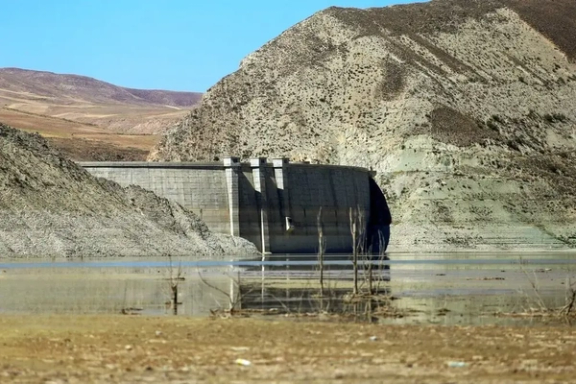
Iran’s key reservoirs are reaching dangerously low levels as years of declining rainfall and heavy reliance on hydropower take their toll, a senior water official warned.

Isa Bozorgzadeh, spokesman for Iran’s water industry, said on Tuesday that the usable capacity of Karaj Dam near Tehran has dropped to nearly half, much of it rendered useless due to sediment buildup.

“Lar Dam has practically dried up, and Latian, Taleqan, and Mamloo reservoirs are facing a 46% decrease in rainfall compared to the average and 25% compared to last year,” he told ILNA news agency.

Water shortages have triggered growing concerns in recent weeks, particularly in Tehran and Isfahan provinces, where officials have raised the possibility of rationing.

Bozorgzadeh cautioned that Tehran is consuming 50 million cubic meters of surface water each month while the combined reserves of the capital’s five main dams—including dead storage and sediment—amount to just 60 million cubic meters.

100%

“Conditions have deteriorated to the point where even a motorcyclist could drive through the reservoirs,” he said.

Eastern Tehran’s water and wastewater company reported that Latian and Mamloo dams are each only 12% full, while Lar is down to just 1%. Karaj, a historically stable reservoir, has shrunk to 7% capacity.

Iran’s water supply depends largely on rainfall, snowmelt, and underground aquifers, but decades of over-extraction have left groundwater tables severely depleted. The sharp decline in precipitation—down more than 40% in Tehran province relative to long-term averages—has compounded the problem.

Beyond Tehran, Bozorgzadeh identified Hormozgan, Sistan and Baluchestan, Khuzestan, Kohgiluyeh and Boyer-Ahmad, and Bushehr as regions struggling with a 50% drop in rainfall.

100%

Government spokeswoman Fatemeh Mohajerani acknowledged the severity of the situation, saying, “A nationwide decrease in average rainfall this year has led to shortfalls as high as 75% in some provinces.”

Iran’s energy ministry reports show that despite lower rainfall, hydropower generation increased by 24% in the fiscal year beginning March 2023, amid the country's energy crisis, reaching 17 terawatt-hours and maintaining that level into the current year.

Dalga Khatinoglu, an oil and gas analyst, suggested the government’s decision to sustain hydroelectric output was a factor in the current crisis.

“Iran failed to achieve its planned growth in thermal and renewable energy, leaving it dependent on hydropower,” he told Iran International. “Over the past two years, the country commissioned just 4 gigawatts of new plants—about 30% of its target—with 90% being gas-fired. The rest came from renewables.”

Hydropower reliance, combined with a persistent drought, has accelerated reservoir depletion, leaving little room for recovery even if precipitation levels were to improve.

Meanwhile, Iranian media has begun to raise alarms about broader implications. Etemad newspaper warned that 2025 could mark a turning point in the country’s water and energy crisis, predicting that shortages could become more severe than any previously experienced. Some hydrologists have cautioned that Iran has used up nearly 1,000 years' worth of groundwater reserves in just three decades.

Most Viewed

Iran negotiators ordered to return after internal rift over Islamabad talks
1
EXCLUSIVE

Iran negotiators ordered to return after internal rift over Islamabad talks

2
ANALYSIS

US blockade enters murky phase as tankers spoof signals and buyers hesitate

3
ANALYSIS

Why the $100 billion Hormuz toll revenue is a myth

4

US tightens financial squeeze on Iran, warns banks over oil money flows

5
ANALYSIS

US blockade targets Iran oil boom amid regional disruption

Banner
Banner

Spotlight

  • Hardliners push Hormuz ‘red line’ as US blockade tests Iran’s leverage
    INSIGHT

    Hardliners push Hormuz ‘red line’ as US blockade tests Iran’s leverage

  • Ideology may be fading in Iran, but not in Kashmir's ‘Mini Iran'
    INSIGHT

    Ideology may be fading in Iran, but not in Kashmir's ‘Mini Iran'

  • War damage amounts to $3,000 per Iranian, with blockade set to add to losses
    INSIGHT

    War damage amounts to $3,000 per Iranian, with blockade set to add to losses

  • Why the $100 billion Hormuz toll revenue is a myth
    ANALYSIS

    Why the $100 billion Hormuz toll revenue is a myth

  • US blockade targets Iran oil boom amid regional disruption
    ANALYSIS

    US blockade targets Iran oil boom amid regional disruption

  • Iran's digital economy battered by prolonged blackout
    INSIGHT

    Iran's digital economy battered by prolonged blackout

•
•
•

More Stories

Iran's currency falls to one million per dollar after Trump threat

Mar 18, 2025, 11:28 GMT+0

A day after US President Donald Trump warned Iran of retaliation if its Houthi allies in Yemen launched an attack, the rial sank to a historic low against major currencies.

The currency was trading at one million per US dollar in Tehran on Tuesday as gold prices also rose. This represents a 14,000-fold devaluation of the rial, which had remained stable at 70 per dollar for over a decade before the 1979 Islamic Revolution.

Food inflation, which has averaged 100% in recent months, is expected to reach critical levels in the coming months unless Tehran initiates negotiations with the Trump administration.

The rial, which was valued at around 40,000 per dollar in early 2018, began to plummet after Trump withdrew from the JCPOA nuclear deal in May of that year and imposed tough economic sanctions, pushing inflation above 40%.

Despite long negotiations with the Biden administration in 2021-2022, Tehran did not reach an agreement with the US over reviving the JCPOA and its economic situation continued to deteriorate.

In February, President Trump called for new negotiations, stressing that Iran must not acquire nuclear weapons and vowing to tighten sanctions. So far, Supreme Leader Ali Khamenei has rejected talks, while Iranian officials maintain that Tehran will not negotiate under pressure.

Three days ago, Trump ordered air strikes against the Yemeni Houthis who have attacked international shipping in the Red Sea region and lobbed missiles at Israel. This was seen as a clear warning to Tehran. On Monday, Trump warned Tehran that it will be punished if its allies the Houthis retaliate against a US air assault over the weekend, escalating his rhetoric against Tehran.

"Every shot fired by the Houthis will be looked upon, from this point forward, as being a shot fired from the weapons and leadership of IRAN, and IRAN will be held responsible, and suffer the consequences, and those consequences will be dire!" Trump wrote on his Truth Social platform.

As tens of millions of Iranians earn the equivalent of less than $150 a month and inflation is rising, some media outlets and commentators in Tehran have warned of potential unrest.

UN rapporteur warns Iran is accelerating use of executions to crush dissent

Mar 18, 2025, 10:52 GMT+0

The United Nations special rapporteur on human rights in Iran, Mai Sato, has warned that the Islamic Republic is increasing its use of executions as a tool to suppress dissent as she presented her first report to the UN Human Rights Council in Geneva on Tuesday.

“The pace is accelerating with at least 169 known executions identified in January and February alone. Should this alarming rate remain consistent, the total number of executions could exceed 1,000 this year, a chilling threshold that demands a collective global response,” Sato warned.

Last year, at least 975 people were executed in Iran, a 17% increase from the 834 executions recorded the previous year, according to a joint report released by the Iran Human Rights Organization (IHRNGO) and Together Against the Death Penalty (ECPM).

It has stepped up since the 2022 uprising. In 2023, the UN quickly identified Tehran's utilising the death penalty to quash dissent.

"Criminal proceedings and the death penalty are being weaponised by the Iranian government to punish individuals participating in protests and to strike fear into the population so as to stamp out dissent, in violation of international human rights law," the UN Human Rights Office (OHCHR) said at the time.

Sato also highlighted the ongoing discrimination against religious and ethnic minorities, the lack of transparency in human rights cases, and the continued crackdown on protests and dissent.

Religious minorities, including Baha’is, Sunnis, and Christian converts, as well as ethnic groups such as Turks, Kurds, Arabs, and Baluchis, remain targets of state repression, she said.

She cited reports of arbitrary arrests, unfair trials, and executions targeting these communities.

Sato also raised concerns about the rising number of executions of women, naming three political prisoners—Pakhshan Azizi, Varishe Moradi, and Sharifeh Mohammadi—who are currently on death row.

At least 179 cases of femicide were documented in Iran last year, she said, adding that women in Iran continue to face systemic discrimination under laws that devalue their testimony in court and restrict their rights in employment and other areas.

Sato said human rights defenders, journalists, and lawyers are being harassed, intimidated, and threatened, particularly in Iranian prisons, where many are denied medical treatment.

She also noted that families of political prisoners face threats outside of prison.

UN fact-finding mission reports sexual violence in Iranian prisons

Sara Hussain, the head of the UN Independent Fact-Finding Mission on Iran, told the council that Iranian authorities have committed widespread human rights violations, including extrajudicial detentions, torture, and sexual violence against prisoners.

"These acts constitute crimes against humanity and gender-based violence," she said.

The fact-finding mission has previously documented the use of torture, forced confessions, and intimidation tactics against detainees.

Calls for Iran to end repression

Representatives from multiple countries called on Iran to halt executions and end its crackdown on dissent.

Germany urged the Islamic Republic to stop executions and guarantee fundamental freedoms, while Switzerland highlighted multiple human rights violations and called for an end to repression.

Spain, Australia, and North Macedonia demanded an end to the persecution of human rights activists and the execution of political prisoners.

The Netherlands called for an extension of the UN fact-finding mission’s mandate, saying Iran has committed "crimes against humanity."

Belgium said the sharp rise in executions was deeply concerning, while Albania condemned the Islamic Republic’s attempts to assassinate dissidents.

Chile described a recent visit by a UN human rights delegation to Iran as a positive step but stressed that "without gender equality, there is no democracy."

Iran's allies push back against criticism of Tehran's human rights record

In contrast, Iran's ally, Venezuela, dismissed the UN fact-finding mission as a politically motivated effort to pressure Iran.

North Korea, also an ally of Iran, accused the international community of systematically targeting Iran and called on the Human Rights Council to end its "double standards."

Allies China, Venezuela, Cuba, and Ethiopia also defended Iran’s human rights record, with Ethiopia criticizing what it called the "politicization" of the issue.

Sudan also said that Iran’s human rights situation was improving and called for respect for each country’s right to determine its own approach to human rights.

Yemen’s Houthis vow to continue Red Sea attacks, defying Iran's plea for calm

Mar 18, 2025, 10:24 GMT+0

Yemen's Houthi foreign minister said the group will not halt its Red Sea attacks on shipping, despite Iran's reported calls for de-escalation.

Jamal Amer told Reuters late on Monday that the Houthis would continue their actions despite US military strikes and requests from allies, including Iran.

"There will be no talk of any dialing down of operations before ending the aid blockade in Gaza. Iran is not interfering in our decision but what is happening is that it mediates sometimes but it cannot dictate things," Amer said.

This comes as two senior Iranian officials told Reuters on condition of anonymity that Tehran had delivered a verbal message to the Houthi envoy in Tehran on Friday, urging them to de-escalate. Amer said, however, that he had not been informed of any message Iran delivered to the Houthi envoy in Tehran.

Iran's Foreign Minister asked Oman, a known mediator with the Houthis, to convey a similar message during a visit to Muscat earlier this week, according to Reuters.

Iran has not made any public comment about recent outreach to the Houthis over their renewed action. Tehran says the group takes decisions independently, a statement echoed by the Houthis themselves.

"(The US) is threatening Iran and hitting Yemen. Now all scenarios are possible. We will do what they will do to us. If they are hitting us from (US aircraft carrier USS Harry S) Truman, we will retaliate by hitting Truman," the Houthi foreign minister said.

Amer acknowledged messages from other powers to de-escalate, but declared, "Now we see that Yemen is at war with the US and that means that we have a right to defend ourselves with all possible means, so escalation is likely."

US President Donald Trump warned Iran on Monday that it will be punished if its Yemeni allies the Houthis retaliate against a US air assault over the weekend, escalating his rhetoric against Tehran.

"Every shot fired by the Houthis will be looked upon, from this point forward, as being a shot fired from the weapons and leadership of IRAN, and IRAN will be held responsible, and suffer the consequences, and those consequences will be dire!" Trump wrote on his Truth Social platform.

Trump on Saturday ordered large-scale military strikes against dozens of targets in Yemen controlled by Tehran-backed Houthi armed group, saying the attacks aimed at ensuring freedom of navigation through shipping lanes the militants have targeted.

Earlier this week, IRGC Commander Hossein Salami denied US accusations of Iranian control over the Houthis' actions.

"We have always declared, and we declare today, that the Yemenis are an independent and free nation in their own land and have an independent national policy," Salami said.

"Ansarullah, as the representative of the Yemenis, makes its own strategic decisions, and the Islamic Republic of Iran has no role in setting the national or operational policies of any movement in the resistance front, including Ansarullah in Yemen," he added.

Six dead, hundreds injured in Iran's fire festival mishaps

Mar 18, 2025, 09:12 GMT+0

Six people have died and 770 others injured in incidents related to Iran's traditional fire festival since mid-February, the country's emergency services said on Tuesday.

"Since the start of Esfand (February 19), at least 770 people have been injured in these incidents, a 26% increase compared to last year," said Babak Yektaparast, spokesperson for Iran's Emergency Organization, in an interview with state broadcaster IRIB.

He added that 91 people remain hospitalized due to severe injuries, 57 have suffered amputations, 200 sustained eye injuries, and 285 suffered burns.

The Islamic Republic’s crackdown over the years has gradually turned the ancient festival of lighting bonfires before Nowruz, known as Chaharshanbeh Suri, into a night of youth defying authorities.

Despite its evolving nature, the festival remains a deeply rooted cultural event—one that continues to reflect both the resilience of tradition and the defiance of Iran’s youth.

Cyber group says it disrupted Iranian shipping communications

Mar 18, 2025, 09:01 GMT+0

A hacker group called Lab Dookhtegan said it has disrupted the communication networks of 116 ships belonging to two major Iranian shipping companies in one of the biggest attacks against Iranian maritime operations, critical to the country's oil sales.

“In an unprecedented move, we successfully disrupted the communication network of two Iranian companies that, among various terrorist activities, are responsible for supplying munitions to Houthis,” the group wrote on Telegram.

The attack, which the group says was timed to coincide with US military operations against the Iran-backed Yemeni Houthis, severed the ships' connections to each other, their ports, and external communication channels.

“As part of this operation, we targeted the communication network of 116 ships belonging to two major Iranian companies sanctioned by the US Department of the Treasury, the United Kingdom, and the European Union: 50 ships belonging to the National Iranian Tanker Company (NITC) and 66 ships belonging to the Islamic Republic of Iran Shipping Lines (IRISL)."

100%

According to the group, these companies facilitate the sale of Iranian oil at reduced prices, with China as a key buyer, while also allegedly supplying munitions to the Houthis in Yemen.

By disrupting ship communications, Lab Dookhtegan says it has significantly hindered operations, adding that full restoration of the affected systems could take weeks. "Ship personnel can no longer communicate with one another, and their connection to the ports and outside world has been severed," the statement read.

There is limited publicly available information on the specific communication systems used by Iranian shipping fleets. However, open-source data and industry analysis suggest that Iranian commercial and military vessels employ a combination of satellite, radio, and encrypted digital networks.

Some reports indicate that NITC's fleet relies on VSAT (Very Small Aperture Terminal) satellite technology for offshore coordination. The attack's success suggests that vulnerabilities may exist in these systems, despite previous efforts to safeguard them.

Lab Dookhtegan, known for previous cyber activities against Iran’s military and intelligence operations, framed the attack as part of a broader strategy to weaken Iranian-backed forces in the region.

Iranian authorities have yet to comment on the attack. In past incidents, state media and officials have either denied cyber intrusions or attributed them to foreign intelligence services. If confirmed, this latest operation would mark one of the most significant cyber disruptions targeting Iran’s maritime sector.

With global attention focused on Iran's regional activities and US military strikes against the Houthis, the implications of the attack extend beyond immediate logistical disruptions. If sustained, communication failures could affect oil exports, insurance risks, and maritime security assessments for Iranian-flagged vessels navigating international waters.

The full extent of the damage remains unclear, but Lab Dookhtegan has indicated that this is only the "tip of the iceberg," suggesting that further operations may follow.