Iranians will celebrate Chaharshanbeh Suri bonfire night on March 18 this year
The Islamic Republic’s crackdown over the years has gradually turned the ancient festival of lighting bonfires before Nowruz into a night of youth defying authorities.
Despite its evolving nature, the festival of Charshanbeh Suri remains a deeply rooted cultural event—one that continues to reflect both the resilience of tradition and the defiance of Iran’s youth.
Traditional Charshanbeh Suri celebrations
Charshanbeh Suri is celebrated on the eve of the last Wednesday before Nowrouz (Norouz), the Iranian New Year, which falls on the Spring Equinox (March 20 or 21). Chaharshanbeh means Wednesday and hence the name of the festival.
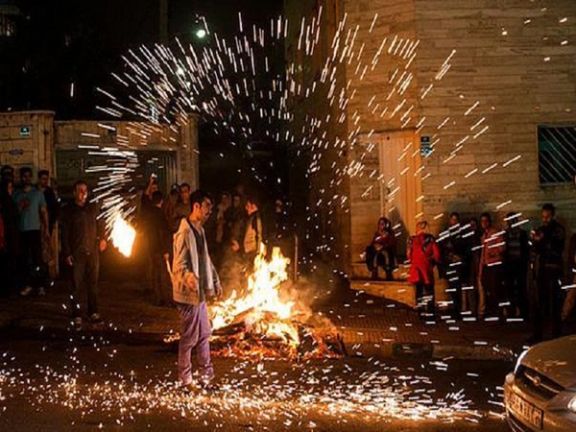
People normally light seven small brushwood bonfires in the streets or courtyards of their homes after sunset, jumping over them while chanting “May your red glow be mine and my pallor yours!”
Customs vary across the country but often include door-to-door spoon-banging in disguise for treats, fortune-telling, candle lighting, and traditional games. In smaller cities and rural areas, these traditions remain central to the festival, often accompanied by special dinners featuring local cuisine.
Iran's former queen, Farah Pahlavi, jumping over Chaharshanbeh Suri fire. Undated photo.
Suppression backfires
Following the Islamic Revolution of 1979, the religious establishment, which disdains ancient Iranian festivals as un-Islamic, imposed an unwritten ban on Charshanbeh Suri due to its association with fire, which they assumed to be a Zoroastrian tradition.
Islamic Revolutionary Committees -- incorporated into the police force a few years later -- soon began cracking down on youth celebrating with bonfires and firecrackers, particularly in major cities like Tehran. However, the more authorities attempted to suppress the festivities, the larger and more defiant the celebrations became.
Banning the sale of firecrackers led to the rise of homemade explosives, often resulting in casualties. Safe firecrackers and fireworks are no longer banned, but homemade variants to make greater noise still claims yearly casualties. In 2022, for instance, 19 died and 2,800 were injured during the celebrations. This year, according to Emergency Medical Services Organization, six have died and 50 have sustained serious limb injuries in the past few days, as celebrations began ahead of March 18, the eve of the festivities.
The police and the Basij militia of the Revolutionary Guards are mobilized annually to suppress gatherings involving large bonfires, loud music, and dancing. Clashes frequently occur, with youth taunting security forces through chants and fireworks.
Some neighborhoods, such as Ekbatan in western Tehran, have become hotspots for large-scale celebrations. The morning after often resembles a battle zone, with smoke from fireworks and homemade “bombs” lingering in the air.
In politically charged years—such as after the Green Movement protests of 2009 and the 2022 Woman, Life, Freedom protests—Charshanbeh Suri has taken on an overtly political tone, with participants chanting anti-government slogans in Tehran and other cities.
This year, Charshanbeh Suri coincides with Ramadan. On Saturday, Iran’s Acting Police Commander issued a categorical warning against “disregard for [Islamic] norms” during the festivities and the New Year holidays.
The name and origins of the festival
There is no evidence of fire-jumping traditions in pre-Islamic Persia. Zoroastrians, who hold fire sacred, would not defile it by jumping over it. However, they did light rooftop fires five days before the New Year to guide the spirits of the dead home for a reunion with their families.
Islamic-era historians have documented widespread celebrations among commoners and at royal courts over the centuries.
Most scholars agree that the celebration on the eve of the last Wednesday of the year is related to the Mesopotamian belief in the inauspiciousness of Wednesday, the fifth day of the seven-day week in the Babylonian calendar later adopted by the Jews who were held captive by them after the siege of Jerusalem in 597 BCE.
Iran has unveiled a prototype of its national artificial intelligence (AI) platform, developed in collaboration with Sharif University of Technology.
The platform, designed to operate on domestic languages and remain functional even with internet disruptions, is slated for full release by March 2026, according to the Vice Presidency for Science, Technology and Knowledge-Based Economy.
"This platform is a living entity and must be constantly updated," said Vice-President Hossein Afshin, during the unveiling ceremony.
A scene from the unveiling ceremony of Iran’s national artificial intelligence (AI) platform in Tehran, March 15, 2025
He outlined a phased rollout, with initial testing and optimization in 2025, followed by limited access for experts and knowledge-based companies, a public beta release, and the final version in March 2026.
Framing the project as a strategic move in a global "war of chips and algorithms.”
Afshin and other officials present in the ceremony cited the platform's open-source nature and domestic infrastructure as key advantages, which they said will ensure its functionality even under sanctions or internet disruptions.
"If they want to sanction us, Iran has already obtained this technology," Afshin said.
"We are moving forward with the world," said Hamidreza Rabiei, head of the Advanced Information and Communication Technology Research Institute. "We are not taking any API from any foreign platform, and if the internet is cut off, nothing will happen to the platform because we are connected to the national internet."
The project, involving nearly 100 researchers and experts, aims to address Iran's lagging AI development compared to regional peers.
"We do not have a good situation in AI indicators compared to the countries of the region," said Hossein Asadi, director of the Rapid Processing Center and Sharif University's representative in the project. He cited declining research articles and slow growth in AI-focused companies as evidence.
A key partner in Iran's new AI platform, Sharif University is under international sanctions for its involvement in military and ballistic missile projects. The university, which maintains close ties with the Ministry of Defense, the Islamic Revolutionary Guard Corps (IRGC), and the IRGC Air Force, has faced sanctions from the European Union, the United Kingdom, and Japan.
A demo of the AI platform was unveiled during a visit of Iran's Supreme Leader Ali Khamenei to an exhibition called "Pioneers of Progress" in late January.
Hossein Assadi (right) unveils a demo of the AI platform during a visit of Iran's Supreme Leader Ali Khamenei and Vice-President Hossein Afshin (left) to an exhibition in January 2025.
According to the creators, the platform's features include a GPU-based processing infrastructure, large language and multi-modal models, intelligent agents, and application layers for various industries.
The country’s first AI platform was unveiled a few months after a European Union report raised concerns about Iran's increasing reliance on AI-driven technologies for surveillance and suppression, highlighting the development of systems aimed at enforcing state control over digital information.
The report, titled "Artificial intelligence (AI) and human rights: Using AI as a weapon of repression and its impact on human rights," detailed how Iran is deploying AI-based tools to enhance its monitoring capabilities.
"Examples include the use of facial recognition technology during protests, the use of AI-driven bots and automated accounts to amplify content favorable to the regime, and the use of AI-based tools to produce content in different languages, in order to reach a global audience,” read the report.
Specifically, the report points to Iran's development of the National Information Network (NIN), a domestically focused internet infrastructure designed to isolate Iranian users from the global web.
The network, the report said, significantly strengthens the government's ability to impose censorship and restrict access to counter-narratives disseminated on foreign websites.
According to the report, Iran's AI development is bolstered by partnerships with Chinese entities, including major companies supplying technology to its police and military. Hardware imports, primarily from the UAE but also from China, Turkey, and India, further support these capabilities.
Hijab protesters pray outside the Parliament during rally
Conservatives farther to the right even of Iran's Supreme Leader Ali Khamenei have become more assertive in their demands to implement a new restrictive hijab law which has been stalled for months.
During a speech on Saturday, Khamenei appeared to avoid responding to an ultra-hardline lawmaker who interrupted the session to ask Iran's ultimate authority on religion and policy why the hijab law had not come into force.
The situation turned awkward when Mohammad-Taghi Naghdali attempted to move closer after Khamenei said that he could not hear him and the veteran theocrat's security guards swiftly led him away to the back of the audience.
Enforcing the morality legislation - which imposes harsh penalties including heavy fines and prison sentences on women who violate strict hijab rules and on businesses that fail to comply - could be highly provocative in the current climate and risk sparking anti-government protests.
In an unprecedented move, lawmaker Mahmoud Nabavian, a member of the ultra-hardline Paydari Party, attempted to distance himself from those he labeled radicals following recent protests outside the Parliament by hardliner vigilantes.
Nabavian accused these radicals of deepening societal divisions and provoking those who oppose mandatory hijab.
“Calling for nationwide protests over [the imposition of hijab] aligns with the enemy’s plans to incite unrest in the country,” he wrote. More significantly, he suggested that these radicals are using social media to directly draw Khamenei into the issue.
Khamenei has conspicuously avoided addressing the hijab issue in his speeches in recent months, including during his December 17 address to an all-female audience.
However, in April 2023, he had taken a firm stance, declaring that disregarding hijab was “religiously and politically haram (forbidden).” In the same speech, he accused foreign intelligence agencies of encouraging Iranian women to defy the mandatory hijab.
A woman in Karaj, near Tehran, arguing with a hijab enforcer in 2024
Currently, most expressions of frustration from vigilante groups toward Khamenei are veiled and circulated on domestic social media platforms such as Eitaa, a popular forum among ultra-hardliners and their associates.
Earlier this week, a small group of female vigilantes staged a rally in the religious city of Qom outside the office of Ayatollah Abdollah Javadi-Amoli, a prominent grand ayatollah recently praised by Khamenei for his scholarly contributions to seminaries.
The rally’s speaker criticized grand ayatollahs for their silence regarding the delayed enforcement of the hijab law. Such direct criticism of senior clerics, particularly those aligned with state ideology, is rare and highly frowned upon.
A widely circulated social media post anonymously criticizing Khamenei for the Supreme National Security Council’s (SNSC) decision in September to shelve the controversial new hijab law has sparked controversy.
Some of Khamenei’s own loyalists have shared the post, interpreting it as an act of disrespect toward the Supreme Leader.
Although the SNSC is chaired by the president, its decisions require Khamenei’s endorsement to be implemented.
This faction played a key role in drafting the controversial hijab law and supports former nuclear negotiator Saeed Jalili, their preferred candidate in the June snap elections.
Despite their professed allegiance to Khamenei, ultra-hardliners strongly back Mohammad-Mehdi Mirbagheri, a mid-ranking cleric known for his extreme religious and political views, particularly on the hijab issue.
Small groups of vigilantes have staged protests after Friday prayers several times in recent months. A dozen women held a sit-in outside the Parliament, erecting makeshift shelters to demand the hijab law’s implementation.
Their protests intensified this week as hundreds were bused in from other cities to join the demonstrations outside Parliament. Unlike other political protests, security forces did not attempt to disperse the roughly 1,500 protesters gathered on Tuesday.
The growing assertiveness of vigilante groups has raised concerns even among conservatives.
Criticizing the “super-revolutionary Paydari associates” for their rigid stance on the hijab law, the conservative Tabnak news website warned on Wednesday that they “are striving to create new challenges for the administration and, perhaps, from an analytical and in-depth perspective, exert pressure on the governance.” In Iranian political discourse, the term “governance” is often used to indirectly refer to Khamenei and the policies he dictates to top officials.
A woman with her hand-painted with the word "Freedom" takes part in a protest following the death of Mahsa Amini, in Athens, Greece, October 1, 2022
Iran is intensifying its crackdown on women, minorities, and activists using drones, facial recognition, and tracking apps to monitor and suppress dissent, a new UN report reveals.
The UN's Independent International Fact-Finding Mission on the Islamic Republic of Iran revealed that Tehran has significantly expanded its efforts to control and restrict the rights of women and girls.
The report highlights how the government is leveraging technology to enforce strict hijab laws and criminalize activism, portraying these efforts as part of a broader strategy to stifle human rights advocacy.
“These repressive measures reflect the State’s ongoing persecutory conduct aimed at suppressing women and girls’ human rights and their right to equality,” the report published on Friday said.
Despite pre-election promises by President Masoud Pezeshkian to ease the enforcement of strict hijab laws, the government has increased its policing since last year. The Noor Plan has intensified surveillance and criminal prosecution of women who defy mandatory hijab rules, according to the report.
In April 2024, Iranian authorities deployed aerial drones in Tehran and southern Iran to monitor women's hijab compliance in public spaces. Additionally, facial recognition software was installed at the entrance of Amirkabir University in Tehran to track female students' adherence to hijab regulations.
A key element of the crackdown is the Nazer mobile application. Vetted individuals and police officers can use this app to report women suspected of hijab non-compliance in private vehicles, taxis, ambulances, and public transport. The app allows users to log the location, date, and time of incidents and submit vehicle license plate information. This triggers an automated message warning the vehicle's owner about the alleged violation and threatening impoundment for repeated offenses.
Sara Hossain, Chair of the Fact-Finding Mission, said, “For two years, Iran has refused to adequately acknowledge the demands for equality and justice that fueled the protests in 2022. The criminalization, surveillance, and continued repression of protesters, families of victims, and survivors, in particular women and girls, is deeply worrying.”
Women hold signs during a protest against the Islamic regime of Iran and following the death of Mahsa Amini, at the Angel of Independence monument in Mexico City, Mexico October 1, 2022.
Women human rights defenders and activists continue to face severe penalties, including fines, long prison sentences, and even the death penalty for peaceful activism. The report noted that at least 11 men and three women remain at risk of execution, amid concerns about torture, forced confessions, and unfair trials.
“The Government’s policies have denied victims in Iran the right to truth, justice, and reparations,” said Viviana Krsticevic, an expert member of the Mission. “Given the gravity of the violations in the country and the serious risk of recurring violence against those who express dissent or challenge the State and its policies, it is crucial for the Human Rights Council to continue supporting the victims in their search for redress and non-repetition.”
The report also noted how the Iranian government has expanded surveillance beyond its borders. Iranian activists and journalists abroad have been targeted through online harassment and threats.
Victims of torture and families of those killed in the protests have been intimidated to remain silent. Those who speak out, including human rights defenders, lawyers, and journalists, face threats and persecution. Many have been forced to flee the country.
Shaheen Sardar Ali, another expert member of the Mission, said, “It is imperative that comprehensive accountability measures also continue to be pursued outside the country.”
The Mission collected over 38,000 evidence items and interviewed 285 victims and witnesses. The report reaffirmed earlier findings of gross human rights violations and crimes against humanity, including rape, torture, and deaths falsely labeled as suicides.
Security forces showed "little or no distinction" between adult and child protesters, subjecting children to the same brutal treatment, including torture and unfair trials.
Ethnic and religious minorities, including Kurds, Baluchis, and LGBTQ+ individuals, were particularly targeted during the protests. The Mission also investigated the roles of Iran’s key state entities, including the Revolutionary Guard, police, morality police, and judiciary, finding these bodies responsible for widespread human rights violations.
The Mission compiled a confidential list of alleged perpetrators, which it will submit to the UN High Commissioner for Human Rights.
This report follows another released on Thursday by UN Special Rapporteur Mai Sato, which condemned Iran for executing over 900 people in 2024, the highest number since 2015. Sato said, "Iran remains the highest per capita user of the death penalty globally."
Sato also criticized Iran’s new hijab law, which imposes harsh penalties, including up to 15 years in prison for women deemed non-compliant. "This law marks an unprecedented expansion of state control over women’s bodies and personal choices," she said.
The Fact-Finding Mission will present its full report to the Human Rights Council in Geneva on Monday, March 18. The Mission urged the Council to appoint a new independent body to continue investigating human rights violations in Iran.
Iran's foreign minister Abbas Araghchi - File photo
Foreign Minister Abbas Araghchi’s suggestion on Thursday about pursuing indirect talks with the United States may signal a sudden shift in Supreme Leader Ali Khamenei’s previously uncompromising stance on negotiations.
This apparent change came shortly after Tehran acknowledged receiving a letter from President Donald Trump, which reportedly outlined the terms of a possible agreement on Iran’s nuclear program and, potentially, other issues, including Tehran’s regional proxies.
As these developments gain momentum, many seem to have overlooked Iran’s scheduled participation in trilateral negotiations with Russia and China in Beijing on Friday. Meanwhile, Russia’s offer to mediate between Tehran and Washington remains on the table, with neither side having rejected it thus far.
Araghchi’s suggestion that indirect negotiations would be a “natural solution” for reaching a deal with Washington may also indicate that Iran is aiming to buy time. The strategy could be to push past the October deadline for the reactivation of the UN trigger mechanism, which would reinstate all previous international sanctions against Iran. Additionally, Iran may be looking ahead to the 2028 US election, hoping to outlast the Trump administration, with which it remains reluctant to engage in direct talks.
Araghchi’s suggestion of Oman as a possible mediator may lead observers to overlook why Qatar, the UAE, and possibly Russia have been sidelined as potential mediators—and why Tehran is now proposing indirect talks in Muscat.
Qatar’s leaders may already be preoccupied with issues related to Gaza, Syria, and Afghanistan, leaving little capacity to take on another complex diplomatic challenge. At the same time, Iran’s handling of Qatar’s recent mediation efforts suggests a degree of distrust. When the Qatari emir delivered a message to Tehran earlier this month, Khamenei largely dismissed it, instead questioning why Qatar has not released Iran’s oil revenues from South Korea frozen in Doha under a US arrangement.
Meanwhile, Iran is unlikely to trust the UAE as a diplomatic intermediary, given its close alliance with Saudi Arabia and the ongoing territorial dispute over three islands in the Persian Gulf.
Furthermore, many politicians in Tehran, including Heshmatollah Falahatpisheh, the former head of the parliament's Foreign Policy and National Security Committee, as well as several centrist and conservative newspapers such as Jomhouri Eslami, have repeatedly questioned Moscow's goodwill as a mediator. They argue that Russia is primarily focused on its own interests rather than genuinely helping Iran navigate a major foreign policy and economic crisis.
Notably, Nour News, a media outlet close to Iran’s Supreme Council of National Security, revealed that Russia refused to deliver Trump's message to Tehran, reportedly objecting to its content. Instead, Moscow passed the task on to the UAE.
At the same time, Iranian officials see indirect negotiations as an effective way to buy time and wait for a more favorable international climate. With the Iranian delegation in one room and US representatives in another, and Omani mediators shuttling messages between them, the process could stretch on for months, if not years. Meanwhile, shifting developments and ad-hoc decisions in Tehran and Washington could continuously delay and extend the talks.
Iranian media have made it clear over the past week that China and Russia have little interest in finalizing a deal between Tehran and Washington. Meanwhile, the low level of officials participating in the upcoming talks further diminishes any hope for a breakthrough.
Instead of sending a senior negotiator like career diplomat Majid Takht-Ravanchi, Iran is dispatching Deputy Foreign Minister Kazem Gharibabadi to Beijing—a lower-profile figure with less influence to advance the discussions.
Whether Iran can navigate multiple diplomatic channels to buy time remains uncertain. Its ability to do so depends on whether it can manage the country’s worsening economic crisis, stave off a major socio-political upheaval, and counter the growing pressure from European countries, some of which have signaled their intent to activate the UN trigger mechanism—all while the clock continues to run out.
Italy has installed Starlink antennas in four high-risk embassies, including one in Iran, as part of a test phase amid Tehran's internet restrictions, a government minister confirmed on Thursday.
Officials insist no national security contract has been signed with Elon Musk's company while the trial is piloted in four countries known for limiting internet freedom.
“Some experiments with Starlink satellite systems were started at diplomatic offices in Burkina Faso, Bangladesh, Lebanon, and Iran, which were therefore equipped with Starlink antennas, although none are active to date," Luca Ciriani, Italy’s Minister for Parliamentary Relations, was quoted by Reuters as saying.
Ciriani clarified that the antennas were installed purely for testing purposes. "The procedure is that the antennas are activated only to test their functioning and are then suspended with the aim of reactivating them only when necessary," he said.
Italy's government is seeking encrypted communication solutions for officials operating in high-risk areas.
Starlink, operated by Musk’s SpaceX, is one of the companies under consideration. However, opposition parties have raised concerns about the involvement of Musk, citing his close political ties to US President Donald Trump.
Ciriani pushed back against security concerns, stressing that the antennas would not be used for classified communications. He also underscored that the installations were arranged through third-party companies. "There has been no entrustment of the country's critical infrastructure to Starlink," he said.
Starlink's role in Iran has grown significantly over recent years. The number of its users in the country has now surpassed 100,000, according to Pouya Pirhosseinlou, head of the Internet and Infrastructure Committee at Iran’s E-Commerce Association.
"Over 30,000 unique users are utilizing satellite internet, suggesting that the total number of satellite internet users exceeds 100,000," Pirhosseinlou told Iran's ILNA news agency earlier this year.
Starlink gained prominence in Iran following the 2022 "Woman, Life, Freedom" protests, which erupted after the death of Mahsa Amini in morality police custody. The Iranian government responded with internet blackouts and widespread censorship, prompting citizens to turn to satellite services like Starlink and virtual private networks (VPNs) to bypass restrictions.
Despite being officially prohibited in Iran, Starlink’s appeal lies in its unrestricted access and high-speed service—an alternative to the heavily filtered and controlled local internet where Iran ranks among the world's lowest for internet freedom, according to Freedom House.
The US government’s 2022 decision to lift certain restrictions allowed SpaceX to provide Starlink access in Iran, offering a lifeline for digital freedom.
However, the service has also faced backlash from Iranian authorities who argue that its high costs drain foreign currency and undermine domestic internet infrastructure. The government has even lobbied the International Telecommunication Union (ITU) to restrict Starlink's coverage over Iran.