• العربية
  • فارسی
Brand
  • Iran Insight
  • Politics
  • Economy
  • Analysis
  • Special Report
  • Opinion
  • Podcast
  • Iran Insight
  • Politics
  • Economy
  • Analysis
  • Special Report
  • Opinion
  • Podcast
  • Theme
  • Language
    • العربية
    • فارسی
  • Iran Insight
  • Politics
  • Economy
  • Analysis
  • Special Report
  • Opinion
  • Podcast
All rights reserved for Volant Media UK Limited
volant media logo

IRGC officials threaten Trump over Soleimani killing
Jan 1, 2025, 15:25 GMT+0Updated: 11:58 GMT+0
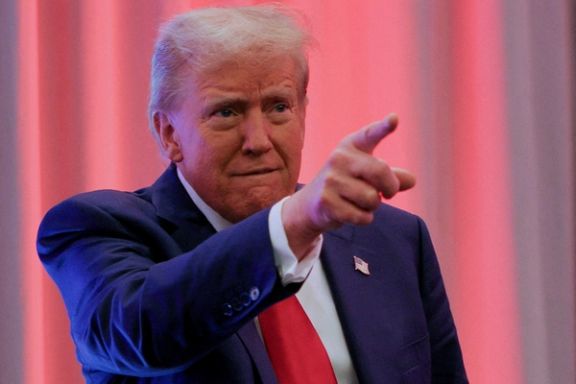
US President-elect Donald Trump

Iran’s top military officials have threatened US President-elect Donald Trump, vowing consequences on the fifth anniversary of the killing of the former IRGC Quds Force commander.

Qasem Soleimani was killed in a US drone strike near Baghdad International Airport in January 2020, a move Trump openly acknowledged ordering.

Brigadier General Iraj Masjedi, Deputy Coordinator of the Quds Force, denounced the operation, which also claimed the life of Iraqi militia leader Abu Mahdi al-Muhandis, as a violation of international law.

“In my opinion, Trump has rendered the greatest service to the terrorist movement in the world, and he must pay for this pure blood,” Masjedi said on Wednesday on the death anniversary of Soleimani. He questioned the legal and moral grounds of the assassination, calling Soleimani “the main agent in the fight against terrorists.”

The US justified the strike by saying Soleimani was planning imminent attacks on American interests in the region. However, his death escalated tensions between Washington and Tehran, leading to Iranian missile strikes on US military bases in Iraq.

“America must leave the region”

Brigadier General Mohammadreza Naqdi, Deputy Coordinator of the IRGC, also called for the expulsion of US forces from the Middle East, describing the Ayn al-Asad missile strike in 2020 as a decisive statement of intent.

Brigadier General Mohammadreza Naqdi, Deputy Coordinator of the IRGC
100%
Brigadier General Mohammadreza Naqdi, Deputy Coordinator of the IRGC

“The world understood how powerful the Islamic Republic is and how weakened America has become,” Naqdi said during an appearance on Iranian state television. However, he added, “America has not yet received its full answer.”

The Ayn al-Asad missile strike occurred on January 8, 2020, as a direct retaliation by Iran for Soleimani's killing. The Islamic Revolutionary Guard Corps (IRGC) launched over a dozen ballistic missiles targeting the airbase in Iraq, which housed US and coalition forces. Another strike targeted a base near Erbil. This marked the first direct Iranian attack on US forces in decades and was one of the most significant escalations in US-Iran tensions.

The strike resulted in no immediate fatalities among US personnel, reportedly due to early warnings and evacuations.

Iran; however, portrayed the attack as a demonstration of its military capability and resolve.

Naqdi also defended Iran’s extensive role in the Syrian conflict, where Soleimani played a pivotal part in mobilizing Shi’a militias to support President Bashar al-Assad.

“Our presence in Syria was the most rational decision, as we sought to remove a significant threat to the Islamic Ummah,” Naqdi added, referring to Iran’s fight against ISIS.

Brigadier General Asghar Arabpour from Isfahan province also urged Iranian leaders to intensify efforts to hold Trump accountable.

“Addressing this case and Trump’s crimes requires greater seriousness from our country’s officials,” Arabpour said in an interview with ISNA.

He also criticized the broader US foreign policy under both Trump and President Joe Biden, arguing that American administrations prioritize Israeli security at the expense of Middle Eastern stability.

Five years after Soleimani’s targeted killing, Iran officials occasionally speak of revenge, keeping his death a cornerstone of their rhetoric against the United States.

Most Viewed

Iran negotiators ordered to return after internal rift over Islamabad talks
1
EXCLUSIVE

Iran negotiators ordered to return after internal rift over Islamabad talks

2
ANALYSIS

US blockade enters murky phase as tankers spoof signals and buyers hesitate

3
ANALYSIS

Why the $100 billion Hormuz toll revenue is a myth

4

US tightens financial squeeze on Iran, warns banks over oil money flows

5
ANALYSIS

US blockade targets Iran oil boom amid regional disruption

Banner
Banner

Spotlight

  • Hardliners push Hormuz ‘red line’ as US blockade tests Iran’s leverage
    INSIGHT

    Hardliners push Hormuz ‘red line’ as US blockade tests Iran’s leverage

  • Ideology may be fading in Iran, but not in Kashmir's ‘Mini Iran'
    INSIGHT

    Ideology may be fading in Iran, but not in Kashmir's ‘Mini Iran'

  • War damage amounts to $3,000 per Iranian, with blockade set to add to losses
    INSIGHT

    War damage amounts to $3,000 per Iranian, with blockade set to add to losses

  • Why the $100 billion Hormuz toll revenue is a myth
    ANALYSIS

    Why the $100 billion Hormuz toll revenue is a myth

  • US blockade targets Iran oil boom amid regional disruption
    ANALYSIS

    US blockade targets Iran oil boom amid regional disruption

  • Iran's digital economy battered by prolonged blackout
    INSIGHT

    Iran's digital economy battered by prolonged blackout

•
•
•

More Stories

Saudi Arabia says it executed six Iranians for drug trafficking

Jan 1, 2025, 13:29 GMT+0

Six Iranian citizens have been executed in Saudi Arabia on charges of drug trafficking, Riyadh’s Ministry of Interior announced on Wednesday. The ministry did not provide further details regarding the time of arrest, trial, and execution.

The executions took place in Dammam, located along the coast of the Persian Gulf, according to the official Saudi Press Agency.

The Iranians were put to death for their involvement in smuggling hashish into Saudi Arabia, the interior ministry said.

Saudi Arabia has executed 330 people this year, marking the highest number in decades, despite Crown Prince Mohammed bin Salman’s 2022 claim that the death penalty would be limited to murder cases under his vision of a modernized kingdom.

However, the latest execution figures, compiled by the human rights group Reprieve and verified by Reuters, represent a sharp increase from 172 executions last year and 196 in 2022. Reprieve has called it the highest recorded total to date.

As part of its Vision 2030 plan, the kingdom is investing billions to shed its image of strict religious restrictions and human rights violations, aiming to rebrand itself as a global tourism and entertainment hub.

According to the Washington-based Abdorrahman Boroumand Center for Human Rights in Iran, the Islamic Republic executed at least 930 people in 2024. The figure for years 2023 and 2022 were 811 and 579 respectively.

“The international community must adopt a unified, consistent, transparent and effective response to protect those targeted and hold Iran, and other countries following its example, accountable,” read the report by Boroumand center on Tuesday.

Many death sentences are drug-related and are handed and carried out with relative ease, sparking criticism from human rights organizations that suggest the rise in executions may aim to intimidate the populace amid ongoing unrest.

Azerbaijan summons Iran's envoy over broadcast insulting President Aliyev

Jan 1, 2025, 11:45 GMT+0

Azerbaijan has summoned Iran's interim chargé d'affaires to the Foreign Ministry, demanding an end to what it called "provocative actions" by Tehran, according to a report by Tasnim news agency on Wednesday.

The move follows a live broadcast on Iran's state news channel featuring inflammatory and insulting rhetoric during a religious ceremony.

The remarks targeted Turkish President Recep Tayyip Erdoğan and Azerbaijani President Ilham Aliyev.

A religious singer at a ceremony compared current Iran-Turkey-Azerbaijan tensions to a 16th-century Ottoman-Safavid war. He insulted Presidents Erdoğan and Aliyev and said that Iran would reclaim territories in Azerbaijan, invoking religious symbolism.

The territory of what is now called the Republic of Azerbaijan was separated from Iran in the first half of the 19th century, through the so-called Russo-Persian Wars.

The event took place in the presence of a representative of Iran’s Supreme Leader Ali Khamenei in the northwestern city of Ardabil earlier this week.

Khamenei defends Iran’s regional strategy, vows to reclaim Syria

Jan 1, 2025, 09:09 GMT+0

Iranian Supreme Leader Ali Khamenei defended Iran's involvement in Syria's civil war and his policy of power projection in the region, dismissing criticism of the country’s diminishing influence in the Middle East.

“Some people, due to a lack of proper analysis and understanding, claim that with the recent events in the region, the blood shed in defense of the shrine was wasted,” Khamenei said in a Wednesday ceremony to mark the fifth anniversary of the death of former Revolutionary Guards Quds Force commander Qasem Soleimani.

He was Iran’s most influential figure in coordinating armed allied groups in the region and was killed by the US in Iraq in 2020.

“They are making this grave mistake; the blood was not wasted,” Khamenei continued.

The defense of the shrine refers to a narrative promoted by Iran as a reason for its military presence in Syria and Iraq. This concept centers around the protection of Shi’a Islamic holy sites, particularly the Shrine of Sayyida Zainab in Damascus, Syria. Sayyida Zainab was the granddaughter of Prophet Muhammad. However, following the October 7 Hamas attack on Israel, Khamenei’s rhetoric expanded beyond shrine defense, openly advocating an all-out war against Israel.

The comments by Khamenei follow a series of regional setbacks for Iran in 2024, as its network of proxy and allied groups faced regular Israeli countermeasures.

Hamas's military power has been almost completely diminished by Israel. Israel has also intensified its campaign against Hezbollah with precise airstrikes, covert operations, and intelligence-led targeting of the group's assets in Lebanon and Syria. These actions aim to degrade Hezbollah’s capabilities, disrupt its supply lines, and prevent the transfer of advanced weapons from Iran.

In Yemen, the Houthis encountered resistance from local factions, and devastating air attacks by Israel, the US and UK. These setbacks underscore the diminishing reach of Iran’s “axis of resistance,” a strategy central to Khamenei’s regional ambitions.

In Syria, a key pillar of Iran’s influence, the Assad government fell after 13 years of Iranian support. Since the Syrian Civil War began in 2011, Iran has heavily invested in preserving Assad’s government, seeing it as vital for maintaining access to Hezbollah and projecting power across the Levant. The loss of Assad unraveled these investments and severed Iran’s land corridor to Lebanon, undermining its ability to supply Hezbollah with arms.

Reclaiming Syria

Despite these challenges, Khamenei repeated his commitment to regional interventions on Wednesday, praising Soleimani for building pro-Iran groups across the region.

In a veiled reference to Syria's new strongman Ahmad al-Sharaa, Khamenei said: “Do not be deceived by this false show; those who are strutting around today will one day be trampled under the feet of the faithful. Those who have encroached on the land of the Syrian people will one day be forced to retreat in the face of the power of Syria's youth.”

This marks the third time Khamenei has promised to reclaim Syria from its new rulers. On December 11 and 23, he made similar vows, encouraging Syrian youth to resist Assad’s successors.

He also described Houthis and Hezbollah as symbols of resistance, adding that they would ultimately prevail. Without naming specific countries, he criticized certain nations for “sidelining their faithful youth,” whom he called “pillars of stability and strength,” warning that they risk facing Syria’s fate.

Iran International analyst Morad Veisi suggested that Khamenei’s rhetoric reflects a refusal to accept regional realities. “Rather than acknowledging his mistakes, he attempts to reshape facts to align with his vision,” Veisi said, adding that this approach has drained Iran’s resources and alienated its neighbors.

These remarks coincide with admissions by Hezbollah’s Secretary-General Naim Qassem, who acknowledged that Assad’s fall has disrupted the group’s primary supply route through Syria. Meanwhile, The New York Times reported that Assad’s downfall has caused confusion among Iranian officials.

Khamenei also praised Soleimani, saying that he utilized the potential of the region's youth to revive the Resistance Front. However, his statements contrasted with a prior speech in which he denied that Iran operates proxy forces in the region.

As Iran’s influence wanes and its regional allies face mounting challenges, Khamenei’s insistence on reclaiming Syria underscores the strain on the Islamic Republic’s strategy.

Iran executed 18 people every week in 2024, rights group reports

Dec 31, 2024, 20:50 GMT+0

Iran witnessed a stark rise in executions this year, with at least 930 death sentences carried out, according to the Washington-based Abdorrahman Boroumand Center for Human Rights in Iran.

The figure for years 2023 and 2022 were 811 and 579 respectively, which shows an alarming upward trend.

“The international community must adopt a unified, consistent, transparent and effective response to protect those targeted and hold Iran, and other countries following its example, accountable,” read the report by Boroumand center on Tuesday.

Many death sentences are drug-related and are handed and carried out with relative ease, sparking criticism from human rights organizations that suggest the rise in executions may aim to intimidate the populace amid ongoing unrest.

Prominent voices have called for urgent international action. Nobel Peace Prize laureate Narges Mohammadi, in an open letter to UN Secretary-General António Guterres, urged the global body to demand that Iran halt its mass executions as a condition for any negotiations.

The cases of individuals executed on charges of political dissent have drawn particular scrutiny.

In August, Iran executed Reza Rasaei, arrested during the 2022 Woman, Life, Freedom protests, for allegedly murdering an intelligence officer. In October, Iranian-German dual national Jamshid Sharmahd was executed following a trial Amnesty International denounced as grossly unfair.

Iran’s increasing reliance on capital punishment has been met with widespread condemnation, with human rights organizations reiterating calls for the abolition of the death penalty.

As 2024 concludes, Iran’s judicial practices remain under close scrutiny from the international community, which continues to advocate for accountability and the protection of fundamental rights.

Iranian students abroad hits record high as hope for change fades

Dec 31, 2024, 17:14 GMT+0

Record number of Iranians left the country in 2024 to study abroad as the country's youth lose hope in change, according to a report carried by Iran's official news agency IRNA.

The number of Iranian students in the ten main destinations has almost doubled in four years, from 60,000 to 110,000, reflecting the nation's ongoing economic woes.

In previous decades, the number of Iranians studying abroad doubled every ten years.

"This trend is not just about education but reflects broader socio-economic factors pushing skilled individuals out of the country,” IRNA quoted migration analyst Bahram Salavati saying.

“In addition to surpassing the critical threshold of 100,000 Iranian students abroad, the list of primary destinations and the growth rates in these countries are particularly striking,” Salavati added.

Turkey has emerged as the leading destination, hosting nearly 30,000 Iranian students in 2024,a staggering 158% increase since 2020. Turkey's proximity is a key factor. It's also cheaper and easier to enter compared to most Western countries.

Other popular destinations for Iranian students include Canada, Germany, Italy, and the United States.

The sharp rise in student migration is closely tied to the worsening of living conditions and shows no sign of slowing despite repeated calls and warnings by Iranian officials.

The latest came from Iran's vice president Mohammad Reza Aref, who asked Iranian professionals overseas to return. "Iran is your homeland and home, and we welcome you to serve your country in the fields of science and technology," Aref said on Tuesday.

Iran’s migration policies remain heavily focused on managing inbound refugees, such as Afghan nationals, and little appears to be done beyond words to control the "brain-drain" or incentivize returns.


In 2022, the Iran Migration Observatory (IMO) reported that the country ranked 17th globally for students studying abroad. With the trend showing no signs of slowing, analysts warn that Iran’s economic and social stability could face even greater challenges without urgent intervention.

Fatemeh Mousavi, a sociologist and social researcher, said the exodus shows a lack of faith in Iran's trajectory among its youth.

“The 140% increase in the migration of young professionals in the past year alone can be seen as an exit strategy resulting from the loss of hope in change and reform in the government,” Mousavi told the Tehran-based outlet Khabar Online.