• العربية
  • فارسی
Brand
  • Iran Insight
  • Politics
  • Economy
  • Analysis
  • Special Report
  • Opinion
  • Podcast
  • Iran Insight
  • Politics
  • Economy
  • Analysis
  • Special Report
  • Opinion
  • Podcast
  • Theme
  • Language
    • العربية
    • فارسی
  • Iran Insight
  • Politics
  • Economy
  • Analysis
  • Special Report
  • Opinion
  • Podcast
All rights reserved for Volant Media UK Limited
volant media logo

Critics say policy deadlocks have stalled Iran’s government

Behrouz Turani
Behrouz Turani

Iran International

Dec 12, 2024, 08:44 GMT+0Updated: 12:10 GMT+0
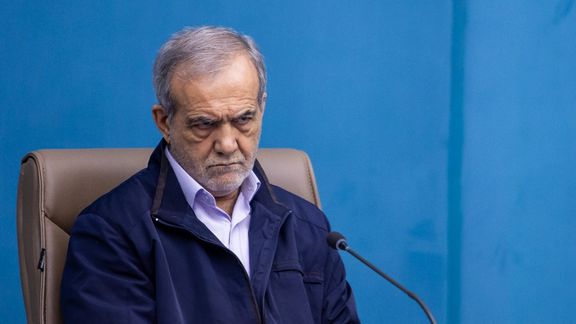
Iran's President Masoud Pezeshkian. File photo

A prominent centrist figure in Iran says that the ongoing deadlock over enforcing the new hijab law and lifting censorship on the Internet has effectively paralyzed the Pezeshkian administration.

Meanwhile, Reformist commentator Abbas Abdi argues that these issues highlight the hard-liners’ resistance to Masoud Pezeshkian's efforts to bridge the gap between the people and the government.

Abdi also criticized the President, holding him personally accountable for the continued censorship of social media in Iran.

Ali Rajaei, a centrist figure within Iran's Islamic political establishment, stated in an interview with the Khabar Online website in Tehran that no significant progress has been made in Iran's foreign relations or the government's cultural and economic policies since Pezeshkian assumed office four months ago. However, he emphasized that all Iranians should work together to strengthen the government and help it preserve its social capital.

"People measure the government's success by seeing how it tackles the problems of hijab and filtering [of the Internet]. At the same time, the government's opponents do not allow it to solve the problems," Rajaei said, adding that "the President cannot do much about other problems if he cannot stand by his promises to lift the filtering and prevent violent hijab enforcement."

He also argued that Iranians see no change in the situation of their livelihood and the government, and the parliament have done very little to improve the situation.

Rajaei said that he does not see any bright prospect for the hijab problem as the President appears to be lacking the bargaining power to convince the hardliners to step back from the new hijab enforcement law.

Meanwhile, Khabar Online website quoted Vice President Mohammad Jafar Ghaempanah as saying that at least 60 percent of Iranians oppose internet restrictions and collectively spend approximately 200 trillion rials (around $300 million) annually on VPNs to bypass the filtering. Ghaempanah also told the Reformist daily Arman Melli that all 15 members of the Supreme Council of Cyberspace are opposed to lifting the restrictions.

According to Reformist commentator Abbas Abdi, the statements by the vice president indicate that there is no short-term solution for the problem of filtering. Abdi added that President Pezeshkian and his administration should be hold accountable. "If there are individuals who can continue to enforce the filtering against the calls made by the President and his aides to lift the censorship, this means that other promises made by Pezeshkian are unlikely to be met," Abdi said.

Abdi further argued, "If a government backed by the people's vote cannot fulfill its promises, it might as well step aside and allow the hardliners to implement their policies." He questioned, "Did Pezeshkian not realize he couldn't uphold his promises when he made them? His excuses now are unacceptable." Abdi added, "It is not enough for the President and his aides to merely oppose internet filtering. People voted for them with the expectation that they would bring about meaningful change."

Motahaeh Shafiei, the lead columnist for Arman Melli newspaper, wrote that based on the Vice President's remarks and Pezeshkian's track record, lifting internet censorship is likely to become increasingly challenging.

Meanwhile, hardline commentator Abbas Nalimi-Namin suggested that the executive and legislative branches should postpone implementing the new hijab enforcement law, as both have acknowledged ambiguities in its enforcement. He further argued that hardliners like Ahmad Alamolhoda, the Friday Prayers Imam of Mashhad, who demand the law's immediate implementation, do so from within an insular circle disconnected from Iranian society and public sentiment.

Most Viewed

Iran negotiators ordered to return after internal rift over Islamabad talks
1
EXCLUSIVE

Iran negotiators ordered to return after internal rift over Islamabad talks

2
ANALYSIS

US blockade enters murky phase as tankers spoof signals and buyers hesitate

3
ANALYSIS

Why the $100 billion Hormuz toll revenue is a myth

4

US tightens financial squeeze on Iran, warns banks over oil money flows

5
ANALYSIS

US blockade targets Iran oil boom amid regional disruption

Banner
Banner

Spotlight

  • Hardliners push Hormuz ‘red line’ as US blockade tests Iran’s leverage
    INSIGHT

    Hardliners push Hormuz ‘red line’ as US blockade tests Iran’s leverage

  • Ideology may be fading in Iran, but not in Kashmir's ‘Mini Iran'
    INSIGHT

    Ideology may be fading in Iran, but not in Kashmir's ‘Mini Iran'

  • War damage amounts to $3,000 per Iranian, with blockade set to add to losses
    INSIGHT

    War damage amounts to $3,000 per Iranian, with blockade set to add to losses

  • Why the $100 billion Hormuz toll revenue is a myth
    ANALYSIS

    Why the $100 billion Hormuz toll revenue is a myth

  • US blockade targets Iran oil boom amid regional disruption
    ANALYSIS

    US blockade targets Iran oil boom amid regional disruption

  • Iran's digital economy battered by prolonged blackout
    INSIGHT

    Iran's digital economy battered by prolonged blackout

•
•
•

More Stories

Tehran intensifies censorship after Assad's exit

Dec 11, 2024, 21:14 GMT+0
•
Maryam Sinaiee

Iranian authorities have tightened control on media and public figures in the aftermath of Bashar al-Assad’s fall and warned them not to draw any parallels between Syria under his rule and the situation in Iran.

In recent days, some state-controlled media and authorized public commentators have emphasized Assad’s unpopularity and the Syrian people’s unwillingness to defend his rule as rebels advanced toward the capital.

Some also reflected on the lessons the Islamic Republic should take from the events in Syria and suggested in mostly veiled terms that the same fate may befall the Islamic system if it fails to meet popular demands for social and political freedoms.

Some of the more outspoken views about Assad, which could be seen as indirect criticism of Iran's Supreme Leader Ali Khamenei, were conspicuously deleted after a few hours on Sunday and Monday without explanation.

Mahmoud Sadeghi, an outspoken reformist politician and former lawmaker, said the intelligence ministry contacted him and other unidentified political figures to warn them about “drawing a parallel between the deposed Syrian regime with the Islamic Republic of Iran's system.”

Sadeghi made the revelation in an open letter published on his Telegram channel Tuesday addressed to Supreme Leader Ali Khamenei.

“Public opinion has unfortunately made such an analogy.” Sadeghi wrote.

“This call made me wonder what has happened to our intelligence apparatus that instead of facing a grim reality such as the sudden and unexpected fall of Bashar al-Assad to properly analyze and understand its roots and dimensions and to seek help from political analysts, it is trying to cover it up and orders political activists to analyze the events according to (authorities’) wishes and views,” he wrote.

Sadeghi added that he had humbly warned the officer who contacted him, apparently by phone, that imposing these restrictions on the public would lead them to see “certain similarities with the deposed Syrian regime which bore the name of a republic but acted like a despotic monarchy and suppressed all voices of dissent instead of listening to those who protested and to carry out reforms.”

He also warned Khamenei that the Islamic Republic may have the same fate as Syria if the Supreme Leader does not take action to correct these wrongs during his lifetime.

The outspoken former lawmaker also said the Islamic Association of University Professors, of which he is a member, is prepared to offer a more comprehensive, confidential analysis of the current circumstances in the country and propose solutions to the Supreme Leader.

The news portal of the Association has run Sadeghi’s letter with the headline “Our System May Have the Same Fate as the Syrian One if You Do Not Correct these Wrongs” but besides the reformist Jamaran news website, no other Iranian newspaper or news website has so far given it coverage.

Dozens of Iranian activists and journalists have in the past four months also reported that authorities have blocked their cellphone SIM cards as an alternative to arresting them or other methods that require official action to force them into submission.

In a tweet on 5 December, a former journalist with the reformist Shargh newspaper, Elahe Khosravi, recounted how her friend’s registered SIM card had been blocked because of his social media activities. According to Khosravi, they were unable to acquire another SIM card because activating the new SIM card required confirmation of a code sent to the blocked registered number.

Others have reported that unexplained blocking of their SIM cards has deprived them of access to many online facilities including internet banking, academic platforms, and using two-step verification of their different online accounts.

Failure of talks with Europe may push Iran toward realism

Dec 11, 2024, 10:44 GMT+0
•
Behrouz Turani

The recent round of talks between Iran and Europe has left many Iranian diplomats and politicians disappointed. However, some observers argue that the failure of the November 29 talks in Geneva does not entirely close the door on diplomacy.

In a commentary for the relatively independent Rouydad24 website, conservative commentator and former lawmaker Jalal Khoshchehreh analyzed Tehran's options after the talks ended in what the outlet described as a deadlock. Contrary to the dominant view among Iranian commentators, diplomats, and politicians—who believe there may be no resolution to this impasse—Khoshchehreh suggested the setback might prompt Iran to adopt a more pragmatic and realistic approach in its relations with Europe.

He noted that Iran is aware a prolonged stalemate with Europe could open the door for Donald Trump’s aggressive policies toward Iran once he takes office as President of the United States in mid-January. According to Khoshchehreh, the latest talks aimed to demonstrate Iran's readiness to manage the crisis. He also emphasized that neither Iran nor Europe favors confrontation, which might encourage Tehran to take more proactive diplomatic steps to avoid a unified front against Iran by the US, Europe, and potentially the international community.

Khoshchehreh further highlighted the importance of balancing domestic political dynamics with foreign relations, asserting that focusing on one without the other is bound to fail. This was apparently a veiled reference to human rights violations and lack of political and social freedoms.

After the Geneva talks, hardliners and members of Iran’s Supreme Council of National Security openly criticized the Foreign Ministry's efforts to negotiate with Europe. Iran’s chief negotiator, Majid Takhtravanchi, walked back his earlier optimistic remarks, stating that what occurred in Geneva amounted to exchange of opinions rather than "negotiations."

This internal discord within Iran's fragmented political landscape has bolstered hardliners who opposed the negotiations from the start. They also attacked Vice President Mohammad Javad Zarif for suggesting that Iran remains open to talks with the United States. Tehran now faces a critical decision: whether to cling to its ideological "principles" or adopt a more realistic foreign policy approach, as Khoshchehreh urged, invoking former Chinese leader Deng Xiaoping’s call for courage in pursuing the right path. Tehran must now weigh its lofty ambitions against the realities it faces.

Conservative commentator Hassan Beheshtipour had remarked earlier that European nations might activate the trigger mechanism in the 2015 nuclear deal, which would reinstate pre-2015 UN sanctions on Iran. Beheshtipour argued that Europe would only take this step if Iran fails to alter its behavior. Breaking with the reluctance of many Iranian commentators to criticize former President Ebrahim Raisi, Beheshtipour claimed Europe’s tough stance is a result of Raisi’s evasive policies, which worsened Iran-Europe relations.

Last week, hardline newspapers Kayhan and Javan, along with the ultraconservative Raja News website, sharply criticized the Iranian government’s efforts to restore ties with Europe. Both Kayhan and Javan urged President Masoud Pezeshkian to replace his advisers, while Raja News questioned Zarif’s authority to make what it called “dangerous suggestions” regarding Iran’s stance toward the United States.

Beheshtipour advised Iran to hold off on prioritizing negotiations with Europe, given Trump’s unpredictable policies and existing US-European divisions over Iran. He suggested Tehran wait until late January to reassess Trump’s shifting positions and isolationist tendencies before deciding on further negotiations.

Amnesty condemns Iran's 'draconian' new hijab law

Dec 10, 2024, 15:43 GMT+0
•
Azadeh Akbari

Amnesty International has condemned Iran's new compulsory veiling law, saying it intensifies the oppression of women and girls while exposing activists opposing the rules to charges carrying the death penalty.

“Iranian authorities have adopted a new draconian law that further erases the human rights of women and girls, imposing the death penalty, flogging, prison terms and other severe penalties to crush ongoing resistance to compulsory veiling,” Amnesty International said in a press release on Tuesday.

The "Law on Protecting the Family through the Promotion of the Culture of Chastity and Hijab," comprising 74 articles, is set to take effect this Friday. It imposes severe penalties on women and girls who defy veiling requirements, including exorbitant fines, prison terms, flogging, and travel bans.

Amnesty highlighted that activism against the hijab law may even be deemed “corruption on earth,” a charge punishable by death under Iran's penal code—a concern recently raised by Iranian women’s rights activists.

“This shameful law intensifies the persecution of women and girls for daring to stand up for their rights following the ‘Woman Life Freedom’ uprising,” said Diana Eltahawy, Amnesty International’s deputy regional director for the Middle East and North Africa.

Drafted in May 2023, less than a year after the Woman Life Freedom uprising sparked by the death in custody of Mahsa Amini in September 2022, the law was introduced in response to widespread defiance of compulsory veiling by women and girls, Amnesty said.

Amnesty detailed sections of the new law and how it, warning it criminalizes acts such as “nudity, indecency, unveiling and bad dressing.”

Article 50 of the law defines “unveiling” as failing to cover the head with a hijab, chador, or headscarf. “Bad dressing” is defined in Article 48 as exposing body parts below the neck, other than the hands and feet, or wearing clothing deemed to “contribute to or incite sin by others”.

However, the rights group warned terms such as “nudity” and “indecency” remain undefined in the new law, allowing for subjective interpretation and enforcement.

Under Article 48, fines for “bad dressing” begin at $160 for a first offense and rise to $4,000 for a fourth. Further infractions can result in $8,000 fines, up to five years in prison, a two-year travel ban, and a two-year ban on social media use. Article 49 mandates that “nudity” in public or online may lead to up to 10 years in prison or a $12,000 fine, with repeat offenses punishable by 15 years in prison or a $22,000 fine.

Amnesty noted that women unable to pay fines face severe restrictions, including being barred from reclaiming impounded vehicles, renewing driving licenses or passports or leaving the country. Article 56 also allows for asset seizures or imprisonment in such cases.

Article 38 prescribes up to five years in prison, travel bans, and fines for “insulting or ridiculing the hijab” or “promoting nudity, indecency, unveiling, and bad dressing.” Meanwhile, the law also bans the import and sale of clothing, dolls, mannequins, books, paintings, and other items that “promote nudity, indecency, unveiling, and bad dressing.”

“The complex web of fines, prison sentences and other severe punishments going as far as the death penalty demonstrates the state policy to control women and girls through fear and economic hardship. This law has particularly devastating consequences for the most economically disadvantaged in society,” Eltahawy added.

Amnesty warned the law grants sweeping powers to Iran’s intelligence and security forces, including the Revolutionary Guard and Basij militia, to enforce veiling rules.

Eltahawy called on the international community to act urgently, urging governments to use diplomatic and legal avenues to hold Iranian authorities accountable for systematic human rights violations.

Ex-Canadian minister warned of Iran's danger—then learned he was a target

Dec 10, 2024, 12:36 GMT+0
•
Negar Mojtahedi

When Canada’s former Justice Minister Irwin Cotler penned an op-ed warning of the dangers of Iran's transnational repression and plots to assassinate dissidents - he did not yet know he too was already a target.

Cotler said he was the subject of an alleged Iranian plot to kill him on Canadian soil.

The threats, according to Cotler, mean anyone who dares speak up against repression even non-Iranians as far away as Canada is in danger, imperiling free speech and posing a key national security challenge.

“My assassination attempt that I experienced should be seen as a wake- up call of a larger phenomenon,” said Cotler, adding that domestic stifling of dissent is linked to Iran's attempts to silence critics abroad.

"The confluence of massive domestic repression, which incentivizes and underpins the extraterritorial aggression targeting those who are engaged in supporting the very Iranian people that are the targets of mass repression."

In an interview with Iran International, Cotler - a vocal critic of Iran’s government - said he was informed by the Royal Canadian Mounted Police (RCMP) in October of an active plot to try and kill him.

“I was supposed to attend the 60th anniversary of my McGill Law class in Montreal. I was prepared. The [RCMP] security detail was prepared to take me there and then I was advised that day that they had a warning of an imminent assassination attempt within the next 48 hours,” said Cotler.

The Globe and Mail, a Canadian newspaper, first reported on the alleged plot in early November, citing law enforcement sources about two suspects involved in his case. Cotler said he’s not aware of the two individuals but said he received confirmation that the threat against him has been lowered substantially.

Threats for more than a year

Cotler’s life has been under threat since 2023, he said, citing Canadian authorities.

The former parliamentarian was flying back home to Montreal from Washington DC with his wife on November 14, 2023 when he was advised by RCMP officials not to leave the airport. Then the text messages started popping up on their screens from neighbors curious about armored vehicles outside the Cotler home.

From that moment he has been under 24-hour police protection. Cotler is accompanied wherever he goes including his medical treatments and family outings.

The life of Cotler and his family would be changed forever, but his voice was not to be silenced.

Armored cars, armed protection and other security details soon became the norm.

“My life was altered with my freedom of movement restricted, but it has not altered my advocacy because I know that the objective of transnational repression and assassination are carried out," said Cotler. "Their purpose is really to intimidate, to silence and to arrest the target. Because I had the beneficiary of the protection, I've been able to engage in my continued public advocacy,”

When he learned later that the threats were coming from Iran, he wasn’t surprised.

“I first advocated for putting the IRGC on the terrorist list back in 2008 when I was a Member of Parliament. It took until 2024 and I fought until it happened.”

As a lawmaker, justice minister and now as chair of human rights organization the Raoul Wallenberg Centre, Cotler has been an advocate for human rights in Iran for decades.

A former lawyer, he also represented Iranian dissidents and political prisoners throughout his career.

As a retired politician, Cotler receives protection that an average Canadian under similar circumstances would not. In speaking directly with Iranian dissidents in Canada and abroad, he understands their fears and threats they face.

One major concern is Iran’s connections to organized crime in Canada.

US law enforcement agencies say two Canadians with ties to the biker gang Hells Angels were hired at the behest of Iran’s intelligence services to carry out assassinations in Maryland.

An unsealed US indictment revealed last month that two men, allegedly hired by the Islamic Republic to kill prominent Iranian-American human rights advocate Masih Alinejad.

Alinejad, whom Cotler refers to as a friend and colleague, has been the subject of several Iranian murder-for-hire plots on US soil. The same indictment also alleges Iran planned to assassinate president-elect Donald Trump prior to the American elections.

Iran's Foreign Minister Abbas Araghchi denied that Tehran was linked to an alleged plot to kill Trump.

While Cotler continues to raise alarm bells, he said Canada can and should be doing more by taking the lead in fighting transnational repression.

In a recent conversation with Canadian Prime Minister Justin Trudeau, Colter said he encouraged the Prime Minister to make Iran's attempts to assassinate critics abroad a top priority at next year’s G7 summit, which Canada is hosting.

“The real problem has been the culture of impunity," said Cotler. "What is needed now is a culture of accountability,”

Iranians draw a parallel between Syria events and situation at home

Dec 10, 2024, 10:11 GMT+0
•
Maryam Sinaiee

As images of brutality and prison abuses flood the internet following Bashar al-Assad’s fall, Iran’s tightly controlled media has cautiously criticized the deposed leader, hinting that a similar fate could befall the Islamic Republic.

“The lesson we should take is to be mindful so that [our] people do not get fed up and weary of the country and its circumstances and maintain their hope in the future,” conservative politician and journalist Naser Imani told Rouydad news website Monday.

While distancing Iran from Syria’s experience, he cautiously added, “The situation in the Islamic Republic is not comparable to Syria at all. Nevertheless, one should take note of the public opinion.”

Iran’s Supreme Leader, Ali Khamenei, has consistently praised Bashar al-Assad as a key figure in the “Axis of Resistance” and maintained unwavering support for him against adversaries. In 2019, during a meeting with the deposed Syrian president, Khamenei called him “the hero of the Arab world.”

Any strong criticism of Assad or Iran’s support for him could be interpreted as a challenge to Khamenei’s views, risking serious consequences for media outlets and public figures expressing such opinions.

The restrictions on criticizing Assad became apparent when several prominent public figures deleted critical social media posts soon after Assad’s ouster, often without explanation. These deletions were likely the result of pressure from security forces.

A commentary on the moderate conservative Asr-e Iran website suggested that foreign conspiracies may have played a role in Assad’s downfall, citing his support for the “Axis of Resistance.” However, it noted that Assad did not appeal to Syrians for support because he knew he would not get any.

“The question is should a government not be wise and discerning and treat its people with love and tolerance to protect itself if it is facing so much hostility from the outside?” the commentary asked, adding that ignoring the “views of the majority and the public’s demands” could be “the most damaging and fatal mistake a politician and a government can make,” as did Assad.

The Islamic Republic faces multiple crises at home and abroad, including Israeli strikes on its regional allies, economic devastation from Donald Trump’s “maximum pressure” campaign, setbacks in relations with Europe, and widespread corruption and decades-long human rights violations that have eroded public trust. Additionally, there is growing demand for greater social and political freedoms.

Ultra-hardliners dominating the Parliament have been pushing for the enforcement of a very controversial new hijab law, which even many conservatives and prominent clerics view as deeply damaging given the current circumstances.

Despite extensive moderation and the removal of “unpublishable” comments, some remarks published by the conservative Alef news website regarding recent events in Syria reveal that many ordinary Iranians are drawing parallels between Assad’s rule in Syria and the situation at home.

“A country’s power lies in its people, not its military force and the nuclear weapons,” a reader commented on an editorial Monday titled “Why Doesn’t the Syrian Army Fight [for Assad]?” The comment received 97 likes and only three dislikes, reflecting strong agreement among readers.

Another reader remarked, “There would be no civil war in Syria and not so much damage and loss of life if Assad had given its people some degree of political freedom and invited all political groups to participate in the government ten or fifteen years ago.”

This comment garnered 149 likes, with only six readers disapproving.

Similarly, readers gave strong approval to comments on another article, “Why Did Assad Fall?” published Sunday on the same website. The article attributed Assad’s downfall to his failure to reform the government.

One comment noted that Assad had claimed the backing of 95 percent of Syrians in elections held three years ago and emphasized, “social capital [is] the biggest asset of a government.”

Nearly 300 readers agreed with the comment, with only three expressing disapproval.