• العربية
  • فارسی
Brand
  • Iran Insight
  • Politics
  • Economy
  • Analysis
  • Special Report
  • Opinion
  • Podcast
  • Iran Insight
  • Politics
  • Economy
  • Analysis
  • Special Report
  • Opinion
  • Podcast
  • Theme
  • Language
    • العربية
    • فارسی
  • Iran Insight
  • Politics
  • Economy
  • Analysis
  • Special Report
  • Opinion
  • Podcast
All rights reserved for Volant Media UK Limited
volant media logo

Dissidents in Iran urge renewed protests against latest hijab law

Maryam Sinaiee
Maryam Sinaiee

Iran International

Dec 5, 2024, 13:21 GMT+0Updated: 12:14 GMT+0
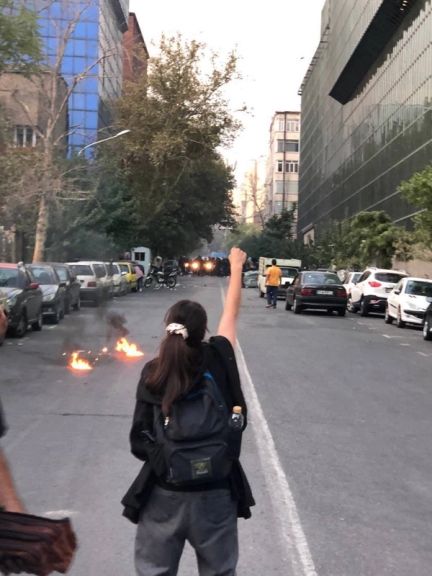
Woman, Life, Freedom protester in Iran, 2022

Several dissident figures linked to Iran's Green Movement from fifteen years ago have called on the Iranian elite to support women's civil disobedience against the hijab mandate rather than merely criticizing the new hijab law.

One such call to civil disobedience came from Abdollah Naseri this week, a former managing director of Iran's official news agency (IRNA), who called the hijab law “pure evil”.

“It is a good time for the revolutionary men and women of ‘Woman, Life, Freedom’ to take over the streets again and without violence shout the right to freedom of how to dress, a gift from God to his creatures,” Naseri said in a note published by the banned Kalemeh website Tuesday.

Like the prominent jailed dissident Mostafa Tajzadeh, Naseri is a member of the banned Mujahedin of the Islamic Revolution, a small but once very influential Reformist political organization withing the Islamic Republic's political elite.

Naseri has been one of several activists and political figures to be vocally against Supreme Leader Ali Khamenei’s leadership and policies including his insistence on the necessity of hijab. The hijab laws have continued to worsen in the wake of the uprising in 2022, sparked by the death in morality police custody of Mahsa Amini, arrested for not wearing her head covering properly.

He said the current situation as laws continue to become ever more draconian, is “extremely unstable”.

Vasmaghi, a female Islamic scholar and politician, has argued that the Islamic Sharia does not require women to cover their hair and alleges that the Islamic Republic has used it to enhance its discrimination against women.

After years of wearing the hijab by choice, Vasmaghi posted a video of herself in October 2023 that showed her unveiling in protest.

In a note published on Telegram about the new hijab law, Isa Saharkhiz, another dissident and former politician, has warned that the new hijab law has the potential to trigger a national civil disobedience movement and an “unpredictable domino [of events]”.

One must emphasize that an opportunity has presented itself now to test the ruling establishment’s reaction to a peaceful but effective “national movement” against the new law, he wrote.

Saharkhiz also raised the question of whether given his declaration of total obedience to Khamenei, President Masoud Pezeshkian will eventually yield and carry out Khamenei’s wishes or resign if he could not honor his promise to stop hijab enforcement.

Some dissident politicians appear very optimistic about what civil disobedience against the hijab can achieve.

“Iranian women’s resistance will defeat the Hijab and Chastity Law,” Ardeshir Amir-Arjomand, the spokesman of the Coordinating Council of the Iranian Green Movement and a former senior adviser to Mousavi, tweeted Sunday.

Amir-Arjomand, who lives in exile, argued in his post that the solution to the problem caused by the new hijab law is “resistance and civil disobedience” rather than appealing to the Supreme Leader to abolish it by using his extraordinary powers as some politicians and the media in Iran have suggested in the past few days.

The UN has called Iran's hijab enforcement a form of "gender apartheid" and rights groups have called it a "draconian campaign" to force women to veil and a "war on women".

Most Viewed

Iran negotiators ordered to return after internal rift over Islamabad talks
1
EXCLUSIVE

Iran negotiators ordered to return after internal rift over Islamabad talks

2
ANALYSIS

US blockade enters murky phase as tankers spoof signals and buyers hesitate

3
ANALYSIS

Why the $100 billion Hormuz toll revenue is a myth

4

US tightens financial squeeze on Iran, warns banks over oil money flows

5
ANALYSIS

US blockade targets Iran oil boom amid regional disruption

Banner
Banner

Spotlight

  • Hardliners push Hormuz ‘red line’ as US blockade tests Iran’s leverage
    INSIGHT

    Hardliners push Hormuz ‘red line’ as US blockade tests Iran’s leverage

  • Ideology may be fading in Iran, but not in Kashmir's ‘Mini Iran'
    INSIGHT

    Ideology may be fading in Iran, but not in Kashmir's ‘Mini Iran'

  • War damage amounts to $3,000 per Iranian, with blockade set to add to losses
    INSIGHT

    War damage amounts to $3,000 per Iranian, with blockade set to add to losses

  • Why the $100 billion Hormuz toll revenue is a myth
    ANALYSIS

    Why the $100 billion Hormuz toll revenue is a myth

  • US blockade targets Iran oil boom amid regional disruption
    ANALYSIS

    US blockade targets Iran oil boom amid regional disruption

  • Iran's digital economy battered by prolonged blackout
    INSIGHT

    Iran's digital economy battered by prolonged blackout

•
•
•

More Stories

Q&A: What was Khamenei’s role in the 2015 nuclear deal?

Dec 5, 2024, 13:07 GMT+0
•
Maryam Sinaiee

Supreme Leader Ali Khamenei, with ultimate authority over Tehran’s nuclear policy, combined strict oversight with cautious deniability in the lead-up to the 2015 nuclear deal—using a dual strategy to safeguard domestic credibility while retaining international leverage.

Q: How and when did Khamenei approve the 2013 nuclear talks?

On September 17, 2013, Supreme Leader Ali Khamenei signaled his approval for nuclear talks with world powers, using a religious analogy in a speech to suggest that "flexibility" is sometimes necessary to achieve victory against adversaries.

Two weeks later, he expressed support for the diplomatic initiative of then-President Hassan Rouhani’s administration in another speech.

Between April and July 2015, as nuclear talks neared their conclusion, Khamenei cautioned military officials against allowing "aliens" to inspect military facilities "under the guise of supervision and inspection." He warned against halting Iran’s defense development or permitting the interrogation of Iranian nuclear scientists. Khamenei also pledged continued backing for the Islamic Republic’s "friends in the region," including the "peoples" of Palestine, Yemen, Syria, Iraq, Bahrain, and Lebanon.

Additionally, Khamenei insisted that all sanctions, whether imposed by the United Nations or the United States, must be lifted immediately once a deal was finalized.

Q: What role did Khamenei play in the 2015 nuclear deal?

Khamenei has consistently claimed that he was not directly involved in the details of the nuclear negotiations with world powers, which began in November 2013.

However, officials’ statements suggest that the negotiating team regularly reported to him, followed his instructions, and adhered to the “red lines” he established. A deal, by all accounts, required his ultimate approval.

In July 2013, Khamenei showcased his in-depth knowledge of the negotiations, citing technical terms and specific figures during a speech to government officials.

“Regarding the enrichment capacity, they aim to make the Islamic Republic consent to 10,000 SWU, but they began by demanding a limitation to 500 SWU or 1,000 SWU. 10,000 SWU is produced by the 10,000 old-type centrifuges we had and still have. Our officials say we need 190,000 SWU. This is the country’s definite need,” he said.

SWU (separative work units) refers to the amount of separation achieved in the uranium enrichment process.

Q: Did Khamenei accept responsibility for the 2015 nuclear deal?

Khamenei avoided taking direct responsibility for the nuclear deal, deferring its final approval to the conservative and hardliner-dominated Parliament. He neither explicitly endorsed nor opposed the agreement.

Speaker Ali Larijani expedited the parliamentary vote, reportedly acting on Khamenei’s instructions, and blocked debate on the legislation despite objections from hardliners. The deal passed with 161 lawmakers voting in favor, 59 opposing, and 13 abstaining.Some reports claimed that Khamenei had conveyed his desire for the deal’s approval through Asghar Hejazi, an official in his office. However, the office issued a statement denying such allegations.

Q: When did Khamenei first publicly criticize the 2015 nuclear negotiation team?

After the US withdrew from the nuclear deal – formally known as the Joint Comprehensive Plan of Action (JCPOA) – in May 2018, Khamenei described the negotiations as a mistake in an August speech.

He stated that he had permitted the talks because senior officials, likely President Hassan Rouhani and his negotiation team led by Javad Zarif, had insisted on pursuing them.

In the same speech, he accused the negotiators of crossing the “red lines” he had set.

Q: Has Khamenei issued a fatwa prohibiting the development of nuclear weapons?Iran's government has consistently stated that it will not pursue nuclear weapons, citing a fatwa (religious edict) by Supreme Leader Ali Khamenei banning all weapons of mass destruction, including nuclear arms.Iranian officials first referenced Khamenei’s fatwa at an IAEA meeting in Vienna in August 2005 and reiterated it at the International Conference on Nuclear Disarmament in April 2010.

According to Khamenei’s official website, Iran’s mission later pledged to submit a translation of the fatwa in several languages to the UN for registration as an official document.

In an October 2019 speech, Khamenei declared that building and maintaining nuclear weapons is "absolutely haram," meaning strictly forbidden under Islamic law. He stated that although Iran had the capability to develop a bomb, it chose not to. He emphasized there is no justification for pursuing a weapon that is religiously prohibited.

However, analysts argue that the so-called fatwa is merely an advisory opinion rather than a binding legal decree. They argue it was intended to mislead the international community about the true intentions of a nuclear program that Tehran insists is peaceful.

Q: Can Khamenei’s ‘nuclear fatwa’ be overturned?

Fatwas are issued by Shia Marja – senior clerics recognized as sources of emulation in Islamic jurisprudence.

Skeptics say that such fatwas are not immutable; they can be revised or revoked based on the “requirements of time and place.” This principle allows rulings to adapt to new circumstances, as shown by historical instances where one Marja or another has altered earlier decisions.

UK Defense Chief: Israel destroyed Iran’s ballistic missile production for a year

Dec 5, 2024, 08:58 GMT+0

The UK's Chief of Defence Staff says Israel's October attack has incapacitated Iran’s ability to produce ballistic missiles for a year, leaving Tehran facing a strategic dilemma in its response.

"In October’s retaliatory strikes again Iran, Israel used more than 100 aircraft, carrying fewer than 100 munitions, and with no aircraft getting within 100 miles of the target in the first wave, and that took down nearly the entirety of Iran’s air defence system," Admiral Sir Tony Radakin said in his annual lecture at the Royal United Services Institute on Wednesday.

"It has destroyed Iran’s ability to produce ballistic missiles for a year, and left Tehran with a strategic dilemma in how it responds," he added, underscoring the significant advantage of modern warfare tactics employed in the Israeli attack.

He said the success was down to the power of 5th generation aircraft, combined with "exquisite targeting and extraordinary intelligence" enabling Israel to achieve vast amounts from a single mission.

Iran has threatened to retaliate against Israel for the airstrikes that, according to Israeli and US officials, destroyed Iran's last three Russian-supplied S-300 air defense missile systems, leaving the country "naked." Meanwhile, Tehran's war rhetoric has significantly decreased since the recent ceasefire between Israel and the Iran-backed Hezbollah.

Radakin also compared Russia's military to Israel's, quipping, "Russia is showing us how not to fight." He contrasted Israel's targeted strike in Iran with Russia's prolonged invasion of Ukraine, which was initially billed as a three-day Special Military Operation.

He pointed to North Korea's deployment of troops to Ukraine, potential tech sharing between Moscow and Pyongyang, and Russia's use of Iranian drones, signaling a global realignment with three distinct blocs emerging.

He highlighted in one group, the increasing collaboration between authoritarian states like Russia, China, North Korea, and Iran that challenge the global order, driven by self-interest, and survival. “In the case of Russia, it is because Putin believes in a historic fiction. In the case of China, it is seeking to reshape the rules around its own interests. And in the case of North Korea and Iran, it is to secure the survival of their regimes at any cost.”

According to him, the second group are democratic nations and responsible actors who seek to uphold stability and international rules. While, a third group of nations, exemplified by the BRICS, seeks to balance between these two blocs for maximum advantage.

Pezeshkian to seek legal solution to Iran's latest hijab law

Dec 5, 2024, 08:43 GMT+0
•
Maryam Sinaiee

Critics of Iran's new hijab law say President Masoud Pezeshkian should not only refuse to take responsibility for its implementation but also try to find a way to shelve or abolish it.

The law mandates extensive surveillance of public spaces to identify women who fail to comply with full hijab regulations, imposing hefty fines and even prison sentences on violators.

The new law also demands businesses including hospitality establishments, retail shops, and taxi services refuse service to unveiled women or report them to the authorities to avoid being penalized themselves.

"The main goal of those insisting on the implementation of the hijab law, in my view, is to bring down Pezeshkian’s government," prominent reformist politician and journalist Abbas Abdi wrote on Wednesday.

Many others, from reformist politician and former vice-president Masoumeh Ebtekar to conservative Qom Seminary teacher Hojjat ol-Eslam Mohsen Gharavian have objected to the provisions of the hijab law ultra-hardliners insist must be implemented.

The government must reject and protest to the hijab law, Gharavian who argues that the punishments stipulated in the law, such as withdrawing the fine for unveiling from people’s bank accounts without their consent, is unacceptable even from the religious point of view, Gharavian said in an interview with Khabar Online news website Tuesday.

According to Pezeshkian’s special aide in matters of social freedoms and rights, Sakineh-Sadat Paad, the President is planning to consult with Chief Justice Gholam-Hossein Mohseni-Ejei, and Parliament Speaker Mohammad-Bagher Ghalibaf in a meeting of the heads of the three government forces to find a solution for the problem.

The rush to implement a law that is questionable to Muslim religious jurists, legal experts, sociologists, and others is not rational, she argued in an X post a day before Pezeshkian’s televised interview Monday. “A good law must be acceptable to the society,” she added.

Since the 2022 Woman, Life, Freedom protests, a significant number of Iranian women have refused to wear the hijab, often facing confrontations with morality police in the streets. Beyond the oppressive nature of the new law, individuals close to the Islamic government worry that violent enforcement of hijab regulations could ignite social unrest.

As president, Pezeshkian is required to give the new law official status by signing it and communicating it to all government bodies for implementation. In a televised interview Monday, he insisted that it would be hard to implement and warned that its enforcement would lead to widespread discontent in Iranian society.

Pezeshkian also said he was conferring with other top officials to find a way not to enforce the hijab law.

Critics of the new law within Iran's political establishment, spanning from reformists to numerous conservatives, have called on President Pezeshkian to appeal to Supreme Leader Ali Khamenei to use his extraordinary powers to issue a decisive ruling and resolve the impasse.

Critics suggest that Pezeshkian could attempt to persuade Khamenei that enforcing the new law runs counter to public and national interests, urging him to either order its suspension or refer the matter to a state body for further deliberation.

Pezeshkian can request through a letter to the Supreme Leader to ask him to have the law removed from the country’s agenda because it is against the fundamental rights of the nation, public interests and national interests, the reformist Sazandegi newspaper wrote Monday.

Khamenei, who has consistently maintained that everyone must adhere to hijab laws regardless of their personal beliefs because "it is the law," has so far refrained from commenting on the new legislation.

Another option critics, including prominent lawyer and member of the central council of the reformist Servants of Construction Party, Mahmoud Alizadeh-Tabatabaei, have proposed is for Pezeshkian to bring the issue before the Supreme National Security Council (SNSC). They contend that the Council holds the authority to suspend the law’s implementation if it determines the matter impacts national

As president, Pezeshkian heads the SNSC. Nevertheless, nearly all the other members including the chiefs of the Revolutionary Guards (IRGC), Police, and Joint Staff of the Armed forces are directly appointed by Khamenei and answer only to him, not the president.

Article 176 of the Iranian Constitution also stipulates that all the decisions taken by the Council must be endorsed by the Supreme Leader to become effective.

A third solution proposed by others, including a group of legal experts who penned an open letter to Pezeshkian, is to call for a national referendum on the issue. Alternatively, the legal experts suggest referring the matter to the Expediency Council, which, under Article 112 of the Constitution, can deliberate on any issue assigned to it by the Supreme Leader.

The proposal to hold a referendum, however, requires the approval of two-thirds of all members of Parliament which s dominated by hardliners and ultra-hardliners. The hijab law was approved in the previous term of the parliament in October 2023. However, ultra-hardliners have a stronger foothold in the new Parliament which started work in late May.

Combative TV interview with Iran's president stokes controversy

Dec 4, 2024, 14:16 GMT+0
•
Behrouz Turani

An Iranian state TV interview with President Masoud Pezeshkian has sparked debate for its sharp line of questioning and well-worn remarks by a new leader facing deep economic and foreign policy challenges.

Reformist-leaning media in Iran criticized Elmira Sharifi-Moghaddam, a female anchor for state TV channel IRINN, for posing challenging questions to President Pezeshkian about the state of the economy.

Commentators seen as reformists argued that her questions were unfair, overlooking long-standing issues Pezeshkian faces, such as sanctions and a deeply inefficient economic system.

However, the questions raised during the interview were far less probing than those typically posed by European or American TV anchors. The interview's style appeared intentionally crafted to align with state TV's political leanings, closely tied to the ultraconservative Paydari party, whose members are known to influence the broadcaster's news and current affairs policies.

A former Tehran mayor, Gholamhossein Karbaschi, who owns and runs the centrist daily Ham Mihan, criticized the President's decision to participate in a live one-hour interview on state television. 

In an article for Iran, the state-owned newspaper, Karbaschi argued that Pezeshkian should have refused the format dictated by state television, instead asserting control over when and how he addressed the nation

"He should have changed the state TV's game and chosen when and for how long to speak to the public," Karbaschi suggested, adding that Pezeshkian could have delivered "just two sentences to convince the people."

Karbaschi argued that the interview was intended to undermine the president rather than facilitate meaningful communication with the public. 

"What we saw on TV was an honest president speaking transparently while facing unfairly challenging questions," he wrote.

The former mayor also accused the anchor of frequently interrupting Pezeshkian and raising provocative topics, such as a potential gasoline price hike, to derail his explanations of the administration’s performance.

Karbaschi further claimed that the president was given limited time to express his views on the controversial hijab law.

Domestic media appeared to express frustration upon realizing that the interview with Pezeshkian, his second since taking office on August 1, differed from those with previous presidents – when anchors typically refrained from challenging their guests and even assisted in portraying their performance in a favorable light. This was especially true in interviews with former President Ebrahim Raisi, much of the media noted.

Conservative columnist Abdoljavad Mousavi commented that "Pezeshkian spoke in the same manner about everything, making it difficult to assess his weaknesses and strengths," but argued that the president spoke with candor and honesty.

In contrast, Amir Hossein Jafari, a columnist for the pro-reform outlet Rouydad24, argued that Pezeshkian's remarks on various issues "hardly convinced the public."

Jafari highlighted key topics addressed in the interview, such as gasoline price hikes, internet censorship, and pressures stemming from the new compulsory hijab law.

"Apart from hijab, the president did not say much about other matters," he noted.

The word "disparity" dominated Pezeshkian's interview, reflecting gaps between the government’s financial resources and expenditures, production and consumption levels, and public expectations versus what the government can realistically deliver.

Throughout the conversation, Pezeshkian emphasized the lack of funding as a core issue. He acknowledged several economic challenges, many of which have escalated into crises, but maintained that there is little the government can do to address these disparities.

Pezeshkian offered no tangible solutions for short- or medium-term problems, instead suggesting measures that would only have been effective had they been implemented years ago.

He frequently remarked, especially regarding cultural issues, "Things should have been addressed when people were in primary school. It’s too late and too difficult to fix them now."

After the interview, Pezeshkian invited feedback on his X account. Many Iranians criticized his approach, calling him too timid.

"You should talk like a hammer!" one social media user urged.

Others expressed discontent over Pezeshkian’s perceived failure to uphold campaign promises, such as improving the economy, lifting internet censorship, and easing pressures on women over the hijab.

As one observer noted, "He has realized that things are not as easy as he thought when he made those promises during his campaign."

Q&A: All you need to know about Iran’s state broadcaster

Dec 4, 2024, 14:14 GMT+0
•
Maryam Sinaiee

The Islamic Republic of Iran Broadcasting (IRIB), Iran's sole radio and television provider, faces international sanctions for human rights violations. Who controls IRIB, and how relevant is it in Iran today?

Q: Who oversees IRIB’s operations and leadership?

Established after the 1979 Islamic Revolution, IRIB is the sole entity authorized to broadcast radio and television signals in Iran.

Under Iran’s Constitution, IRIB operates under the control of the supreme leader, who holds the authority to appoint and dismiss its head. The supreme leader's influence extends through his appointed representative within the organization.

The IRIB Supervisory Council, formed under Article 175 of the Constitution, includes representatives from the president and Parliament, each selecting two members. The chief justice, appointed by the supreme leader, selects two of the council's six members, further consolidating the supreme leader’s oversight.

Q: What are the sources of IRIB’s budget?

Unlike public service broadcasters in some other countries, such as the BBC, which is primarily funded through license fees and advertising, IRIB receives its budget from the government, supplemented by advertising revenue.

For the Iranian calendar year ending March 20, 2025, Parliament allocated 240 trillion rials (approximately $400 million) to IRIB. Despite an estimated $35 billion budget deficit, IRIB’s funding has consistently increased over the years, often surpassing inflation. This year’s allocation is three times higher than the previous year’s.

In addition to its main budget, IRIB receives separate funding for “cultural” activities and earns substantial revenue from advertising, amounting to trillions of rials annually.

IRIB is a vast organization employing between 30,000 and 50,000 people, significantly more than the BBC, which has around 21,000 employees.

Q: To which political factions are IRIB heads affiliated?

The IRIB is currently led by ultra-hardliners closely linked to the Paydari (Steadfastness) Party and the Revolutionary Guards (IRGC), both of which hold significant influence in Iran’s political system.

In 1987, shortly after becoming supreme leader, Ali Khamenei reinstated Mohammad Hashemi-Rafsanjani as the head of IRIB. Hashemi-Rafsanjani had been appointed by Khamenei’s predecessor, Ruhollah Khomeini, the founder of the Islamic Republic. He is also the brother of Akbar Hashemi-Rafsanjani, a prominent moderate conservative politician who played a key role in ensuring Khamenei succeeded Khomeini as supreme leader.

Hashemi-Rafsanjani’s tenure at IRIB ended in 1993. Since then, Khamenei has exclusively appointed leaders from the Principlist political camp, a coalition of conservative and ultra-hardline groups that dominate Iran’s right-wing politics.

Principlists have traditionally formed alliances against reformist politicians in elections. However, in the past decade, these alliances have narrowed, with many moderate conservatives—such as former President Hassan Rouhani and former Speaker of Parliament Ali Larijani, who headed IRIB from 1994 to 2004—distancing themselves from hardliners and ultra-hardliners.

Q: Who is the current head of IRIB?

Supreme Leader Ali Khamenei appointed Peyman Jebelli, a former head of IRIB’s foreign services, as the organization’s chief in 2021. Jebelli is politically aligned with Saeed Jalili, an ultra-hardline politician and former secretary of the Supreme National Security Council, who ran in the snap presidential elections of July 2021.

Jebelli appointed Vahid Jalili, Saeed Jalili’s brother, as his cultural deputy. In this role, Vahid Jalili wields significant influence over IRIB’s policy direction. He is also a member of the ultra-hardline Paydari (Steadfastness) Party, further consolidating the faction’s control over the state broadcaster.

Q: What foreign-language services does IRIB offer?

Press TV, launched in July 2007, is IRIB’s primary international channel, broadcasting in English.

In addition to Press TV, IRIB operates several channels targeting foreign audiences in multiple languages. These include Arabic-language channels such as Al-Alam, Al-Kawthar TV, and Al-Alam Syria; a Spanish-language channel, Hispan TV; and Hausa TV, which is aimed at West African audiences.

The IRIB also runs the Sahar Universal Network (SUN), launched in 1997, which broadcasts in languages including Dari, Azeri, Kurdish, Urdu, and Balkan languages such as Bosnian and Albanian.

The Jam-e Jam Network, which targeted Iranian expatriates and shared its name with the California-based opposition channel Jaam-e Jam that began broadcasting in 2015, ceased operations in 2023.

Q: Why has IRIB faced international sanctions?

IRIB has been sanctioned by multiple countries and organizations, including the United States and the European Union, for its role in censorship and human rights violations.

These sanctions cite IRIB’s broadcasting of forced confessions and its close ties to Iran’s security apparatus, which have been used to suppress dissent.

The current head of IRIB, Peyman Jebelli, is also under Western sanctions, including those by the US, for facilitating the suppression of free speech and using the media to support state violence.

Press TV, IRIB’s English-language outlet, has been sanctioned by the US and European entities for similar reasons.

Q: What is IRIB’s viewership?

IRIB’s viewership has significantly declined over the past two decades as many Iranians have turned to satellite TV channels, including banned Persian-language news and entertainment channels based abroad, instead of the national broadcaster.

IRIB officials claim that the organization retains a viewership of 72 percent. However, a survey by the Iranian Students Polling Agency (ISPA), a government-affiliated polling body, reported a substantial drop, with only 12.5 percent of respondents identifying IRIB as their primary source of news, down from 51 percent in 2017. The same survey found that just 11.5 percent watch IRIB’s entertainment programs.

In recent years, IRIB’s monopoly has also been challenged by the rise of online entertainment platforms such as Filimo, which are gaining popularity among Iranian audiences.