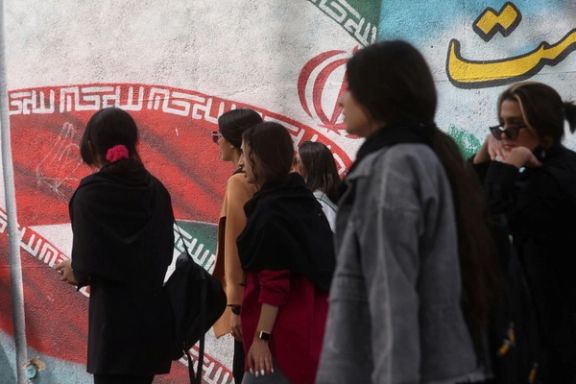
Iranian women walk on a street without mandatory hijab surveillance in Tehran, Iran, April 15, 2023.
Iran's Cyber-Police (FATA) has threatened women fashion businesses, surgery clinics and gyms with closure over unveiled photos in their social media content.
Ramin Pashaei, deputy chief of FATA, said Monday Cyber Police aims at “clearing the [Persian language] cyberspace of immoral content” and warned that any social media content considered “outside norms and against moral standards” would bring about prosecution.
Authorities accuse boutiques, beauty salons, modelling agencies, gyms and plastic surgery establishments of encouraging women not to wear the hijab by their “immoral” content. FATA on some occasions in the past has prosecuted them or forced them to shut down their accounts.
Ramin Pashaei, the deputy chief of Iran's Cyber-Police
Last week an official of the “Basij-Militia of Retailers”, Gholamreza Hasanpour, told the semi-official Mehr News Agency that female sales staff should wear uniforms to work but have been given a “choice” of one hundred different designs to choose from.
Unveiled girl protesting against compulsory hijab by performing gymnastics on the streets of Boukan in western Iran.
Women’s defiance of hijab rules has a history as long as the Islamic Republic itself, but it has escalated to new levels since the death of 22-year-old Mahsa (Jina) Amini in custody of morality police for “improper hijab” sparked nationwide protests.
Protests gradually subsided after several months but defiance of hijab rules as a form of civil disobedience has forced the government to try to stop the anti-compulsory hijab movement by taking various measures.
Such measures include preventing defiant women from using public transportation, entering government offices and boarding planes, shutting down shops and shopping malls as well as various plans to “encourage and convince” them to wear the hijab such as billboards and banners extolling “hijab and chastity”.
One such banner put up by the ministry of Islamic Guidance and Tehran International Bookfair last week quoted the 19th century Russian writer Leo Tolstoy as saying that corruption, sexual derangement, and lack of hijab caused profusion of divorces in Europe. Another banner they have put up quoted 19th century French author Victor Hugo praising modesty of women and its allure for men.
Sepideh Rashno, a 28-year-old art student whose defiance of hijab rules and heated dispute with a hijab enforcer on a city bus landed her in prison in July last year, a few months before the Mahsa protests, was suspended from Alzahra University in Tehran due to "non-observance of the Islamic hijab" last week for two semesters.
"As a citizen, I have the right to choose the clothes I wear,” she wrote in response to the decision, adding that she planned to return to the university after her suspension “in my preferred outfit”, that is, unveiled.
Pundits have said the regime’s determination to reinforce strict hijab rules is political in nature. Vice President in Legal Affairs Mohammad Dehghan on Sunday confirmed such theories. “The Islamic Republic will not mean much if there is no hijab in the country,” he said.
On April 4 at a meeting with state officials Tuesday, Khamenei claimed that foreign intelligence services were encouraging Iranian women to disobey mandatory hijab.
“Discarding hijab is haram based on Sharia and also politically,” he declared. His declaration was a clear signal to authorities that they need to do anything it takes to re-establish control over women which has somehow waned following anti-regime protests.
“The order given by his excellency is clear,” Parliament Speaker Mohammad-Bagher Ghalibaf said a day after Khamenei’s speech while promising to give precedence to any hijab-related motion or bill.
Former Iranian Member of Parliament Mahmoud Sadeghi has been summoned to the security prosecutor's office after recent criticisms of the regime on social media.
Publishing the picture of his summons on Twitter, this former representative wrote that he should go to the seventh branch of the Security Prosecutor's Office located in Evin prison in Tehran on May 23.
There is no accusation mentioned in the notice, but it is stated that the former reformist MP will be arrested if he does not show up.
Sadeghi is an Iranian lawyer, jurist, and academic who was a member of the parliament representing Tehran from May 2016 to May 2020.
Sadeghi is an associate professor at the Tarbiat Modares University and his field of expertise is Private law.
In 2016, he appeared before the specialcourt for culture and media in Tehran to answer questions about his comments on possible corruption among senior officials. He was released after posting a bond, but later he was sentenced to 21 months of discretionary custodial imprisonment.
Sadeghi has been summoned several times since 2016, but refused to appear before the court, citing his legislative immunity. Judicial authorities attempted to arrest Sadeghi at his home in Tehran at the time with an arrest warrant based on a plaintiffs’ case against him.
He was heading a new faction in parliament which was charged with helping ensure “transparency and purification of the economy.”
His remarks on the personal bank accounts of the judiciary chief put him in trouble. Sadeghi asked the justice minister to explain the reason behind the alleged transfer of public funds to the personal accounts of the then Judiciary Chief Sadegh Larijani.
Iran’s Medical Council says no doctor has the right to refuse to accept and examine a patient over hijab issues.
However, the head of Medical Council, Mohammad Rais-Zadeh, said Sunday that no hijab-related case has been sent to the council so far.
The ruling follows reports of a doctor refusing to accept a veiled patient in the northeastern city of Mashhad.
In February, a medical office in the northeastern Iranian city of Kashmar was shut when a doctor there objected to a woman harassing a patient over her “improper clothing”.
Earlier in February, Iran’s Health Minister Bahram Einollahi said violation of hijab regulations is considered a crime at hospitals and if they do not abide by hijab regulations, they will not receive approval to operate. He added that public hospitals have been required to comply with the hijab law and provide services to women by female staff.
“Women's ultrasound should be performed by women, and in some cases that we do not have enough radiologists, we ask female general practitioners and gynecologists to be given short-term training,” underlined the minister.
The clerical regime continues to strictly enforce the "mandatory hijab", despite the mass protests that followed the death in custody last September of 22-year-old Mahsa Amini, who had been arrested by the morality police for defying modesty rules.
About a month before the death of Mahsa Amini, the so-called morality police had started patrolling medical and academic centers in Iran’s northeastern city of Mashhad to enforce compliance with the Islamic dress code. Social media users earlier reported the presence of teams from what the Islamic Republic calls the ‘Enjoining right and forbidding vice headquarters’ in various wards of hospitals and medical centers in other cities, with some reports of pressures on hospitals to separate male and female patients admitted to the ICU.
The uprising has made it increasingly difficult for the clerical regime to enforce the mandatory Islamic dress code. Appearing in public without a full veil has become a common sight even in small and more conservative towns. Since the beginning of the ‘Women, Life, Liberty’ movement in September last year, thousands of girls and women have set fire to their headscarves in a symbolic move and voiced opposition to compulsory hijab.
The head of Iran's Medical Council, Mohammad Rais-Zadeh
Rais-Zadeh also voiced his concern over the low income of doctors and surgeons, saying current wages mean no one would study for many years to qualify.
Iran’s medical profession is facing a crisis as more and more doctors leave the country for better wages and working conditions.
There are no transparent data on the emigration of healthcare and other professionals, but medical officials and lawmakers often offer fragmentary information on the scope of the problem. The number of doctors emigrating has more than doubled in the past decade, according to one report.
Thousands of physicians, dentists, midwives, and nurses have either emigrated in the past few years or are planning to leave for other countries. Many in Iran, including lawmakers, have repeatedly warned that the ever-increasing desire of healthcare professionals to leave will result in the deterioration of the country’s healthcare system.
In February, Mohammad Sharifi-Moghadam, a member of the central council of Iran's Nurses’ Organization, said between 2,500 to 3,000 nurses were emigrating from Iran each year, based on the number of requests for good standing certificates, confirming that the applicant is entitled to practice medicine in the country.
The average salary for a doctor in Iran is about $400 per month, against ten as much or more in the US and UK. Physicians and other health professionals’ maximum feesas well as private hospitals’ tariffs are set and announced by the government annually.
Mohammad-Ali Mohseni-Bandpey, a member of the parliament health committee, said last year that wrong government policies affecting doctors included ignoring their needs and demands and refusing to allow them to raise their fees despite higher costs of living and running their practices. According to Mohseni-Bandpey, despite an almost 50 percent annual inflation rate, the government is trying to prevent a similar increase in doctors’ fees, to keep healthcare costs down. He suggested that the government should allow them to increase their fees but shift the burden to insurance companies rather than patients.
Doctors in Iran must also contend with a lack of adequate medical equipment and resources.
With fewer doctors available to provide care, the quality of medical care in Iran is declining, especially in rural areas, where access is already limited.
Moreover, medical schools are struggling to attract and retain students, leaving the future of the medical profession in Iran in doubt.
A major investment in the healthcare system, as well as increased funding for medical schools and hospitals is required to salvage the situation and stop the flood of emigrating doctors. However, Iran’s dire financial plight means such investment is impossible for the foreseeable future.
People gathered outside Isfahan Central Prison on May 14, 2023
Iranians in the Islamic Republic and abroad have voiced their fears for three political prisoners whose execution is imminent.
Protestors gathered overnight outside the prison in Esfahan (Isfahan) where Majid Kazemi, Saleh Mirhashmi, and Saeed Yaqoubi await their death sentence, having been found guilty in a trial condemned as a travesty of justice by human rights campaigners.
They were convicted over the death of two IRGC’s Basij militia members and a police officer in protests of November last year, in what Persian media have dubbed the ‘Isfahan House’ case.
Responding to social media calls on Sunday night, people gathered outside Esfahan (Isfahan) Central Prison hoping to stop the executions. Videos posted by activists show dozens chanting slogans in front of the prison, while gunfire was also heard as thick smoke caused by teargas enveloped the area.
Following the increase in the executions of prisoners in recent weeks, families of those sentenced to death held a protest rally outside the Judiciary’s office in Tehran’s Keshavarz Street on Monday, demanding an end to the killing.
Opposition activists say the death penalty is being used against the Isfahan House three as an intimidation tactic to stop further protests.
Majid Kazemi, Saleh Mirhashemi and Saeed Yaghoubi
Campaigners say the prisoners were tortured into confessions, and there is no reliable evidence against them. According to an audio file released on Sundayof Kazemi talking to his cousin, he was coerced into confession by threats to his family of rape and death.
Exiled prince Reza Pahlavi tweeted on Sunday night, saying, “We must not allow this murderous regime to take another innocent life and turn another mother into a mourner.”
Prominent activist Masih Alinejad said: “We should not allow the regime of crime and madness to take more young people from us and make more families grieving.”
Canada-based dissident figure Hamed Esmaeilion, whose daughter and wife were killed in the shooting down of Flight PS752 by Iran’s Revolutionary Guard in 2020, tweeted, “When will the insanity stop? When will the free world stand behind its own values? How many more executions will it take for the world to stand up?”
Last week, Australian Senator Jordon Steele-John, a political sponsor of Majid Kazemi called on the Australian Foreign Minister Penny Wong “to have an urgent meeting with her Iranian counterpart to do all they can to prevent the execution of Majid, which could happen at any moment”.
Iranian expatriate communities plan demonstrations against the executions in cities worldwide on Saturday, May 20.
Iran has always had a high number of executions but the number started to rise after President Ebrahim Raisi – the former head of the country’s notorious judiciary -- took office in August 2021.
Majid Kazemi, Saleh Mirhashemi and Saeed Yaghoubi, who face execution after forced confessions
Demonstrators have gathered outside a jail in Iran overnight ahead of the feared execution of three anti-government protesters.
Videos posted by activists show dozens chanting slogans in front of the Isfahan Central Prison, while gunfire was also heard. The clips also show thick smoke caused by tear gas.
Iranian authorities intend to execute Majid Kazemi, Saleh Mirhashmi, and Saeed Yaqoubi.
The three detainees received the death penalty in connection with an armed attack on November 16on “Isfahan House” neighborhood last year.
The Iranian authorities claim that two members of the security forces and a police officer were killed by protesters.
Campaigners say the three men were tortured into confessions, and there is no reliable evidence against them.
Amnesty International on Saturday spoke of its fears for the fate of the three detainees.
The international human rights organisation said: “Majid Kazemi, Saleh Mirhashemi and Saeed Yaghoubi are at imminent risk of execution at central Isfahan prison (also known as Dastgerd prison) after Iran’s Supreme Court upheld their unjust convictions and death sentences in early May 2023.”
After a wave of nationwide anti-government protests last year which has still yet to subside, the Iranian regime has embarked on a wave of executions which has seen dozens of prisoners hanged this year.
The regime used overwhelming force with military weapons in its crackdown on the protests, killing more than 500 civilians. Hundreds of other protestors suffered permanent injuries, including the loss of eyes when shotgun pellets were fired at the faces of demonstrators. More than 20,000 people were arrested.
The entrance to Tehran's notorious Evin prison that also houses a prosecutor office
Iran's judiciary has been building cases against dozens of independent lawyers for representing dissidents and supporting the Women, Life, Freedom movement.
Iran International has learned that summoning lawyers to the Prosecutor’s Office in Tehran, which started in March, resumed last week after a pause due to the relocation of the prosecutor in charge.
The judiciary’s intelligence organization, sources in Iran said, is behind the prosecution of these lawyers most of whom had expressed their support for the Women, Life, Freedom movement on social media.
The case involves 170 lawyers of whom, sources told Iran International, 27 individuals from different parts of the country have already been summoned by the Evin prison prosecutor on charges of “propaganda against the regime” and “assembly and collusion with the intention of acting against [national] security”.
Iran International has also learned that lawyers who were summoned were forced to sign a pledge that implies acceptance of the charges. One of the two lawyers who refused to sign the pledge was detained for a few hours and another one for a few days.
UK-based lawyer and women’s rights activist Samaneh Savadi told Iran International that the regime is taking revenge on lawyers, many among whom volunteered to represent protesters. She said that the attorneys are being punished “for standing beside the people”.
Ali Mojtahedzadeh, one of the summoned lawyers, told Etemad newspaper Sunday that most of these lawyers had participated in the protests or voiced support on social media. He said he and some of his colleagues had received the letter to present themselves to the prosecutor in the past few days.
He pointed out that the cases against most of these lawyers were dropped following Supreme Leader Ali Khamenei’s “amnesty”, but now new charges have been brought against them.
In February, Khamenei agreed to a proposal by Judiciary chief Gholam-Hossein Mohseni Ejei to pardon some prisoners and reduce sentences for those arrested during antigovernment protests last year. The move appeared to be designed to show clemency after hundreds were killed and around 20,000 arrested, and to rescue the image of the regime amid a grim economic crisis and mass public rejection of Khamenei’s rule.
Another lawyer, Mitra Izadifar, told Etemad that she is being prosecuted again, after being pardoned earlier. She added that she has been summoned to Tehran although she lives and practices in Mashhad.
Mohammad-Hadi Jafarpour who practices law in Shiraz also told Etemad “I was once arrested on November 2 on charges of ‘propaganda against the regime’ and ‘assembly and collusion with the intention of acting against [national] security. At the time, I was mostly questioned by prosecutors about my media commentaries, [Instagram] posts, and tweets… I had to sign a pledge in order to be pardoned [by Khamenei].”
He added that he has also been summoned to Tehran by the Evin prosecutor although despite a legal requirement that says he should be prosecuted in his own city. Jafarpour pointed out that the summons letter he received did not mention the charges.
Earlier in March a Revolutionary court permanently deprived prominent lawyer Nemat Ahmadi, a member of the Union Internationale des Avocats or International Association of Lawyers, from practicing law in Iran.
Ahmadi, a former professor of law sacked from Azad University for his political activities and representing political prisoners, was sued by the intelligence ministry for the same reason.
Dissidents and protesters are often deprived of their right to choose their own lawyers and must accept defense attorneys the judiciary appoints from a government-trusted list.