• العربية
  • فارسی
Brand
  • Iran Insight
  • Politics
  • Economy
  • Analysis
  • Special Report
  • Opinion
  • Podcast
  • Iran Insight
  • Politics
  • Economy
  • Analysis
  • Special Report
  • Opinion
  • Podcast
  • Theme
  • Language
    • العربية
    • فارسی
  • Iran Insight
  • Politics
  • Economy
  • Analysis
  • Special Report
  • Opinion
  • Podcast
All rights reserved for Volant Media UK Limited
volant media logo

Celebrity Actresses Anger Iran Hardliners With Hijab Defiance

Maryam Sinaiee
Maryam Sinaiee

Iran International

Apr 9, 2023, 05:39 GMT+1Updated: 17:23 GMT+1
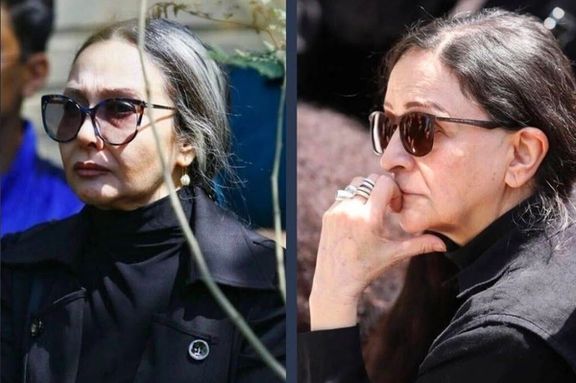
Iranian actresses Katayoun Riyahi (left) and Golab Adineh

Three prominent actresses defiantly appeared ‘bare headed’ at the funeral of a colleague Friday despite authorities’ warnings of serious consequences for ‘hijabless’ women.

Katayoun Riahi, Golab Adineh, and Fatemeh Motamed-Aria attended the funeral of popular film director, Kiumars Pourahmad in Tehran, who tragically ended his own life earlier this week.

Angered by such open defiance, hardliners on social media are calling for their punishment to set an example for others while taking their cue from Supreme Leader Ali Khamenei’s speech earlier this week. Officials, lawmakers and regime clerics are vowing to re-impose the hijab rules that women have increasingly been defying in the past six months.

“Start from celebrities, not the hijabless girls on the street because these celebrities are their role models,” a hijab promoter said in a Twitter post with the ‘hijabless’ images of Riahi and Adineh at the funeral.

Riahi, 61, was the first among Iranian female artists to express her solidarity with the Mahsa Movement amidst the nationwide protests in September by sharing her photo without a veil on Instagram. “Iranian women are each other’s voices,” she said in her post.

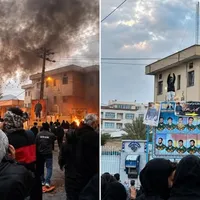
A man wearing a shawl over his head at a protest rally outside the National Library

The award-winning actress fled in time to avoid being arrested by security forces who raided her house but was arrested in November after living in hiding for two months.

Riahi was subjected to huge phycological pressure during her trial in December to “apologize’ for her deed but had to be taken to hospital from the court after fainting and losing her consciousness in front of the cameras filming the proceedings, apparently for airing on the state television.

Kazem Sadighi, head of the regime’s chastity outfit, the headquarters for Promoting Virtue and Preventing Vice, said Saturday that the “hijab criteria” drawn up by his organization has been sent to the president, parliament and the judiciary and that it will be communicated to government offices to enforce after being finalized.

Katayoun Riahi telling Iran International TV in November that she had never believed in hijab to “remove” it now.

In their sermons this Friday, the ultra-hardliner Friday imam of the religious city of Mashhad, Ahmad Alamolholda, threatened again that “people” may take the matter into their own hands against women who defy the hijab if authorities did not “have plans” to deal with “hijablessness”.

Katayoun Riahi telling Iran International TV in November that she had never believed in hijab to “remove” it now.

Khamenei and other officials including Chief Justice Gholam-Hossein Mohseni Ejei have repeatedly accused those opposed to compulsory hijab of working for “enemy” intelligence services.

At a meeting with state officials Tuesday, Khamenei claimed that foreign intelligence services were encouraging Iranian women to disobey mandatory hijab. He also claimed that “the enemy” is working according to “a plan and plot” and urged authorities to have their own plan for dealing with the issue of hijablessness.

While claiming that most Iranians agree with enforcing compulsory hijab, Ejei’s deputy, Mohammad Mosaddegh, repeated Khamenei’s accusations Thursday and said the judiciary will “take serious action” against “hostile” individuals who are “cooperating with foreign intelligence services to promote hijablessness”.

The police in several cities including Tehran have been summoning women whose ‘hijabless’ images were picked up by CCTV cameras. The police have also asked citizens to report the plate numbers of cars in which passengers are ‘hijabless’ and threatened to punish them “in accordance with the law”.

The measure has backfired and caused chaos in the system as many citizens have reported the plate numbers of cars whose passengers wore hijab, particularly the long black veil known as chador that the regime has always promoted as the measure of excellence in hijab abidance.

On Friday a small group of male and female members of the National Library protested outside the library against the decision to cancel the membership of ‘hijabless’ women.

Men who had participated in the rally wore headscarves in protest to compulsory hijab and after chanting “Woman, Life, Freedom” women threw their headcovers into a fountain.

Most Viewed

Iran negotiators ordered to return after internal rift over Islamabad talks
1
EXCLUSIVE

Iran negotiators ordered to return after internal rift over Islamabad talks

2
ANALYSIS

US blockade enters murky phase as tankers spoof signals and buyers hesitate

3
ANALYSIS

Why the $100 billion Hormuz toll revenue is a myth

4

US tightens financial squeeze on Iran, warns banks over oil money flows

5
ANALYSIS

US blockade targets Iran oil boom amid regional disruption

Banner
Banner

Spotlight

  • Hardliners push Hormuz ‘red line’ as US blockade tests Iran’s leverage
    INSIGHT

    Hardliners push Hormuz ‘red line’ as US blockade tests Iran’s leverage

  • Ideology may be fading in Iran, but not in Kashmir's ‘Mini Iran'
    INSIGHT

    Ideology may be fading in Iran, but not in Kashmir's ‘Mini Iran'

  • War damage amounts to $3,000 per Iranian, with blockade set to add to losses
    INSIGHT

    War damage amounts to $3,000 per Iranian, with blockade set to add to losses

  • Why the $100 billion Hormuz toll revenue is a myth
    ANALYSIS

    Why the $100 billion Hormuz toll revenue is a myth

  • US blockade targets Iran oil boom amid regional disruption
    ANALYSIS

    US blockade targets Iran oil boom amid regional disruption

  • Iran's digital economy battered by prolonged blackout
    INSIGHT

    Iran's digital economy battered by prolonged blackout

•
•
•

More Stories

Iran's Hardliners Wish To Change Election Law To Bar 'Moderates'

Apr 8, 2023, 21:41 GMT+1
•
Iran International Newsroom

Hardliner lawmakers dominating Iran’s parliament amid multiple crises are looking for ways to ensure their re-election, including tampering with electoral law.

The semi-official news agency ISNA reported April 6 that a parliamentary committee has suggested that no one who has already served as a lawmaker for three rounds in the parliament (Majles) should be allowed to run in the next parliamentary election in March 2024. The proposal is not to bar those who have served consecutive terms, but anyone who has served three terms.

Many of the ultra-conservatives in the current Majles are first term lawmakers, while there are many prominent and more moderate politicians who can challenge them next year.

Social media users in Iran noted that that the motion is a way of barring individuals such as former President Hassan Rouhani and former Majlis Speaker Ali Larijani from running for the next round of the parliament.

Former President Hassan Rouhani (left) and former Majlis Speaker Ali Larijani
100%
Former President Hassan Rouhani (left) and former Majlis Speaker Ali Larijani

This is presumably meant to save the embarrassment of disqualifying high-profile candidates ahead of the upcoming election, social media activists said.

In the 2020, the Guardian Council packed with loyalists of the Supreme Leader Ali Khamenei, disqualified hundreds of ‘reformists’, allowing the hardliners to breeze through in a low-turnout election. But the mass rejections became a serious embarrassment for the regime and after months of protests, Khamenei would prefer to bar unwanted politicians in a less direct manner.

According to ISNA, the suggestion has been made by the internal affairs committee of the Majles as part of the proposed amendment to the election law. However, the deputy speaker should review the suggestion to make sure it does not contradict the current laws before sending it for debate in an open session.

If the suggestion is discussed and approved by the Majles, then the constitutional watchdog Guardian Council has two weeks to accept or reject it. However, it is a known fact in Iran that the council operates based on Khamenei's preferences rather than the law.

Reformist daily Shargh wrote on the same date that others including former Vice President Es'haq Jahangiri and former lawmaker Ali Motahari will also be barred from running for the next Majles if the suggestion is approved.

According to Shargh, if accepted, the move will provide a stronger guarantee for the current ultraconservative "young revolutionary" lawmakers' re-election. In a similar move, the ultraconservatives raised the minimum age for presidential candidacy so that former IT Minister Mohammad Javad Azari Jahromi would not be able to run for President in 2021.

Former IT Minister Mohammad Javad Azari Jahromi  (undated)
100%
Former IT Minister Mohammad Javad Azari Jahromi

Shargh's columnist Vahideh Karimi wrote that as far as the young lawmakers of the current Majles are concerned, the ratification of this suggestion is a fateful event for them. They know that individuals such as Ali Larijani or Motahari can quickly form a strong alliance once they are elected, and this will make it hard for the remaining ultraconservatives at the Majles to exercise influence.

The move will also bar some of the conservative members of the parliament such as Mostafa Mirsalim from running in 2024 but the ultraconservatives cannot be less concerned as Mirsalim and other elderly and experienced traditional conservatives are less popular than the moderates who might wish to make a comeback.

In the meantime, the poor performance of the current parliament has left very little hope for most current lawmakers' re-election. As a Khabar Online report noted earlier, hardliners in Majles have done little in three years, except trying to pass laws to restrict freedoms.

Meanwhile, according to a Tasnim news agency report, Majles Speaker Mohammad Bagher Ghalibaf has called for boosting the people's trust in the government to ensure a higher turnout in the next election. Last time, less than 20 percent of potential voters took part in Tehran and around 40 percent in small towns and villages. "Without this trust, everyone will lose, and the people will trust us only if we share decision-making with them," said Ghalibaf.

Prisoners Pardoned By Khamenei Summoned To Court: Attorney

Apr 8, 2023, 21:27 GMT+1

An Iranian lawyer says some protest detainees, who were earlier pardoned by Supreme Leader’s amnesty, have been summoned to face trials.

Ali Mojtahedzadeh, wrote in Etemad daily Saturday that not only the cases of many of the defendants, who were granted amnesty in February, are not closed but they face more judicial proceedings, and conviction.

“Unfortunately, it seems that a number of the middle ranks in the judicial system close their eyes to the amnesty and insist on pursuing these cases,” he added.

In early February, Supreme Leader Ali Khamenei agreed to pardon tens of thousands of prisoners, including many detained during recent protests.

A week later, Iran’s Attorney General Mohammad Javad Montazeri said Khamenei’s amnesty is not for everyone, adding that the people who created fake deaths and caused damages during the protests will not be pardoned and must be held accountable.

Several activists including Iranian human rights defender, Narges Mohammadi, slammed Khamenei’s prisoner amnesty as a sham to feign compassion to the Western world.

In a letter written to the UN Human Rights Council in Geneva from inside Tehran’s notorious Evin Prison, she said the amnesty reflects “politics of the Islamic Republic [which] is based on lies”.

Mohammadi also added that she is ready to testify against the authorities regarding widespread torture, harassment and abuse of prisoners.

Technical Delegation In Tehran To Discuss Reopening Of Embassy: Saudi Media

Apr 8, 2023, 21:15 GMT+1

Saudi news media say officials have arrived in Iran to discuss procedures for reopening Riyadh's embassy in Tehran and consulate in Mashhad.

Saudi Press Agency (SPA) reported that a technical team tasked with discussing mechanisms for reopening the Kingdom’s embassy in the Islamic Republic of Iran arrived in capital Tehran Saturday.

“The Saudi technical team, headed by Nasser bin Awad Al-Ghannoum, met with the Chief of Protocols at the Iranian Ministry of Foreign Affairs, Mehdi Honardoust,” added SPA.

This is the first visit of a Saudi delegation to Iran after China brokered a deal to restore relations between the two regional powers. Relations were severed in January 2016 following attacks by Iranian mobs on Saudi diplomatic missions.

However, Iran’s foreign ministry has not yet published any news about the visit at the time of writing this report.

On Thursday, the foreign ministers of Iran and Saudi Arabia met in Beijing for the first formal meeting in more than seven years.

After years of hostility that fueled conflicts across the Middle East, Iran and Saudi Arabia agreed to end their diplomatic rift and reopen their diplomatic missions in March.

Chinese President Xi Jinping helped broker the surprise deal which left the United States on the sidelines.

Russian Presidential Aide In Tehran Meeting Top Officials

Apr 8, 2023, 20:37 GMT+1

Iranian media report that the special assistant of the Russian president will hold talks with Iran's national security chief Ali Shamkhani on Sunday.

According to IRNA state news agency, Igor Levitin, who arrived in Tehran Friday night, will meet secretary of Iran's Supreme National Security Council on Sunday.

During Levitin's visit to Iran last January, the two countries agreed that the remaining part of the North-South strategic corridor, in Iran’s northern Rasht-Astara route, will be built with the direct investment of Russia.

IRNA, also added that the two sides will review the process of implementing joint economic projects, especially speeding up the implementation of the North-South Corridor.

Meanwhile, Russia’s Sputnik reported that Levitin was scheduled to meet with First Vice President Mohammad Mokhber and Minister of Roads and Urban Development, Mehrdad Bazrpash on Saturday.

The International North-South Transport Corridor (INSTC) is a 7,200-km-long multi-mode network of ship, rail, and road route for moving freight between India, Iran, Azerbaijan, Russia, Central Asia and Europe.

The objective of the corridor is to increase trade connectivity between major cities such as Mumbai, Moscow, Tehran, Baku, Bandar Abbas, Astrakhan, etc.

Russia, Iran and India signed the agreement for the NSTC project in 2002. All three countries are founding member states on the project. Other important member states include Azerbaijan, Armenia, Kazakhstan and Belarus with other states having varying levels of involvement.

Iran started construction work to complete the missing link of the Qazvin-Rasht-Astara road and railway in 2017.

UN Special Rapporteur Expresses Support For Iranian Hunger Striker

Apr 8, 2023, 19:47 GMT+1

The UN special rapporteur on Iran has expressed solidarity with the Iranian hunger striker who has camped outside the British Foreign Office for 44 days.

Javaid Rehman, the UN human rights rapporteur, Friday visited Vahid Beheshti who has been campaigning for the UK to proscribe the Islamic Revolutionary Guard Corps.

Beheshti has been battling the bitter winter outside the UK Foreign Office to raise awareness for the need to designate the IRGC responsible for the deaths of hundreds of Iranian citizens since September.

In his third letter on Monday the British prime minister, he reiterated his desire to meet PM Rishi Sunak, adding that “my body grows ever weaker, yet internally, I grow ever stronger in my conviction that this is the right thing to do.”

Beheshti called his request to the British government "simple and at the same time, very important" emphasizing the urgency of proscribing the IRGC.

He said the designation urgently needs to happen, not only for the people of Iran who yearn for democracy, but also for the people of Britain and "the values we uphold".

“As long as we continue with our appeasement policy, the IRGC will continue with their hostage taking policies,” he said. “They only understand one language, pressure and strong leadership.”

Beheshti has not eaten since February 23 and lost a large amount of his body mass. In the past days, a group of other Iranians also joined him and set up tents next to him.