• العربية
  • فارسی
Brand
  • Iran Insight
  • Politics
  • Economy
  • Analysis
  • Special Report
  • Opinion
  • Podcast
  • Iran Insight
  • Politics
  • Economy
  • Analysis
  • Special Report
  • Opinion
  • Podcast
  • Theme
  • Language
    • العربية
    • فارسی
  • Iran Insight
  • Politics
  • Economy
  • Analysis
  • Special Report
  • Opinion
  • Podcast
All rights reserved for Volant Media UK Limited
volant media logo

Government's Internet Shutdown Hurting Iran's Ecommerce
Iran International Newsroom
Oct 9, 2022, 18:59 GMT+1Updated: 18:12 GMT+1
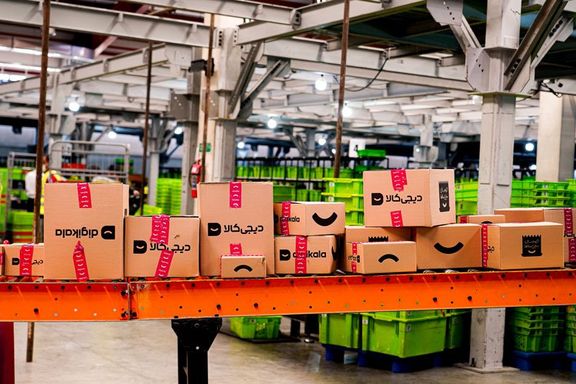
A processing center for Digikala, Iran's largest ecommerce company

It may be too early to estimate the economic impact of protests on Iran’s economy, but early signs show serious disruption in the retail ecommerce sector.

The government has been severely restricting Internet access in general and access to popular social media platforms in particular that play a key role in ecommerce. The government is extremely nervous that people use the Internet and social media to share news and images about protests, possibly motivating a larger segment of the population to join demonstrations. It also does not like videos of the popular unrest to reach abroad.

For more than three weeks, authorities have been blocking access to the Internet during certain hours of the day and slowing down connections to make uploading videos more difficult. But what impacts ecommerce is the decision to block WhatsApp and Instagram altogether.

Specially Instagram is an extremely popular platform for individuals, small family firms and larger companies with employees to offer goods and services online. Some estimates put the number of all such enterprises at close to one million units in Iran, however businesses with 10-200 employees is a small fraction of this number, although no reliable figures exists.

The Internet disruption and the ban on Instagram have immediately stopped or slowed down sales by hundreds of thousands of large and small businesses.

One report from an online business association October 8 said that ecommerce businesses with 10 and more employees are losing anywhere from $1,500 to nearly $20,000 a day. These are substantial figures in local currency.

An online ad in Iran for learning how to use Instagram for ecommerce
100%
An online ad in Iran for learning how to use Instagram for ecommerce

Smaller businesses run by individuals and families would be losing much less but the impact of their loss would be detrimental to their livelihoods.

A news website said that in many cases ecommerce businesses have lost all income, but most have seen a 70-percent decrease in orders and in the best cases merchants are experiencing 50-percent losses.

An unofficial poll among 104 retailers (10-200 employees) showed that 53 percent are losing $1,500 a day in sales, while 21 percent lose up to $3,000, 18 percent three to fifteen thousand dollars and the top 8 percent lose more. The top tier are businesses with more than 200 employees.

This means that ecommerce total daily losses could run into millions of dollars a day considering the hundreds of thousands of small family businesses that each might be losing a few tens of dollars a day. Postal deliveries have also decreased by more than 25 percent.

This does not include the general damage to the economy by Internet disruptions. Some reports say that government and companies have resorted to telephone and fax to communicate.

There is no total estimate of daily ecommerce volume in Iran, but the sheer number of social media accounts and webpages running their businesses online provides a sense of the economic impact from the Internet shutdown.

It is not clear if the government intends to maintain the ban on Instagram and WhastApp if the protests end. The hardliners who have been in control of both the government and parliament for more than a year were planning to further restrict access to the Internet even without the current protests. Now, some appear to be arguing that this is the time to keep foreign apps banned forever, to protect the religious government’s ideological and political restrictions on citizens and prevent Western cultural influences.


Most Viewed

Iran negotiators ordered to return after internal rift over Islamabad talks
1
EXCLUSIVE

Iran negotiators ordered to return after internal rift over Islamabad talks

2
ANALYSIS

US blockade enters murky phase as tankers spoof signals and buyers hesitate

3

US tightens financial squeeze on Iran, warns banks over oil money flows

4
INSIGHT

Ideology may be fading in Iran, but not in Kashmir's ‘Mini Iran'

5
INSIGHT

Hardliners push Hormuz ‘red line’ as US blockade tests Iran’s leverage

Banner
Banner

Spotlight

  • Hardliners push Hormuz ‘red line’ as US blockade tests Iran’s leverage
    INSIGHT

    Hardliners push Hormuz ‘red line’ as US blockade tests Iran’s leverage

  • Ideology may be fading in Iran, but not in Kashmir's ‘Mini Iran'
    INSIGHT

    Ideology may be fading in Iran, but not in Kashmir's ‘Mini Iran'

  • War damage amounts to $3,000 per Iranian, with blockade set to add to losses
    INSIGHT

    War damage amounts to $3,000 per Iranian, with blockade set to add to losses

  • Why the $100 billion Hormuz toll revenue is a myth
    ANALYSIS

    Why the $100 billion Hormuz toll revenue is a myth

  • US blockade targets Iran oil boom amid regional disruption
    ANALYSIS

    US blockade targets Iran oil boom amid regional disruption

  • Iran's digital economy battered by prolonged blackout
    INSIGHT

    Iran's digital economy battered by prolonged blackout

•
•
•

More Stories

Opec+ Oil Cut Sparks Tremors In Washington, Ripples Round Iran

Oct 8, 2022, 16:49 GMT+1
•
Iran International Newsroom

While outraging United States President Joe Biden, the Opec+ decision to cut oil production by 2 million barrels a day has mixed implications for Iran.

Market analyst Oilprice.com wrote Friday in its ‘Oil and Energy Insider’ bulletin that the decision had “placed the Biden Administration between a rock and a hard place, with oil prices climbing ahead of the mid-terms [November 8 US Congressional elections] and very few viable options to counter it.”

Biden’s press secretary Karine Jean-Pierre accused Opec+ of “aligning with Russia.” Biden himself said Wednesday the government would release an additional 10 million barrels in November from US strategic reserves, although the Strategic Petroleum Reserve (SPR) is already at its lowest level, 416 million barrels, since 1984.

The Wall Street Journal piled on criticism with an editorial Wednesday citing earlier lobbying efforts by senior Biden officials to dissuade the Saudis from production cuts. The Journal noted that the prospect of higher gasoline prices before the November 8 Congressional election had “sent the White House into overdrive.” The paper concluded that the Saudis “don’t seem to think risking relations with the US is all that big a deal” and had put “friendly relations with Russia above their ‘reputation’ in the US.”

Biden’s Democrats had been more optimistic, especially as oil prices eased in the summer, over their prospects for the November elections. But even before the Opec+ decision, there were encouraging signs for Republicans, including so-called “election deniers” close to Donald Trump sharing the former president’s unsubstantiated claims that the 2020 presidential election was rigged.

A shift away from the Democrats would likely increase voices in Congress critical of Biden’s efforts to revive the 2015 Iran nuclear deal, the JCPOA (Joint Comprehensive Plan of Action). At the same time, reviving the deal, and lifting US ‘maximum pressure’ sanctions targeting Tehran’s crude exports, would bear down on oil prices with perhaps an extra 1.5 million barrels a day (b/d) of Iranian oil reaching world markets.

$100 a barrel?

In the meantime, more expensive oil boosts Iranian revenues, albeit on the lower prices Tehran receives from sales of around 750,000-900,000 b/d, mainly to China exported in the face of tightening US sanctions.

In Tehran, Arman newspaper Saturday played down expectations of higher prices, although its headline noted that Opec+ aimed at an oil price of $100 a barrel. The $100 level is built into the Saudi strategic plan, Vision 2030. With the benchmark Brent crude at around $98 a barrel Friday, analysts are unsure how upward price pressure from lower production will balance downward pressure of recession fears.

Biden’s July trip to Israel and Saudi Arabia was widely portrayed as creating a new security alliance directed largely at Iran and extending the ‘normalization agreements’ made with Israel by the United Arab Emirates and Bahrain. But both Saudi Arabia and Israel have refused to follow the US line over Russia, with Riyadh coordinating with Moscow over oil production and the Israelis refusing to supply Ukraine with weapons given their own good relations with Moscow.

Washington broadsheet opinion

The Wall Street Journal, although a staunch supporter of close US ties with the Saudis and critical of the JCPOA, mocked Biden in its Wednesday editorial. “Mr Biden called Saudi Arabia a ‘pariah’ during the 2020 campaign, delayed a planned arms shipment, and continues to pursue a nuclear deal with Iran that would give the Saudis’ main enemy hundreds of billions of dollars to promote terrorism and other trouble. The President had to go hat in hand to the Saudi Crown Prince in July to ask for more oil production, and all he got was a lousy fist bump.”

The Washington Post piled in Friday, with an editorial arguing Biden was “begging foreign dictators to increase production” not only with the Saudis but by “preparing to lift sanctions on Venezuela’s narco-socialist dictatorship.” The Post said the US 264 billion barrels of untapped oil should be “unleashed” by ending Biden’s “war on fossil fuels at home.” Over half these US reserves require fracking, which is banned in much of Europe due to its heavy contribution to global warming, use of toxic chemicals, and seismic unpredictability.

Magnitude 5.7 Earthquake Strikes Northwestern Iran

Oct 5, 2022, 07:14 GMT+1

A magnitude 5.7 earthquake struck northwestern Iran on Wednesday, and medical authorities in the area reported that at least 276 people had been injured.

The quake's epicentre was close to the town of Khoy in the province of West Azerbaijan. Khoy Medical Emergency Service was quoted as saying that "276 people have been injured so far, including 68 who were hospitalised for minor fractures."

The quake was about 11.6 km (7.2 miles) from Khowy and at a depth of 10 km (6.21 miles), the United States Geological Survey said.

The quake hit at 3:51 local time and was followed by several aftershocks according to Iran seismological center. A local official sadi that the the aftershocks have prevented people from returning to their homes.

The GFZ German Research Centre for Geosciences (GFZ) earlier said that the quake was magnitude 5.5 and close to the Armenia-Azerbaijan-Iran border region.

Iran’s Rial Drops To Low Point Over Protests, Doubts On Nuclear Deal

Oct 3, 2022, 14:02 GMT+1

Iran’s rial has dropped to its lowest point since June when it registered an all-time low against other currencies. The rial is close to breaking that record.

On Monday, Iran’s battered currency was trading at 332,000 against one US dollar amid pessimism over a nuclear deal with the United States and nationwide antigovernment protests.

The rial, which has dropped tenfold in the past five years, has proven to be sensitive to news about the nuclear talks. It began a steep fall in early 2018 when it appeared that former US president Donald Trump intended to withdraw from the Obama-era nuclear accord known as the JCPOA. After Trump announced his decision in May 2018 and imposed economic sanctions on Iran, the rial fell more drastically, and annual inflation rose to more than 40 percent.

Negotiations to revive the JCPOA have stalled after 18 months of indirect talks between Tehran and Washington, with no immediate prospect of a resumption.

In the absence of a deal, Iran’s crude oil exports remain sanctioned by the US and its banking system isolated from the international financial system.

Before the 1970 revolution that toppled the monarchy, the US dollar was worth 70 rials. The current exchange rate represents an almost 5000-fold drop in 43 years.

Russia Never Invested 'A Penny' In Iran's Energy Sector

Sep 26, 2022, 08:30 GMT+1
•
Iran International Newsroom

As Tehran provides military drones to Moscow, an Iranian energy expert says Moscow has never invested a penny in Iran’s energy sector, despite contracts and deals.

Iran’s oil and gas industries that have remained its main financial providers, have been deprived of Western investments and technology since the 1980s due to Tehran’s anti-Western foreign policy. As a result, the government has been constantly advertising the great benefits of cooperation with Russia and China and hinting at tens of billions of dollars in possible trade and investments.

Morteza Behruzifar, an energy expert in Tehran told the ILNA news website recently that a recent memorandum of understanding with Russia for building LNG terminals in Iran and for swapping natural gas will not lead anywhere. Russia has never invested in Iran’s energy sector perhaps because it perceives Iran as a potential competitor, especially in exports to Europe.

In July, Iran’s national oil company announced it had reached a $40-billion agreement with Russia’s Gazprom to develop joint energy projects, including pumping Russian gas to Iran for a potential swap deal. Ostensibly, Iran will deliver the gas to Russian customers, but this is unrealistic because none of Iran’s neighbors currently buys Russian gas, except for Turkey that has its own direct pipeline.

A gas swap would have made sense if Iran had liquified natural gas (LNG) technology and terminals to export gas to markets such as Europe. The other theoretic possibility would be for Russia to help build this technology, but Moscow itself must rely on Western companies to build an LNG export infrastructure.

“Until now Russia has not been able to build even the smallest LNG plant for itself,” Behruzifar said, adding that there are just a handful of Western firs that are capable of infrastructure for LNG export. “We should not have any expectation that Russia can help us” in this field he maintained.

He also explained that the only technology Russia and Iran have available is to build underwater pipelines in shallow seas, such as a segment of the Persian Gulf between Iran and the United Arab Emirates, but Abu Dhabi would hardly agree to that given outstanding security and regional issues with Tehran.

India is another possible market for Russian gas through Iran, but the problem is that a pipeline must pass through Pakistan, an option New Delhi does not like because it will establish a leverage for Islamabad.

The other possible rout for exports would be a pipeline to Oman, but that requires deep-water technology that both countries do not have. In fact, Nord Stream 2 was built by European companies, which will not deal with Iran and Russia, both under stringent sanctions.

“Even before the war with Ukraine [Russia] had not invested a penny in Iran,” abiding by all United States’ sanctions, Behruzifar said.

Russia has always been Iran’s competitor in the energy sector, never its partner, the analyst said. It would never allow Iran to become a natural gas exporter to Europe, he added.

However, the clerical government in Iran having failed to normalize relations with Washington has doubled down on its policy of partnering with Russia. Supreme Leader Ali Khamenei in a meeting with Vladimir Putin in Tehran in July praised his “initiative” of invading Ukraine, describing it as a necessary reaction to the West and NATO.

Iranians Debate Economic Loss As Nuclear Deal In Limbo

Sep 23, 2022, 09:59 GMT+1
•
Iran International Newsroom

Iranian pundits and politicians are concerned about the impact of the pause in negotiations to revive the 2015 nuclear deal on the country's economy.

In a long debate on the chatroom platform Club House earlier this week, several figures said that Iran loses at least $150 million per day because of delay and indecision in the talks for more than a year. Nonetheless, they warned that Iran is facing a threat far bigger than the delay in getting results from the talks - a government plagued by indecision.

Conservative politician Mohammad Mohajeri said this threat is far bigger than any unfavorable outcome in the JCPOA talks. Even if Iran decides not to go back to its obligations under the JCPOA, it needs plans to deal with pressing problems. "Under circumstances marked by indecision, no domestic or foreign investor will be ready to invest in Iran," he said.

Subsequently, he noted, medical doctors, engineers and entrepreneurs leave the country in droves, posing a serious problem for the future. A survey earlier this year published by Iran International, found that three out of ten Iranians want to leave the county because of economic hardship, while others highlight lack of freedoms and despair.

The survey, by Keyou Analytics, found that over 33 percent of 1,300 respondents would emigrate, permanently or temporarily, if able to.

Iranian 'reformist' pundit Mohammad Mohajeri
100%
Iranian 'reformist' pundit Mohammad Mohajeri

Meanwhile, another Iran International report quoted officials and lawmakers as warning that Iran may be forced to hire foreign doctors as Iranian physicians are emigrating to other countries in large numbers. According to an official at the Iranian Medical Council, wrong government policies is causing disillusionment among young medical practitioners leading to a wave of emigration.

Hojjatollah Samadi, an economic expert and a former banking official said on Club House that lack of planning by the Raisi administration has caused big losses for the country. Iran currently sells 1.5 million barrels of oil less per day because of the delay in reaching an agreement with the United States.

Samadi added that Iran is also losing around 7 to 8 billion dollars a month in revenue as it cannot sell items such as copper, iron ore, and petrochemicals. "We are losing out even more as Iran cannot import technology to boost its gross domestic product," he said.

Meanwhile, Morteza Afghah, an academic at the Shahid Chamran University in Ahvaz, said the impact of sanctions on the people of Iran has redoubled while the government appears to be confused about what to do while it knows that the livelihood of Iranians has depended on oil revenues in the past 40 years. "The impact of indecision on economic issues is undeniable. Indecision has done the worse harm to Iran's economy, the number of poor people has risen, and the situation is fueling tensions while the elite cadres are leaving the country," he said.

Afghah added that "the decision to make up for the budget deficit by increasing taxes will impose hardships on the people, while the government is unable to use the taxes to offer better services to the people."

Mehdi Pazouki, an economist at the Allameh Tabatabai University, said that the losses incurred because of the delay in reaching an agreement with the United States should be calculated not on a daily basis, but minute by minute.

He added: During the past two months while Iran has been making small amounts of profits, Iraq has sold 22 billion dollars and Saudi Arabia has sold 35 billion dollars' worth of oil thanks to benefitting from the US and European modern technology.