• العربية
  • فارسی
Brand
  • Iran Insight
  • Politics
  • Economy
  • Analysis
  • Special Report
  • Opinion
  • Podcast
  • Live TV
  • Iran Insight
  • Politics
  • Economy
  • Analysis
  • Special Report
  • Opinion
  • Podcast
  • Live TV
  • Theme
  • Language
    • العربية
    • فارسی
  • Iran Insight
  • Politics
  • Economy
  • Analysis
  • Special Report
  • Opinion
  • Podcast
  • Live TV
All rights reserved for Volant Media UK Limited
volant media logo

Hormuz diplomacy stalls as attacks deepen pressure on Persian Gulf oil routes

Sep 14, 2026, 00:40 GMT+1
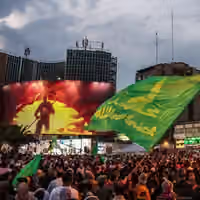
Vessels transit the Strait of Hormuz in an image published by ISNA on September 9, 2026.

Hormuz diplomacy hit a fresh setback Sunday as Oman postponed talks between Iran and Persian Gulf states, while attacks on shipping and Saudi energy infrastructure raised pressure on key regional oil routes.

The postponement came as Washington and Tehran hardened their positions over what any future negotiations should cover. The Trump administration wants talks with Iran focused on Tehran’s nuclear program rather than reopening the Strait of Hormuz, CNN reported, citing three sources familiar with the matter.

Iran, meanwhile, has signaled that it would consider nuclear negotiations only after the dispute over the strait is resolved, including the lifting of the US naval blockade.

Omani Foreign Minister Badr Albusaidi said the meeting planned for Monday in Salalah had been postponed “in the interests of consensus.” Iran’s IRGC-affiliated Fars News later reported that Tehran and Muscat had jointly agreed to the delay at the request of some regional countries.

Saudi Arabia had submitted amendments to the Omani-Iranian proposal over concerns that its wording could establish a new status quo in the strait unacceptable to Riyadh and other GCC states, Axios reported Sunday, citing a senior regional official.

The disagreements have emerged despite a flurry of regional diplomacy. Qatar’s prime minister and Oman’s foreign minister discussed efforts toward a solution guaranteeing freedom of maritime navigation, while the foreign ministers of Kuwait and Saudi Arabia also discussed ensuring the safety and freedom of shipping through Hormuz.

US blockade remains in force

The United States has continued to tighten its maritime pressure on Iran even as regional states search for a diplomatic arrangement.

US Central Command said Sunday that American forces had redirected 101 commercial vessels to ensure compliance with the blockade against Iran, up from 100 a day earlier.

US officials told CNN they believe American forces currently have the military upper hand in the strait, but questions remain over how long Washington can sustain the large-scale escort and naval operation.

Iranian Foreign Minister Abbas Araghchi has said an agreement with Oman on shipping arrangements would not itself reopen the strait, insisting that reopening depends on Washington meeting Tehran’s demands.

President Donald Trump, meanwhile, said Sunday that Iran “wants to make a deal so badly” and suggested the war could end before or shortly after the US midterm elections.

Vessel strike adds to Hormuz risks

Security risks around the strait also intensified on Sunday after an Iranian commercial container ship was struck by an unidentified projectile near Hengam Island, off Qeshm.

Iranian authorities said one crew member was killed and four others wounded. UK Maritime Trade Operations separately reported a vessel struck by an unknown projectile in the Strait of Hormuz, followed by a fire and crew evacuation, though it was not officially confirmed that the two reports concerned the same vessel.

Several explosions of unknown origin were also reported later Sunday in Sirik, in southern Hormozgan province, according to Iranian state media.

Saudi oil route under pressure

The pressure on Hormuz has become more acute for Saudi Arabia after drone attacks forced it to shut its East-West oil pipeline, a critical route carrying crude from the kingdom’s eastern oilfields to the Red Sea.

The pipeline had been transporting around 4 million barrels per day and allowed Riyadh to bypass the disruption in Hormuz. Reuters reported that stocks at the Red Sea port of Yanbu may be sufficient to sustain exports for only five to seven days if the pipeline remains shut, after which as much as 4% of global oil supply could be at risk.

Oil prices rose sharply as markets reopened, with Brent climbing above $108 a barrel after fresh attacks on Saudi Arabia and shipping in the Persian Gulf.

The Iraqi government has meanwhile stepped up security measures after Saudi Arabia said drones used in the pipeline attack were launched from Iraqi territory. Baghdad has begun reopening several border crossings with Iran after temporary closures and security reviews, with commercial traffic through Shalamcheh expected to resume Monday.

Houthis tighten pressure at Bab el-Mandeb

Saudi Arabia is also facing growing pressure on its western flank as Yemen’s Iran-aligned Houthis expand their position around Bab el-Mandeb, the narrow waterway linking the Red Sea to the Gulf of Aden.

The Houthi advance along Yemen’s Red Sea coast has raised fears that Saudi oil exports diverted away from Hormuz could face disruption at a second chokepoint. The US Navy has remained on high alert as the Houthis move closer to Bab el-Mandeb.

The Houthis said Sunday that four commanders of Saudi-backed Yemeni forces were killed and five others wounded in operations near Bab al-Mandab, according to the group-run Saba news agency.

The combination of pressure at Hormuz, attacks on Saudi infrastructure and Houthi gains near Bab el-Mandeb is narrowing the region’s alternatives at a time when diplomatic efforts remain divided over the terms of any maritime settlement.

With the Oman meeting now postponed and Washington and Tehran publicly at odds over the agenda for negotiations, there is no clear timetable for a diplomatic breakthrough even as the economic and military costs of the conflict continue to rise.

Most Viewed

Mideast oil flows recover while Iran exports vanish, tracker says
1

Mideast oil flows recover while Iran exports vanish, tracker says

2

Iranians buy bread on credit, queue for chicken scraps

3

Deadly ship strike deepens crisis over Strait of Hormuz

4

Hormuz diplomacy stalls as attacks deepen pressure on Persian Gulf oil routes

5
VOICES FROM IRAN

Iran students go without as elite schools charge billions

Banner
Banner
Banner

Spotlight

  • Rushed trials, public hangings: Iran courts race to crush dissent
    INSIGHT

    Rushed trials, public hangings: Iran courts race to crush dissent

  • Israeli envoy says no victory until Islamic Republic falls

    Israeli envoy says no victory until Islamic Republic falls

  • Russia may fill Iran gap if support for Yemen Houthis falters
    ANALYSIS

    Russia may fill Iran gap if support for Yemen Houthis falters

  • Bid to oust Pezeshkian exposes rift among Iran conservatives
    INSIGHT

    Bid to oust Pezeshkian exposes rift among Iran conservatives

  • Iran’s hardliners bet on escalation as options narrow
    ANALYSIS

    Iran’s hardliners bet on escalation as options narrow

•
•
•

More Stories

Deadly ship strike deepens crisis over Strait of Hormuz

Sep 13, 2026, 13:45 GMT+1
100%

An Iranian container ship was struck by an unidentified projectile, killing one crew member and injuring four, with Iran ruling out reopening the Strait of Hormuz despite plans for a new maritime corridor on Sunday.

The vessel was hit near Hengam Island, south of Qeshm Island, Qeshm Governor Hossein Amir-Teymouri told state-run IRNA. Ten crew members were aboard, he added.

One crew member, Jamshid Rajabi, was killed and four others injured. Iranian authorities have not identified the projectile or said who was responsible.

UK Maritime Trade Operations separately said a vessel transiting the Strait of Hormuz had been struck by an unknown projectile. A fire broke out and local authorities assisted with the crew’s evacuation, UKMTO added.

Neither UKMTO nor Iranian authorities have confirmed that the reports concerned the same vessel.

Iran rules out reopening Hormuz

The attack came a day before a regional meeting in Oman on a proposed maritime route through the Strait of Hormuz.

Iran will brief participating countries on an agreement with Oman and present maps of the proposed corridor, Foreign Minister Abbas Araghchi told Al-Araby Al-Jadeed.

“The agreement with the Sultanate of Oman does not in any way mean the reopening of the Strait of Hormuz,” Araghchi said.

Tehran would agree to reopen the waterway only if the United States returned to its commitments under the Islamabad memorandum, Araghchi added.

The strait has become a major front in the conflict, with the United States and Iran targeting vessels and disputing control over maritime traffic.

Meanwhile, hardline Iranian newspaper Kayhan called for a sharp expansion of retaliation against attacks on Iranian oil tankers, proposing that Tehran target multiple vessels for every Iranian tanker hit.

“The Islamic Republic of Iran must officially announce that, from now on, if one Iranian tanker is attacked, it will target all tankers in the Persian Gulf and the Gulf of Oman,” Kayhan wrote.

The newspaper, published under the supervision of supreme leader’s representative, argued that disabling large numbers of tankers could cause a global supply shortage and drive oil prices sharply higher.

Saudi-Houthi confrontation widens

Shipping risks have also increased on the other side of the Arabian Peninsula, where Yemen’s Iran-backed Houthis said they targeted Saudi military facilities with ballistic missiles and drones.

Houthi military spokesperson Yahya Saree said the group struck weapons depots and command facilities at a Saudi base in the southern Sharurah region in response to Saudi military operations in Yemen.

Saudi authorities did not immediately confirm the attack.

Iranian President Masoud Pezeshkian sought to distance Tehran from the confrontation.

“We are not at war with Saudi Arabia,” Pezeshkian said. “The Houthis have their own issues.”

His comments followed a drone strike on Saudi Arabia’s East-West oil pipeline, which Riyadh temporarily shut down. The route provides an alternative to shipping oil through the Strait of Hormuz.

Iraqi authorities said drones used in the pipeline strike were launched from Iraqi territory. Iraq subsequently seized 15 drone-launch platforms and pledged to prevent its territory from being used for attacks on neighboring countries, Al Arabiya reported.

The Houthi operations have raised the prospect of simultaneous disruption around the Strait of Hormuz and Bab el-Mandeb, two of the world's most important maritime energy routes.

Lawmakers raise nuclear withdrawal

Iranian politicians have meanwhile raised the possibility of withdrawing from the Nuclear Non-Proliferation Treaty following a resolution by the International Atomic Energy Agency’s Board of Governors.

Leaving the treaty and reconsidering Iran’s nuclear doctrine were “entirely attainable and readily achievable,” parliament presiding board spokesperson Abbas Goudarzi said.

Such measures would “put the United States and its lackeys in their place,” Goudarzi added.

However, two members of parliament’s National Security and Foreign Policy Committee said no legislation to withdraw from the NPT had been submitted to the panel.

Their accounts contradicted lawmaker Hosseinali Hajideligani, who earlier said several lawmakers had signed an expedited bill seeking withdrawal. Hajideligani has also called for tests needed to develop a nuclear weapon, arguing that Iran requires “atomic deterrence.”

A Foreign Ministry official separately said Iran had denied IAEA inspectors access to some nuclear sites following attacks by the United States and Israel.

Diplomacy continues at BRICS summit

Diplomatic contacts continued alongside the military and nuclear disputes, with Pezeshkian meeting Abu Dhabi Crown Prince Sheikh Khaled bin Mohamed bin Zayed on the sidelines of the BRICS summit.

UAE presidential adviser Anwar Gargash said the meeting reflected Abu Dhabi’s approach of combining deterrence with diplomacy.

“Neither can function properly without the other,” Gargash said. “Deterrence strengthens the credibility of diplomacy, while diplomacy succeeds when it begins from a position of parity and capability.”

Gargash also praised Pezeshkian’s approach during the crisis, describing his positions as “balanced and rational.”

Araghchi separately released images of conversations with the foreign ministers of Russia, China, Egypt, Indonesia and Kazakhstan at the summit, without providing details of what was discussed.

Monday’s talks in Oman will take place with the Strait of Hormuz still closed and no responsibility established for Sunday’s deadly strike, leaving the proposed maritime corridor facing an immediate test of whether ships can use it safely.

Mideast oil flows recover while Iran exports vanish, tracker says

Sep 12, 2026, 20:49 GMT+1
100%
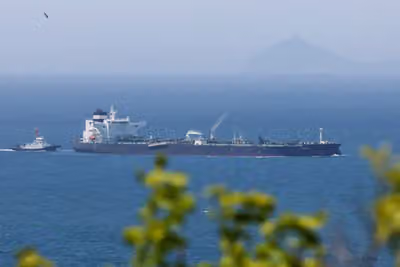
A tugboat guides the crude oil tanker Odessa, carrying UAE crude after passing through the Strait of Hormuz with its Automatic Identification System transponder turned off, navigates the waters at Daesan port, where it is expected to discharge crude oil, in Seosan, South Korea, May 8, 2026.

Middle Eastern oil exporters are finding ways around months of war and shipping disruption, with UAE crude exports back at pre-war levels, according to TankerTrackers.com, which says Iranian exports have effectively vanished.

Southern Iraqi exports are now about 33% below pre-war levels, the vessel-tracking service said, a dramatic improvement from April, when they were down 95%.

The recovery comes despite severe disruption to the Strait of Hormuz and a US naval blockade that has reshaped oil flows from the region.

TankerTrackers said not a single barrel of Iranian crude had crossed the blockade line between the Gulf of Oman and Arabian Sea over the past 60 days.

Iran's loss of export capacity does not appear to be creating the storage crunch that might normally follow such a collapse in overseas sales. TankerTrackers estimates Iranian production has fallen to roughly the level required for domestic consumption and refining, leaving little excess crude to store.

Oil finds new routes

Other data suggest producers and traders are adapting to the disruption.

Ship-to-ship transfers of crude in the Gulf of Oman averaged 7.15 million barrels per day over the past 14 days, TankerTrackers said, up 56% from the previous month.

The service also said some Arab producers have begun using tankers previously involved in sanctions-busting trades to move their oil.

“They can spoof their positions thanks to the military-grade transponders that still operate onboard them,” it posted on X. “It also means that they are pinging on the other side of the planet.”

The adaptations come as oil prices remain elevated after another week of attacks and threats to key Middle Eastern export routes.

Brent crude settled at $104.61 a barrel on Friday despite falling 2.8% on the day, gaining more than 8% over the week. US West Texas Intermediate remained above $100.

The Strait of Hormuz remains severely disrupted after months of fighting and the US blockade, while Iran-backed Houthis have advanced around the Bab el-Mandeb Strait, putting further pressure on shipping between the Red Sea and Gulf of Aden.

Saudi Arabia has meanwhile shut its East-West pipeline as a precaution after a drone attack. The route, which carries Saudi crude west to the Red Sea and bypasses Hormuz, had recently been moving about 4 million to 5 million barrels per day.

Saudi and Iraqi authorities said the drones were launched from Iraqi territory.

Attention now turns to Oman, where Iran and regional states are expected to meet on Monday to discuss Hormuz and regional security.

Iran and Oman have held consultations over arrangements for safe shipping through the strait, although Tehran says their understanding would establish a framework for any eventual reopening rather than reopen Hormuz immediately.

Iraqi groups deny Saudi pipeline strike, say ‘would be proud if we did it’

Sep 12, 2026, 15:05 GMT+1
100%
Satellite image shows damage to the East-West pipeline facility in the Hejaz Region, Saudi Arabia, on September 11, 2026. 2026

Iran-backed Iraqi armed groups denied responsibility on Saturday for the drone attack on Saudi Arabia’s East-West oil pipeline, rejecting an accusation that has already prompted Baghdad to dismiss a military commander and close border crossings with Iran.

The Islamic Resistance in Iraq said an attack on Saudi Arabia’s critical infrastructure would be “a source of pride” if it had carried it out, but insisted that it had not.

“The accusations against the Iraqi resistance regarding the attack on Saudi Arabia’s vital infrastructure, while a source of pride if we had carried out such an action, are not something we claim,” the alliance said in a statement carried by Iran’s Tasnim news agency.

Iraq closed three border crossings with Iran on Saturday, officials told AFP, after Iraqi and Saudi authorities said the drones that struck the pipeline had been launched from Iraqi territory.

An Iraqi security source said the closures were “part of an intelligence effort to track down the perpetrators and prevent their escape” and to hinder the smuggling of drones through the crossings.

Iraqi Prime Minister Ali al-Zaidi also dismissed the military commander in Maysan province, which borders Iran, after authorities determined that drones had been launched from the province.

No group has claimed responsibility.

The statement criticized the Iraqi government for what it called a rush to accept the accusations “without documented and reliable evidence or an investigation,” and said the alliance was prepared to participate in any government inquiry aimed at establishing what happened.

US President Donald Trump has said Iran was probably behind the attack, while Saudi Arabia has said the drones originated in Iraq. Neither Riyadh nor Baghdad has publicly identified the group responsible.

The dispute has also spilled over into relations between Baghdad and Tehran.

Iran’s ambassador to Iraq, Mohammad Kazem Al-e Sadegh, told Tasnim that the Mehran and Khosravi crossings remained open and said Tehran was in talks with senior Iraqi officials over the closure of the Chazabeh and Shalamcheh crossings.

Al-e Sadegh acknowledged reports that the closures had been ordered in connection with an operation against Saudi Arabia launched from Iraqi territory, but questioned their relevance to the border and said large numbers of Iraqis who had travelled to Iran for pilgrimage or medical treatment had been left stranded.

The attack has taken on wider significance because of the growing importance of the East-West pipeline during the war.

The route carries Saudi crude from the kingdom’s oil-producing east to the Red Sea, bypassing the Strait of Hormuz as shipping through the waterway faces severe disruption.

Trump says Iran likely behind Saudi pipeline attack

Sep 12, 2026, 13:20 GMT+1
100%
US President Donald Trump walks after delivering remarks to US embassy personnel and business leaders at Deerfield Residence, the residence of the US Ambassador to Ireland, in Dublin, Ireland, September 12, 2026.

US President Donald Trump said on Saturday that Iran was probably responsible for the aerial attack that shut Saudi Arabia’s East-West oil pipeline, while predicting that the war with Tehran would end “very soon.”

“I think they are, probably they are,” Trump told reporters in Dublin when asked whether Iran was behind the attack.

Trump said he expected the conflict to end shortly after the US midterm elections in November. “I think very soon. I think it'll be probably right after the mid-terms,” he said, adding that oil prices would “tumble” once the war ended.

He also said Washington controlled the Strait of Hormuz and that the Iran-backed Houthis “don't want to fight with us.” Asked about Saudi Arabia, Trump described Crown Prince Mohammed bin Salman as “a good friend of mine” and said: “Everything will work out fine.”

Saudi pipeline attack triggers border restrictions

The comments followed an aerial attack on Saudi Arabia’s East-West pipeline, a critical route carrying crude from the kingdom’s eastern oil-producing areas toward the Red Sea. The strike caused injuries and material damage and forced the pipeline to shut.

Saudi Arabia said the drones involved in the attack were launched from Iraqi territory.

Iraq subsequently ordered the closure of the Shalamcheh border crossing with Iran as a precaution, Reuters reported, citing two security sources. The sources said a large-scale operation was underway to pursue those responsible for the attack.

Valiollah Hayati, deputy governor of Iran's Khuzestan province, said Iraqi authorities had also closed the Chazabeh crossing from early Saturday, halting passenger and commercial traffic through both crossings.

Hayati later said Iraq's prime minister had ordered authorities to allow stranded passengers on both sides of the Shalamcheh and Chazabeh crossings to pass. Travelers were given a two-hour window to cross before the borders were to close again, he said.

Sources at Basra airport also reported the suspension of flights to and from Iran.

The attack drew condemnation from several regional governments, while Spain called for urgent de-escalation and said freedom of navigation through both the Strait of Hormuz and Bab el-Mandeb must be guaranteed.

BRICS seeks common ground as Iran-UAE tensions persist

Diplomatic attention also turned to New Delhi, where BRICS leaders unanimously adopted a joint declaration calling for conflicts to be resolved through “dialogue, consultation and diplomacy” and warning about growing nuclear risks.

The declaration condemned unilateral coercive measures that it said violated international law and said nuclear safeguards, safety and security must be upheld even during armed conflicts. Reuters had earlier reported that the text was expected to avoid naming individual countries as members worked to bridge differences between Iran and the United Arab Emirates over the regional war.

The agreement marked a change from a BRICS foreign ministers’ meeting in May, when divisions between Tehran and Abu Dhabi prevented the group from issuing a joint statement.

Iranian President Masoud Pezeshkian met UAE President Sheikh Mohamed bin Zayed Al Nahyan on the sidelines of the summit on Saturday, though Iran’s embassy in India gave no details of their discussions.

Chinese President Xi Jinping meanwhile urged BRICS members to take on a peacemaking role in the Middle East conflict, saying the war did not serve the common interests of the international community.

Tehran hardens military and nuclear rhetoric

Inside Iran, senior officials and lawmakers continued to signal a tougher posture. Lawmaker Esmail Kowsari said Iran had moved beyond a defensive military posture and that its war strategy had become offensive.

IRGC commander Ahmad Vahidi said Israel’s military would “collapse in a very short time” without US support and argued that Washington and Israel had underestimated Iran’s military capabilities.

Another member of parliament’s National Security and Foreign Policy Committee, Mohammadreza Mohseni-Sani, said Iran no longer regarded itself as constrained by the Nuclear Non-Proliferation Treaty and could reconsider its enrichment policy.

“Everything is changing” and “anything is possible,” he said when asked about higher enrichment levels and changes to Iran’s nuclear and defense doctrine.

At the same time, Russia’s state nuclear corporation Rosatom said it planned to increase the number of its specialists at Iran’s Bushehr nuclear power plant to 150 in the near future.

Fall of Hezbollah heights ignites blame game in Tehran

Sep 12, 2026, 11:14 GMT+1
•
Maryam Sinaiee
100%
A satellite image shows damage at the Ali al-Taher ridge near Nabatiah, Lebanon, March 8, 2026.

The fall of the Ali al-Taher heights to Israel has turned Iran's hardliners on the negotiators of the June deal with Washington, whose clause on Lebanon was sold at home as a victory and whose defenders now say it has been dead for two months.

The heights, overlooking the city of Nabatieh in southern Lebanon and long regarded as a strategic Hezbollah position, came under heavy Israeli attack this week. On Thursday night, explosions destroyed underground facilities that the Israeli military said included command centers and weapons tunnels running more than two kilometers.

Within hours the loss had become an Iranian domestic argument. Hardliners contend that Israel could not have taken the heights had Tehran not tied its own hands by signing the agreement with the United States on June 28.

The clause that was a victory

That agreement, reached in Islamabad, opened with a commitment by both sides to halt military operations immediately and permanently on all fronts, Lebanon included, and referred explicitly to Lebanon's sovereignty and territorial integrity.

Iran said afterwards that any continued Israeli operations in Lebanon would violate the understanding and would be answered.

Israel resumed bombing Lebanon less than a day after the signing. Iran briefly suspended the follow-on talks in Switzerland and briefly closed the Strait of Hormuz. It did not respond militarily in Lebanon.

Mohammad-Bagher Ghalibaf, the parliament speaker and Iran's chief negotiator in Islamabad, has since repeatedly described the inclusion of Lebanon in the agreement as a victory for Tehran. It is that claim, set against the smoke over Ali al-Taher, that his critics are now holding up.

'Political score-settling'

The reformist daily Shargh, in a report on Wednesday headlined "Polarization under the code name Ali al-Taher," warned that the Israeli attacks were being used for "political score-settling at home."

"The latest Israeli attacks on southern Lebanon and the dispute over the Ali al-Taher heights, instead of being judged solely by the realities on the ground, have once again created the conditions for polarization and attacks on the negotiators and the June 28 Iran-US understanding," the paper wrote.

Shargh said some critics were charging that the negotiators had, through the agreement's first clause, effectively "sold" Hezbollah, or at least abandoned effective support for it. The charge bites because Iranian officials had presented that very clause as the mechanism for protecting the Lebanese front.

Ghalibaf the target

On social media the confrontation has been rawer, and Ghalibaf is its main object.

"What greater betrayal could Ghalibaf have committed to deserve prosecution?" one account wrote, adding that Yemen's Houthis were fortunate not to have placed themselves under his control, "otherwise Yemen's fate would have been no better than southern Lebanon."

Another laid out the hardline case in full: "The day after the ceasefire, 300 points in Lebanon were bombed in 10 minutes. You prevented a response under the pretext of negotiations. You repeatedly prevented a deterrent attack and failed to maintain the continuity and coordination of the various resistance fronts. The responsibility is yours."

Another user accused Iranian officials of allowing the agreement to prevent a military response: “Is there any reason for Iran’s failure to launch a major response against Israel at the last moment other than the insistence of officials on adhering to that worthless, ridiculous piece of paper and keeping it from falling apart? If there is another reason, tell us so we can know too.”

The defense, and what it concedes

Ghalibaf's camp has answered that a dead agreement cannot be blamed for a live war.

"For nearly 60 days, the agreement that imposed restrictions has not been implemented," Mohammad-Saeed Ahadian, a journalist and political aide to the Ghalibaf, wrote on X.

"During this period, some people have offered nothing but vague and imaginary solutions, yet they say the agreement, which they claim is dead, is responsible for the fall of Ali al-Taher. Enough of this destructive game of domestic politics."

Another defender, Vahid Hajipour, argued the fall was a consequence of the agreement's collapse, not its terms: "Now go ahead and insult Ghalibaf again. With this, you are making Netanyahu even happier."

The defense carries its own admission. The clause Ghalibaf called a victory has, by his own aide's account, not been in force for two months. The argument in Tehran is therefore not whether the Lebanon provision protected Hezbollah, since neither side now claims it did, but who should answer for the fact that it did not.