• العربية
  • فارسی
Brand
  • Iran Insight
  • Politics
  • Economy
  • Analysis
  • Special Report
  • Opinion
  • Podcast
  • Live TV
  • Iran Insight
  • Politics
  • Economy
  • Analysis
  • Special Report
  • Opinion
  • Podcast
  • Live TV
  • Theme
  • Language
    • العربية
    • فارسی
  • Iran Insight
  • Politics
  • Economy
  • Analysis
  • Special Report
  • Opinion
  • Podcast
  • Live TV
All rights reserved for Volant Media UK Limited
volant media logo
INSIGHT

Iran shrugs off US economic war as analysts sound alarm

Behrouz Turani
Behrouz Turani

Iran International

Aug 25, 2026, 00:50 GMT+1
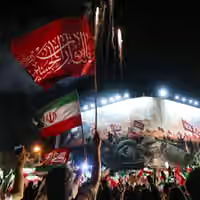
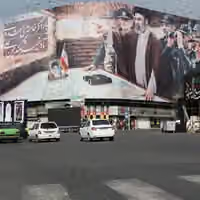
Supporters of Iran’s Supreme Leader attend a state-backed event in Tehran, with a billboard depicting the Statue of Liberty toppled amid Iranian and religious flags, August 22, 2026

Iranian officials have dismissed Washington’s “Economic D-Day” as another failed attempt to cripple the country, but analysts inside Iran warn that an economy weakened by war may be far less capable of absorbing the latest US pressure campaign.

US Treasury Secretary Scott Bessent has described the campaign as the “endgame,” while Iran’s Central Bank Governor Abdolnasser Hemmati insisted it would have “no impact on Iran.”

Other senior officials have warned regional and European states against helping Washington enforce its measures.

But Abdolrahman Fathollahi, an analyst writing in Shargh, cautioned against assuming that decades of experience circumventing sanctions mean Tehran can simply weather the latest campaign.

Iran, he said, is now more economically fragile after the recent conflicts known as the 12-day and 40-day wars. The new measures are designed not simply to add restrictions but to close Iran’s remaining economic lifelines—and test how far China is prepared to go to keep them open.

That could prove crucial.

Hamed Vafaei, an associate professor of Chinese studies at the University of Tehran, argues that Beijing is likely to maintain enough oil purchases and trade to prevent Iran’s complete economic isolation, but will not sacrifice its own interests to rescue Tehran.

China’s economic relationships with the United States, Western markets and Persian Gulf Arab states dwarf its trade with Iran. Vafaei said Tehran should therefore view Beijing as a pragmatic strategic partner rather than an unconditional ally.

International affairs analyst Esmail Beshari similarly told Shargh that tougher US sanctions would create additional obstacles but were unlikely to sever Iran-China trade altogether.

Some Iranian analysts have urged Tehran to move beyond what they describe as a “North Korea model” of relying on China for basic economic survival toward a “Pakistan model” based on deeper, mutually beneficial trade and investment.

The warnings come as pressure on Iran’s domestic economy is already mounting. Annual inflation reached 66 percent in July and food prices were 128 percent higher than a year earlier, according to official data, while gasoline supplies have also come under strain.

Iranian economic newspapers have cautioned against complacency. Donya-ye Eghtesad warned that relying on methods used to circumvent previous sanctions could prove a mistake, arguing that Tehran must also address its domestic vulnerabilities.

Concern about those vulnerabilities is increasingly visible within the security establishment.

Police chief Ahmadreza Radan said foreign powers were preparing to exploit economic hardship to foment unrest. President Masoud Pezeshkian has said it would be better to end the war while Iran remains in a position of “power and dignity.”

Parliament Speaker Mohammad Bagher Ghalibaf was blunter.

“No matter how much military power we have, we won't survive if people are hungry and we don't have financial turnover, economic growth and national production,” he said.

Such warnings sit uneasily alongside Tehran’s public insistence that Washington’s latest campaign will fail.

Iran has survived decades of sanctions and analysts do not expect the new measures to completely sever its economic links with China. But keeping some trade and oil exports flowing is not the same as insulating an economy already weakened by war from further pressure.

The question for Tehran may therefore be not whether “Economic D-Day” can completely isolate Iran, but how much additional pressure the country can absorb.

Most Viewed

Iran state TV airs threat against Trump’s son Barron
1

Iran state TV airs threat against Trump’s son Barron

2
PODCAST

Will Iran bend or escalate as US launches economic war?

3

Iran security chief hints at nuclear doctrine shift after US attacks

4
VOICES FROM IRAN

Nine out of ten shun marriage, parenthood in Iran International poll

5
INSIGHT

Iran shrugs off US economic war as analysts sound alarm

Banner
Banner
Banner

Spotlight

  • Iran keeps finding gas. Getting it out is the problem
    ANALYSIS

    Iran keeps finding gas. Getting it out is the problem

  • Who speaks for Iran? Rezaei’s threats fuels divide over war and diplomacy
    INSIGHT

    Who speaks for Iran? Rezaei’s threats fuels divide over war and diplomacy

  • Iran shrugs off US economic war as analysts sound alarm
    INSIGHT

    Iran shrugs off US economic war as analysts sound alarm

  • Tehran mosques used to surveil, shoot at January protesters
    EXCLUSIVE

    Tehran mosques used to surveil, shoot at January protesters

  • Will Iran bend or escalate as US launches economic war?
    PODCAST

    Will Iran bend or escalate as US launches economic war?

  • Iran leader’s absence gives war camp room to shape policy
    ANALYSIS

    Iran leader’s absence gives war camp room to shape policy

•
•
•

More Stories

Tehran gas stations run dry as Iran’s fuel deficit bites

Aug 24, 2026, 22:08 GMT+1
100%
A deserted gas station in Tehran, Iran, in this undated file photo

Reports of gasoline shortages spread across Tehran on Monday, with filling stations closing after running out of fuel and motorists describing long searches and queues for increasingly scarce supplies.

Images, videos and accounts posted widely on Persian-language social media showed closed stations and lines of cars at others still operating, with shortages reported in several parts of the capital, including central and northern Tehran.

The disruption was also acknowledged by state-affiliated media.

“Some gas stations have closed without a clear explanation, creating considerable concern and questions for people,” SSN wrote, calling on the government to explain whether the closures were part of an attempt to curb fuel consumption and how long they would last.

The shortages bring into the open a problem Iranian officials have been warning about for months: the country is consuming more gasoline than it can produce.

Reza Sepahvand, spokesperson for parliament’s Energy Committee, said this month that Iran was producing about 130 million liters of gasoline a day while consuming around 137 million liters, leaving a daily shortfall of about seven million liters.

Sepahvand also said gasoline imports had stopped under the US naval blockade, removing one of the ways Tehran had previously made up the difference between domestic production and demand.

Other official estimates have put the deficit even higher. Mohammad Jafar Ghaempanah, President Masoud Pezeshkian’s executive deputy, said this month that Iran faced a gasoline imbalance of around 14 million liters a day.

The government is therefore confronting an increasingly difficult choice: finding ways to reduce consumption without sharply raising the price motorists pay at the pump.

Iran has for years sold heavily subsidized gasoline, contributing to high consumption and imposing a growing burden on state finances. Pezeshkian himself has questioned the logic of buying fuel at international prices while selling it domestically at a fraction of the cost.

But attempts to raise gasoline prices carry considerable political risk.

A sudden increase in November 2019 triggered nationwide protests that quickly expanded into broader demonstrations against the Islamic Republic. Security forces responded with a deadly crackdown and a near-total internet shutdown.

The memory of those protests has made gasoline prices one of the most politically sensitive economic issues facing successive Iranian governments.

Officials have instead discussed alternatives including changes to fuel quotas, limiting subsidized gasoline and charging higher prices for consumption above allocated amounts.

But uncertainty over those plans has itself contributed to anxiety among motorists, with long queues reported at filling stations in recent days.

The supply squeeze comes as Iran faces a broader deterioration in economic conditions following months of war and sanctions.

Washington on Monday expanded its campaign of secondary sanctions against Tehran as part of what US Treasury Secretary Scott Bessent has called an “economic D-Day” intended to sever Iran’s remaining economic lifelines.

For motorists in Tehran, however, the consequences are increasingly immediate.

Social media reports on Monday described people visiting several stations before finding gasoline, waiting for hours in the summer heat and arriving at pumps only to find supplies exhausted.

The closures have also fueled speculation that restricting supply may itself be emerging as a way of forcing down consumption without announcing a politically dangerous price increase.

There has been no official announcement that the government has adopted such a policy.

Nine out of ten shun marriage, parenthood in Iran International poll

Aug 24, 2026, 11:40 GMT+1
100%
An Iranian couple, with the woman wearing a wedding dress, walk along a street in Tehran.

Nine in 10 respondents to an Iran International Instagram poll said they did not want to marry or have children under Iran’s economic, social and political conditions, according to results gathered from about 100,000 participants.

More than 12,000 people also commented on the poll, with financial pressure, job insecurity, housing costs and concerns about children’s futures emerging repeatedly among the reasons given for putting off marriage or parenthood.

Some respondents said they wanted to marry or have children but lacked the financial or social conditions to do so. Others pointed to divorce and unsuccessful marriages as reasons for avoiding marriage.

Men accounted for 68% of respondents and women for 32%. The largest age group was 25 to 34, representing 40.3% of participants, followed by people aged 35 to 44 at 29.2%.

  • Continued decline in Iran's marriage rates despite Supreme Leader's growth push

    Continued decline in Iran's marriage rates despite Supreme Leader's growth push

Respondents aged 18 to 24 made up 13.3%, while those aged 45 to 54 accounted for 9.8%.

Economic pressures weigh on family plans

Many respondents linked their reluctance to start families to the cost of everyday life, according to an examination of comments submitted with the poll.

Some wrote that meeting their own expenses had become difficult enough and that supporting a spouse or child was beyond their financial means. Others said they remained interested in marriage or parenthood but could not afford either.

Iran has faced years of high inflation and a steep decline in the value of its currency, eroding household purchasing power and making housing and other basic costs harder to meet.

The economic strain has been compounded by international sanctions and government policies at home and abroad, with their contribution to Iran’s economic problems a subject of continuing political debate.

Personal experiences of divorce and unsuccessful marriages also appeared repeatedly in the responses. Some participants described marriage under present conditions as a “high-risk decision.”

100%
A man and a woman sit on a bench in Tehran.

Others who were already married said they had decided against having children because of economic and social conditions. Respondents also cited mistrust and difficulty finding a suitable partner.

A smaller number expressed support for marriage or having children.

Parents question children's prospects

Concerns about the conditions in which children would grow up formed another major strand of the responses.

Some said they wanted children but were unwilling to bring them into a society where they feared they could face poverty, inflation, electricity shortages, insecurity and an uncertain future.

A number used much stronger language, describing having children under present circumstances as a “crime” or a “betrayal” of the child because parents could not guarantee an adequate quality of life or future.

Iran faces severe environmental challenges including air pollution, groundwater depletion, forest fires and wider ecosystem degradation. Experts have linked such problems to a combination of poor policymaking, weak environmental protections, corruption and insufficient resources.

Political outlook feeds pessimism

Some respondents connected their decisions directly to Iran’s political and social conditions and their expectations for the country’s future.

Years of economic hardship have coincided with repeated waves of anti-government protests and deadly crackdowns, alongside restrictions on political and social freedoms.

  • Sex work blessed by religion: Inside Iran’s temporary marriage network

    Sex work blessed by religion: Inside Iran’s temporary marriage network

For some participants, those pressures appeared to have turned decisions about marriage and parenthood into a broader judgment about what kind of future is possible in Iran.

The scale and substance of the responses point to a question facing many of them: not simply whether they can afford to build families, but whether they see a future in which they want to do so.

Will Iran bend or escalate as US launches economic war?

Aug 24, 2026, 01:16 GMT+1
•
Negar Mojtahedi
100%
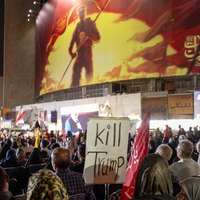
A participant holds a sign reading “Kill Trump” at a state-backed event in central Tehran, as a giant billboard depicting an avenging warrior looms over the crowd, August 21, 2026

Iran’s leadership may see an end to the war as necessary under mounting US economic pressure, but that does not mean Tehran will heed Washington’s demands, experts say, warning that the pressure could instead drive it toward further escalation.

President Masoud Pezeshkian said Friday that it would be better to end the war now, while Iran remains in what he called a position of “power and dignity.” Parliament Speaker Mohammad Baqer Ghalibaf was more blunt about the stakes of a deteriorating economy.

“No matter how much military power we have, we won't survive if people are hungry and we don't have financial turnover, economic growth and national production,” Ghalibaf said, according to Iran’s official news agency IRNA.

Raz Zimmt, director of the Iran and Shiite Axis Research Program at Israel’s Institute for National Security Studies, believes the statements reflect growing recognition in Tehran that the current situation is unsustainable.

But he says there is a potentially dangerous gap between recognizing that reality and deciding to compromise.

“If they have to make a choice between taking the risk for a new round of war with the United States or making concessions which they consider to be full capitulation to the United States... I think it’s very clear that they are not going to give up,” Zimmt told Iran International’s Eye for Iran podcast.

The dilemma comes as Washington prepares to intensify the pressure. US Treasury Secretary Scott Bessent has promised the “toughest sanctions in history,” alongside a naval blockade already squeezing Iranian trade.

Iran entered the war with high inflation and a weakened currency. By July, annual inflation had reached 66 percent and food prices were 128 percent higher than a year earlier, according to official data.

‘Reasons to resist’

Zimmt says Iran’s ability to use Hormuz as leverage could also erode as the United States makes military gains in opening a corridor through the strait. But he sees no evidence yet of a consensus in Tehran for a change of course.

Iran’s calculation, he argues, is shaped by what happens after any agreement as much as by what happens now. Its leaders do not appear convinced that concessions would guarantee a permanent end to the war.

Instead, they may fear reopening Hormuz and surrendering leverage in exchange for a ceasefire that Washington could abandon after the US midterm elections in November.

Washington’s own messaging may be reinforcing that distrust.

Bessent said Thursday that the combination of the blockade and new sanctions could “collapse this regime,” even as he argued that successful economic pressure could reduce the likelihood of another large-scale military campaign.

From Tehran’s perspective, Zimmt argues, such statements can strengthen those who ask why Iran should make concessions to an administration that is simultaneously talking about its collapse.

The war itself may have given Tehran another reason to resist concessions.

“The conclusion in Iran is that the United States and Israel don’t have the capability to force Iran into major concessions,” Zimmt said.

‘Escalation before negotiations’

Hormuz provides Tehran with another source of leverage. After decades of threatening to close the strategic waterway, Iran has demonstrated its ability to severely disrupt it. Only seven commodity vessels passed through on Thursday, compared with more than 130 a day before the war, according to Kpler data.

Zimmt believes Iran’s leadership may therefore calculate that it can inflict enough economic pain on its Persian Gulf neighbors and the global economy to improve its position before negotiating.

He points to Iran’s behavior after Trump withdrew from the nuclear deal during his first presidency. Tehran initially responded to maximum pressure with what it called “strategic patience” but escalated as the economic damage mounted, including through attacks on Persian Gulf shipping and the downing of a US drone.

He sees the possibility of the same logic asserting itself again.

“If the Iranians reach the conclusion that they can’t resist or they can’t handle the growing economic pressure,” Zimmt said, “their decision would actually be to escalate things even further before returning to negotiations.”

The pressure may be working. The unanswered question is what Tehran chooses to do because of it.

You can watch Eye for Iran on YouTube or listen on any podcast platform.

Iranians voice economic despair as dollar hits 2 million rials

Aug 23, 2026, 09:33 GMT+1
•
Hooman Abedi
100%
Iranian rials and US dollars are exchanged in Tehran. (File photo)

Iranians described deepening financial hardship and questioned whether economic pressure can change government policy as the dollar hit a historic 2 million rials, extending the currency's sharp decline on Sunday.

The US dollar reached 2 million rials on Iran's open market, crossing a threshold it had approached rapidly in recent days.

“We saw revolution, war, sanctions, rising prices and hardship,” one person told Iran International. “Now that we are over 50, we worry about our children, their jobs, their future, education, university and marriage costs. Pressure from outside, pressure from inside. How much can one endure?”

The dollar stood at around 1.865 million rials at the beginning of last week, putting its rise at more than 7% in less than a week. It has more than doubled from around 958,000 rials during the same period last year.

The British pound climbed above 2.72 million rials, while the euro approached 2.34 million rials. Rates can vary between sources because open-market trading is informal and fragmented.

Iranians describe pressure from all sides

The currency's latest fall comes days after US President Donald Trump announced what he called the “most crushing economic operation ever taken against any country,” warning of unprecedented economic isolation and consequences for countries whose financial institutions, businesses or government entities continue providing Tehran with an economic lifeline.

  • Can Iran's fragile economy survive Trump's 'Economic D-Day'?

    Can Iran's fragile economy survive Trump's 'Economic D-Day'?

“Oil smuggling, swap lines, cash transfers, exchange houses, ship registries, front companies – it all needs to stop NOW,” Trump wrote on Truth Social, calling on US allies to join the campaign.

Messages sent to Iran International in response to a question about US economic pressure largely focused on the burden borne by ordinary people rather than its effect on the Islamic Republic.

“Iran has been under sanctions for nearly 50 years and the Islamic Republic is still governing,” one person said. “These measures do not work. They only leave the Iranian people poorer and hungrier, without medicine, healthcare or housing.”

Others questioned whether greater economic pressure could force authorities to change course.

“I don't think the government will come under pressure because it covers its budget deficit from people's pockets,” another respondent said. “The tip of the sanctions spear is aimed directly at the people; healthcare, nutrition, education and sports are all at risk.”

Rial's decline compounds daily hardship

Market participants point to high inflation, growing demand for foreign currency, declining foreign-exchange revenues and concern over sanctions as factors driving demand for dollars.

Political uncertainty, disruption to regional oil exports and the deadlock between the Islamic Republic and the United States have added to inflation expectations.

The currency slide comes alongside electricity and water shortages that have disrupted production and daily life. Further rial depreciation can raise the cost of imported raw materials and essential goods, adding to pressure on household budgets.

  • Iran leaders sound economic alarms under Trump’s Economic D-Day

    Iran leaders sound economic alarms under Trump’s Economic D-Day

Some Iranians who contacted Iran International argued that economic pressure would be more effective if directed at assets held abroad by officials and their relatives.

“When they can freeze the foreign accounts of officials and their children, then you can call it pressure on the government,” one respondent said. “Seize their assets.”

IRGC chief backs state broadcaster amid clashes with Pezeshkian, Ghalibaf

Aug 22, 2026, 15:21 GMT+1
100%

IRGC commander-in-chief Ahmad Vahidi praised Iran’s state broadcaster for its performance during the war with the US, throwing his weight behind an institution that has clashed with President Masoud Pezeshkian and drawn criticism from Parliament Speaker Mohammad Bagher Ghalibaf.

In a message to IRIB chief Peyman Jebelli, Vahidi described the broadcaster’s performance as a “valuable effort” and “effective role-playing,” saying it had made an important contribution to strengthening the Islamic Republic’s “media front” during the conflict.

Vahidi’s endorsement comes against the backdrop of a broader power struggle between Pezeshkian and senior Guards commanders. Iran International reported in April, citing sources close to the presidential office, that Pezeshkian had accused Vahidi and other senior IRGC commanders of acting unilaterally during the war, undermining ceasefire prospects and pushing Iran toward economic disaster.

Pezeshkian has also repeatedly criticized IRIB. In May, he said the broadcaster presented an unrealistic picture of conditions in the country and needed a serious overhaul.

The confrontation escalated in July when Pezeshkian’s office accused IRIB of censoring part of a televised interview in which the president said the late Supreme Leader Ali Khamenei had privately instructed officials to negotiate with the United States despite publicly ruling out talks. The broadcaster did not publicly explain why the remarks were omitted.

  • Iran parliament cries censorship after Ghalibaf interview cut short

    Iran parliament cries censorship after Ghalibaf interview cut short

Ghalibaf interview also cut

Ghalibaf has had his own clashes with the broadcaster. In July, parliament accused IRIB of censorship after it abruptly cut short a pre-recorded interview with the speaker as he discussed the release of Iranian assets abroad.

Parliament said roughly 20 minutes covering politically sensitive issues had not been aired, including possible IAEA inspections, frozen Iranian assets, the reported $300 billion reconstruction credit in the US-Iran memorandum of understanding and Ghalibaf’s response to President Donald Trump.

IRIB said the interview had been divided into two installments, but parliament said it had received no advance notice that parts would be withheld.

This week, Ghalibaf renewed his criticism, saying IRIB had failed to achieve the necessary results in “cognitive warfare” and referring to what he called the broadcaster’s “structural, approach and performance inefficiencies.”