• العربية
  • فارسی
Brand
  • Iran Insight
  • Politics
  • Economy
  • Analysis
  • Special Report
  • Opinion
  • Podcast
  • Iran Insight
  • Politics
  • Economy
  • Analysis
  • Special Report
  • Opinion
  • Podcast
  • Theme
  • Language
    • العربية
    • فارسی
  • Iran Insight
  • Politics
  • Economy
  • Analysis
  • Special Report
  • Opinion
  • Podcast
All rights reserved for Volant Media UK Limited
volant media logo

Tailored Quran verses at Khamenei funeral spark diplomatic debate

Maryam Sinaiee
Maryam Sinaiee

Iran International

Jul 5, 2026, 08:21 GMT+1Updated: 09:24 GMT+1
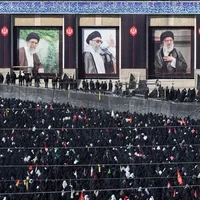
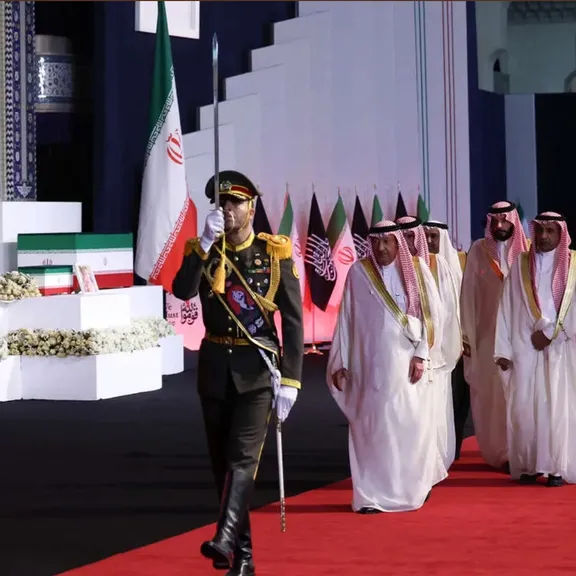
Saudi Arabia's delegation paying their respects to Iran's slain leader, Ali Khamenei, at Tehran's Mosalla, July 3, 2026.

Quran verses recited for foreign delegations attending the funeral of Iran's slain Supreme Leader Ali Khamenei have sparked debate after Iranian media and social media users argued the passages were carefully chosen to send political and diplomatic messages to visiting officials.

Organizers did not explain why different Quranic passages were recited for each delegation. However, several Iranian media outlets portrayed the selections as deliberate rather than routine religious readings.

The news website Fararu wrote that the verses appeared to have been chosen "not randomly, but deliberately." Conservative outlet Tabnak described the practice as "an innovation in public diplomacy," saying the tailored recitations could be interpreted as ethical and political messages to each delegation.

The verse that drew the greatest attention was recited as Saudi Deputy Foreign Minister Waleed bin Abdulkarim approached Khamenei's coffin.

The passage, Verse 13 of Surah Al Imran, recalls the Battle of Badr, in which the Prophet Muhammad's followers defeated a much larger force. It concludes: "God supports whom He wills with His help. Surely in this is a lesson for those with insight."

Some linked the choice to Iran's recent conflict with Israel and the United States, during which Saudi Arabia was reported to have allowed US military operations from its territory while also urging Washington to avoid a wider regional war.

The verse recited for Turkey's delegation highlighted the superiority of believers who fight in God's cause over those who stay behind without valid reason. Some commentators interpreted it as a reference to Ankara's cautious approach during the recent conflict and broader regional crises.

Lebanon's official delegation and a separate delegation from Hezbollah received different passages. The Lebanese state delegation heard a verse suggesting that following divine guidance and making sacrifices in God's cause would have been better for them. Hezbollah, whose name means "Party of God," was greeted with a verse promising victory for the "Party of God."

The Hamas delegation received a verse praising believers "who have remained true to the covenant they made with God" and never broke their pledge.

Khomeini’s grandson draws attention

Another widely discussed moment came when members of the family of Islamic Republic founder Ruhollah Khomeini approached the coffin.

Verse 95 of Surah An-Nisa, which contrasts believers who stay at home with those who strive "with their wealth and their lives" in God's cause, began to be recited as former leader’s grandson Hassan Khomeini approached.

Videos circulating online appeared to show him leaving the ceremony shortly after the recitation began, prompting criticism from some conservatives.

Hassan Khomeini is generally associated with Iran's reformist camp.

Mixed reactions

The choice of Quranic passages prompted widespread discussion on Persian and Arabic-language social media.

Supporters argued the selections reflected the recent conduct of regional governments rather than personal criticism.

One Persian-language user wrote that reminding neighboring countries of the consequences of their policies during the war was "a reminder of responsibility, not an insult."

Others argued that using Quranic verses to criticize official mourners was inappropriate.

"If the selection of the verses recited during yesterday's ceremony was intentional, then it was a mistake," one user wrote. "Taunting a guest who has come to offer condolences is consistent neither with our cultural traditions nor with religious teachings."

Another user wrote: "I do not agree with reciting Quranic verses to criticize anyone who has come to pay their respects. It is inappropriate. As far as I know, reproaching guests was never the practice of the prophets, the Prophet Muhammad, the Imams, or the martyred leader."

The discussion also spread across Arabic-language social media. Iraqi commentator Yaseen Aziz described the verses recited for the Saudi delegation as "an indicator of the existing hatred and the diplomatic stupidity of the current leadership in Iran."

Most Viewed

Classified warning projected up to 3,000 deaths at Khamenei funeral - Die Welt
1

Classified warning projected up to 3,000 deaths at Khamenei funeral - Die Welt

2
PODCAST

After the war, Iran’s rulers face their biggest question

3

Tailored Quran verses at Khamenei funeral spark diplomatic debate

4
ANALYSIS

Behind the funeral: Khamenei’s coffin becomes stage for Iran’s wounded power

5

Iran's new IRGC Navy chief emerges without formal decree: who is Ali Azmaei?

Banner
Banner
Banner

Spotlight

  • Iran buries Khamenei as fight over his power continues
    ANALYSIS

    Iran buries Khamenei as fight over his power continues

  • After the war, Iran’s rulers face their biggest question
    PODCAST

    After the war, Iran’s rulers face their biggest question

  • Behind the funeral: Khamenei’s coffin becomes stage for Iran’s wounded power
    ANALYSIS

    Behind the funeral: Khamenei’s coffin becomes stage for Iran’s wounded power

  • Iran hardliners warn Hormuz authority slipping to US-backed Omani route
    INSIGHT

    Iran hardliners warn Hormuz authority slipping to US-backed Omani route

  • Funeral expenses deepen anger over Ali Khamenei's week-long burial
    VOICES FROM IRAN

    Funeral expenses deepen anger over Ali Khamenei's week-long burial

•
•
•

More Stories

After the war, Iran’s rulers face their biggest question

Jul 4, 2026, 22:20 GMT+1
•
Negar Mojtahedi
After the war, Iran’s rulers face their biggest question
100%
Iranian officials at Ali Khamenei's funeral on July 3, 2026. From left to right: Abbas Araghchi, Sadegh Amoli Larijani, Gholamhossein Mohseni Ejei, Mohammad Bagher Ghalibaf, Masoud Pezeshkian, Mohsen Rezaei

The Iran-US truce has exposed a deeper battle inside Tehran, where public rifts over censorship, negotiations and the system’s future point to a survival debate that could reshape or further destabilize the regime, experts told the Eye for Iran podcast.

In the days since the fighting subsided, Iran's political establishment has offered an unusually public glimpse into divisions that have long remained largely behind closed doors.

State television abruptly cut short a pre-recorded interview with Parliament Speaker Mohammad Bagher Ghalibaf as he discussed the use of blocked Iranian funds abroad, prompting accusations that politically sensitive remarks had been censored. State broadcaster IRIB insisted the interview had always been scheduled to air in two parts.

Elsewhere, hardliners heckled Foreign Minister Abbas Araghchi during a visit to Karbala, chanting "death to the appeaser" and "we don't want pretense" as Tehran pursues negotiations with Washington. Establishment commentators have also begun openly discussing ideas that, until recently, would have been politically difficult to imagine entering the public conversation.

Individually, each episode could be dismissed as another example of factional politics inside the Islamic Republic.

Taken together, however, they point to something more significant.

They suggest the post-war debate inside Tehran is no longer simply about diplomacy, sanctions or military strategy.

It is increasingly about how the Islamic Republic must adapt if it is to preserve power in the wake of one of the greatest shocks in its 47-year history.

"The question isn't whether they're engaging in soul-searching," Alex Vatanka, a senior fellow at the Middle East Institute, told Eye for Iran. "They have to."

For Vatanka, the significance of this moment is not that the Islamic Republic has suddenly embraced reform.

It is that the war appears to have stripped away old assumptions.

"I think there is a lot more clarity today than there was before the war," he said. "The regime knows the old model failed. The question now is what comes next."

He believes survival—not reform—is driving the conversation.

"If you're in the business of surviving, you don't want this to happen to you again," he said. "Maybe this is the moment you change course."

That should not be mistaken for moderation.

"You don't do it because you love the people of Iran," Vatanka said. "You do it because you want to survive."

The debate itself could prove destabilizing.

"When the knives are out within the regime, they go after each other in vicious ways," Vatanka warned, arguing that competition between rival factions could intensify as different camps attempt to shape the Islamic Republic's post-war future.

Behnam Ben Taleblu, senior director of the Iran Program at the Foundation for Defense of Democracies, argues that understanding those debates first requires understanding the nature of the political system itself.

"It is not straight-up Islamic theocracy," he said.

Instead, he described the Islamic Republic as a political project drawing on multiple ideological traditions.

"A traditional Shia marja has basically taken Karl Marx, the Quran and Plato and put it together and created a political system on top of that."

That, Taleblu argues, is why outsiders should be careful not to confuse adaptation with transformation.

"I think it is a real battle within this regime of how best to preserve the prerogatives and the privileges of power while also sacrificing as little as possible on the ideology."

Even if institutions evolve, he says, the guiding principles may not.

"Real transformation comes with behavior. It comes with substance—not style."

Historian Shahram Kholdi remains skeptical that the current debate represents a genuine break with the past.

"Any difference that has existed between any of these people, in my opinion, has always been one of degree rather than in kind," he said. "Tactics are different. Worldviews, strategies, expectations and demands are all the same."

Rather than seeing reform, Kholdi sees a political elite trying to preserve the system after one of its most serious crises.

But he also believes the post-war period could intensify competition among rival centers of power.

"If Ghalibaf and his ilk manage to get the upper hand... the rest of the gang would feel completely insecure, and that intra-conflict then would materialize into a hot conflict within them," he said.

"And that may very well spell their final doom once and for all."

Whether that prediction proves correct remains to be seen.

What is already clear is that the conversation unfolding inside Tehran has moved beyond the immediate consequences of the war.

It has become a debate about the future of the Islamic Republic itself.

In July 2006, Henry Kissinger argued that Iran's leaders would eventually have to decide whether they were governing "a cause or a nation."

Today, that question is no longer being asked only by foreign observers. Increasingly, it appears to be one the Islamic Republic is asking itself.

Behind the funeral: Khamenei’s coffin becomes stage for Iran’s wounded power

Jul 4, 2026, 11:14 GMT+1
•
Naeimeh Doostdar
Behind the funeral: Khamenei’s coffin becomes stage for Iran’s wounded power
100%
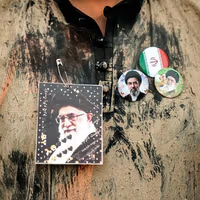
A man attending Ali Khamenei’s funeral ceremonies displays images of the former Supreme Leader and his successor Mojtaba Khamenei on his clothing on July 4, 2026

As Ali Khamenei’s coffin is carried through days of state-orchestrated mourning, the Islamic Republic is trying to recast a humiliating wartime death as martyrdom, continuity and power, and repair a system wounded by war and public distrust.

The funeral is not simply the burial of a dead ruler. It is an attempt to rebuild the image of a damaged power structure.

The Islamic Republic lost its leader in the first blow of the war, at the heart of its own power network and alongside members of his family.

Now it is trying to use a coffin, flags, religious elegies, organized crowds and the language of sacrifice to change the meaning of that defeat.

Whether Khamenei’s actual body is inside the coffin may matter less than what the coffin is being made to carry.

That uncertainty is itself part of the Islamic Republic’s new condition: a system that hides the truth, manages death and turns opacity into political ritual.

The coffin is therefore more than a funeral object. It is a message. The system wants to show that it can still stage power, mobilize crowds and manufacture a national narrative.

  • Classified warning projected up to 3,000 deaths at Khamenei funeral - Die Welt

    Classified warning projected up to 3,000 deaths at Khamenei funeral - Die Welt

A coffin in place of authority

In life, Khamenei was the final symbol of unaccountable power in the Islamic Republic.

For decades, he oversaw repression, executions, the elimination of opponents, control over women’s bodies, engineered elections and security violence. But the way he died broke the image of invulnerability built around him.

A leader who presented himself as commander of the “resistance” and the center of regional power was not killed on a battlefield. He was targeted in a moment that exposed the vulnerability of the structure he ruled.

That is why the Islamic Republic has to rewrite the scene of his death.

  • Funeral expenses deepen anger over Ali Khamenei's week-long burial

    Funeral expenses deepen anger over Ali Khamenei's week-long burial

The funeral is meant to replace the image of defeat with another image: a slain leader, a grieving religious community, a foreign enemy and a system that still stands after being struck.

As so often in the Islamic Republic, religious ritual becomes a tool of political survival.

In the Islamic Republic’s political culture, death is rarely allowed to remain death. If it can serve power, it is turned into martyrdom.

The state is now trying to reconstruct Khamenei not as the repressive ruler of the past four decades, but as a sacred and wronged figure killed by an external enemy.

But the problem for the Islamic Republic is that society’s memory has not been erased.

For millions of Iranians, Khamenei’s name is tied to the January 2026 killings, the suppression of the Woman, Life, Freedom movement, the bloody crackdown of November 2019, the execution of protesters, mass poverty, forced migration, structural corruption and the reduction of ordinary life to survival.

  • Khamenei funeral preparations draw complaints of forced attendance

    Khamenei funeral preparations draw complaints of forced attendance

The government wants the sound of elegies and the image of crowds to cover that memory. But official mourning is not the same as social grief.

A crowd gathered through buses, public holidays, state resources, administrative pressure, round-the-clock propaganda and networks linked to the Basij and other government bodies is not proof of public love.

It is proof of the state’s capacity, and insistence, on organizing the street.

The Islamic Republic wants to turn bodies present in public space into evidence of loyalty, even if many of those bodies are there because of fear, coercion, benefit, habit or indifference.

  • Iran media urged to avoid spotlighting political disputes during Khamenei funeral

    Iran media urged to avoid spotlighting political disputes during Khamenei funeral

A ritual for political survival

The timing of the ceremonies during the holy Shiite month of Muharram gives the state a powerful symbolic opportunity.

Since its birth, the Islamic Republic has narrated politics through the language of Ashura: oppression, blood, enemies, sacrifice and martyrdom.

It is now trying to place Khamenei’s death inside the same structure of meaning.

In that narrative, a ruler responsible for many deaths is recast as a victim whose blood must be avenged. This reversal is the core of the propaganda.

The real victims are removed from the scene, while the agent of repression is placed in the position of the wronged.

The mothers of those killed, political prisoners, suppressed women and the families of executed protesters are absent from this stage.

The scene is designed for only one authorized form of mourning: grief for humiliated power.

  • Past funeral disasters cast a shadow over Khamenei's burial

    Past funeral disasters cast a shadow over Khamenei's burial

But the state’s urgent need for religious spectacle also exposes weakness. If political authority were enough, why would the system need so much ritual, spending, closure, security and propaganda to prove that it continues?

The answer is that after Khamenei’s death, the fracture in the image of power has become visible.

His funeral is the first major test of the Islamic Republic after Khamenei.

The system wants to show that his death has not produced collapse, paralysis or a vacuum, and that it can still occupy the street.

The ceremonies are a postwar maneuver by a state that has suffered a military blow, lost much of its social legitimacy and faces a deeply distrustful society.

That is why Khamenei’s funeral is not the end of an era. It is an attempt to control the narrative of how that era ended.

The Islamic Republic knows that the way Khamenei died symbolizes weakness. It is trying to make the way he is buried symbolize power.

But the project contains a central contradiction. A system trying to build authority from Khamenei’s coffin is admitting, without saying so, that authority alone is no longer enough.

If real legitimacy existed, such a vast display would not be necessary. If society were truly grieving, this level of organization would not be needed.

If Khamenei were genuinely loved, the state would not have to rewrite his death with such a volume of propaganda, ritual and security control.

Iran hardliners warn Hormuz authority slipping to US-backed Omani route

Jul 3, 2026, 22:13 GMT+1
•
Maryam Sinaiee
Iran hardliners warn Hormuz authority slipping to US-backed Omani route
100%
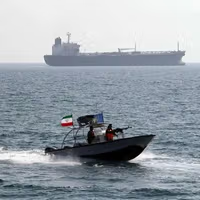
An IRGC speedboat sailing in Iran's southern waters

Iranian hardliners have accused the country's negotiators of compromising Tehran’s authority over the Strait of Hormuz, claiming a recent understanding with the United States has pushed international shipping toward what they call a US-backed Omani route.

Opponents of the Iran-US understanding have launched a fierce campaign against Parliament Speaker Mohammad-Bagher Ghalibaf, described as the agreement's chief negotiator, and President Masoud Pezeshkian, accusing them of surrendering Iran's authority over the Strait of Hormuz, thereby allowing the establishment of an Oman-American shipping corridor.

The criticism intensified after a televised interview with Ghalibaf aired on Tuesday, during which he appeared to reject calls by hardliners to close the strategic waterway.

"We must not turn the Strait against itself. The Strait is valuable only if traffic through it increases day by day, not decreases," he said.

His remarks were interpreted by conservative critics as a signal that Tehran has accepted Washington’s preferred arrangements governing maritime traffic through the Strait.

Focus shifts to Omani route

The controversy was fueled by satellite-based vessel tracking videos recently published by Kpler, which appeared to show that many non-Iranian commercial vessels have recently transited the Omani side of the Strait apparently accompanied by US naval vessels, while only a limited number of Iranian vessels were using the Iranian side. Hardliners argue that this reflects a de facto shift away from Iran's jurisdiction.

Ehsan Hosseini, editor-in-chief of the conservative economic website Khat-e Energy, claimed in a video posted online that both "the naval blockade and the Omani corridor are products of negotiations with the United States."

"At this very moment, groups of ships are passing through this corridor under US military escort. Your grave mistake is unforgivable."

In a separate social media post, Hosseini wrote that Iran's diplomats had "not only failed to collect any fees, but also created the conditions for establishing an Omani corridor through the Strait." He questioned whether Iran lacked the military capability to prevent the arrangement or whether "someone has tied the hands of the armed forces."

Military issues warning

Amid the growing debate, the Khatam al-Anbiya Central Headquarters issued a strongly worded statement on Thursday amid hardliner pressure, without explicitly referring to the alleged Omani corridor.

The military command said all commercial and oil tankers were required to navigate through routes designated by Iran and warned that any vessel departing from those routes or disregarding “Iranian navigation protocols” in the Strait would face "an immediate and decisive response by the armed forces," placing the security of non-compliant ships at risk.

Several Friday prayer leaders also addressed the issue.

Hassan Ameli, Friday prayer leader of Ardabil, claimed the United States had violated the agreement by establishing "a new waterway alongside Oman."

Mohammad-Nabi Mousavifard, the Friday prayer leader of Ahvaz, issued an even stronger warning.

"If any ship passes through this waterway without permission and without observing the laws of the Islamic Republic, it will be sunk in the depths of the Persian Gulf."

Dispute over Strait management fees

According to The Wall Street Journal, US officials proposed during talks in Doha earlier this week that Iran abandon its demand to collect transit charges from ships crossing the Strait in exchange for access to frozen Iranian assets abroad. Tehran reportedly continues to insist on charging vessels for passage.

Hardliners argue that revenue generated from shipping fees could rival Iran's oil income.

They also accuse Ghalibaf of keeping parliament inactive to allow the agreement with Washington to proceed without interference from lawmakers affiliated with the ultra-hardliner Paydari (Steadfastness) Party, who are reportedly preparing draft legislation on a new legal framework for administering the Strait.

Iranian officials have maintained that the payments would be "management fees" rather than transit tolls, which could raise legal objections under international maritime law.

In his interview, Ghalibaf said ships would be allowed to pass without charge for only 60 days under the signed understanding, although he did not specify the type or amount of the fees that would eventually be imposed.

Social media backlash

Hardliner social media users also directed their criticism at Ghalibaf and the Pezeshkian administration.

One X user, Reza Valizadeh, referred to the Kpler tracking footage and wrote: “This is the doing of Ghalibaf and Pezeshkian. Nobody is passing through the Iranian section of the Strait of Hormuz."

Another user, Mohammad-Hossein Chavoshi, claimed that "part of the Strait of Hormuz has effectively slipped out of Iran's control" because international vessels were using a route designated by Oman.

He argued that the sovereign rights over the Strait emphasized by Supreme Leader Mojtaba Khamenei had effectively been abandoned and warned that "no one knows what will happen in two months if this continues."

Pezeshkian's aide draws fire for saying institutions review Khamenei’s views

Jul 3, 2026, 09:59 GMT+1
•
Maryam Sinaiee
Pezeshkian's aide draws fire for saying institutions review Khamenei’s views
100%
A man holding a photo of Supreme Leader Mojtaba Khamenei during a religious ceremony in Tehran

A senior aide to President Masoud Pezeshkian has turned Iran’s dispute over the US memorandum into a fight over authority, arguing that Supreme Leader’s views are subject to expert review within the state’s decision-making bodies rather than implemented automatically.

Vice President Mohammad-Jafar Ghaempanah came under fierce criticism from ultra-hardliners after saying Khamenei’s recent message on the memorandum showed respect for the Islamic Republic’s institutional decision-making process, not opposition to the agreement.

The dispute follows the publication of a written message attributed to Khamenei, in which he said he had “a different view in principle” about the memorandum but approved it after receiving assurances from the Supreme National Security Council and its chairman, Pezeshkian, that Iran’s national interests and those of the so-called Axis of Resistance would be protected.

That phrase has become the center of an increasingly bitter dispute.

Ultra-hardliners argue that Khamenei’s statement proves he had serious reservations about the agreement and accepted it only under pressure.

Some conservative figures and media outlets, including the hardline daily Kayhan, have warned that portraying the Supreme Leader as being at odds with the SNSC risks deepening political polarization.

Vice President Mohammad-Jafar Ghaempanah (left) and Iranian President Masoud Pezeshkian
100%
Vice President Mohammad-Jafar Ghaempanah (left) and Iranian President Masoud Pezeshkian

A message read two ways

According to Ghaempanah, Khamenei had instructed that the memorandum be discussed at an SNSC meeting attended by senior military commanders, and had said the agreement should be accepted if three-quarters of members approved it.

“If every opinion expressed by the Leader were implemented without question, there would be no need for institutions such as parliament or the SNSC. The Leader expresses his views, and those views are examined by experts,” he added.

Ghaempanah said all but one member voted in favor of signing the memorandum, after which Khamenei authorized it while warning that “Iran must not retreat in the face of excessive American demands.”

He also said Khamenei’s reported remark that he had “a different view in principle” did not mean opposition to the memorandum, but instead strengthened Iran’s bargaining position with the United States.

Authority at the center of backlash

Ultra-hardliners interpreted Ghaempanah’s remarks as diminishing the doctrine of Velayat-e Faqih, or Guardianship of the Islamic Jurist, arguing that he had implied the Supreme Leader’s view could be subordinated to decisions taken by the SNSC.

Reza Narimani, a prominent eulogist or maddah (religious singer) associated with the ultra-hardline camp, accused Ghaempanah of misunderstanding the concept of Velayat-e Faqih.

  • Why is Iran's religious symbolism politically significant?

    Why is Iran's religious symbolism politically significant?

  • Eulogists Are Khamenei's Favorite Politicians, Mob Influencers

    Eulogists Are Khamenei's Favorite Politicians, Mob Influencers

Writing on the hardline Raja News website, Narimani said Ghaempanah should not hold office if he believed “not everything the Leader says is binding,” arguing that practical commitment to the Leader’s directives is a prerequisite for serving in the Islamic Republic.

He further wrote that Ghaempanah “is not in a position to subject the Leader’s opinion to expert review because the Leader’s opinion itself is the expert judgment within the framework of divine law.”

Addressing Ghaempanah directly, Narimani added: “The problem is your understanding. Your understanding of the Guardianship of the Islamic Jurist is flawed, and that is why the country’s problems remain unresolved. Instead of negotiating with America and looking to the West to solve the country’s problems, improve your own understanding until it reaches that of the Leader.”

The comments were widely shared by ultra-hardline social media users.

One user, Hamid Khorasani, wrote: “This system is the system of the Guardianship of the Islamic Jurist. Either you do not understand the meaning of Absolute Guardianship of the Islamic Jurist, or you do understand and are acting on behalf of the enemy.”

Another user wrote: “You cannot consider your own opinion on par with the opinion of the Leader! According to the Constitution … the Leader’s opinion is the top priority of the entire system and governmental institutions.”

The 'coup' claim spreads

The controversy comes amid an escalating ultra-hardline campaign against the Pezeshkian administration over the US memorandum.

  • Iran ultra-hardliners accuse Ghalibaf, Pezeshkian of ‘coup’ over US deal

    Iran ultra-hardliners accuse Ghalibaf, Pezeshkian of ‘coup’ over US deal

Hardline lawmaker Mahmoud Nabavian has already accused Pezeshkian and Parliament Speaker Mohammad Bagher Ghalibaf of carrying out a “coup” against the Supreme Leader by bypassing his authority to push through the agreement with Washington.

A hardline social media user, Shahram Rashidnia, wrote that “the time for advice and warnings to Pezeshkian’s government is over; the coup against the Leader is now open and explicit.”

He urged supporters to use Khamenei’s funeral ceremonies to defeat what he described as the conspiracy.

Government says remarks distorted

Supporters of the government argue that Ghaempanah was explaining Khamenei’s message, not challenging his authority.

They say the text shows that Khamenei initially held a different view but approved the memorandum after receiving guarantees from Pezeshkian on behalf of the SNSC, while making clear that implementation depended on the United States honoring its commitments and avoiding excessive demands.

The Executive Vice Presidency’s public relations office issued a statement on Wednesday rejecting criticism of Ghaempanah’s remarks, saying they had been taken out of context and distorted.

It said his comments “in no way conflict with the position of the Guardianship of the Islamic Jurist.”

The statement also warned that “in the current sensitive circumstances, taking officials’ remarks out of context and creating a false dichotomy between the Leader and the state’s institutions not only fails to protect the position of the Guardianship of the Islamic Jurist but could weaken national cohesion and distort understanding of governance in the Islamic Republic.”

US, Iran clash at UN over Bahrain attacks and Hormuz tensions

Jul 2, 2026, 20:26 GMT+1
US, Iran clash at UN over Bahrain attacks and Hormuz tensions
100%
US Ambassador to the United Nations Mike Waltz addresses a United Nations Security Council meeting on the situation in the Middle East, at the United Nations headquarters, in New York City, U.S., June 29, 2026.

The United States and Iran clashed at the UN Security Council on Thursday as US Ambassador Michael Waltz warned that President Donald Trump’s patience was “not unlimited” in the face of Iranian attacks on its Arab neighbors and commercial shipping.

The Security Council's meeting followed Iran's drone and missile attacks targeting Bahrain and Kuwait over the weekend, and its attacks on commercial vessels in or near the Strait of Hormuz, incidents that have threatened the June 17 memorandum of understanding between Iran and the US.

Ambassador Waltz said Iran had continued attacks despite diplomatic efforts and accused it of disrupting shipping through the Strait of Hormuz in violation of its MoU commitments.

“I cannot stress enough the possibility of real transformative positive opportunity for the nation and people of Iran is on the table,” Waltz said, adding: “But President Trump’s patience is not unlimited.”

He said Iran "cannot, and we cannot allow it to, hold the world’s economy hostage," urging Tehran to stop attacks on its neighbors and keep the international waterway open.

Bahrain’s foreign minister Abdullatif Al-Zayani, in turn, accused Iran of "deliberately" targeting civilian facilities, critical infrastructure and residential areas, resulting in the deaths of three innocent civilians and injuries to 465 others during its attacks on the Arab state.

Iran’s representative rejected the US and Bahraini statements as baseless and accused Washington and its allies of trying to silence Tehran’s position at the council. But Waltz pushed back sharply.

“Let me remind you where you are. This is not Tehran. This is the United States of America. This is the United Nations Security Council. You will not silence this body,” Waltz responded.

Waltz displayed photographs of damage in Bahrain, asking whether civilians, hotel guests and first responders hit by Iranian strikes were “lying.”

He rejected Iran’s claim of self-defense, saying the closure of international waterways and attacks on Singaporean and Panamanian-flagged vessels could not be justified under the UN Charter.

“It is a cynical, sad, and sick attempt at global blackmail. Plain and simple,” Waltz said.

Iran’s representative responded that 10 regional countries, including Bahrain, had facilitated US and Israeli attacks by allowing their territory and airspace to be used.

“I think that it should be clear for our neighboring countries that the presence of American bases in their countries not only does not bring security to their countries but also make their countries vulnerable,” Amir-Saeed Iravani said.

He also accused Washington of blocking international vessels from reaching Iranian ports.

Al-Zayani rejected Iran’s arguments, saying Security Council Resolution 2817 had already condemned Iranian attacks on neighboring states and threats to international navigation.

Addressing the same meeting, UN Assistant Secretary-General Elizabeth Spehar said the Secretary-General welcomed the joint decision by the United States and Iran “to de-escalate and exercise restraint,” saying the MoU offered “a measure of hope that dialogue and diplomacy can regain momentum."

Diplomatic efforts to implement the June 17 memorandum remain under strain following two days of talks in Doha, which covered frozen assets, the Strait of Hormuz and Lebanon.

The talks paused on July 1 and are expected to resume after funeral processions for slain Supreme Leader Ali Khamenei, set to begin in Tehran on July 4 and end with his burial in Mashhad on July 9.