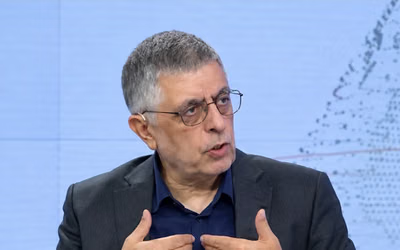
A hardline lawmaker sparked a major backlash after reading excerpts from what were described as top-secret letters by Iran’s Supreme Leader on state TV, claiming he opposed US talks, before he was interrupted and the program was abruptly cut off.
Mahmoud Nabavian, a member of parliament’s National Security and Foreign Policy Committee, said Supreme Leader Mojtaba Khamenei had repeatedly objected to the course of negotiations with the United States and set conditions that were not reflected in the Iran-US memorandum of understanding.
His remarks came as Iran’s negotiating team travelled to Switzerland for a new round of technical talks with the United States, days after Tehran and Washington signed the MoU aimed at ending the war and opening the way for further negotiations.
“The Supreme Leader explicitly expresses his dissatisfaction,” Nabavian said on the program. “He says, ‘Why did you not observe the conditions?’”
He said Khamenei had written that Iran was “neither in a hurry nor under any compulsion to negotiate or reach an agreement,” adding that the talks should be aimed at “ending the war and securing compensation,” not the nuclear issue.
According to Nabavian, Khamenei had also told negotiators not to discuss what he called “the main issue," apparently referring to Tehran's nuclear program.
“I will read one sentence. There is no other choice,” Nabavian said, before quoting from what he described as Khamenei’s correspondence: “What has taken shape in the Pakistan negotiations is fundamentally different from what was supposed to happen and from what constituted the condition for the legitimacy of the negotiations.”
Nabavian said Khamenei then called for the negotiations to be stopped.
He also said Khamenei repeated his position on the nuclear file on April 4, April 18 and April 24, insisting that Iran should either achieve “victory” by forcing the other side to fully recognize its right to enrichment, or remove the nuclear issue from the agenda of negotiations “forever.”
On the Strait of Hormuz, Nabavian said Khamenei viewed the waterway as a key point of leverage against Washington.
“The Strait of Hormuz is a very important key,” Nabavian quoted him as saying. “If the Americans want pressure taken off their throat, they must first implement preconditions, foremost among them the payment of compensation and debts.”
Nabavian added that “none of these things” had appeared in the MoU.
He said Khamenei had insisted that management of the Strait of Hormuz must remain exclusively in Iran’s hands, “not even with Oman, let alone other countries.”
According to Nabavian, Khamenei had also divided ships into different categories, saying some vessels should be stopped altogether, some could pass after paying tolls, and others, including ships belonging to Iran’s allies, could pass without payment.
He said the instructions were included in a message dated March 12.
As Nabavian continued speaking, he was interrupted by the state TV's presenter and the program abruptly ended.
State TV vows legal action
Iran’s state broadcaster later called his remarks a legal violation warranting judicial action, saying his references to classified documents and correspondence by senior officials were punishable.
It also said one director at the organization had resigned over the incident and that disciplinary action would be taken.
The disclosure also drew criticism from conservative media circles. The editor-in-chief of Mashregh accused Nabavian of selectively reading from a wider set of correspondence.
“Why don’t you say these selective excerpts of yours were from about 20-something correspondences, and in fact from the earliest ones?” Hossein Soleimani wrote on X, addressing Nabavian. “Since you disclosed and published the system’s secret and top-secret documents, you should at least have disclosed them correctly and accurately.”
Nabavian and other figures close to the hardline Paydari Front have sharply criticized the Iran-US MoU in recent days, accusing President Masoud Pezeshkian, Parliament Speaker Mohammad Bagher Ghalibaf and Foreign Minister Abbas Araghchi of making dangerous concessions to Washington.
The criticisms come as a message attributed to Khamenei said he authorized the signing of the memorandum of understanding despite having “another view in principle,” after receiving assurances from Pezeshkian that Iran’s rights and those of the “Resistance Front” would be protected.
Iranian media have reported that the negotiating team, led by Ghalibaf and including Araghchi, Central Bank Governor Abdolnaser Hemmati and other senior officials, has left for Switzerland for technical talks with the United States.
The talks are being held as the Islamic Revolutionary Guard Corps (IRGC) Navy has once again closed the Strait of Hormuz over what Tehran describes as violations of the MoU in Lebanon.
On Saturday, Iran’s Supreme National Security Council, in a directive seen by Iran International, instructed media outlets not to portray the renewed closure of the Strait of Hormuz and Iran’s simultaneous participation in talks as a split between the “field” and diplomacy.
The directive said Iran was pursuing a single strategy combining military pressure and diplomacy, and urged media outlets to frame action in Hormuz not as an alternative to negotiations but as support for them.
An illustration showing an ancient Iranian soldier and a Revolutionary Guard member holding a weapon together, displayed during a November 7 ceremony in Tehran where a statue of pre-Islamic Persian King Shapur I was unveiled.
Tehran’s unveiling of a towering statue depicting the Roman Emperor Valerian kneeling before pre-Islamic Persian King Shapur I has renewed criticism of the Islamic Republic’s appeal to nationalist sentiment following the June war with Israel.
For over forty years, the theocracy purged ancient Persian history from schoolbooks, replacing it with post-Islamic narratives. But after the 12-day conflict with Israel, officials have turned to the distant pre-Islamic past to rally a divided society.
From murals of ancient kings and soldiers to patriotic songs added to Shi’ite mourning ceremonies performed before Supreme Leader Ali Khamenei, Tehran now embraces imagery once deemed heretical by its own revolutionary ethos.
The statue unveiled in Tehran's Revolution Square
'Kneel before Iran' campaign
Tehran’s Revolution (Enghelab) Square was the scene of an unusual spectacle on Friday as officials unveiled a massive bronze statue depicting Roman Emperor Valerian kneeling in submission before Sassanid King Shapur I, commemorating Iran’s victory at the Battle of Edessa (260 AD).
The event was held under the slogan “Kneel before Iran,” part of what authorities describe as a campaign to project “national unity and historical pride” following the June war with Israel.
Tehran Mayor Alireza Zakani, a staunch ultraconservative, said on X: “Enmity with Great Iran can only end in kneeling before this historic nation.”
Municipal official Davood Goodarzi said the installation would be accompanied by visual displays depicting “other victories of Iranians over foreign aggressors,” including the defeat of British forces by local commander Rais-Ali Delvari, Mirza Kuchak Khan’s resistance against Russian troops, and Surena’s triumph over Rome at the Battle of Carrhae in 53 BCE.
The goal, Goodarzi said, is “strengthening concepts such as national dignity, social unity, and Iranian identity.”
The statue, he said, would remain temporarily at Revolution Square before being moved to a city gateway “where it will stand as the first emblem of Iran before diplomats and foreign visitors.”
Unveiled women were allowed to attend the unveiling ceremony—an uncommon scene at events organized by Tehran’s ultra-hardline municipality.
The turn to the pre-Islamic past
The sharp reversal also recalls remarks once made by Khamenei. In a 2011 speech, he asserted that “all the great military victories of this nation came after Islam,” dismissing pre-Islamic accounts as “things that are not documented.”
In 1987, he had said that prophets triumphed over kings such as Cyrus and that “nothing remains of these monarchs in history but names remembered with derision.”
Nevertheless, pro-government social media accounts have now gone so far as to circulate posters equating Khamenei himself with Shapur, showing him standing with a staff as Benjamin Netanyahu and Donald Trump kneel before him. The caption reads: “You will kneel before Iran.”
Image circulating by hardliners on social media
'Hypocrisy'
Pro-government figures have hailed the move as a patriotic success. Conservative political reporter Hossein Saremi posted: “Today’s grand Iranian gathering showed that people and the state share one essence: Iran itself. Nothing can take our homeland away.”
Others, however, called the spectacle “hypocrisy.” Journalist Gholamhossein Pashaei wrote on X: “Every year you close Pasargadae to stop people from celebrating Cyrus Day, yet you unveil Shapur’s statue in Enghelab Square with drums and fireworks during Fatimiyya (mourning period)!”
Dissident commentator Hamid Asafi called the ceremony “a perfect snapshot of the Islamic Republic’s contradictions.”
On Telegram he wrote: “A week ago they closed Cyrus’s tomb out of fear of the crowds, and now they glorify Shapur in the same breath. The Islamic Republic fears living history but poses for selfies with its corpse.”
He added: “They know people no longer respond to rosaries and sermons. That’s why they’ve brought history back to the stage—in a controlled costume. If they can’t erase the past, they’ll try to own it.”
The irony deepened as UNESCO formally recognized Cyrus’s Charter as one of the earliest human-rights documents.
President Masoud Pezeshkian wrote on X: “Iran, the cradle of dialogue, justice, and coexistence, can still inspire peace today.”
Users swiftly replied, questioning how such pride could coexist with a government that blocks access to Cyrus’s tomb each year to those wishing to visit it on his birthday.