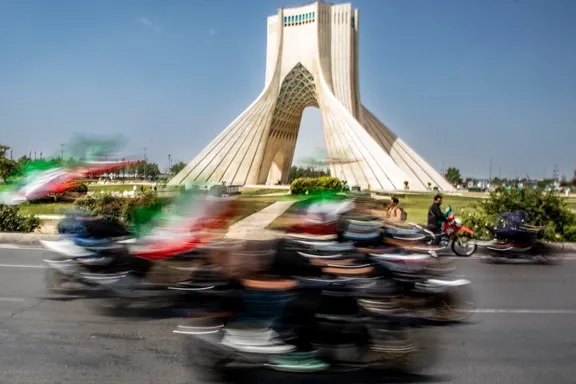
Motorcyclists wave Iranian flags as they pass Tehran's iconic Azadi Tower during a state-sponsored rally, May 20, 2026
Hope for a limited US-Iran agreement gained momentum Friday as regional mediators intensified efforts to stabilize the ceasefire, but the fragile diplomacy faced hostility from Iranian hardliners who cast negotiations as a prelude to renewed conflict.
Iranian Foreign Ministry spokesman Esmail Baghaei said Friday morning that despite growing speculation surrounding the talks, “no significant progress” had been made.
Diplomatic sources say discussions have focused on a possible memorandum of understanding envisioned as a first step toward broader negotiations, including over Iran’s nuclear program.
The proposed framework would reportedly seek to stabilize the ceasefire and establish mechanisms for managing shipping and navigation disputes in the Strait of Hormuz.
Such an arrangement could provide both sides with temporary political breathing room while reducing pressure on global energy markets already shaken by weeks of conflict and shipping disruptions.
But neither Tehran nor Washington has ruled out military escalation if negotiations collapse before an agreement is finalized.
The Trump administration was preparing on Friday for a fresh round of military strikes against Iran, CBS reported citing sources familiar with the planning, even as indirect diplomacy continues.
The fragility of the process was also underscored Friday by continued attacks from Iranian hardliners who argue the ceasefire itself represented a strategic mistake.
Tehran University lecturer Mohammad Sadegh Koushki said in an interview with the IPTV program Zoom, affiliated with the Fararu website, that Iran had halted military operations just as it had gained the upper hand.
“It’s like a football team that is up by a goal and can score one or two more,” he said. “The momentum of battle was brought to a screeching halt under the name of negotiations and a ceasefire.”
Koushki dismissed the idea that Iran’s conflict with the United States could ultimately be resolved through diplomacy, arguing that years of negotiations had only resulted in greater sanctions and pressure.
Similar arguments appeared across hardline political circles Friday. MP Alireza Salimi said Iran’s control over the Strait of Hormuz was “not negotiable” and that Tehran alone would define and enforce the strait’s “new rules.”
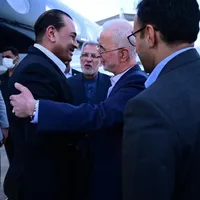
Diplomatic activity nevertheless appeared to intensify throughout Friday as Pakistani Interior Minister Mohsin Naqvi returned to Tehran, with CBS citing a senior Pakistani official as saying his meetings had helped negotiations move “in an important direction,” prompting Pakistan’s Field Marshal Asim Munir to join the mediation effort.
Reuters also reported that a Qatari negotiating team arrived in Tehran in coordination with the United States to help secure an agreement aimed at ending the war and resolving outstanding disputes.
Still, similar moments of optimism earlier in 2025 and again in early 2026 ultimately collapsed into waves of US and Israeli strikes on Iran, leaving deep skepticism about the durability of diplomacy.
In a widely circulated post on X, establishment academic Foad Izadi argued that Washington had paid too little a cost for the conflict to abandon long-term pressure on Iran.
“The cycle of attack, ceasefire, negotiation and attack will repeat,” Izadi wrote, warning against rapid concessions or reopening the Strait of Hormuz too quickly.
The remarks reflected broader hardline skepticism toward the diplomatic push even as intensified mediation efforts suggested Tehran and Washington may still see a narrow path toward a limited deal.
Pakistani top general Asim Munir’s trip to Tehran has fueled speculation about a possible temporary Iran-US agreement to end the war and resume broader talks, although Tehran says the high-profile visit does not necessarily mean a deal is close.
Munir’s visit on Friday follows days of lower-level negotiations that have reportedly narrowed some of the major disagreements between Tehran and Washington.
The Pakistani commander visited Tehran last month as well, where he held meetings with senior Iranian civilian and military officials.
Pakistan’s Interior Minister Mohsin Naqvi also traveled twice to Tehran and remained there on Friday as negotiations continued.
Iranian and Pakistani media reports described the visit as part of Islamabad’s broader mediation effort aimed at reducing tensions over Iran’s uranium enrichment program and the closure of the Strait of Hormuz.
Axios reported on Friday that Munir’s visit could represent a “final push” by Pakistan to secure a temporary agreement under which both sides would halt hostilities and continue negotiations for another 30 days over unresolved disputes, including Iran’s nuclear program.
Media speculation
However, expectations of an imminent breakthrough remain cautious.
An Iranian source close to the negotiations told the Arabic outlet Al-Araby Al-Jadeed that Pakistan’s interior minister had not delivered any new American proposal to Tehran and that reports about a finalized draft agreement were “media speculation.”
According to the source, “the visits by Pakistani officials to Tehran are aimed at strengthening Islamabad’s mediation role and preventing further escalation.”
Iran’s Foreign Ministry spokesman downplayed the significance of the Pakistani top general's trip to Tehran, saying, "Despite becoming more frequent, such exchanges are a continuation of the same diplomatic process. We cannot necessarily say we have reached a point where a deal is near."
“The differences between Iran and the United States are so deep and extensive that it cannot be said we must necessarily reach a result after a few rounds of visits or negotiations within a few weeks," Iran's foreign ministry spokesman Esmaeil Baghaei said on Friday.
Iranian outlet Farda News, considered close to parliament speaker Mohammad Bagher Ghalibaf who is leading Iran’s negotiating team, wrote that “Islamabad is not merely a messenger, but is playing a role beyond transmitting messages and below that of a direct negotiator.”
Pakistan, Iran’s eastern neighbor, has emerged over the past two months as the principal intermediary between Tehran and Washington.
Its mediation efforts accelerated after Islamabad helped broker a ceasefire on April 7. But the first round of direct talks between Iran and the United States failed to produce a lasting agreement, and recent weeks have shown signs of growing diplomatic deadlock.
‘Unprecedented progress’
Oman had previously served as the primary mediator. Talks between Tehran and Washington were underway in Muscat before US and Israeli strikes on Iran began on February 28.
At the time, Omani Foreign Minister Badr Albusaidi publicly said that “significant and unprecedented progress” had been achieved before diplomacy collapsed following the outbreak of war.
Unlike Oman, which largely positioned itself as a neutral intermediary, Pakistan enters the process with closer security ties to Saudi Arabia.
Some analysts argue this complicates Islamabad’s role. Pakistan signed a defense agreement with Saudi Arabia in 2025 committing both countries to support one another in the event of an attack. Iran repeatedly targeted Saudi territory during the war, raising questions among some observers about Pakistan’s neutrality.
London-based Amwaj Media wrote that the Islamabad-Riyadh defense pact demonstrates “the limits of Pakistan’s neutrality” in mediating between Iran and the United States.
Iranian state news agency IRNA described Pakistan’s primary concern as preventing the conflict from spreading beyond Iran into the wider region.
The report said Pakistan fears the war could spill into South Asia and destabilize its western border regions at a time when Islamabad is already managing tensions with India along its eastern frontier.
‘The limits of Pakistan’s neutrality’
At the same time, Pakistani officials appear to see strategic opportunities in successful mediation.
IRNA argued that if Islamabad helps secure a diplomatic settlement, it could strengthen Pakistan’s regional standing and deepen economic ties with a post-sanctions Iran.
“Honest mediation by Islamabad could elevate Pakistan’s position in a future Iran free from sanctions and transform it into an important partner,” IRNA wrote.
Pakistan’s mediation effort has also drawn support from China, one of Tehran’s closest strategic partners. Pakistani Prime Minister Shehbaz Sharif has confirmed that Islamabad’s diplomatic efforts are backed by Beijing.
Although Beijing has avoided taking on a direct mediation role, Chinese Foreign Minister Wang Yi recently said China supports Pakistan playing a “greater role” in resolving the conflict.
A small port on Oman’s Musandam Peninsula has become part of Iran’s workaround to the maritime blockade in the Strait of Hormuz, traders say, as goods once routed through the UAE are shifted through costlier channels.
Before the war involving the United States, Israel and Iran, Khasab was better known to many Iranians as a stop on informal maritime routes used by fishermen, tourists and fast boats moving between Oman and Iran’s southern coast.
Among those boats were vessels known locally as shooti boats, a term borrowed from Iranian smuggling slang. In Iran, shooti usually refers to high-speed cars that carry untaxed or smuggled goods across long distances, often traveling in groups and avoiding stops.
Around Khasab, traders and locals use the same word for fast boats that make quick crossings to places such as Qeshm and other Iranian coastal points.
For years, the route was associated mostly with informal trade and small-scale smuggling. Iranian cigarettes, alcohol and hashish were moved from Iran to Oman, while consumer goods, home appliances and luxury items were brought back from Oman to Iran.
Iranian fishing boats around Khasab were also a familiar part of the area’s maritime landscape.
A port at the mouth of Hormuz
Khasab is the capital of Oman’s Musandam governorate, an exclave separated from the rest of Oman by the United Arab Emirates.
Its geography gives it unusual importance: the port sits near the mouth of the Strait of Hormuz, about 35 kilometers from Iran, surrounded by dry mountains and fjord-like inlets that before the war were mostly associated with leisure boats and maritime tours.
The blockade has changed the function of the route.
With main passages in the Strait of Hormuz closed to Iranian ships and vessels linked to the Islamic Republic, Khasab has shifted from a local secondary route into one of several alternatives for moving goods into Iran.
Cargoes that previously traveled through standard commercial channels and UAE ports are now, in parts of the transport network, being redirected through Oman and Khasab.
How the route works
A trader told Iran International that since the ceasefire, Iran-bound cargo is first carried from UAE ports to Khasab on vessels flying non-Iranian flags.
The goods are then unloaded at Khasab’s pier onto Iranian vessels, which take them to Iranian ports outside the main controlled routes.
A significant share of the movement is carried by landing craft, the trader said.
Those vessels are useful for the route because they can move through shallow waters and dock at smaller piers. Some can carry hundreds of tons of cargo, and in some cases close to 1,000 tons, including containers, vehicles and heavier freight.
The goods moving through Khasab are not limited to one category, according to trade sources.
They can include cars, spare parts, home appliances, consumer goods, hygiene products and some items linked to petroleum products.
Iranian vessels carrying goods from Khasab toward Iran
A costly workaround
The route is significantly more expensive than Iran’s previous channels.
One trader told Iran International that moving goods through Khasab costs about six times more than the earlier route from the UAE to the southwestern port city of Khorramshahr.
Still, the trader said the higher cost has become one of the few remaining options for many businesses trying to continue operating.
Local officials in Iran have also referred to the growing use of Omani ports.
Khorshid Gazderazi, head of the Bushehr Chamber of Commerce, said on Thursday that the UAE had previously served as Iran’s main hub for exports and imports, but that after the war began and loading and container departures were disrupted, using Omani ports was placed on the agenda.
He named Khasab, Suwaiq, Shinas and Muscat among the ports being used to move goods.
Morad Zerehi, governor of Bandar Khamir in Hormozgan province, also announced a plan called “boat transport” for the “legal transfer of basic goods from Omani ports” to the county.
A route advertised online
The shift is also visible on Iranian social media, where accounts selling goods have begun advertising the Oman route.
Some accounts have posted videos of goods being moved from Oman, presenting the route as proof that imports into Iran are continuing despite the war and maritime restrictions.
They market Khasab as a new way to bring goods into Iran and encourage customers to keep buying.
But the route also shows the limits of Iran’s workaround.
For traders, Khasab offers a way to keep goods moving. For Iran’s trade network, it is also a sign of how the blockade has pushed ordinary commerce into longer, more expensive and less predictable routes.
As food prices spiral and farms shut down across Iran, even establishment figures are openly questioning how a country capable of producing precision missiles cannot manufacture affordable cars or keep chicken within reach of ordinary families.
Former Industry Minister Mostafa Hashemitaba says the crisis is rooted not only in consumer markets but across the country’s collapsing production chain, from fertilizers to poultry farming.
Writing in Sharq on May 20, Hashemitaba said the price of a 50-kg bag of triple-phosphate fertilizer had jumped within months from three million rials to 70 million rials, a nearly 24-fold increase. Other fertilizers, he added, rose by more than 1,100 percent over the same period.
The result, he argued, has been the shutdown of farms and poultry operations, feeding directly into soaring prices for fruit, vegetables and meat.
As food prices spiral and farms shut down across Iran, even establishment figures are openly questioning how a country capable of producing precision missiles cannot manufacture affordable cars or keep chicken within reach of ordinary families.
Former Industry Minister Mostafa Hashemitaba says the crisis is rooted not only in consumer markets but across the country’s collapsing production chain, from fertilizers to poultry farming.
Writing in Sharq on May 20, Hashemitaba said the price of a 50-kg bag of triple-phosphate fertilizer had jumped within months from three million rials to 70 million rials, a nearly 24-fold increase. Other fertilizers, he added, rose by more than 1,100 percent over the same period.
The result, he argued, has been the shutdown of farms and poultry operations, feeding directly into soaring prices for fruit, vegetables and meat.
A report published by Etemad described growing despair among Iranians struggling with job losses, displacement and rapidly rising living costs after the conflict.
Columnist Nayereh Khademi interviewed a 40-year-old university-educated man who said that after losing his job during the war, he briefly considered living in a cardboard box with his wife.
“What frightened me most was a future in which nothing was certain,” he said.
Another man described the horror of watching missile strikes destroy homes around him. When he realized his own house was still standing, he said he felt guilt rather than relief.
For many who lived through the attacks, the war’s aftermath brought a second shock: rapidly rising prices and shrinking access to basic necessities.
One resident interviewed by Etemad described it as “surreal” to walk past shops selling everyday goods that had suddenly become unaffordable.
Several Tehran newspapers reported last week that a kilogram of poultry meat had reached 1.5 million tomans, roughly one-tenth of an ordinary worker’s monthly salary.
Even some members of parliament, usually focused on rhetoric about national strength and resistance, publicly acknowledged the severity of rising food prices.
Hashemitaba contrasted the economic deterioration with what he described as unrealistic official ambitions elsewhere in the economy.
He recalled that in September 2023, then-President Ebrahim Raisi’s industry minister proudly showed him an electric vehicle and promised that 100,000 units would be produced by March. By spring, he wrote, it became clear that the display model was effectively the factory’s only output.
“How can a country that manufactures precision missiles fail to produce cars?” Hashemitaba wrote.
The worsening economic picture is also reinforcing arguments inside parts of Iran’s political establishment that some form of relief through negotiations with Washington may be unavoidable after months of war and financial turmoil.
While hardliners continue to frame diplomacy as resistance management rather than compromise, even some conservative figures have increasingly acknowledged the scale of economic pressure facing ordinary Iranians.
The strain is now extending beyond households. Cafés and restaurants in Tehran that once offered a temporary escape from political tensions and economic anxiety are also reportedly struggling to survive amid surging supply costs.
Government officials, including President Massoud Pezeshkian, who once tried to downplay the scale of the crisis, have increasingly acknowledged the depth of the country’s economic problems.
But hardline critics on Thursday attacked Pezeshkian simply for publicly recognizing the extent of public hardship—a reaction that underscored how disconnected parts of the political establishment appear from the realities facing many ordinary Iranians.
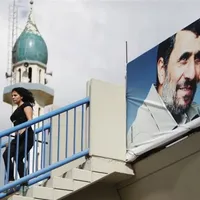
New York Times report claiming former Iranian president Mahmoud Ahmadinejad was considered by some US officials for a post-war role in Iran triggered a storm of speculation, ridicule and conspiracy theories inside Iran.
The report alleged that during the opening days of Israeli and US attacks on Iran, discussions took place in Washington about whether Ahmadinejad could help manage a political transition after the collapse of the Islamic Republic’s leadership and the death of Supreme Leader Ali Khamenei.
But many Iranian commentators quickly questioned both the credibility of the report and the assumptions behind it.
Conservative journalist Parisa Nasr described the story as “weak and flimsy” in a post on X, arguing that circulating such narratives under current conditions risked contributing to “wartime psychological operations.”