Israel’s campaign in Iran has reached far beyond missile depots and military command. Over roughly a month, it has also hit the architecture of domestic repression: intelligence compounds, police stations, Basij bases, judicial buildings, and senior officials tied to crackdowns.
That matters not only because of the damage done, but because of what these places meant. In Iran, repression has never depended on one institution alone. It has been built as a layered system, running from the top decision-making bodies in Tehran down to the neighborhood police station, the local Basij outpost and the courthouse where detainees are processed.
A review by Iran International of citizen reports and source material found that, in about one month after the war began, at least 130 sites tied to internal repression were destroyed or hit.
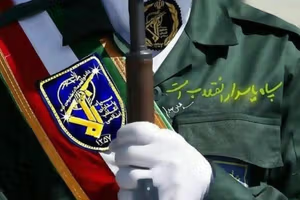
They included 57 Basij buildings or bases, 43 police (FARAJA) facilities, 10 Revolutionary Guards compounds, and 11 security complexes involved in repression. Other targets included judicial buildings and the state broadcaster, institutions that helped complete the chain through prosecutions, propaganda and coerced confessions.
Iran International sources also put the toll among security forces at nearly 5,000 dead and about 21,000 wounded.
From the command center to the street
The internal security system has long worked in three layers.
At the top sits the command structure: the Supreme Leader, the Supreme National Security Council, provincial security councils and, in Tehran, the IRGC’s Tharallah headquarters, which can take control of multiple security organs during major unrest. Around the capital, a similar role has been played by the Seyyed al-Shohada corps.
Below that are the operational forces: The Police Command of the Islamic Republic of Iran (abbreviated as FARAJA); special anti-riot units; provincial Revolutionary Guards formations; and IRGC’s specialized units such as Saberin and Fatehin.
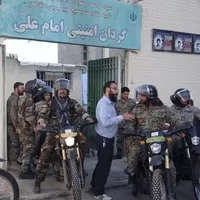
Alongside them is the Basij, the paramilitary network embedded in neighborhoods across the country. Its Imam Ali battalions, often arriving on motorcycles, became one of the most recognizable instruments of street repression after the 2009 protests.
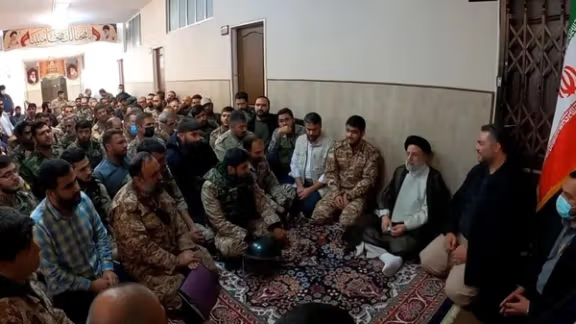
Iran’s then-President Ebrahim Raisi meets members of the Fatehin unit after the crackdown on the 2022 protests.
The third layer is institutional support: intelligence bodies, courts, prisons and state media.
The strikes appear to have touched every layer.
Senior figures reported killed include Ali Khamenei, the longtime ultimate authority over crackdowns; the intelligence minister and several of his deputies; senior Guards and Basij commanders; commanders tied to Tehran’s suppression apparatus; police intelligence officials; and members of the judiciary, including officials linked to Evin prison and Tehran’s prosecutorial system.
The symbols that fell
The targets were not only militarily useful. Many were symbols.
In Tehran, the Ministry of Intelligence and compounds linked to the Revolutionary Guards’ intelligence arm were hit again after earlier strikes in the June 12-day war. Tharallah-linked facilities in northern Tehran, security clusters in eastern Tehran, anti-riot police facilities and Basij sites across the capital were also struck.
Some locations had an importance that went beyond their walls. Tehran’s Revolutionary Court building on Moallem Street was one of them. For decades, it stood as a symbol of summary trials, political prosecutions and death sentences. Its destruction carried a message larger than the physical damage.
The same was true of the state broadcaster. For many Iranians, it was not just a media institution but a place associated with forced confessions and public humiliation of dissidents. Seeing it hit again mattered for that reason.
Even when buildings had been partly emptied, they still housed the tools of coercion: files, servers, records, communications systems, vehicles and equipment.
In some post-strike videos, papers and official documents could be seen scattered in the streets after blasts ripped through buildings that looked outwardly residential or commercial.
One attack in western Tehran offered a different picture: a strike on the 12,000-seat Azadi sports hall, where anti-riot personnel appear to have been moved. Iran International’s reporting estimates that between 900 and 1,200 security personnel may have been killed there.
From the capital to small towns
What happened in Tehran was echoed outside it.
On the capital’s outskirts, command centers in Rey, Karaj and Mahdasht were hit, along with Basij and police-linked sites in surrounding towns.
In the provinces, Iran International identified heavy strikes on intelligence, police, judicial and Guards facilities in cities including Isfahan, Khorramabad, Ilam, Sanandaj, Semnan, Shiraz, Urmia and Tabriz.
In small towns, local police posts carry a special weight. They are often the clearest symbol of the central government’s presence, and one of the first places where people encounter coercion directly.
That is what makes a place like Abdanan important. The town had already become known for the violence used against residents during the January uprising. Even a mourning ceremony for local victims was met with gunfire.
Days later, residents watched their police station and Guards facilities explode. For people who had just buried their dead, the collapse of those buildings was not just another wartime image. It was the visible breaking of a local order that had seemed untouchable.
What remains after the strikes stop
If the campaign ends soon, the central question will not be only what has been destroyed, but what has been exposed.
The Islamic Republic’s internal coercive machine appears weaker, less insulated and less imposing than before.
Walls around intelligence compounds have fallen. Buildings long associated with fear have been reduced to rubble. Officials who once threatened subordinates from the top of the pyramid are gone.
But the country that remains will also be poorer and angrier.
Official figures show point-to-point food inflation in the last month of the Persian year running above 113%, with some staples such as cooking oil up as much as 220% and bread up 140%, while wages rose only 20% to 30%.
Power cuts, already worsening before the war because of years of underinvestment, point to deeper structural decay that long predates the current fighting.
The war will end. What will remain for ordinary Iranians is a country already battered by record food inflation, stagnant wages and years of neglected infrastructure long before the current fighting began.
For many of those who lost relatives in the January crackdown, that larger story may be distilled into one image: not an oil turbine or a military depot, but the police station, Basij base or courthouse that once embodied fear, now lying in ruins.
A deepening rift at the top of the Islamic Republic has spilled into an unusually sharp confrontation, with President Masoud Pezeshkian accusing senior Guards commanders of unilateral actions that have wrecked ceasefire prospects and pushed Iran toward disaster.
Two sources close to the presidential office said a tense exchange took place on Saturday, April 4, between Pezeshkian and Hossein Taeb, a powerful figure close to Supreme Leader Mojtaba Khamenei. Those present described the conversation as unusually difficult and highly charged.
During the meeting, Pezeshkian accused IRGC chief commander Ahmad Vahidi and Ali Abdollahi, commander of Khatam al-Anbiya Central Headquarters – the country’s armed forces' unified command, of acting unilaterally and driving escalation through attacks on regional countries, especially against their infrastructure.
According to the sources, Pezeshkian said those policies had destroyed any remaining chance of a ceasefire and were steering the Islamic Republic directly toward “a huge catastrophe.”
He also warned that, based on what he described as precise assessments, Iran’s economy would not be able to withstand a prolonged war for much longer and that full economic collapse was inevitable under current conditions.
The confrontation comes amid mounting evidence of a broader power shift inside the Islamic Republic, with military and intelligence networks increasingly displacing both the elected government and the traditional clerical order.
A regional source familiar with internal developments told Iran International in February that the model of velayat-e faqih (guardianship of the jurist) that has defined the Islamic Republic for more than four decades is now undergoing a fundamental transformation and even an “ideological collapse.”
According to that source, the appointment of Mojtaba Khamenei to the leadership, despite lacking the traditional qualifications and legitimacy associated with the position, took place through an opaque process that in practice amounts to the sidelining of the traditional clergy and the consolidation of full control by the Guards’ military-intelligence apparatus.
The source said this process has strengthened what many insiders describe as the Islamic Republic’s “hidden state.”
Iran International has previously reported growing tensions between Pezeshkian and senior IRGC commanders, particularly Vahidi, over how the war should be managed and over its destructive impact on people’s livelihoods and the economy.
On March 28, informed sources said Pezeshkian had criticized the Guards’ approach to escalating tensions and continuing attacks on neighboring countries, warning that without a ceasefire the economy could collapse within three weeks to a month.
Subsequent reporting by Iran International showed that the president’s authority has continued to shrink.
Sources said the Guards have resisted Pezeshkian’s appointments and decisions, effectively stripped the government of executive control and erected a security barrier around the core of power.
According to those reports, Pezeshkian’s attempt to appoint a new intelligence minister collapsed under direct pressure from Vahidi, who rejected all proposed candidates, including Hossein Dehghan, and insisted that all key wartime positions must, for now, be chosen and managed directly by the Guards.
Alongside the political infighting, fresh field reports received by Iran International point to a worsening human and logistical crisis inside the Guards and the Basij.
Sources said that over the past 72 hours, operational forces have faced acute shortages of basic supplies, including edible food, hygiene facilities and places to sleep.
Recent strikes on infrastructure and bases have left many Guards and Basij personnel sleeping in the streets, and in some areas they have had access to only one meal a day.
According to informed sources, some personnel were forced to buy food from shops and restaurants with their own money after expired rations were distributed.
At the same time, disruptions affecting Bank Sepah’s electronic systems have reportedly delayed the salaries and benefits of military personnel, fueling fresh anger and mistrust within the ranks.
Iran International had previously reported similarly dire conditions in field units, including severe shortages of ammunition, water and food, as well as growing desertions by exhausted soldiers.
Even in the Guards’ missile units, which have historically received priority treatment, sources reported serious communications failures and food shortages. They said commanders were continuing to send only technical components needed to keep missile systems operational, rather than food or basic individual supplies for personnel.
Iranian security forces have still not returned the body of 18-year-old protester Amirhossein Hatami to his family, four days after his execution, in what informed sources described as further pressure on relatives already reeling from his death.
Information obtained by Iran International shows that Hatami, who was executed on April 2, remains unburied as authorities continue to withhold his body.
Hatami was one of the defendants in a case linked to a fire at the Mahmoud Kaveh Basij base on Namjoo Street in eastern Tehran during the January protests.
Others in the same case included Mohammadamin Biglari, Shahin Vahedparast Kalur, Abolfazl Salehi Siavashani and Ali Fahim, all of whom were sentenced to death.
Biglari and Vahedparast were executed on April 5, while Fahim’s execution was carried out on Monday, April 6.
Informed sources told Iran International that Hatami’s body has not been released because his name appeared on a website linked to the Mojahedin-e Khalgh organization, an allegation his family strongly rejects.
Sources familiar with the case said Hatami was an industrial design student at the University of Tehran and was fluent in three languages.
A source with knowledge of the events of January 8 said the case involved seven defendants, none of whom had any role in starting the fire.
According to the source, Hatami and the others entered the Basij base with around 50 other people only after the fire had already broken out.
Minutes later, another fire began. Many managed to escape, but seven people, including Hatami, were unable to flee.
They went to the rooftop, where they were detained by Basij forces and severely beaten, the source said.
Judicial authorities later accused the defendants of trying to gain access to the armory.
After their arrest, the detainees were subjected to severe interrogations and then transferred to Ghezel Hesar prison.
They were denied in-person visits throughout their detention and were allowed only phone calls.
Their trial was presided over by Judge Abolghasem Salavati, and they were denied access to lawyers of their own choosing.
Death sentences were issued on February 7.
Sources told Iran International that the confessions in the case were extracted under pressure and coercion, and that the judicial process ended in executions carried out without the defendants and their families having full knowledge of the proceedings.
In the same case, 28-year-old Shahin Vahedparast was also executed on April 5, and his body, too, has still not been returned to his family, according to informed sources.
Those sources said Vahedparast’s wife was four months pregnant at the time of his execution.
Relatives said he had dreamed of opening a restaurant with her.
Iran’s petrochemical sector is now openly under threat, marking a significant escalation in the conflict and raising the prospect of far-reaching economic consequences for the country and potentially the wider region.
Israeli strikes in recent days have hit Iran’s two main petrochemical hubs, Mahshahr and Assaluyeh, while US President Donald Trump has warned that further attacks on the country’s energy infrastructure could follow if no deal is reached by Tuesday night.
Iranian authorities said Monday that industrial facilities in the Mahshahr petrochemical zone are being evacuated ahead of Trump’s deadline.
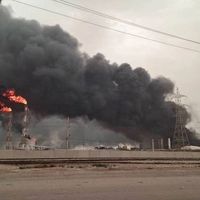
On Saturday, April 4, Israeli forces targeted at least eight major petrochemical complexes in the Mahshahr region, along with critical supporting infrastructure, including power plants that supply electricity to the industrial zone.
Two days later, similar strikes hit the vast petrochemical facilities in Assaluyeh, the center of Iran’s South Pars gas and petrochemical operations.
Although the full extent of the damage remains unclear, Iranian officials have acknowledged that operations in both regions have been halted.
Mahshahr accounts for approximately 28 percent of Iran’s petrochemical production, while Assaluyeh contributes more than 48 percent. Together, the two hubs represent roughly three-quarters of the country’s total petrochemical output.
Iran’s petrochemical industry is the second-largest source of export revenue after crude oil. The country has a nominal production capacity of about 95 million tons per year, although actual output is closer to 75 million tons due to persistent shortages of electricity and natural gas.
Around half of this production—valued at approximately $13 billion annually—is exported, accounting for more than one-fifth of Iran’s non-oil exports.
The shutdown of these facilities therefore represents more than a temporary industrial setback. It directly threatens one of Iran’s most important sources of foreign currency earnings.
If the damaged infrastructure cannot be restored in the medium term, the second-largest producer of petrochemicals in the Middle East could even face shortages.
Over the past decades, Iran has invested an estimated $70 billion in developing petrochemical infrastructure. In the event of severe damage, rebuilding these facilities would pose a major financial and technical challenge.
Given the constraints imposed by sanctions, limited access to international capital and broader economic pressures, Iran is unlikely to have the resources required for rapid reconstruction.
Even if external financing were secured, restoring production capacity would take years, and possibly more than a decade.
Petrochemical plants are highly complex systems that depend not only on physical infrastructure but also on stable energy supply, advanced technology and efficient logistics networks—all of which are currently under strain in Iran.
The strikes on petrochemical facilities come alongside recent attacks on major steel plants in Isfahan and Khuzestan, which together account for roughly half of Iran’s steel output. Taken together, the pattern suggests a broader strategy aimed at weakening Iran’s industrial backbone rather than targeting isolated sectors.
The timing of these strikes is particularly significant given Iran’s pre-existing structural weaknesses.
In recent years, the country has faced chronic shortages of natural gas, electricity and refined fuels, forcing many industries to operate well below capacity. These constraints have already reduced industrial output and increased production costs.
At the same time, Iran’s logistics sector suffers from deep inefficiencies. According to World Bank data, the country ranks near the bottom in regional logistics performance, second only to Afghanistan. This limits Iran’s ability to reroute supply chains, manage disruptions or quickly recover from large-scale damage to infrastructure.
The combined effect of these factors could push Iran into a deeper economic crisis. A sustained disruption in petrochemical exports would significantly reduce foreign currency inflows, putting additional pressure on the national currency and exacerbating inflation.
Ultimately, the burden of this crisis will fall disproportionately on ordinary Iranians who are already struggling with high inflation, energy shortages and rising unemployment.
If Trump follows through on his threat, the conflict could move further into the economic domain, reshaping the trajectory of Iran’s economy and potentially sending shockwaves through regional—and even global—energy markets.
The heaviest wave of attacks in more than a week struck Iran on Monday, killing at least 49 civilians and injuring 58 others as the war between Iran, rights group HRANA reported ahead of President Trump's Tuesday deadline to hit Iranian power plants.
The strikes were spread across 20 provinces, according to the Washington-based monitoring group Human Rights Activists News Agency, and represented the highest rate of attacks recorded in the past 10 days.
Among those killed were four children and two women, HRANA said, adding that the figures remain preliminary and could rise as more information emerges.
In total, the group documented at least 573 individual strikes across 215 separate incidents during the past day, a scale of bombardment that analysts say reflects a widening focus on strategic sectors of Iran’s economy.
Many of the attacks targeted infrastructure linked to the country’s core industries, including elements of Iran’s energy sector, HRANA reported.
The latest wave of strikes comes as President Trump has warned that the United States could launch sweeping new attacks on Iranian infrastructure if Tehran does not agree to negotiations by Tuesday evening.
In a statement Monday, the White House said Iran would be “sent back to the stone ages tomorrow night if they fail to engage in a serious way” with diplomatic efforts.
The war, now in its sixth week, has already inflicted heavy losses across the region.
Iranian authorities and monitoring groups estimate that more than 2,000 people have been killed inside Iran since the conflict began. Israeli officials say at least 26 people have been killed there, while missile and drone attacks launched by Iran have also caused dozens of casualties in the Persian Gulf countries.
With negotiations uncertain and attacks intensifying on both sides, Tuesday is shaping up as one of the most consequential moments in the conflict since it began more than five weeks ago.
The mission to rescue an American pilot downed in Iran showed how a tactical success can open wider strategic possibilities, sharpening debate over how far the United States may expand its footprint inside Iran.
The operation may have cost the United States several military assets, but it also forced Iran to reveal what it considers key terrain, according to former intelligence officer Michael Pregent.
A veteran with more than 28 years of experience in security and terrorism in the Middle East, Pregent believes that in scrambling to protect what it thought would be the next landing zone, Iranian forces exposed troop movements and defensive priorities that US planners may now be able to exploit.
“You can see movement of assets to protect key terrain that we may not have thought was key terrain but the regime does, and that gives an opportunity to exploit the situation," Pregent told Iran International.
"The establishment of this base now changes that focus. It's not just about fixed airstrips. Air bases that the US can take over—now it's just flat terrain, because that's what this was.”
For Pregent, the deeper implication is what the mission revealed about the regime’s internal weakness.
“It indicates a lack of command and control of regime forces due to the degradation, due to key leaders being taken out… the regime wasn't able to do anything about it. And that says something.”
That reading is echoed, though more cautiously, by Farzin Nadimi, a defense and military expert on Iran at the Washington Institute, who says the rescue proved American reach but also exposed how fragile that success was.
The mission itself was among the most daring US operations of the war so far. Special operations forces moved deep into Iran under cover of darkness, crossed mountainous terrain to reach the stranded weapons systems officer, and rushed him toward extraction before dawn.
But the operation nearly unraveled when two transport aircraft were unable to take off, forcing commanders to improvise a new extraction plan in real time to avoid leaving roughly 100 troops stranded inside Iran.
US troops destroyed the disabled MC-130s and four additional helicopters inside Iran rather than risk leaving sensitive equipment behind.
Ahead of the mission, the CIA reportedly ran a deception campaign inside Iran, planting false information that US forces had already found and moved the missing officer. As the rescue unfolded, US forces also jammed communications and struck key roads near the location to keep Iranian forces away.
"Over the past several hours, the United States military pulled off one of the most daring search and rescue operations in US history," Trump said in a statement. The airman was injured, but Trump said "he will be just fine."
For Nadimi, that near miss is the real takeaway.
“It was a very successful operation… It showed real reach, real flexibility, and real results. But at the same time, it also showed… that the mission could very well have failed. And that would leave almost 100 troops in the middle of Iran," he told Iran International.
That warning now carries added weight as the fate of Iran’s uranium stockpile remains unresolved.
The International Atomic Energy Agency (IAEA) had estimated Iran held roughly 440.9 kilograms of uranium enriched to near weapons-grade levels before the latest round of strikes, much of it still unaccounted for.
But when asked whether the rescue mission could make a future operation to secure that stockpile more likely, Nadimi is blunt.
“I think the simple answer is no.”
His assessment is that a mission to secure more than 400 kilograms of highly enriched uranium would require a fundamentally different scale of operation: heavy engineering equipment, excavation teams, perimeter defense, airlift support and the ability to seize and hold key terrain for days or even weeks.
Yet the political lesson may be moving in the opposite direction.
Shahram Kholdi, a Middle East historian whose own Iranian conscript service to the regular army (Artesh) gives him firsthand insight into how the Islamic Republic prioritizes the IRGC and Basij in any domestic theater, says the operation may strengthen the hand of those in Washington arguing that half measures are no longer enough.
“Those so-called hawks now have a stronger view… to convince the president not to go in half-baked anymore… we are going to see blows that would be interdisciplinary actions.”
The Islamic Republic's rush to capture the downed airman may reinforce arguments among hawks that future operations should combine overwhelming air power with more deliberate ground-enabled missions, according to Kholdi.
The rescue not only brought both men home but also demonstrated that Washington can execute complex operations deep inside Iran—leaving the far bigger question of how, and how far, it may use that lesson next.