• العربية
  • فارسی
Brand
  • Iran Insight
  • Politics
  • Economy
  • Analysis
  • Special Report
  • Opinion
  • Podcast
  • Iran Insight
  • Politics
  • Economy
  • Analysis
  • Special Report
  • Opinion
  • Podcast
  • Theme
  • Language
    • العربية
    • فارسی
  • Iran Insight
  • Politics
  • Economy
  • Analysis
  • Special Report
  • Opinion
  • Podcast
All rights reserved for Volant Media UK Limited
volant media logo
ANALYSIS

Iran-Russia trade shrinks despite closer security ties

Dalga Khatinoglu
Dalga Khatinoglu

Oil, gas and Iran economic analyst

Oct 21, 2025, 01:30 GMT+1Updated: 00:09 GMT+0
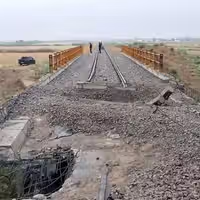
Containers are stacked at Iran's Caspian port of Anzali

Despite years of official rhetoric about a “strategic partnership,” new data show that Russia has slipped from Iran’s list of main trading partners.

Iran’s customs chief Faroud Asgari confirmed the shift without specifying trade volume for the first half of the current Iranian fiscal year (March 21–September 22).

Figures from Iran’s Chamber of Commerce show, however, that bilateral trade totaled less than $1.1 billion in the first five months—just 4.5% of Iran’s total non-oil foreign trade.

This comes despite a 2023 agreement between Tehran and Moscow to boost annual trade to $40 billion after Russia’s invasion of Ukraine and the onset of Western sanctions.

Last year, Iran–Russia trade stood at $2.5 billion.

Exaggerations

Following reports that Russia had fallen off Iran’s main trading list, Deputy Trade Minister Mohammad Ali Dehgan said Iranian exports to Russia had grown by 30% in the first five months of this year, “approaching one billion dollars.”

But data from the Chamber of Commerce show the real figure was less than half that amount.

Tehran has long tried to frame its ties with Moscow as a deep strategic alliance, though critics say Russia sees Iran merely as a tool in its standoff with the West.

Former foreign minister Mohammad Javad Zarif recently said Russia “sabotaged” talks between Tehran and Western powers, calling any improvement in Iran–West relations a “red line” for the Kremlin.

Despite signing more than 100 memoranda of understanding and contracts in the oil and gas sector, Moscow has failed to implement any of them or deliver promised investments in Iran’s logistics infrastructure.

Even so, Russia moved two weeks ago to activate its “Comprehensive Strategic Agreement” with Tehran—a pact focused on military and security cooperation rather than trade or investment.

In 2018, Moscow pledged $40 billion in investments after US President Donald Trump tore up the 2015 nuclear deal and reinstated sanctions on Iran. That promise never materialized either.

Such agreements appear aimed more at encouraging Tehran to resist Western pressure than advancing real economic cooperation. Iranian officials, in turn, use them to project strength and deny isolation at home and abroad.

Broader trade decline

According to customs data, Iran’s non-oil exports reached about $26 billion in the first half of the fiscal year, nearly unchanged from last year, while imports fell 15% to $28.3 billion.

Iraq remains Iran’s second-largest non-oil export market after China, but exports to Iraq dropped 12% year-on-year to $4.5 billion, mostly food products.

In late September, Iraq banned the import of 44 types of agricultural and livestock goods to protect domestic producers, further cutting Iranian exports.

Three-quarters of Iran’s total exports now go to just five countries—China, Iraq, the United Arab Emirates, Turkey, and Afghanistan—underscoring the growing concentration and isolation of its trade.

The same pattern holds for imports. For the first time, 80% of Iran’s imports this year have come from only five countries: the UAE, China, Turkey, India, and Germany.

The trend is not promising for Tehran as UN sanctions return: if trade with Russia fails to recover, nearly all of Iran’s economic eggs will be in the Chinese basket.

Most Viewed

Iran negotiators ordered to return after internal rift over Islamabad talks
1
EXCLUSIVE

Iran negotiators ordered to return after internal rift over Islamabad talks

2
ANALYSIS

US blockade enters murky phase as tankers spoof signals and buyers hesitate

3
ANALYSIS

Why the $100 billion Hormuz toll revenue is a myth

4

US tightens financial squeeze on Iran, warns banks over oil money flows

5
ANALYSIS

US blockade targets Iran oil boom amid regional disruption

Banner
Banner

Spotlight

  • Hardliners push Hormuz ‘red line’ as US blockade tests Iran’s leverage
    INSIGHT

    Hardliners push Hormuz ‘red line’ as US blockade tests Iran’s leverage

  • Ideology may be fading in Iran, but not in Kashmir's ‘Mini Iran'
    INSIGHT

    Ideology may be fading in Iran, but not in Kashmir's ‘Mini Iran'

  • War damage amounts to $3,000 per Iranian, with blockade set to add to losses
    INSIGHT

    War damage amounts to $3,000 per Iranian, with blockade set to add to losses

  • Why the $100 billion Hormuz toll revenue is a myth
    ANALYSIS

    Why the $100 billion Hormuz toll revenue is a myth

  • US blockade targets Iran oil boom amid regional disruption
    ANALYSIS

    US blockade targets Iran oil boom amid regional disruption

  • Iran's digital economy battered by prolonged blackout
    INSIGHT

    Iran's digital economy battered by prolonged blackout

•
•
•

More Stories

One in three deaths in Iran linked to poor nutrition, official warns

Oct 20, 2025, 16:08 GMT+1

About 120,000 Iranians die each year from nutrition-related causes, an Iranian official said on Monday, as soaring food prices and declining consumption of key staples such as dairy, meat, fruits, and vegetables deepen the country’s public health crisis.

Out of 400,000 to 420,000 annual deaths in the country, roughly 35% are linked to malnutrition, Ahmad Esmailzadeh, director of the Nutrition Improvement Office at Iran’s Health Ministry, said at a World Food Day event.

“Deficiencies in diet and lack of essential nutrients have become a major contributor to mortality,” he said.

Government data show that nutritional imbalances—ranging from vitamin and mineral deficiencies to obesity in children and expectant mothers—are escalating nationwide.

Each year, about 10,000 Iranians die due to insufficient intake of omega-3 fatty acids, another 10,000 from not consuming enough fruits and vegetables, and 25,000 from low consumption of whole grains and bread.

Vitamin D deficiency, affecting between 50% and 70% of the population, remains widespread and directly impacts bone and immune health.

Rising prices, falling nutrition

Much of the crisis is attributed to soaring food inflation, which has sharply reduced household access to healthy diets, Tehran-based Rouydad24 wrote on Monday. The consumption of dairy and meat, two vital protein sources, has fallen to less than half of recommended levels.

Even vitamin supplements have become unaffordable for many families, particularly in deprived provinces such as Sistan and Baluchestan, Kerman, and Hormozgan, according to the outlet.

The consequences extend beyond mortality. Rouydad24 quoting nutrition experts reported alarming increases in obesity among children, stunted growth in poorer provinces, and rising rates of chronic illnesses such as hypertension and diabetes.

Research cited by the outlet shows that one in five children and adolescents is overweight or obese, while 30% of pregnant women experience unhealthy weight gain.

Economic and social costs

The financial burden of maintaining a balanced diet is straining family budgets, added the report. As inflation continues, more households are forced to cut back on basic food items, fueling a vicious cycle of malnutrition, illness, and poverty. Experts warn the crisis could have long-term effects on human development, including reduced cognitive performance in children.

“If iodine deficiency in pregnant women continues, the IQ of future generations will decline,” Esmailzadeh cautioned. “Nutrition is not only a health issue but a vital economic and social concern.”

Without comprehensive intervention, the daily warned, Iran will continue to face silent deaths and a worsening decline in public health.

Iran loses 1,500 top university professors in five years

Oct 20, 2025, 13:50 GMT+1

At least 1,500 engineering and technical faculty members have left Iran’s leading universities over the past five years, according to Karan Abri-Nia, secretary of the Iranian University Professors’ Trade Union.

In an interview with KhabarOnline, Professor Ebrahim Azadegan of Sharif University of Technology said, “These days, we lose one university professor every week.”

Abri-Nia added that between the 2018-19 and 2022-23 academic years, about a quarter of the 6,000 faculty members in key engineering departments at top Iranian universities emigrated.

“I see migration as a wound on the body of our universities, one that keeps deepening,” he said.

The departures highlight a growing brain drain from Iran’s higher education system, long strained by political pressures, economic hardship, and limited academic freedom.

Vetting procedures

The two academics attributed the resignations and departures not only to economic pressures but also to security vetting procedures they said disqualified faculty for reasons such as having signed petitions, being unmarried, or having had a café photo in the US.

Azadegan gave the example of a faculty candidate with a doctorate from Princeton who was rejected from Sharif because “he had a photo with a few girls and boys in a café in America.”

In engineering mechanics at the University of Tehran, Abri-Nia said, “about ten professors either retired early to continue work abroad or went on sabbatical and never returned.”

He added that while many younger scholars accepted research visits abroad, they did not come back, effectively ending their ties to Iranian academia.

  • Purged professors returning to Iranian universities?

    Purged professors returning to Iranian universities?

  • Crackdown, Bleak Prospects Force Iranian Students To Migrate

    Crackdown, Bleak Prospects Force Iranian Students To Migrate

  • Iranian Students In Revolt After Crackdown In University

    Iranian Students In Revolt After Crackdown In University

Emigrations up after 2022 protests

The boost in faculty emigration follows the Woman, Life, Freedom protests of late 2022, which both academics said coincided with a decline in intellectual freedom on campuses.

According to Azadegan: “We were faced with a disaster at Sharif University in the last three years: nearly 70 professors left and we still haven’t found adequate replacements.”

Azadegan described the events of 2022 as “dark days” for Sharif University, recalling that security forces attacked the campus during nationwide protests, beating many students and faculty “without cause” and imposing a heavy security presence.

In October 2022, security and plainclothes forces surrounded Sharif University, arrested between 30 and 40 students, and opened fire on those attempting to leave the campus.

He said that even now, women stationed at the university gates warn students about dress code violations, surveillance cameras cover much of the campus, and students are still summoned before disciplinary committees over compulsory hijab rules.

Car prices jump in Iran as rial slides against foreign currencies

Oct 20, 2025, 10:26 GMT+1

Prices of Iranian-made and assembled cars have surged as the rial weakened against the dollar, with major manufacturers raising official rates to offset mounting costs, Iranian media reported on Monday.

Fluctuations in the exchange rate remain one of the most decisive factors shaping the car market, according to Tabnak website.

“When the dollar is stable, the car market stays calm, but even a slight rise in the exchange rate causes an immediate increase in vehicle prices,” the outlet wrote.

Khabar Online website described the latest changes as “an unusual wave of price adjustments,” saying that prices of several popular models climbed sharply after the dollar strengthened.

Automakers announce new price hikes

Iran Khodro, the country's largest car makers, on Sunday announced updated prices for 42 models, showing an average increase of 6.3 percent -- equivalent to about 389 million rials, or $350 per car. Kerman Motor also raised prices for five of its vehicles by over 14 percent.

Iran Khodro’s Dena Plus Turbo automatic (model 2025) rose by 100 million rials to about 13.3 billion rials -- roughly $12,090. The 2024 version was priced around 11.4 billion rials ($10,360). The Peugeot 207 automatic reached about 13.3 billion rials ($12,090), while its manual model traded near 9.9 billion rials ($9,000). The Tara automatic was listed at 12.7 billion rials ($11,540).

Market pressure mounts amid currency slide

Economists say the dual effect of a weakening rial and official price revisions is fueling rapid inflation in the auto sector.

“Manufacturers and assemblers have formally raised their prices, and that immediately drives another wave of market increases,” said Reza Gheibi, an analyst at Iran International.

The depreciation of the rial -- now trading around 1.1 million per dollar -- has intensified broader economic strains, which analysts link to renewed pressure following the reactivation of UN sanctions under the snapback mechanism.

Iran MP warns of four-fold gasoline price rise amid fuel reform debate

Oct 19, 2025, 22:00 GMT+1

A lawmaker warned on Sunday that Iran’s new energy plan could raise gasoline prices by up to 266%, even as officials deny any plan to hike fuel costs — a move widely seen as a potential trigger for protests amid rising poverty.

Based on a recent cabinet decision, Tehran lawmaker Hamid Rasaei wrote on X, the cost of fuel delivery and station commissions will soon be added to the pump price, raising the state-subsidized rate from 15,000 rials (about $0.014) per liter to roughly 55,000 rials ($0.05) per liter.

The administration insists no price hike is planned. However, the cabinet recently approved a comprehensive energy-allocation program, which President Masoud Pezeshkian has pledged to implement.

The measure obliges the government to fix the widening gap between Iran’s gasoline production and consumption — known as the fuel imbalance — without resorting to the sudden price shocks seen in November 2019.

A series of nationwide protests in Iran, known as Bloody November, took place in 2019. Initially triggered by a 50 to 200-percent increase in fuel prices, the demonstrations quickly turned into calls for the overthrow of the Islamic Republic and Supreme Leader Ali Khamenei.

At least 1,500 people were killed by the Islamic Republic's security forces during those protests, Reuters reported at the time.

Gradual reform and multiple pricing scenarios

Officials say the policy will unfold gradually through non-price reforms such as modernizing vehicles, expanding public transport, promoting compressed natural gas (CNG) use, and improving energy efficiency.

A step-by-step rise in prices would come only after these measures are in place and would follow annual inflation rates.

Several pricing models are under review, according to the local media. One option would introduce a tiered system: subsidized gasoline for low-income households at about 30,000 to 40,000 rials ($0.027–$0.036) per liter, semi-subsidized fuel at 60,000 to 70,000 rials ($0.054–$0.063), and a market rate near 100,000 rials ($0.09) for luxury or high-consumption vehicles.

Another plan would assign monthly fuel quotas per person rather than per car (60 liters now), letting unused portions be sold at market rates. Broader adoption of CNG and incentives for electric and hybrid cars are also being considered to cut reliance on gasoline imports.

Debate over fairness and timing

Analysts estimate that aligning prices with inflation could raise overall consumer prices by 5 to 10 percent but help reduce smuggling, energy waste, and budget deficits.

Parliament Speaker Mohammad-Bagher Ghalibaf said on Sunday that economic reform must start with fairness rather than price hikes.

“The first step is not raising prices but making these public resources truly people-centered,” he said.

The government is expected to announce its final decision before presenting the next year’s budget, amid mounting debate over how to balance fiscal needs with public tolerance.

Iran’s dairy intake less than half recommended level as prices soar

Oct 19, 2025, 10:39 GMT+1

Iran’s Health Ministry says milk consumption in the country has dropped to less than half the recommended level, warning of rising nutritional risks amid falling purchasing power and food insecurity.

Ahmad Esmailzadeh, head of the ministry’s Nutrition Improvement Office, said on Sunday that high prices have driven dairy consumption to record lows, while malnutrition, obesity, and vitamin deficiencies are worsening.

He added that the government plans to resume the long-suspended school milk distribution program within two weeks to support children’s nutrition.

Over 120,000 deaths each year in Iran are linked to diet-related illnesses such as high blood pressure, diabetes, and obesity, according to ministry data.

Nearly one in five children is overweight, and up to 70% of Iranians suffer from vitamin D deficiency, Esmailzadeh said.

  • Iran’s Dairy and Meat Consumption Plummets Amid Escalating Poverty

    Iran’s Dairy and Meat Consumption Plummets Amid Escalating Poverty

According to UN Food and Agriculture Organization data, Iran’s per capita dairy consumption fell from 101 kg in 2010 to 70 kg in 2023, less than half the global average.

The decline reflects a broader collapse in household food spending as inflation and sanctions-driven poverty deepen. Meat consumption has dropped 17% over the past decade, and calorie intake has fallen 22% since 2010.

Industry officials say milk exports have surged more than 500% in recent years as domestic demand collapses, following the government’s suspension of free milk distribution in schools during the mid-2010s.