• العربية
  • فارسی
Brand
  • Iran Insight
  • Politics
  • Economy
  • Analysis
  • Special Report
  • Opinion
  • Podcast
  • Iran Insight
  • Politics
  • Economy
  • Analysis
  • Special Report
  • Opinion
  • Podcast
  • Theme
  • Language
    • العربية
    • فارسی
  • Iran Insight
  • Politics
  • Economy
  • Analysis
  • Special Report
  • Opinion
  • Podcast
All rights reserved for Volant Media UK Limited
volant media logo

MI5 warns Iran, Russia and China spying to influence UK lawmakers

Oct 14, 2025, 00:00 GMT+1Updated: 00:13 GMT+0
Flags of Great Britain and Islamic Republic of Iran.

Britain’s MI5 warned members of Parliament that spies from China, Russia and Iran are targeting UK politicians in an effort to influence policy, gather intelligence and undermine democracy, Reuters reported on Monday.

MI5 Director General Ken McCallum urged lawmakers to stay alert to blackmail attempts, phishing attacks,and approaches from individuals seeking to cultivate long-term relationships or make donations to sway decisions.

“When foreign states steal vital UK information or manipulate our democratic processes, they don’t just damage our security in the short term—they erode the foundations of our sovereignty,” McCallum said, mentioning the three countries.

Iran’s inclusion alongside Russia and China highlights growing concern over Tehran’s global network of influence operations, which British and European officials say increasingly target lawmakers, journalists and activists.

MI5’s warning follows reports linking Iranian cyber groups to intimidation and disinformation campaigns abroad, including against UK-based journalists critical of the Islamic Republic.

The advisory comes a week after prosecutors dropped a high-profile espionage case against two British men accused of spying for China, after the government declined to present classified evidence in court. The case has sparked debate over how to confront foreign interference while protecting intelligence sources.

McCallum concluded his message by urging vigilance among lawmakers: “Take action today to protect democracy—and yourself.”

Most Viewed

Iran negotiators ordered to return after internal rift over Islamabad talks
1
EXCLUSIVE

Iran negotiators ordered to return after internal rift over Islamabad talks

2
ANALYSIS

US blockade enters murky phase as tankers spoof signals and buyers hesitate

3
ANALYSIS

Why the $100 billion Hormuz toll revenue is a myth

4

US tightens financial squeeze on Iran, warns banks over oil money flows

5
ANALYSIS

US blockade targets Iran oil boom amid regional disruption

Banner
Banner

Spotlight

  • Hardliners push Hormuz ‘red line’ as US blockade tests Iran’s leverage
    INSIGHT

    Hardliners push Hormuz ‘red line’ as US blockade tests Iran’s leverage

  • Ideology may be fading in Iran, but not in Kashmir's ‘Mini Iran'
    INSIGHT

    Ideology may be fading in Iran, but not in Kashmir's ‘Mini Iran'

  • War damage amounts to $3,000 per Iranian, with blockade set to add to losses
    INSIGHT

    War damage amounts to $3,000 per Iranian, with blockade set to add to losses

  • Why the $100 billion Hormuz toll revenue is a myth
    ANALYSIS

    Why the $100 billion Hormuz toll revenue is a myth

  • US blockade targets Iran oil boom amid regional disruption
    ANALYSIS

    US blockade targets Iran oil boom amid regional disruption

  • Iran's digital economy battered by prolonged blackout
    INSIGHT

    Iran's digital economy battered by prolonged blackout

•
•
•

More Stories

Iranian media warned against positive coverage of Trump peace signals

Oct 13, 2025, 21:59 GMT+1

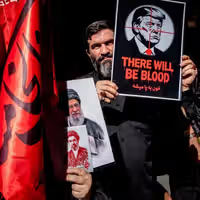
Iran’s top security body warned domestic media against positive coverage of US President Donald Trump’s talk of peace with Iran, calling it part of an enemy psychological war, according to a confidential directive seen by Iran International.

President Trump told the Israeli Knesset on Monday that Tehran was tired of war and Washington was ready for peace after US attacks on Iranian nuclear sites in June.

Hours later, Iran’s Supreme National Security Council (SNSC) sent a directive to domestic media instructing them to exercise caution in covering his remarks.

"Trump’s remarks in the parliament of the Zionist regime, along with certain claims such as pursuing peace, making a deal with Iran and attempting to influence the media environment, make it necessary for colleagues to exercise vigilance regarding the enemy’s psychological warfare."

"Any optimistic view or excitement over a possible shift in the US approach could send wrong signals abroad, harm the economy, and undermine national unity," the SNSC said, according to the directive a copy of which was obtained by Iran International.

It also urged media outlets to provide analytical coverage of Trump's remarks and not simply repeat or amplify his statements.

In a later speech in Egypt's Sharm el-Sheikh, Trump said Iran could not survive sanctions and that it would likely return to negotiations.

"I think Iran will come along. They've been battered and bruised and, you know, they're out there. They need some help. There are big sanctions, as you know, tremendous sanctions," he told reporters alongside Egypt's President Abdul Fattah al-Sisi.

"I'd love to take the sanctions off when they're ready to talk. But they can't really survive with those sanctions," he added ahead of the Middle East Peace Summit which gathered the leaders of 20 countries following a US-brokered ceasefire in Gaza.

Iran was also invited by Cairo to the summit, but declined the invitation citing the presence of Trump who ordered strikes on Iran in June and has imposed the harshest sanctions against the country.

"While favoring diplomatic engagement, neither President Pezeshkian nor I can engage with counterparts who have attacked the Iranian People and continue to threaten and sanction us," Foreign Minister Abbas Araghchi said on Sunday.

Trump says 'bully' Iran humbled, will not revive nuclear program

Oct 13, 2025, 21:40 GMT+1

US President Donald Trump said on Monday that US attacks on Iranian nuclear sites had dealt a blow to the Middle East's "bully" that convinced them not to restart the program.

Trump said Iran would now seek global reintegration and economic recovery rather than pursuing nuclear weapons. Tehran denies seeking a bomb.

“I think Iran is going to be a country that wants to get back into the world of good economies,” Trump told Fox News in Israel. “The last thing they're going to do is get into the nuclear world again, because look what it’s gotten them, and I would just have to do it again.”

“The bully of the Middle East has been taken down,” Trump said. “And I think the bully of the Middle East may very well turn out to be a very productive partner for a lot of other countries, much different than what they look like before.”

On June 13, Israel launched a surprise military strike on Iran, targeting senior military officials and key nuclear sites. The United States joined the campaign on June 22, striking Iran’s key nuclear facilities in Fordow, Natanz and Isfahan.

In response, Iran fired scores of missiles and drones toward Israel. The United States brokered a ceasefire on June 24.

“They don't have a nuclear program; it was obliterated,” Trump added. “It was those B-2 pilots and 30 Tomahawks coming in from submarines. It was complete and total obliteration.”

Trump said the administration was in touch with Iranian officials. Asked if he was speaking to Iran's President Masoud Pezeshkian, he declined to elaborate. “I don’t want to say who, but we speak to him quite often, actually."

Iran was invited to attend a peace conference in Egypt chaired by Trump, but Pezeshkian and Foreign Minister Abbas Araghchi declined.

Leaders of over 20 countries participated in the Sharm El-Sheikh Peace Summit, co-chaired by Egyptian President Abdel Fattah el-Sisi and Trump.

A troika of European powers triggered the reimposition of international sanctions on Iran last month, accusing Tehran of spurning diplomacy and nuclear inspections.

Trump reinstated the so-called "maximum pressure" campaign of US sanctions when he resumed office in January.

Under Trump’s Gaza peace plan, Israel would maintain a military presence along Gaza’s border, while an international force—composed largely of troops from Arab and Muslim nations—would oversee security inside the territory.

The United States would lead a major, internationally funded reconstruction effort in the war-ravaged enclave.

Russia will meet Iran's military needs despite UN sanctions, Lavrov says

Oct 13, 2025, 20:57 GMT+1

Russia is permitted by international law to step up military ties with Iran even after UN sanctions were reimposed last month, Foreign Minister Sergey Lavrov said on Monday.

The comments may signal stepped-up security cooperation between the two heavily-sanctioned powers deeply at odds with Washington and the West.

A troika of European powers triggered the reimposition of international sanctions on Iran last month, accusing Tehran of spurning diplomacy and nuclear inspections.

Russia and China sought to block the move at the UN Security Council on September 26 not enough member states supported their bid and the sanctions were reimposed the following day.

Asked in Moscow whether Russia would continue cooperating with Tehran on advanced military systems including the S-400 air defense system, Lavrov confirmed the relationship would advance.

“We will develop military-technical cooperation with Iran. After you noted the UN Security Council sanctions, we have no restrictions," RIA Novosti quoted Lavrov as saying.

"In full compliance with international law, we are engaged in supplying the equipment that the Islamic Republic of Iran needs.”

Iranian-designed drones have been key to Russia's war effort against Ukraine

While Iranian-designed drones have been key to Russia's war effort against Ukraine, Moscow provided little support during the brief summer war.

The two countries have signed a long-term security framework, but Russia’s restraint underscores the limits of its backing.

Earlier this month, leaked Russian defense documents indicated Iran had signed a €6 billion deal to buy 48 Su-35 fighter jets from Moscow, with deliveries expected between 2026 and 2028.

Last month, an Iranian lawmaker said Russian MiG-29 fighter jets had arrived in Iran as part of a short-term plan to bolster its air force, with more advanced Sukhoi Su-35 aircraft to follow gradually.

Iran has long sought to modernize its aging air force, which relies heavily on US-made jets purchased before the 1979 revolution and a small number of Russian and locally upgraded aircraft.

Western analysts say Iran’s request for 50 aircraft remains only partly fulfilled, with deliveries slowed by Russia’s own needs in Ukraine.

Tehran also faces vulnerability in air defenses after Israeli strikes earlier this year destroyed its last Russian-provided S-300 systems. Iran had acquired the four S-300 battalions from Russia in 2016.

'What foreign policy?': Iranians lament Tehran’s snub of Trump Gaza summit

Oct 13, 2025, 19:15 GMT+1
•
Tehran Insider

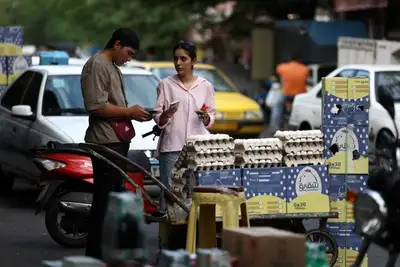
Tehran’s decision to skip a Gaza peace summit in Egypt has left many Iranians feeling further cut off from the world—another sign, they say, of leaders who mistake isolation for strength or dignity.

What might once have passed as defiance now feels like self-inflicted irrelevance, an empty gesture that deepens the country’s loneliness.

“(Foreign Minister Abbas) Araghchi said they won’t engage with those who threaten Iranians,” says my friend Sima, an emergency-room doctor. “Well, no one has harmed and threatened us like the Islamic Republic does.”

We’re sitting in a crowded café in central Tehran. The air is thick with the scent of coffee beans and the sound of drab Iranian ‘fusion’ music. Almost no woman wears a headscarf.

I started the conversation, admittedly forcing the topic. My friends were reluctant at first, wary of repeating the same hopeless arguments. But once you start bashing the Islamic Republic, you can’t stop.

“Who gave Araghchi the mandate to talk on our behalf?” Sima continues. “Did they ask us if we wanted them to go to Sharm el-Sheikh? Have they ever asked if we want to be friends or foes with the United States?”

‘Unnecessary isolation’

As glaring as the vanishing hijab is, the fact that no one whispers when politics come up—not because the state has relaxed its grip, but because more and more people are simply assuming their liberty.

“Posturing is all that’s left for them,” says my other friend Amir, a digital marketing manager. “What’s to gain from not being at the table? They’re more irrelevant than ever. Another generation has to suffer this unnecessary isolation.”

Across the table, Elham, a musician, nods. “Listen, I do care about Palestine—and not many around me do, honestly. But what these idiots do, and have been doing for decades, does nothing for the Palestinian cause. You don’t recognize Israel and then what? It’s just empty sloganeering.”

“I don’t think it’s posturing,” Sima interjects. “It’s calculated. Think of Iran as a business worth hundreds of billions. Real change means losing privilege. Why would they?”

‘They don’t want to be normal’

As we speak, I keep checking my social-media feed—with a VPN, of course. Photos from Sharm el-Sheikh flood in: Trump landing, surrounded by world leaders from Europe, the Arab world, and beyond.

For once, Iran wasn’t excluded. It excluded itself.

“They don’t want to act normal,” Amir says, agreeing with Sima, “because behaving normal might be the end of them.”

Elham adds, “Truth is, because elections aren’t free, we never even have the option to show what we want. Only those who toe Khamenei’s line get through. So we can’t even vote for someone who says: stop this madness and be a normal country.”

Her tone isn’t angry—just flat, like someone long past expecting change.

‘Nothing to lose’

Amir smiles bitterly, making it hard to gauge if he's serious or joking.

“Once Khamenei’s gone, things could change," he says. "Khamenei is nearly ninety. He’s got nothing to lose—unlike us. He wants to be remembered as the one who stayed the course. He doesn’t care that his course leads us to ruin.”

This isn’t a typical conversation in Tehran. Most people talk about rent, prices or finding medicine. But scratch the surface, and the anger spills out.

Everyone I know, in one way or another, links their daily struggles to what they see as a deluded, self-defeating foreign policy—one that isolates Iran while pretending to defend its dignity.

As Sima put it, calling this foreign policy “violates the word itself.”

Iran’s top medical official warns of looming shortage of pediatricians

Oct 13, 2025, 13:17 GMT+1

Iran will soon face a severe shortage of pediatric specialists, even in major cities, due to declining interest among general physicians in pursuing pediatric training, the head of Iran’s Medical Council warned on Sunday.

The shortage of pediatricians has reached alarming levels, said Ahmad Reza Rezaeizadeh and questioned why “general practitioners in Iran are not interested in specializing in pediatrics.” Many doctors now turn to the lucrative cosmetic field instead of entering essential specialties such as child medicine, he added.

Iran International reported on October 5 that with the rise of extreme beauty trends on social media, cosmetic surgery clinics across the country have seen a surge in demand.

Health officials have repeatedly sounded the alarm over unfilled positions in key medical disciplines. More than 80 percent of emergency medicine residencies and one-third of anesthesiology positions remain vacant, Ali Jafarian, deputy health minister said recently.

Nearly 29 percent of registered general practitioners in Iran are not practicing medicine, the state-affiliated Nour News website reported in September. Falling interest in six core specialties poses “a structural challenge to Iran’s healthcare system,” said Abbasali Rais Karami, head of Tehran University of Medical Sciences.

Budget crisis and policy failure

The shortage, Rezaeizadeh said, reflects years of policy neglect and underinvestment. “We have patients in various cities but no specialist doctors. In the past four years, the infrastructure for medical education has not been developed. We need 600 trillion rials to expand medical training capacity,” he said.

Policymakers, he warned, remain focused on the number of general physicians rather than ensuring pathways for them to enter specialist programs. “No one is thinking about the prerequisites for admitting general practitioners to specialty training,” he said.

Eghtesad24 reported last year that the lack of pediatricians had already become a major challenge across several provinces, forcing families to travel to Tehran for their children’s medical care.

Pediatric graduates have dropped to less than one percent of total medical specialists since 2017, according to the Research Center of Iran’s parliament. The trend has been worsened by an accelerating wave of emigration among Iranian doctors.

Merit-based policies were vital to retaining talent, said Health Ministry official Shahin Akhondzadeh in September, noting that “most of the top 100 university entrance exam scorers in medical fields emigrate because proper conditions are not provided for them.”