• العربية
  • فارسی
Brand
  • Iran Insight
  • Politics
  • Economy
  • Analysis
  • Special Report
  • Opinion
  • Podcast
  • Iran Insight
  • Politics
  • Economy
  • Analysis
  • Special Report
  • Opinion
  • Podcast
  • Theme
  • Language
    • العربية
    • فارسی
  • Iran Insight
  • Politics
  • Economy
  • Analysis
  • Special Report
  • Opinion
  • Podcast
All rights reserved for Volant Media UK Limited
volant media logo

Netanyahu says Iran seeks to put US in missile range

Oct 7, 2025, 11:58 GMT+1Updated: 18:17 GMT+1
US President Donald Trump greets Israeli Prime Minister Benjamin Netanyahu at the White House in Washington, DC, September 29, 2025.

Israeli Prime Minister Benjamin Netanyahu said Iran is developing long-range ballistic missiles capable of reaching the United States, warning that Tehran’s expanding weapons program poses a global security threat.

“Iran can blackmail any American city,” Netanyahu warned in an interview with Ben Shapiro, alleging that Tehran is developing intercontinental ballistic missiles with a range of 8,000 kilometers.

“People don’t believe it. Iran is developing intercontinental missiles with a range of 8,000 kilometres, add another 3,000, and they can get to the East Coast of the US.”

He said the missiles could “put New York City, Boston, Washington or Miami under their atomic guns.”

“That’s a really big danger, you don’t want to be under the nuclear gun of these people, who are not necessarily rational and chant ‘death to America,’” he added.

Netanyahu said Israel is “doing great work keeping that away,” crediting cooperation with Washington for bolstering regional defense.

He said Israel and the United States are co-developing “the most advanced offensive weapons on the planet,” and claimed Israeli intelligence had prevented attacks by ISIS, including plots against US targets.

Turning to Gaza, he said Israel is “close to the end of the war, but not there yet,” adding that “we smashed the Iranian axis with most of their proxies.”

Netanyahu said Israel’s campaign would only conclude once Hamas rule in Gaza ends and the remaining hostages are freed.

Most Viewed

Iran negotiators ordered to return after internal rift over Islamabad talks
1
EXCLUSIVE

Iran negotiators ordered to return after internal rift over Islamabad talks

2
ANALYSIS

US blockade enters murky phase as tankers spoof signals and buyers hesitate

3
ANALYSIS

Why the $100 billion Hormuz toll revenue is a myth

4

US tightens financial squeeze on Iran, warns banks over oil money flows

5
ANALYSIS

US blockade targets Iran oil boom amid regional disruption

Banner
Banner

Spotlight

  • Hardliners push Hormuz ‘red line’ as US blockade tests Iran’s leverage
    INSIGHT

    Hardliners push Hormuz ‘red line’ as US blockade tests Iran’s leverage

  • Ideology may be fading in Iran, but not in Kashmir's ‘Mini Iran'
    INSIGHT

    Ideology may be fading in Iran, but not in Kashmir's ‘Mini Iran'

  • War damage amounts to $3,000 per Iranian, with blockade set to add to losses
    INSIGHT

    War damage amounts to $3,000 per Iranian, with blockade set to add to losses

  • Why the $100 billion Hormuz toll revenue is a myth
    ANALYSIS

    Why the $100 billion Hormuz toll revenue is a myth

  • US blockade targets Iran oil boom amid regional disruption
    ANALYSIS

    US blockade targets Iran oil boom amid regional disruption

  • Iran's digital economy battered by prolonged blackout
    INSIGHT

    Iran's digital economy battered by prolonged blackout

•
•
•

More Stories

Iran says Afghan attempts to cross border illegally have doubled

Oct 7, 2025, 11:40 GMT+1

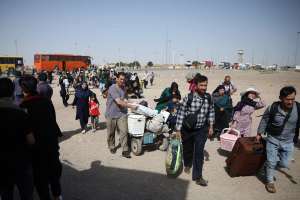
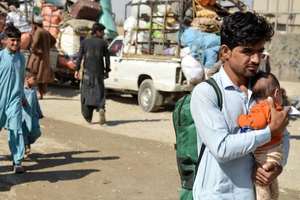
Attempts by Afghan citizens to cross illegally into Iran have doubled over the past six months compared with the same period last year, a senior Iranian border commander said, as Tehran accelerates deportations and tightens control along its frontier with Afghanistan.

Majid Shoja, border guard commander for Iran’s Khorasan Razavi province, said this week that more than 1.5 million Afghan nationals had returned to their country since the start of the Persian year in March -- triple the number from last year.

About 500,000 of them left legally after their residence permits expired, mostly through the official crossings of Dogharoun and Taybad, he said.

Shoja added that around 40,000 illegal crossings were prevented in the first half of the year, double the figure from the same period in 2024.

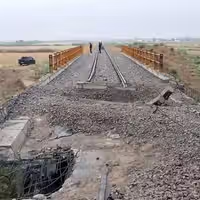
Iran, he said, is expanding its eastern border sealing project, including the construction of a 300-kilometer border wall, of which 100 kilometers have been completed, and the installation of thermal cameras, acoustic sensors, and 360-degree watchtowers.

These systems, he said, can detect movement up to 45 kilometers away and reduce reliance on manpower.

The commander described the use of advanced surveillance and what he called border diplomacy with Afghanistan and Turkmenistan as key to enhancing security and managing migration.

He also reported a 12% rise in cross-border vehicle traffic and the growing importance of the Taybad free-trade zone and the Khaf–Herat railway link for legal commerce.

  • Iran border guards kill six Afghan migrants in Sistan-Baluchestan - Haalvsh

    Iran border guards kill six Afghan migrants in Sistan-Baluchestan - Haalvsh

  • Iran expels 1.8 million Afghans, eyes 800,000 more

    Iran expels 1.8 million Afghans, eyes 800,000 more

Broader crackdown on Afghan migrants

The tighter border measures come amid a nationwide crackdown on undocumented Afghans. In late August, an Interior Ministry official said Iran had expelled 1.8 million migrants over the past year -- most of them Afghans -- and planned to deport at least 800,000 more under a new removal plan.

Rights groups have reported several deadly incidents involving Afghan migrants. On September 8, border guards in Sistan-Baluchestan province opened fire on about 120 Afghans attempting to cross, killing six and wounding five, according to the Baluch rights group Haalvsh.

  • Khamenei-linked daily says Afghan expulsions failed to curb bread prices

    Khamenei-linked daily says Afghan expulsions failed to curb bread prices

  • With post-war deportations, Afghans in Iran bear brunt of official failures

    With post-war deportations, Afghans in Iran bear brunt of official failures

Human rights monitors, including HRANA, condemned the use of heavy weapons and described the incident as a violation of international law.

The United Nations has warned that mass deportations could trigger a humanitarian crisis in Afghanistan, where the Taliban government is struggling to absorb the influx.

Tehran says its policies are aimed at enforcing immigration law and protecting its borders, insisting that Afghan migrants are treated in accordance with domestic and international norms.

Iran says US conditions for talks not formally presented

Oct 7, 2025, 09:55 GMT+1

Iran said on Tuesday it had not received any formal conditions from the United States for negotiations, after a US newspaper report said Washington had set four requirements.

“According to the foreign minister, such conditions have not been formally presented to Iran, and until that happens they cannot be seriously reviewed,” government spokeswoman Fatemeh Mohajerani told reporters in Tehran.

The Washington Post reported last week that the Trump administration wants Tehran to agree to direct and meaningful talks, end uranium enrichment, impose curbs on its missile program, and stop funding regional armed groups as the basis for any renewed diplomacy.

US officials cited in the report said the reimposition of United Nations snapback sanctions last month was meant to create the environment for a diplomatic solution.

The measures, triggered by Britain, France and Germany, restored pre-2015 sanctions covering arms transfers, financial restrictions, and missile-related activities.

  • US puts stiff peace conditions on Iran - Washington Post

    US puts stiff peace conditions on Iran - Washington Post

Iran has dismissed the new sanctions as “illegal and politically motivated,” saying they violate its right to peaceful nuclear development.

The sanctions followed a June conflict in which Israeli and US strikes targeted Iranian military and nuclear sites, killing hundreds of personnel and civilians. The 12-day war ended with a US-brokered ceasefire on June 24.

Tehran has consistently denied pursuing nuclear weapons, insisting its program is civilian in nature.

Iranian President Masoud Pezeshkian told the UN General Assembly last month that Iran remains open to dialogue but that “the wall of distrust with Washington is quite thick and quite tall.”

  • Calls for Larijani to lead nuclear talks may signal push for rethink

    Calls for Larijani to lead nuclear talks may signal push for rethink

Earlier, Iran’s Security Chief Ali Larijani said US efforts to dictate Tehran’s military and foreign policy predetermine any negotiation outcome, calling them incompatible with Iran’s sovereignty.

The two countries held indirect talks earlier this year aimed at reducing tensions over Iran’s nuclear activities, but progress stalled after the June escalation.

Analysts say the US conditions -- particularly ending enrichment and curbing missile development -- mirror past sticking points that have derailed previous rounds of diplomacy.

US will 'take to grave' wish to limit Iran's missile range, official says

Oct 7, 2025, 08:33 GMT+1

A senior Iranian official on Tuesday rejected the idea of limiting Iran’s missile program, repeating that Washington’s proposal to cut missile range was unacceptable.

“Americans will take the wish of reducing Iran’s missile range to below 500 kilometers to the grave,” Armed Forces Judiciary chief Ahmadreza Pourkhaghan said during a meeting with Revolutionary Guard aerospace commanders, according to state media.

The comments follow those of Ali Larijani, secretary of Iran’s Supreme National Security Council, who said last month that the United States had raised a proposal to cap the range at 500 kilometers. “No honorable person would accept such a condition,” he said then.

Iranian commanders have instead stressed the opposite. Last week, Mohammad Jafar Asadi of the Khatam al-Anbiya central headquarters said Tehran would extend its missiles “to wherever necessary” and insisted the country was ready to defend itself.

Iran’s missiles have a declared range of up to 2,000 kilometers, which officials say covers Israel and is sufficient for deterrence.

Pourkhaghan said Iran’s missile and drone capabilities had shifted regional conflicts. “Powerful missile and drone strikes forced the Zionist enemy to raise the white flag and ask for a ceasefire,” he said.

Two Revolutionary Guard members killed in western Iran clash

Oct 7, 2025, 08:23 GMT+1

Two members of Iran’s Revolutionary Guards were killed and three others wounded in clashes with armed militants in the western city of Sarvabad in Kordestan province, the Guards said on Tuesday.

The Beit al-Moqaddas unit in Kordestan province said the assault took place late Monday, when attackers threw a grenade at a Guard post in the town’s Hezbollah Square area.

It identified the dead as cleric Alireza Valizadeh and Ayoub Shiri, describing them as security personnel. Three others were taken to the hospital with injuries.

The unit blamed “mercenary terrorists linked to global arrogance” and said security forces were pursuing the assailants.

“The martyrdom and injury of several of the brave men of Sarvabad is proof that the security of Iran rests on the courage of selfless defenders,” the statement said. “This kind of terrorist action will never weaken our resolve to safeguard the people.”

Sources close to Kurdish parties in Iran confirmed the report to Iran International.

According to these sources, “after the grenades exploded, gunfire was heard for several minutes, but no one was injured as a result of the shooting.”

They added, “the first attack was carried out by throwing grenades, which killed two security forces, and after about an hour the clashes ended. So far, no group has claimed responsibility for the operation.”

  • Gunmen kill police officers in Iran's restive southeast

    Gunmen kill police officers in Iran's restive southeast

  • Four killed in clash between police and Jaish al-Adl gunmen in southeastern Iran

    Four killed in clash between police and Jaish al-Adl gunmen in southeastern Iran

Last month, armed men opened fire on a police vehicle in Sistan-Baluchestan province, killing at least two officers.

The provinces of Kordestan and Sistan-Baluchestan,home to ethnic Kurdish and Baluch minorities, have long seen insurgent and militant activity against Tehran.

Kordestan, bordering Iraq, is a hotspot for sporadic attacks by Kurdish armed groups seeking autonomy. In Sistan-Baluchestan, Sunni militant factions such as Jaish al-Adl have staged frequent ambushes on security forces near the Pakistan and Afghanistan borders.

Tehran blames “foreign-backed terrorists” for the unrest and has intensified security operations in both areas amid wider regional instability.

Iran rejects EU and GCC criticism over nuclear and defense issues

Oct 7, 2025, 07:51 GMT+1

Iran dismissed remarks by European Union and Gulf Cooperation Council officials who linked Tehran to regional instability and pressed it to act as a responsible power.

EU foreign policy chief Kaja Kallas said on Sunday the reactivation of UN sanctions on Iran was “a setback but not the end of diplomacy,” and called for continued dialogue to reduce tensions. Germany’s Foreign Minister Johann Wadephul accused Tehran of using Yemen’s Houthis to project destabilizing influence and said their attacks endangered Israel and international shipping.

Foreign Ministry spokesman Esmail Baghaei said on Tuesday those comments were unacceptable. “Those who reimposed restrictions on Iran and accuse us of destabilization have no right to lecture us,” he said. “It is shameful that the very parties responsible for the current situation now present themselves as accusers.”

He added that European criticism of Iran’s defense policy was misplaced. “The parties that spend hundreds of billions of dollars to turn our region into a warehouse of destructive weapons cannot question the indigenous defense capabilities of the Iranian people,” he said.