• العربية
  • فارسی
Brand
  • Iran Insight
  • Politics
  • Economy
  • Analysis
  • Special Report
  • Opinion
  • Podcast
  • Iran Insight
  • Politics
  • Economy
  • Analysis
  • Special Report
  • Opinion
  • Podcast
  • Theme
  • Language
    • العربية
    • فارسی
  • Iran Insight
  • Politics
  • Economy
  • Analysis
  • Special Report
  • Opinion
  • Podcast
All rights reserved for Volant Media UK Limited
volant media logo
INSIGHT

Tehran infighting over sanctions persists as Iranians lament ‘empty tables’

Maryam Sinaiee
Maryam Sinaiee

Iran International

Oct 3, 2025, 15:07 GMT+1Updated: 00:32 GMT+0
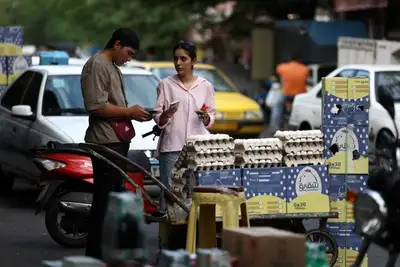
People walk and shop at Mashad's grand bazaar in northeast Iran, September 28, 2025

As Iran’s factions bicker over whether returning UN sanctions are calamitous or mere “psychological” warfare, ordinary people stare into an economic abyss.

“The worst way of living is life in suspense,” journalist Ehsan Mohammadi wrote on X, "It weighs down the human psyche.”

The business daily Donya-ye-Eqtesad reports basic food requirments now account for 63 percent of spending for those on the minimum wage, raising fears of a food security crisis. Lawmaker Soleiman Es’haghi lamented recently that many households can no longer afford rice, chicken or meat.

Hardliners, however, downplay the threat. The Kayhan daily, overseen by the Supreme Leader’s office, argued sanctions are “not as frightening as the West tries to scare Iran with,” calling their effects mostly psychological.

Economic Hardship

The line drew fire from reformists. Vocal academic Sadegh Zibakalam accused the opposite camp of being detached from reality in a sarcastic post on X.

“The revolutionaries are right: the return of sanctions is nothing new,” he wrote, “but the dollar, the rial and—more importantly—those willful prices do not understand this simple point that the hardliners correctly make.”

Prominent politician Mostafa Tajzadeh blamed the highest office in the land in a statement from Evin Prison following the punishing US-Israeli war in June.

He faulted Supreme Leader Ali Khamenei's stated “neither war nor peace” mantra as a failure on both scores, saying the policy drift now has Iranians sliding into poverty.

The rial has broken record lows several times since the return of UN sanctions on September 28, losing 15 percent of its value in less than a week.

Inflation, already near 45 percent, may exceed 90 percent, Tehran’s Chamber of Commerce warned this week, with growth turning negative and unemployment climbing into double digits.

Endless Suffering

Moderate journalist Akbar Montajabi captured the sense of collapse: “With the activation of the snapback mechanism and the return of sanctions, the shot has been fired not at diplomacy but at the dinner table of the middle and lower classes.”

Concerns are also rising about medicine shortages and price hikes. Although formally exempt from sanctions, many in the industry say drug procurement becomes inevitably harder with the secondary impact of other restrictions.

“Maybe a few cancers could be treated with nuclear medicine,” a user wrote on X, mocking official claims of medicinal use for the enrichment program. “But the same treatment would have been available without sanctions too—like in Turkey.”

Another user, posting under the name Saeed Pakdel, summed up the national mood: “All Iranians are preoccupied with the question: what will happen now?! The snapback mechanism has been activated. Every day we hear bad news of war and inflation … Result: confusion and endless suffering.”

Most Viewed

Iran negotiators ordered to return after internal rift over Islamabad talks
1
EXCLUSIVE

Iran negotiators ordered to return after internal rift over Islamabad talks

2
ANALYSIS

US blockade enters murky phase as tankers spoof signals and buyers hesitate

3
ANALYSIS

Why the $100 billion Hormuz toll revenue is a myth

4

US tightens financial squeeze on Iran, warns banks over oil money flows

5
ANALYSIS

US blockade targets Iran oil boom amid regional disruption

Banner
Banner

Spotlight

  • Hardliners push Hormuz ‘red line’ as US blockade tests Iran’s leverage
    INSIGHT

    Hardliners push Hormuz ‘red line’ as US blockade tests Iran’s leverage

  • Ideology may be fading in Iran, but not in Kashmir's ‘Mini Iran'
    INSIGHT

    Ideology may be fading in Iran, but not in Kashmir's ‘Mini Iran'

  • War damage amounts to $3,000 per Iranian, with blockade set to add to losses
    INSIGHT

    War damage amounts to $3,000 per Iranian, with blockade set to add to losses

  • Why the $100 billion Hormuz toll revenue is a myth
    ANALYSIS

    Why the $100 billion Hormuz toll revenue is a myth

  • US blockade targets Iran oil boom amid regional disruption
    ANALYSIS

    US blockade targets Iran oil boom amid regional disruption

  • Iran's digital economy battered by prolonged blackout
    INSIGHT

    Iran's digital economy battered by prolonged blackout

•
•
•

More Stories

Bus crash in northern Iran kills at least four, injures 20

Oct 3, 2025, 10:16 GMT+1

At least four people were killed and about 20 injured when a passenger bus plunged into a valley on the Damavand–Firouzkouh road in the Alborz mountains northeast of Tehran, Red Crescent chief Shahin Fathi said on Friday, according to Iranian media.

Fathi said the accident happened around 8 a.m. near the Dehkadeh Sibland complex. He said rescue teams were immediately sent to the site and that the number of victims could rise.

The road links Tehran to Mazandaran province through mountain passes and is one of the busiest intercity routes in northern Iran.

Police road chief Ahmad Karami Asad said the Scania bus, carrying 33 passengers from Qazvin to Mazandaran, overturned in the Aminabad area. He said preliminary checks suggested the driver had been tired and drowsy.

Emergency officials said two of the injured were taken to Imam Khomeini hospital in Firouzkouh, three to Som’e Shaban hospital in Damavand and three were flown by helicopter to Tehran. Other passengers were treated on site. Several of the wounded were reported to be in critical condition.

IRGC-affiliated Tasnim news agency said some passengers were trapped inside the bus before being freed by rescuers.

Road crashes have become a major public concern in Iran. The Legal Medicine Organization said in May that nearly 19,500 people died in traffic accidents in the last Iranian year, most of them on intercity highways. Official data show more than 20,000 deaths were recorded the year before, the highest toll in 12 years.

At least 26 students have died in 13 accidents involving university buses across Iran over the past decade, the daily Ham-Mihan reported this week, reviving concerns about road safety and vehicle standards.

It's the economy, donkey!

Oct 2, 2025, 19:28 GMT+1
•
Kambiz Hosseini

With Iran's rial hitting fresh depths daily amid new international sanctions, it's helpful to remember how the Islamic Republic's founder viewed the economy. The late theocrat famously said it's for the donkeys.

Half a century ago, Ayatollah Ruhollah Khomeini dismissed economics as trivial. “Those who see the economy as the foundation of everything—they see man as an animal,” he said. “An animal’s foundation is its economy."

"A donkey’s foundation, too, is its economy.” 

The words were meant as a rebuke to materialism, a call to put ideology and faith above worldly matters. But today, with the rial in free fall, his words feels prophetic. If the economy was fit only for donkeys, the donkey has finally brayed back.

In Iran, the value of money is measured in hours, not days. A few decades ago, a paycheck might last a week. Today, it barely stretches through the weekend. By Monday, the cash in your pocket feels lighter, not because you spent it, but because it has already lost its worth.

The rial, Iran’s national currency, has been devalued so many times that it now flutters like a useless note in the wind. Days after the reimposition of UN snapback sanctions, it trades on Iran's black market at a new low of more than 1.18 million rials to the US dollar.

The rial is no longer currency; it is confession: a declaration that the state has failed to keep its promise to protect the value of people’s lives.

A Broken Machine

Iran’s economic malaise is neither sudden nor accidental. The collapse of the rial is the product of a machine designed to fail: decades of chronic budget deficits, an overreliance on oil, institutional corruption and a governing class that treats money as both tool and weapon.

When oil revenues fall, the state reaches instinctively for the central bank, borrowing and printing money without backing.

Inflation rises; the rial weakens. Banks offer interest rates that lag far behind inflation, eroding public trust. Who, then, would save in rials? Instead, households convert earnings into safer stores of value: gold coins, real estate, US dollars.

Sanctions, too, are the invisible hand pushing Iran’s economy down. Restrictions on oil exports and banking channels cut the country off from hard currency.

Each new penalty, each geopolitical flare-up—whether a US Treasury announcement or a skirmish in the Strait of Hormuz, triggers panic. People rush to buy dollars, and the cycle repeats.

The market itself has become a theater of fear. A small uptick in the dollar can unleash a stampede. Rumors spread faster than official statements. In the currency shops of Tehran, the mere sight of a crowd can turn hesitation into frenzy.

Corruption by Design

If panic is the fuel of this collapse, corruption is its engine. Iran’s multi-tiered exchange-rate system all but invites abuse. Those with political connections receive dollars at subsidized “official” rates.

Some import nothing at all; others flip their cheap dollars on the black market. Either way, fortunes are made. The public pays the price.

This dual economy—one rate for the powerful, another for the powerless—has created a new class of profiteers: the sanctioned, the middlemen, the “dollar kings.” They thrive on scarcity. Every collapse in the rial fattens their accounts.

The Human Ledger

The first line of casualties runs straight through the Iranian kitchen. Rice, meat and fruit—staples of family meals—climb in price by the week.

Medicine, though never formally sanctioned, becomes unaffordable as the exchange rate pushes drugs beyond reach. A prescription that cost ten dollars last year now devours an entire month’s salary.

Rents rise, transportation costs surge, fuel becomes scarce. Savings—those careful stacks of rials stored for weddings, tuition or emergencies—melt like ice left on a Tehran rooftop in a hot summer.

Small manufacturers and workshops, unable to plan around daily price swings, shutter their doors. The result is a slow bleed of jobs, dignity and trust.

What remains is despair.

Young entrepreneurs who once dreamed of building companies now dream only of leaving. Pensioners find their stipends shredded by inflation. Families count coins at night and wonder how to stretch them through the morning.

Winners and Losers

The gulf between winners and losers is vast. On one side are exporters of oil, petrochemicals and metals. Every dollar they earn abroad multiplies when converted into rials.

They are joined by speculators and brokers who treat volatility as opportunity, buying and selling on rumor. And above them, perched like hawks, are those closest to power—officials and insiders who profit from the state’s controlled currencies and the rents they generate.

On the other side is everyone else. Office clerks, teachers and factory workers watch their wages dissolve.

Pensioners shrink under inflation’s weight. Small producers collapse under the cost of imported materials. Patients forgo medicine. Children see parents’ hopes dim.

The Donkey’s Reckoning

The fall of the rial is often described in the language of catastrophe—an earthquake, a storm, a collapse. But unlike those, it is no act of nature. It is a man-made disaster, engineered by structural weakness, amplified by sanctions and perpetuated by fear.

There is a cruel symmetry to it: the winners are narrow and known, the losers broad and nameless. The gains of exporters, speculators and power brokers stand in direct proportion to the losses of the public. The more the rial falls, the higher the profits for those at the top.

In the end, Khomeini’s sneer at economics has come to define the very fate of the Islamic republic he built. To treat the economy as beneath concern is to condemn it to ruin. To deride bread and butter as donkey’s business is to ensure that ordinary people bear the burden of hunger.

The rial’s collapse is not just an economic fact; it is a political one. It testifies to the bankruptcy of a system that equates survival with endurance, not prosperity. It reminds Iranians that in their country, profit flows upward, into the pockets of the few, while loss is spread thinly but cruelly across the many.

And it leaves them with a bitter lesson: you can mock the donkey all you want, but when the donkey finally collapses, it takes the cart with it.

Iran talks down war fears but US deployments stir anxiety

Oct 2, 2025, 17:20 GMT+1
•
Maryam Sinaiee

Iranian officials are downplaying talk of another war with Israel and the United States but US carrier and tanker movements have sparked anxiety as weary citizens weigh readiness for a possible re-run of a punishing summer war.

Mohammad-Jafar Ghaempanah, the President’s executive deputy, told reporters after a cabinet meeting on Wednesday that Iran is “fully prepared” for any new war, though he judged it unlikely Iran's foes would “repeat the mistake”.

Ali Saeedi, head of the Supreme Leader’s Ideological-Political Office, told state media he “could not give a clear answer” on whether war will come.

“The armed forces must be fully prepared, but people should continue their lives and should not be inflamed. At present, we do not observe signs of an enemy attack.”

Flight tracking data over the weekend showed a rapid deployment of aerial refueling craft to the Al Udeid airbase in Qatar, the largest American military installation in the region.

The last large-scale movement of such assets coincided with surprise US and Israeli attacks on Iran in a brief June war. That conflict sent tens of thousands of Iranian civilians heeding Israeli warnings to flee major urban areas. Hundreds were killed.

Open-source satellite imagery and flight tracking date shows the USS Nimitz aircraft carrier and its attendant aircraft operating in the Persian Gulf and docked at Dubai's Jebel Ali port as of last month. Such port calls are largely routine.

Behnam Saeedi, secretary of parliament’s National Security Committee, rejected a link between snapback of UN sanctions and war: “Whether a war restarts or not, in the current circumstances, it has nothing to do with the snapback.”

Still, he described the situation as “not a ceasefire but a suspension of combat operations.”

Military posture: beefing up deterrence

Nour News, a news outlet close to Iran's mercurial ex-security boss Ali Shamkhani, on Tuesday framed new US deployments as a “political message” of support to regional allies and a warning to Iran that the military option is still on the table.

Chief of the General Staff Major-General Amir Mousavi declared the Army and the Revolutionary Guards maintain “extraordinary readiness for a possible future clash.”

Brigadier General Mohammad-Jafar Asadi of the Khatam al-Anbiya headquarters promised Iran would “increase the range of its missiles as far as necessary,” while maintaining that Tehran “will not initiate a war but will give a decisive response to any aggression.”

Competing calculations: low or high risk?

Journalist Hossein Yazdi assessed the probability of renewed large-scale strikes as low. He argued Iran’s nuclear sites, already hit, have not been rebuilt; Israel has extracted its revenge; and the US would likely block further escalation.

“The military phase is over,” he wrote on X, suggesting Israel is now using psychological pressure to sap Iran’s economy.

But others warn that the prospect of strikes are high.

“If you think that the deployment of this volume of armaments, refueling aircraft, fighter jets, and so on by America is random, accidental, or merely for the sake of creating fear and intimidation, congratulations," writer Mohammad-Reza Mohajer posted on X. "You are extremely optimistic, and no other event can destroy this optimism in you."

Political analyst Ali Nasri called endless speculation corrosive: “Keeping society continually struggling to ‘predict’ or ‘await’ a military attack is itself a tool of psychological warfare and collective torture of the Iranian people."

"It aims to further damage the economy and disrupt life. If there is a war, we will respond proportionately," he added on X. "For now, our challenge as citizens is to continue ordinary life.”

Street-level voices: fear, anger, fatigue

Signals of potential conflict are already being priced in Iran's moribund markets.

The rial and gold have reacted, with the dollar rate again breaking records against the prone rial and gold hitting new highs. On social media, frustration dominates.

One user lamented: “Instead of enjoying the weekend, everyone I meet talks about war and the dollar and the misery the clerics have given us!”

Another wrote: “Dollar, sanctions and the possibility of war — I really have no strength left to continue.”

Iran's rial dips to 1.18 million per dollar following UN sanctions snapback

Oct 2, 2025, 13:46 GMT+1

Iran’s rial weakened on Thursday to about 1,180,000 per US dollar on Tehran’s unofficial market, roughly a week after the United Nations reimposed snapback sanctions, as President Masoud Pezeshkian urged cost-cutting and efficiency to shield households.

Traders also quoted the euro around 1,386,500 rials and the pound at about 1,591,200.

The UN measures, restored over Iran’s nuclear program, have added pressure to an economy already struggling with high inflation and repeated supply strains. Iran denies seeking nuclear weapons.

Visiting Bandar Abbas on Thursday, Pezeshkian said savings and better management could soften the blow.

“We can organize livelihoods, living conditions and housing by saving 10% in costs, which is equivalent to $16–18 billion a year,” he said.

“They say with snapback, they will sanction you, while we have sanctioned ourselves,” he added, arguing that curbing waste and relying less on oil and gas would blunt external pressure.

“They scare us with snapback because we tied our life to oil and gas,” he said. “I think of a day when we have neither oil nor gas. Should we die?”

The president called for practical conservation across government. He said employees and managers could work in smaller offices and avoid unnecessary energy use, recalling that at the United Nations “the corridor was partitioned and managers worked there in 2-by-3 rooms, next to the Secretary-General’s office. In Iran, everyone has a room, and the secretary has a room. You can avoid keeping all the lights on.”

Denial dominates Iran’s parliament, but sanctions toll hard to ignore

Oct 2, 2025, 08:19 GMT+1
•
Behrouz Turani

While Iran’s hardline-led parliament resounds with defiant statements dismissing the impact of new UN sanctions, a few lawmakers are beginning to admit the likely economic toll.

Independent MP Hamid Reza Goudarzi broke ranks on Wednesday, saying the so-called snapback of measures halted under the 2015 nuclear deal has “damaged Iran’s economy.”

His remarks drew sharp criticism from colleagues but resonated with many outside parliament who are struggling with higher prices and a collapsing currency.

The rial, which hovered around one million to the US dollar before the sanctions’ return, surged past 1,160,000 by midday Wednesday, a new low. Food and basic staples are increasingly out of reach.

Another moderate MP, Salman Eshaghi, lamented the strain on his constituents in eastern Iran: “People can no longer afford meat, chicken, rice and other staples,” he said, urging the judiciary to summon local and national officials over the price hikes.

But the dominant voices in the Majles remain combative.

‘They want riots’

Vahid Ahmadi, a member of the National Security and Foreign Relations Committee, dismissed the currency crash as a “psychological” effect.

“Nothing has happened as a result of the snapback,” he insisted. “The rise in exchange rates has no economic reason.”

Ahmadi argued that sanctions were simply a continuation of war by other means: “The 12-day war against Iran was intended to trigger regime change and national disintegration. Now that our enemies have failed and begged for a ceasefire, they aim to confront the Islamic Republic through snapback sanctions.”

Another senior MP Ahmad Rastineh echoed this line: “the snapback is designed to incite riots in Iran,” he asserted. “We seek the destruction of Israel, and we will continue to pursue that goal.”

Cracks in hardline narrative?

Hossein Ali Haji Deligani, notorious for his incendiary remarks, took it a step further.

“The European troika is a slave and servant of the United States,” he said. “It is not in Iran’s interest to remain in the 2015 nuclear deal or the Non-Proliferation Treaty.”

Many interpreted this as an open call to review Iran’s nuclear doctrine, edging toward weaponization.

Such hardline voices dominate Iran’s parliament, but cracks are widening as economic pressure intensifies.

Hossein Samsami, an MP for Tehran, tied rising prices directly to the collapsing exchange rate, contradicting colleagues who blamed foreign plots or “psychology.”

The fact that even conservative outlets like the Students News Network are publishing such remarks shows how far the looming crisis has pushed officials: denial still dominates, but moments of candor are breaking through.