• العربية
  • فارسی
Brand
  • Iran Insight
  • Politics
  • Economy
  • Analysis
  • Special Report
  • Opinion
  • Podcast
  • Iran Insight
  • Politics
  • Economy
  • Analysis
  • Special Report
  • Opinion
  • Podcast
  • Theme
  • Language
    • العربية
    • فارسی
  • Iran Insight
  • Politics
  • Economy
  • Analysis
  • Special Report
  • Opinion
  • Podcast
All rights reserved for Volant Media UK Limited
volant media logo
OPINION

It's the economy, donkey!

Kambiz Hosseini
Kambiz Hosseini

Host of nightly show The Program

Oct 2, 2025, 19:28 GMT+1Updated: 00:32 GMT+0

With Iran's rial hitting fresh depths daily amid new international sanctions, it's helpful to remember how the Islamic Republic's founder viewed the economy. The late theocrat famously said it's for the donkeys.

Half a century ago, Ayatollah Ruhollah Khomeini dismissed economics as trivial. “Those who see the economy as the foundation of everything—they see man as an animal,” he said. “An animal’s foundation is its economy."

"A donkey’s foundation, too, is its economy.” 

The words were meant as a rebuke to materialism, a call to put ideology and faith above worldly matters. But today, with the rial in free fall, his words feels prophetic. If the economy was fit only for donkeys, the donkey has finally brayed back.

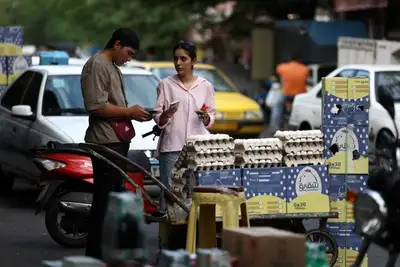
In Iran, the value of money is measured in hours, not days. A few decades ago, a paycheck might last a week. Today, it barely stretches through the weekend. By Monday, the cash in your pocket feels lighter, not because you spent it, but because it has already lost its worth.

The rial, Iran’s national currency, has been devalued so many times that it now flutters like a useless note in the wind. Days after the reimposition of UN snapback sanctions, it trades on Iran's black market at a new low of more than 1.18 million rials to the US dollar.

The rial is no longer currency; it is confession: a declaration that the state has failed to keep its promise to protect the value of people’s lives.

A Broken Machine

Iran’s economic malaise is neither sudden nor accidental. The collapse of the rial is the product of a machine designed to fail: decades of chronic budget deficits, an overreliance on oil, institutional corruption and a governing class that treats money as both tool and weapon.

When oil revenues fall, the state reaches instinctively for the central bank, borrowing and printing money without backing.

Inflation rises; the rial weakens. Banks offer interest rates that lag far behind inflation, eroding public trust. Who, then, would save in rials? Instead, households convert earnings into safer stores of value: gold coins, real estate, US dollars.

Sanctions, too, are the invisible hand pushing Iran’s economy down. Restrictions on oil exports and banking channels cut the country off from hard currency.

Each new penalty, each geopolitical flare-up—whether a US Treasury announcement or a skirmish in the Strait of Hormuz, triggers panic. People rush to buy dollars, and the cycle repeats.

The market itself has become a theater of fear. A small uptick in the dollar can unleash a stampede. Rumors spread faster than official statements. In the currency shops of Tehran, the mere sight of a crowd can turn hesitation into frenzy.

Corruption by Design

If panic is the fuel of this collapse, corruption is its engine. Iran’s multi-tiered exchange-rate system all but invites abuse. Those with political connections receive dollars at subsidized “official” rates.

Some import nothing at all; others flip their cheap dollars on the black market. Either way, fortunes are made. The public pays the price.

This dual economy—one rate for the powerful, another for the powerless—has created a new class of profiteers: the sanctioned, the middlemen, the “dollar kings.” They thrive on scarcity. Every collapse in the rial fattens their accounts.

The Human Ledger

The first line of casualties runs straight through the Iranian kitchen. Rice, meat and fruit—staples of family meals—climb in price by the week.

Medicine, though never formally sanctioned, becomes unaffordable as the exchange rate pushes drugs beyond reach. A prescription that cost ten dollars last year now devours an entire month’s salary.

Rents rise, transportation costs surge, fuel becomes scarce. Savings—those careful stacks of rials stored for weddings, tuition or emergencies—melt like ice left on a Tehran rooftop in a hot summer.

Small manufacturers and workshops, unable to plan around daily price swings, shutter their doors. The result is a slow bleed of jobs, dignity and trust.

What remains is despair.

Young entrepreneurs who once dreamed of building companies now dream only of leaving. Pensioners find their stipends shredded by inflation. Families count coins at night and wonder how to stretch them through the morning.

Winners and Losers

The gulf between winners and losers is vast. On one side are exporters of oil, petrochemicals and metals. Every dollar they earn abroad multiplies when converted into rials.

They are joined by speculators and brokers who treat volatility as opportunity, buying and selling on rumor. And above them, perched like hawks, are those closest to power—officials and insiders who profit from the state’s controlled currencies and the rents they generate.

On the other side is everyone else. Office clerks, teachers and factory workers watch their wages dissolve.

Pensioners shrink under inflation’s weight. Small producers collapse under the cost of imported materials. Patients forgo medicine. Children see parents’ hopes dim.

The Donkey’s Reckoning

The fall of the rial is often described in the language of catastrophe—an earthquake, a storm, a collapse. But unlike those, it is no act of nature. It is a man-made disaster, engineered by structural weakness, amplified by sanctions and perpetuated by fear.

There is a cruel symmetry to it: the winners are narrow and known, the losers broad and nameless. The gains of exporters, speculators and power brokers stand in direct proportion to the losses of the public. The more the rial falls, the higher the profits for those at the top.

In the end, Khomeini’s sneer at economics has come to define the very fate of the Islamic republic he built. To treat the economy as beneath concern is to condemn it to ruin. To deride bread and butter as donkey’s business is to ensure that ordinary people bear the burden of hunger.

The rial’s collapse is not just an economic fact; it is a political one. It testifies to the bankruptcy of a system that equates survival with endurance, not prosperity. It reminds Iranians that in their country, profit flows upward, into the pockets of the few, while loss is spread thinly but cruelly across the many.

And it leaves them with a bitter lesson: you can mock the donkey all you want, but when the donkey finally collapses, it takes the cart with it.

Most Viewed

Iran negotiators ordered to return after internal rift over Islamabad talks
1
EXCLUSIVE

Iran negotiators ordered to return after internal rift over Islamabad talks

2
ANALYSIS

US blockade enters murky phase as tankers spoof signals and buyers hesitate

3
ANALYSIS

Why the $100 billion Hormuz toll revenue is a myth

4

US tightens financial squeeze on Iran, warns banks over oil money flows

5
ANALYSIS

US blockade targets Iran oil boom amid regional disruption

Banner
Banner

Spotlight

  • Hardliners push Hormuz ‘red line’ as US blockade tests Iran’s leverage
    INSIGHT

    Hardliners push Hormuz ‘red line’ as US blockade tests Iran’s leverage

  • Ideology may be fading in Iran, but not in Kashmir's ‘Mini Iran'
    INSIGHT

    Ideology may be fading in Iran, but not in Kashmir's ‘Mini Iran'

  • War damage amounts to $3,000 per Iranian, with blockade set to add to losses
    INSIGHT

    War damage amounts to $3,000 per Iranian, with blockade set to add to losses

  • Why the $100 billion Hormuz toll revenue is a myth
    ANALYSIS

    Why the $100 billion Hormuz toll revenue is a myth

  • US blockade targets Iran oil boom amid regional disruption
    ANALYSIS

    US blockade targets Iran oil boom amid regional disruption

  • Iran's digital economy battered by prolonged blackout
    INSIGHT

    Iran's digital economy battered by prolonged blackout

•
•
•

More Stories

US puts stiff peace conditions on Iran - Washington Post

Oct 2, 2025, 16:01 GMT+1

Washington is seeking stiff concessions from Iran for any peace deal, the Washington Post reported on Thursday citing a US official, including curbs to its missile program and support for armed allies in the region.

The United States wants Tehran to commit to direct talks with the United States, ending uranium enrichment, curbing its missile program and ending funding for its armed affiliated in the Middle East, the newspaper cited the official as saying.

European-triggered international sanctions were reimposed on Tehran over the weekend as a standoff over Iran's nuclear activities lingers despite Israeli and US attacks in June which US President Donald Trump says "obliterated" Iran's program.

According to the US official cited by the Post, the so-called snapback sanctions will “create the environment” for “a diplomatic solution."

Tehran denies seeking a bomb and has called the new sanctions an illegal attempt to violate its sovereignty and end enrichment activities permitted by international law.

On Wednesday, Iran's security chief Ali Larijani said US attempts to dictate its military capabilities, foreign policy and nuclear rights were unacceptable and anticipated the outcome of any talks before they had even began.

The Trump administration and Tehran held two months of talks earlier this year to reach an agreement on Iran's disputed nuclear program.

But the day after Trump's 60-day deadline passed, Israel launched a surprise attack on Iran on June 13, striking military and nuclear facilities as well as senior commanders and officials.

Hundreds of military personnel and civilians were killed. Iran retaliated with ballistic missiles and drones which killed 31 Israeli civilians and an off-duty soldier.

On June 22, the US joined the campaign, hitting three major nuclear sites in Isfahan, Fordow, and Natanz, which President Trump said destroyed Iran’s capacity to build a nuclear bomb.

A ceasefire was brokered by the United States on June 24, ending the 12-day war.

Arab caution

Tensions remain high in the region, especially after a failed Israeli attempt to assassinate senior Hamas officials based in Qatar last month.

A senior Arab government official close to the Trump administration cited by the Post cautioned against a continuing cycle of violence.

“The region today cannot go through the same Iranian-Israeli war or the other wars of the last two years. The cost is too high,” the daily quoted the official as saying, adding “de-escalation” and "diplomacy has to be the way forward".

Since the ceasefire, the United Kingdom, France, and Germany in August have pushed Iran to enter direct negotiations with the US and fully cooperate with the International Atomic Energy Agency (IAEA). Iran, however, had suspended cooperation in response to the attacks.

The three European powers warned that if Iran refused, they would trigger the return of UN sanctions under a UN resolution codifying a now mostly lapsed 2015 nuclear deal. Those sanctions are now in force.

The new sanctions further strained Iran’s already fragile economy. Oil exports, the country’s main source of revenue, have faced renewed restrictions, threatening foreign currency earnings.

The Iranian rial has continued to lose value against the dollar, pushing inflation higher and worsening the cost of living crisis. International banking channels remain largely closed to Iran, hampering trade and investment.

Iran's rial dips to 1.18 million per dollar following UN sanctions snapback

Oct 2, 2025, 13:46 GMT+1

Iran’s rial weakened on Thursday to about 1,180,000 per US dollar on Tehran’s unofficial market, roughly a week after the United Nations reimposed snapback sanctions, as President Masoud Pezeshkian urged cost-cutting and efficiency to shield households.

Traders also quoted the euro around 1,386,500 rials and the pound at about 1,591,200.

The UN measures, restored over Iran’s nuclear program, have added pressure to an economy already struggling with high inflation and repeated supply strains. Iran denies seeking nuclear weapons.

Visiting Bandar Abbas on Thursday, Pezeshkian said savings and better management could soften the blow.

“We can organize livelihoods, living conditions and housing by saving 10% in costs, which is equivalent to $16–18 billion a year,” he said.

“They say with snapback, they will sanction you, while we have sanctioned ourselves,” he added, arguing that curbing waste and relying less on oil and gas would blunt external pressure.

“They scare us with snapback because we tied our life to oil and gas,” he said. “I think of a day when we have neither oil nor gas. Should we die?”

The president called for practical conservation across government. He said employees and managers could work in smaller offices and avoid unnecessary energy use, recalling that at the United Nations “the corridor was partitioned and managers worked there in 2-by-3 rooms, next to the Secretary-General’s office. In Iran, everyone has a room, and the secretary has a room. You can avoid keeping all the lights on.”

Iran signals ‘strategic patience’ after rejecting latest US proposal - IRNA

Oct 2, 2025, 09:55 GMT+1

Iran is adopting a policy of “strategic patience” in response to mounting Western pressure, the government's news agency IRNA said on Thursday, after Foreign Minister Abbas Araghchi returned from talks in New York.

Araghchi told CNN this week that negotiations with Washington under the current conditions amounted to “a total deadlock,” citing what Tehran calls repeated breaches of commitments by the United States.

He said UN sanctions reimposed under the snapback mechanism had made diplomacy more complicated and difficult.

The IRNA analysis said Iran and the United States, since Donald Trump’s return to the White House in January, had moved between dialogue and confrontation.

Initial indirect talks mediated through Oman and Qatar saw US envoy Steve Witkoff float limited enrichment proposals, but Washington later demanded zero enrichment and the handover of enriched uranium stockpiles.

Iran has strongly rejected US demands, a stance underscored by Supreme Leader Ali Khamenei in a televised address just before President Masoud Pezeshkian’s speech to the UN General Assembly.

  • Khamenei’s reversal on secret US talks hamstrings president at UN

    Khamenei’s reversal on secret US talks hamstrings president at UN

Echoing that line, Ali Larijani, secretary of Iran’s Supreme National Security Council, said on Thursday that Western powers were not seeking genuine negotiations but aimed to exploit economic and security pressure. “Western governments see economic pressure as a tool to trigger unrest and weaken Iran,” he said.

Pezeshkian also rejected those terms, saying: “Why should we give them our enriched uranium? For what reason? If there is to be dialogue, it must be about the whole issue. Otherwise this is not negotiation; this is surrender.”

Government spokesperson Fatemeh Mohajerani said on Wednesday that, according to Araghchi, Iran had expressed readiness in New York to hold a meeting with the three European countries, the International Atomic Energy Agency and US envoy Steve Witkoff, but the proposal was either rejected or the counterparts failed to attend.

Mistrust deepens after June conflict

IRNA said Tehran views US demands as unilateral impositions and believes the American approach has aligned with Israel’s military campaign against Iran earlier this year.

The agency added that Israel’s 12-day conflict with Iran in June, joined briefly by US forces, was seen in Tehran as “a shot at diplomacy” that reinforced mistrust.

Citing Iranian officials, IRNA said Washington most recently offered to delay snapback sanctions by three, then nine, and finally 12 months in return for a halt to enrichment and the transfer of uranium stocks.

Tehran rejected the plan, with Pezeshkian calling it “excessive and coercive.”

  • G7 blames Iran for renewed sanctions, urges immediate US talks

    G7 blames Iran for renewed sanctions, urges immediate US talks

  • Sanctions response betrays Tehran's entrenched divides, policy drift

    Sanctions response betrays Tehran's entrenched divides, policy drift

Tehran mulling over response

The analysis said Iran’s immediate response is likely to be guided by the Supreme National Security Council, with possible measures including suspending the “Cairo Agreement” with the International Atomic Energy Agency.

While exit from the Nuclear Non-Proliferation Treaty was described as unlikely, IRNA said Iran would continue to rely on “resistance economics,” closer ties with non-Western partners such as China and Russia, and selective diplomacy.

  • EU revives bans on Iran’s oil, banking and transport sectors after UN snapback

    EU revives bans on Iran’s oil, banking and transport sectors after UN snapback

The government is scheduled to approve a response plan to the UN snapback sanctions on Sunday, Mohajerani said on Wednesday, adding the strategy assigns ministries tasks to ease public pressure.

“Tehran currently sees the solution in adopting strategic patience until the West changes course or the playing field shifts,” the agency wrote. It added that success would depend on domestic economic reforms, unity at home, and stronger backing from non-Western allies.

US attorney says clients deported to Iran without due process - ABC News

Oct 2, 2025, 09:06 GMT+1

An attorney representing two Iranian nationals alleged on Wednesday that US authorities deported his clients to Iran without due process, placing them at risk of persecution, ABC News reported.

Ali Herischi, who represents several Iranians seeking asylum in the United States, told ABC News that two of his clients “disappeared” from the Immigration and Customs Enforcement (ICE) detainee locator system this week and were then deported to Iran.

He said one of them is a Christian convert who had arrived at the southern border earlier this year with his pregnant wife.

“We tried multiple times to ask for his appeal,” Herischi said. “And suddenly, without any information, we realized that he disappeared from [the ICE] detainee locator and then the news broke that Iranians had been deported back to Iran.”

Herischi said his client’s wife, who recently gave birth and remains in the United States, was able to briefly speak with her husband after his deportation. According to Herischi, the man told her that he was “shackled and handcuffed all the way to Iran.”

The attorney called the deportations “unconscionable,” adding, “It was so wrong, and unfortunately these are the same people that … US foreign policy tries to protect. These are those who stand up against the regime, who pay a price for standing up against the regime, and then you give them back directly to the hand of evil.”

ABC News reported that Herischi represents 25 people who are worried about being deported to Iran.

  • US deports over 100 Iranians in rare deal with Tehran - NYT

    US deports over 100 Iranians in rare deal with Tehran - NYT

Earlier this week, Iranian state media quoted an official as saying about 120 Iranian nationals detained in the US would be returned in the coming days.

The New York Times reported on Tuesday that a chartered US flight carrying more than 100 Iranians departed Louisiana and was scheduled to arrive in Tehran via Qatar.

Iranian officials confirmed that 120 citizens are being repatriated, some voluntarily, while others had asylum claims denied.

For decades, the US has provided refuge to Iranians fleeing political or religious persecution. Human rights advocates warn that returnees -- including converts to Christianity, dissidents and activists -- could face serious risks on arrival in Iran.

Turkey freezes assets linked to Iran’s nuclear program

Oct 2, 2025, 01:55 GMT+1

Turkey has frozen the assets of dozens of individuals and entities tied to Iran’s uranium enrichment and nuclear activities, moving in lockstep with the latest UN sanctions against Tehran.

The decision, signed by President Recep Tayyip Erdogan, extends to organizations across Iran’s energy, shipping, banking, and research sectors.

The Atomic Energy Organization of Iran, Bank Sepah and several firms involved in nuclear fuel production and uranium conversion are among the most significant entities blacklisted by Ankara.

Other sanctioned entities include Isfahan Nuclear Fuel Research and Production Center (NFRPC), Isfahan Nuclear Technology Center (ENTC), First East Export Bank, Irano Hind Shipping Company, IRISL Benelux NV, Jaber Ibn Hayyan, Karaj Nuclear Research Center, Kavoshyar Company, Mesbah Energy Company, Modern Industries Technique Company, Novin Energy Company, Agriculture and Medical Nuclear Research Center, Pars Trash Company, Pishgam Energy Industries, South Shipping Line Iran and Tamas Company.

The decision was made official on Wednesday when it was published in Turkey’s Official Gazette — the government’s legal record of new laws and decrees.

The measure updates earlier Turkish actions from 2006, 2015, and 2021 that implemented United Nations Security Council resolutions on Iran.

The latest decree underscores Ankara’s alignment with a renewed global pressure campaign targeting Tehran’s nuclear ambitions.

The coordinated steps follow the United Nations’ recent reimposition of sanctions against Tehran through the so-called snapback mechanism.

The sanctions had been lifted under the 2015 nuclear deal, but European powers triggered the mechanism citing Tehran’s failure to comply with its obligations.

  • G7 blames Iran for renewed sanctions, urges immediate US talks

    G7 blames Iran for renewed sanctions, urges immediate US talks

Turkey’s decision to free Iran’s assets signaled its support for the broader international effort to contain Iran’s nuclear and military programs, even as Ankara maintains complex trade and diplomatic ties with its eastern neighbor.