• العربية
  • فارسی
Brand
  • Iran Insight
  • Politics
  • Economy
  • Analysis
  • Special Report
  • Opinion
  • Podcast
  • Iran Insight
  • Politics
  • Economy
  • Analysis
  • Special Report
  • Opinion
  • Podcast
  • Theme
  • Language
    • العربية
    • فارسی
  • Iran Insight
  • Politics
  • Economy
  • Analysis
  • Special Report
  • Opinion
  • Podcast
All rights reserved for Volant Media UK Limited
volant media logo

Verdict nears for British couple detained in Iran as diplomacy sours

Oct 2, 2025, 18:34 GMT+1Updated: 00:32 GMT+0
Lindsay and Craig Foreman are seen traveling in Iran in this file photo.

A verdict looms for a British tourist couple tried in Iran over the weekend on espionage charges just as Tehran's relations with London plumb new lows over a European move to impose new international sanctions.

Lindsay and Craig Foreman, from East Sussex, were arrested during a motorcycle world tour in January and accused of spying - allegations they deny.

Lindsay's son Joe Bennett said the pair made a court appearance on Saturday and that a verdict was expected within days.

"Although they're mentally resilient, I think their physical health is really starting to suffer," he was quoted as saying by BBC Radio 4. Their family is "exhausted", he added, and "terrified by what may come next".

"I have nightmares thinking about how Mum and Craig can possibly be coping with this injustice, hearing false accusations, feeling helpless to be able to defend themselves, knowing that their words have been mistranslated," he added.

A UK Foreign Office representative was not allowed to attend the couple's Tehran trial on Saturday, the Guardian reported on Thursday, citing their family.

Critics and rights groups have long accused Tehran of engaging in so-called hostage diplomacy by detaining foreigners in exchange for jailed nationals abroad or economic and political concessions.

Iran denies the accusations and says it faces Israeli and Western intelligence infiltration.

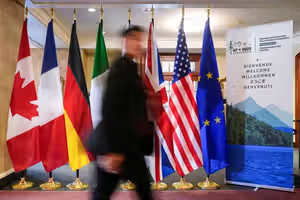
France, the United Kingdom and Germany last month triggered the resumption of long dormant international sanctions on Iran which took effect over the weekend, accusing Tehran of evading its nuclear inspections. Iran denies seeking a bomb.

Three French nationals also remain in Iranian custody. Two of them, Cécile Kohler and Jacques Paris, were detained in May 2022. Iran's state TV aired a confession from the pair in October of that year in which they admitted spying charges.

Rights advocates say they are being held in torture-like conditions in Iran's Evin prison and that authorities routinely extract false admissions through physical and emotional pressure.

The last prisoner swap between Iran and a European country came when Italy freed an Iranian national wanted by the United States for allegedly supplying Tehran with drone technology in exchange for an accredited Italian journalist arrested in Iran.

Most Viewed

Iran negotiators ordered to return after internal rift over Islamabad talks
1
EXCLUSIVE

Iran negotiators ordered to return after internal rift over Islamabad talks

2
ANALYSIS

US blockade enters murky phase as tankers spoof signals and buyers hesitate

3
ANALYSIS

Why the $100 billion Hormuz toll revenue is a myth

4

US tightens financial squeeze on Iran, warns banks over oil money flows

5
ANALYSIS

US blockade targets Iran oil boom amid regional disruption

Banner
Banner

Spotlight

  • Hardliners push Hormuz ‘red line’ as US blockade tests Iran’s leverage
    INSIGHT

    Hardliners push Hormuz ‘red line’ as US blockade tests Iran’s leverage

  • Ideology may be fading in Iran, but not in Kashmir's ‘Mini Iran'
    INSIGHT

    Ideology may be fading in Iran, but not in Kashmir's ‘Mini Iran'

  • War damage amounts to $3,000 per Iranian, with blockade set to add to losses
    INSIGHT

    War damage amounts to $3,000 per Iranian, with blockade set to add to losses

  • Why the $100 billion Hormuz toll revenue is a myth
    ANALYSIS

    Why the $100 billion Hormuz toll revenue is a myth

  • US blockade targets Iran oil boom amid regional disruption
    ANALYSIS

    US blockade targets Iran oil boom amid regional disruption

  • Iran's digital economy battered by prolonged blackout
    INSIGHT

    Iran's digital economy battered by prolonged blackout

•
•
•

More Stories

Iran signals ‘strategic patience’ after rejecting latest US proposal - IRNA

Oct 2, 2025, 09:55 GMT+1

Iran is adopting a policy of “strategic patience” in response to mounting Western pressure, the government's news agency IRNA said on Thursday, after Foreign Minister Abbas Araghchi returned from talks in New York.

Araghchi told CNN this week that negotiations with Washington under the current conditions amounted to “a total deadlock,” citing what Tehran calls repeated breaches of commitments by the United States.

He said UN sanctions reimposed under the snapback mechanism had made diplomacy more complicated and difficult.

The IRNA analysis said Iran and the United States, since Donald Trump’s return to the White House in January, had moved between dialogue and confrontation.

Initial indirect talks mediated through Oman and Qatar saw US envoy Steve Witkoff float limited enrichment proposals, but Washington later demanded zero enrichment and the handover of enriched uranium stockpiles.

Iran has strongly rejected US demands, a stance underscored by Supreme Leader Ali Khamenei in a televised address just before President Masoud Pezeshkian’s speech to the UN General Assembly.

  • Khamenei’s reversal on secret US talks hamstrings president at UN

    Khamenei’s reversal on secret US talks hamstrings president at UN

Echoing that line, Ali Larijani, secretary of Iran’s Supreme National Security Council, said on Thursday that Western powers were not seeking genuine negotiations but aimed to exploit economic and security pressure. “Western governments see economic pressure as a tool to trigger unrest and weaken Iran,” he said.

Pezeshkian also rejected those terms, saying: “Why should we give them our enriched uranium? For what reason? If there is to be dialogue, it must be about the whole issue. Otherwise this is not negotiation; this is surrender.”

Government spokesperson Fatemeh Mohajerani said on Wednesday that, according to Araghchi, Iran had expressed readiness in New York to hold a meeting with the three European countries, the International Atomic Energy Agency and US envoy Steve Witkoff, but the proposal was either rejected or the counterparts failed to attend.

Mistrust deepens after June conflict

IRNA said Tehran views US demands as unilateral impositions and believes the American approach has aligned with Israel’s military campaign against Iran earlier this year.

The agency added that Israel’s 12-day conflict with Iran in June, joined briefly by US forces, was seen in Tehran as “a shot at diplomacy” that reinforced mistrust.

Citing Iranian officials, IRNA said Washington most recently offered to delay snapback sanctions by three, then nine, and finally 12 months in return for a halt to enrichment and the transfer of uranium stocks.

Tehran rejected the plan, with Pezeshkian calling it “excessive and coercive.”

  • G7 blames Iran for renewed sanctions, urges immediate US talks

    G7 blames Iran for renewed sanctions, urges immediate US talks

  • Sanctions response betrays Tehran's entrenched divides, policy drift

    Sanctions response betrays Tehran's entrenched divides, policy drift

Tehran mulling over response

The analysis said Iran’s immediate response is likely to be guided by the Supreme National Security Council, with possible measures including suspending the “Cairo Agreement” with the International Atomic Energy Agency.

While exit from the Nuclear Non-Proliferation Treaty was described as unlikely, IRNA said Iran would continue to rely on “resistance economics,” closer ties with non-Western partners such as China and Russia, and selective diplomacy.

  • EU revives bans on Iran’s oil, banking and transport sectors after UN snapback

    EU revives bans on Iran’s oil, banking and transport sectors after UN snapback

The government is scheduled to approve a response plan to the UN snapback sanctions on Sunday, Mohajerani said on Wednesday, adding the strategy assigns ministries tasks to ease public pressure.

“Tehran currently sees the solution in adopting strategic patience until the West changes course or the playing field shifts,” the agency wrote. It added that success would depend on domestic economic reforms, unity at home, and stronger backing from non-Western allies.

US attorney says clients deported to Iran without due process - ABC News

Oct 2, 2025, 09:06 GMT+1

An attorney representing two Iranian nationals alleged on Wednesday that US authorities deported his clients to Iran without due process, placing them at risk of persecution, ABC News reported.

Ali Herischi, who represents several Iranians seeking asylum in the United States, told ABC News that two of his clients “disappeared” from the Immigration and Customs Enforcement (ICE) detainee locator system this week and were then deported to Iran.

He said one of them is a Christian convert who had arrived at the southern border earlier this year with his pregnant wife.

“We tried multiple times to ask for his appeal,” Herischi said. “And suddenly, without any information, we realized that he disappeared from [the ICE] detainee locator and then the news broke that Iranians had been deported back to Iran.”

Herischi said his client’s wife, who recently gave birth and remains in the United States, was able to briefly speak with her husband after his deportation. According to Herischi, the man told her that he was “shackled and handcuffed all the way to Iran.”

The attorney called the deportations “unconscionable,” adding, “It was so wrong, and unfortunately these are the same people that … US foreign policy tries to protect. These are those who stand up against the regime, who pay a price for standing up against the regime, and then you give them back directly to the hand of evil.”

ABC News reported that Herischi represents 25 people who are worried about being deported to Iran.

  • US deports over 100 Iranians in rare deal with Tehran - NYT

    US deports over 100 Iranians in rare deal with Tehran - NYT

Earlier this week, Iranian state media quoted an official as saying about 120 Iranian nationals detained in the US would be returned in the coming days.

The New York Times reported on Tuesday that a chartered US flight carrying more than 100 Iranians departed Louisiana and was scheduled to arrive in Tehran via Qatar.

Iranian officials confirmed that 120 citizens are being repatriated, some voluntarily, while others had asylum claims denied.

For decades, the US has provided refuge to Iranians fleeing political or religious persecution. Human rights advocates warn that returnees -- including converts to Christianity, dissidents and activists -- could face serious risks on arrival in Iran.

Decades of defiance: why Khamenei still believes time is on his side

Oct 1, 2025, 21:10 GMT+1
•
Lawdan Bazargan

Iran’s Supreme Leader Ali Khamenei blocked any potential signal of compromise before President Masoud Pezeshkian even landed in New York—a move some saw as a reckless gamble but in fact a calculated strategy rooted in decades of survival.

By calling negotiations with the United States “pointless” and “harmful,” the 86-year-old theocrat closed the door in advance, after which Pezeshkian delivered one of the harshest speeches of his career on the UN rostrum.

The choreography left no doubt: foreign policy remains Khamenei’s domain, and presidents, however reform-minded are confined to carrying out his script.

Since taking power in 1989, Khamenei has built a structure designed to withstand shocks. He has consolidated control over the military, judiciary and intelligence services, silenced dissent before it could spread, and constructed a security state that has absorbed everything from economic collapse to mass protest.

Khamenei’s doctrine is simple: so long as no foreign power places “boots on the ground” in Tehran, the Islamic Republic can survive.

Regimes in neighboring Iraq and Afghanistan collapsed only when foreign armies physically invaded. Iran’s ruler wagers that Israel lacks the capacity — and Washington the will — to do the same in Iran.

Weapon of time

Airstrikes, sabotage and cyberattacks may wound the system, but the Islamic Republic has bunkers intelligence tools designed to outlast them. This is the logic of endurance: time, not compromise, is Tehran’s strongest weapon.

Yet the June war with Israel revealed how fragile that calculation may be. Precision strikes and AI-driven targeting allowed Israel to decapitate Iranian command structures in hours.

For the first time, senior officers rather than foot soldiers became the primary casualties, along with hundreds of civilians. In such a war, no bunker guarantees safety.

Khamenei’s confidence is shaped not only by military assumptions but also by diplomacy.

One formative lesson came in 1997, when a German court found Iran responsible for the assassinations of three dissidents in a Berlin restaurant. European states briefly withdrew their ambassadors in protest, only to quietly return them months later.

For Khamenei, this was proof that Europe’s resolve is fleeting, its economic and political interests overriding its outrage. He has leaned on that lesson ever since.

Sanctions, what sanctions?

Even now, as the snapback mechanism is reactivated, he assumes enforcement will fray. He expects Europe’s divisions and Washington’s caution to leave loopholes that allow Iran to keep exporting oil, especially to China and India, at discounted rates.

Sanctions, in the octogenarian’s view, are never airtight. They are survivable obstacles, not existential threats.

Khamenei’s rhetoric serves multiple aims: it projects deterrence abroad by drawing red lines; reassures loyalists at home by projecting strength; frames any Western retreat as weakness; and, above all, buys time.

The longer Iran resists, the thinking goes, the more likely international resolve will weaken—as it has before.

But the strategy is not without risk.

Internal unrest can erupt faster and wider this time. Sanctions may dig deeper into the economy, hollowing out the state’s support base. Warfare itself has changed in ways that undercut the assumption that endurance alone ensures survival.

Khamenei continues to rely on the playbook that has carried him through three decades: repression at home, resilience abroad and a conviction that the West will ultimately step back.

The gamble is that history will repeat itself. The danger is that this time, it may not.

US condemns Iran over prison deaths, activist hunger strike, and looming execution

Oct 1, 2025, 07:30 GMT+1

The United States on Wednesday accused Iran of gross human rights violations following the deaths of three women in prison, the deteriorating condition of an imprisoned activist on hunger strike, and the looming execution of a Kurdish political prisoner.

The State Department’s Persian-language account on X said three women -- Somayeh Rashidi, Jamileh Azizi and Soudabeh Asadi -- died in recent days at Qarchak prison near Tehran after being denied medical care, adding their deaths followed that of Farzaneh Bijanpour in January.

It cited a statement by 45 women prisoners who condemned “inhumane treatment” of fellow inmates.

Washington also highlighted the case of Hossein Ronaghi, a well-known dissident jailed for criticizing the authorities, who is on hunger strike in protest at what it called “horrific prison conditions.”

  • UN experts condemn Iran’s ‘industrial-scale’ executions

    UN experts condemn Iran’s ‘industrial-scale’ executions

The US said his health had sharply worsened due to denial of medication for chronic illness and demanded his immediate release.

Separately, it condemned what it described as the arbitrary detention and torture of Kurdish activist Pakshan Azizi, arrested with relatives in August 2023 and sentenced to death after what it called a sham trial.

“We call on the regime to halt her execution, free her and all political prisoners, and end its campaign of terror against its own people,” the statement said, adding more than 1,000 executions in Iran so far in 2025.

Foreign supply chains enabled Iran protest crackdown, report finds

Sep 30, 2025, 22:55 GMT+1

A new investigation has revealed how Iranian security forces relied on global supply chains and intermediary companies to obtain weapons later turned on protesters during the 2022 Woman, Life, Freedom uprising.

The joint report by the Iran Human Rights Documentation Center and independent news outlet IranWire describes how Turkish, European and North American firms, often through shadowy networks and front companies, supplied or enabled the transfer of shotguns, ammunition and paintball guns used to quell street unrest.

“Shooting protesters in the eyes is a deliberate form of torture meant to instill fear. Hundreds of cases involving teenagers and adults reveal a state-sanctioned pattern, with weapons supplied and repurposed through state-linked channels," it said.

"Targeting eyes and faces reflects a calculated effort to incapacitate protesters and create cautionary examples. These acts violate ICCPR Article 7, constitute crimes against humanity under the Rome Statute and breach domestic firearms laws."

The report argues that while the Iranian government has long imported arms despite sanctions, the 2022 protests marked a shift.

Security forces deliberately deployed so-called less-lethal weapons not as a means of crowd control but as tools of intimidation and punishment. Shotguns, pellet rounds, paintball guns and tear gas canisters were routinely fired at eyes, leaving many protesters permanently blinded or disfigured.

Doctors in Tehran and Kurdistan reported hundreds of eye injuries, suggesting the practice was widespread and state sanctioned.

Investigators documented 134 victims across 24 provinces, with an average age of 29. At least 114 were struck by pellets, nine by paintball rounds, and nine by direct hits from tear gas canisters.

The report said that these numbers represent only a fraction of the total, with many victims avoiding hospitals for fear of arrest.

'Complicity'

The companies named include Turkish shotgun makers Hatsan, Akkar and Sarsilmaz, whose Escort, Karatay and SAR-branded models were traced inside Iran.

European firm Cheddite was linked to ammunition identified by headstamps recovered from protest scenes. Paintball markers produced by Tippmann in the United States and DYE Precision in Canada were also diverted into the hands of police and Basij forces.

These products reached Iran through Turkish intermediaries such as Yavascalar YAF, as well as front companies tied to the FARAJA Cooperative Foundation and the Defense Industries Organization.

Some procurement was disguised under the cover of sports, with the Iran Paintball Association and other federations providing channels to skirt restrictions.

The report warns that such transfers may constitute corporate complicity in human rights abuses under international law. It highlights potential breaches of export control rules and exposure to secondary sanctions, particularly where companies made sales despite Iran’s documented record of violent crackdowns.

The authors call for urgent action, including classifying shotguns and paintball markers as dual-use products subject to strict end-user verification, closer scrutiny of financial intermediaries including crypto platforms and new pathways for victims to seek justice.

They argue that without accountability, foreign firms and evasive intermediaries will continue to arm Iran’s security forces with tools of repression.