• العربية
  • فارسی
Brand
  • Iran Insight
  • Politics
  • Economy
  • Analysis
  • Special Report
  • Opinion
  • Podcast
  • Iran Insight
  • Politics
  • Economy
  • Analysis
  • Special Report
  • Opinion
  • Podcast
  • Theme
  • Language
    • العربية
    • فارسی
  • Iran Insight
  • Politics
  • Economy
  • Analysis
  • Special Report
  • Opinion
  • Podcast
All rights reserved for Volant Media UK Limited
volant media logo
ANALYSIS

Gas-rich but power-poor: Iran risks 'terrifying' shortfall by 2040

Dalga Khatinoglu
Dalga Khatinoglu

Oil, gas and Iran economic analyst
Sep 20, 2025, 15:10 GMT+1Updated: 00:38 GMT+0
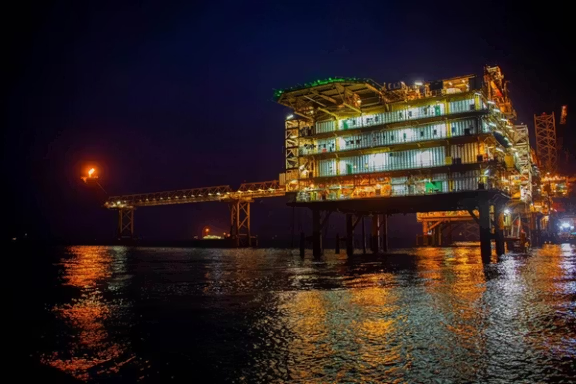
An offshore platform at South Pars gas field at night, Iran, September 2025

Iran’s gas deficit will double in the next 15 years, reaching “terrifying” heights, a senior advisor to the president has warned.

“If the gas imbalance continues at this rate, by the year 2041 we will be facing a 512-million-cubic-meter shortfall. This figure is terrifying,” Ali Rabiei told Tehran media this week.

Such a gap would leave the government unable to meet two-thirds of domestic demand. The warning is stark given that Iran holds 33 trillion cubic meters of proven gas reserves, the world’s second largest after Russia.

Yet a mix of delayed field development, lack of energy diversification, declining reservoir pressure, and systemic inefficiencies has already created an unsustainable deficit.

Parliament’s Research Center estimates a current shortfall of 150 million cubic meters per day, rising above 250 million in peak winter—roughly equal to Turkey’s entire seasonal consumption.

Heavy reliance on gas

Around 70% of Iran’s energy consumption depends on natural gas, according to the Ministry of Petroleum. Clean energy contributes barely 1% of electricity generation, while over 90% comes from thermal power plants, most of them gas-fired.

By comparison, Turkey produces 40 times more electricity from renewables.

The International Energy Agency (IEA) puts Iran’s current daily output at about 750 million cubic meters. After a decade of 5% annual growth, production growth slowed to just 1% last year.

Even with new investments, the IEA projects output could shrink by as much as 40% without substantial investment by the decade’s end.

Decline and waste

Nearly three-quarters of Iran’s gas comes from South Pars, a giant offshore reservoir shared with Qatar.

The field entered the second half of its lifecycle last year, with output expected to fall by 30 million cubic meters annually due to declining pressure.

Qatar has invested heavily to offset this decline, deploying massive 20,000-ton platforms with industrial-scale compressors and signing $29 billion in contracts with global energy majors.

Iran once had a similar plan under a $5 billion deal with TotalEnergies and CNPC in 2015, but both firms withdrew three years later when US president Donald Trump pulled out of the nuclear deal.

The technology remains concentrated in Western companies, leaving Iran reliant on smaller 4,000-5,000-ton platforms that experts say will not halt decline.

Iran also loses huge volumes of gas to waste.

The IEA and World Bank estimate daily losses of 88 million cubic meters through leaks, flaring, and inefficiencies. This makes Iran the world’s second-largest gas flarer after Russia, and the fourth-largest methane emitter after China, the U.S., and Russia.

Iran’s paradox is clear: a country sitting on the world’s second-largest gas reserves is sliding toward a severe energy crunch.

Without major investment, technological access, and diversification, shortages will deepen—leaving households and industries exposed to chronic power cuts and mounting economic strain.


Most Viewed

Iran negotiators ordered to return after internal rift over Islamabad talks
1
EXCLUSIVE

Iran negotiators ordered to return after internal rift over Islamabad talks

2
ANALYSIS

US blockade enters murky phase as tankers spoof signals and buyers hesitate

3
ANALYSIS

Why the $100 billion Hormuz toll revenue is a myth

4

US tightens financial squeeze on Iran, warns banks over oil money flows

5
INSIGHT

Ideology may be fading in Iran, but not in Kashmir's ‘Mini Iran'

Banner
Banner

Spotlight

  • Hardliners push Hormuz ‘red line’ as US blockade tests Iran’s leverage
    INSIGHT

    Hardliners push Hormuz ‘red line’ as US blockade tests Iran’s leverage

  • Ideology may be fading in Iran, but not in Kashmir's ‘Mini Iran'
    INSIGHT

    Ideology may be fading in Iran, but not in Kashmir's ‘Mini Iran'

  • War damage amounts to $3,000 per Iranian, with blockade set to add to losses
    INSIGHT

    War damage amounts to $3,000 per Iranian, with blockade set to add to losses

  • Why the $100 billion Hormuz toll revenue is a myth
    ANALYSIS

    Why the $100 billion Hormuz toll revenue is a myth

  • US blockade targets Iran oil boom amid regional disruption
    ANALYSIS

    US blockade targets Iran oil boom amid regional disruption

  • Iran's digital economy battered by prolonged blackout
    INSIGHT

    Iran's digital economy battered by prolonged blackout

•
•
•

More Stories

Unfinished yet irreversible: Iran's Woman, Life, Freedom three years on

Sep 18, 2025, 18:48 GMT+1
•
Jamshid Barzegar

Three years after the killing of Mahsa "Jina" Amini in the custody of Iran’s morality police, and in the shadow of the Islamic Republic’s recent 12-day war with Israel, the outlines of a durable social transformation are clear.

Commentators disagree on labels—uprising, movement, revolution—but most accept that the protests of 2022 and their afterlife have marked a foundational rupture. They drew in multiple strata of society, altered daily life and public discourse and forced the Islamic Republic into retreats that once seemed inconceivable.

The chant “Woman, Life, Freedom,” first voiced at Amini’s burial in the town of Saqqez in Iran's Kurdistan province, condensed demands for autonomy, dignity and equality into three words that spoke across class and region.

A society long fragmented by divide-and-rule tactics has moved toward solidarity. Women and men, Kurds and Persians, Baluch and Azeris, urban and rural citizens stood together in 2022, building a pluralism not seen in recent memory.

The movement challenged not only gender discrimination but the state’s entire normative order, and it did so through radically non-violent means. In compelling the regime to cede ground—above all on the legally-mandated hijab—it achieved changes that would once have been described as revolutionary in themselves.

Inside homes, younger generations have renegotiated relations with parents in ways that blunt the state’s intrusion into private life.

The state’s grip on the streets has been broken; unveiled women now walk freely in Tehran, Mashhad, Shiraz, and countless smaller cities. Equality and bodily autonomy, once dismissed as Western imports, have moved to the center of Iranian discourse.

An even more draconian hijab and chastity law passed by parliament was frozen by Iran's Supreme National Security Council in May out of concern it would spark unrest.

Not easy

But the obstacles remain—and repression is still lethal.

In 2022 at least 552 protesters were killed, thousands more jailed, and executions have mounted since. The ruling elite retain an effective coercive apparatus, even if their confidence has been shaken by war and domestic unrest.

Economically, decades of corruption, sanctions, inflation and environmental degradation have pushed both state and society into survival mode.

Families channel scarce energy into endurance, leaving less room for organized protest. A potential revolution’s strength—its horizontal, decentralized nature—has also limited its ability to produce leadership or coherent organization.

Opposition forces remain fragmented, particularly in the diaspora, and coordination inside Iran has faltered as street protests ebbed.

Even so, the balance of change is striking.

In just three years, the movement has embedded demands that no future order can ignore. Its art, slogans, and public faces have entered common life.

No credible opponent of the regime positions themselves against it; all align with or inherit from it.

Hopes for future

Looking forward, much will depend on four interlinked tasks.

Daily civil resistance appears to be institutionalized, above all the unveiled presence of women in public life.

Economic grievances and livelihood protests have yet to be joined to clear political demands. If and when they are, a broader front against misrule would come to life.

Fragmented opposition forces need to converge on a clearer vision for post–Islamic Republic Iran. And international sympathy must be translated into targeted support that strengthens civil society without dragging it into destructive conflict.

The Islamic Republic’s institutions still stand, but their legitimacy has been stripped to the bone. Voter participation has sunk to historic lows, public trust has collapsed, and governance has narrowed to the sheer mechanics of survival.

Those in power are now fixated on endurance rather than service. In this vacuum, civil society advances on a different track.

Three years on, “Woman, Life, Freedom” remains the principal engine of transformation. Street protests may have wound down, but the changes in culture and imagination look irreversible.

The revolution is unfinished, but it endures in daily defiance, in a pluralist solidarity that defies the state’s order, and in a vision of citizenship rooted in universal rights.

That, already, is an achievement historic in scale—one whose ultimate destination may yet be a secular, democratic Iran.

Khamenei-linked daily says Afghan expulsions failed to curb bread prices

Sep 18, 2025, 11:19 GMT+1

The Islamic Republic’s mass expulsions of Afghan migrants have not eased Iran’s economic strain nor slowed soaring bread prices, the hardline Kayhan newspaper, overseen by Iran's Supreme Leader Ali Khamenei, wrote on Wednesday.

“The claim was that Afghan nationals were consuming so much bread that they were pushing prices higher. Yet even after more than 1.5 million have left, the price of Sangak [a popular traditional Iranian bread] has risen fourfold,” the paper said.

“Why should bread prices climb 300 percent compared to 2024 when no major shortage is expected?” the paper asked.

A loaf of subsidized Sangak bread cost 5,000 rials (about $0.05) in September 2024 but now sells for 200,000 rials (about $0.20), marking a 300-percent increase in one year.

Iran’s state news agency IRNA says that in Tehran Sangak priced at 100,000–150,000 rials has effectively disappeared; most customers now pay 200,000–500,000 rials per loaf, with sesame-topped bread commonly around 300,000 (about $0.30).

Official rates diverge from street prices, which vary by neighborhood and bakery. A government task force set a 600-gram sangak at 76,000 rials (about $0.07), but shoppers say loaves at that price are smaller and poorer quality.

Interior Minister Eskandar Momeni argued in August that expulsions reduced bread transactions by six percent, calling this a government achievement. Lower demand would help stabilize supply, he said.

  • Rampant inflation may ignite bread riots in Iran, economist warns

    Rampant inflation may ignite bread riots in Iran, economist warns

  •  Iran sees steep bread price hikes as inflation bites

    Iran sees steep bread price hikes as inflation bites

Deportations tied to security rhetoric

The Islamic Republic intensified deportations in recent months, especially after the 12-day war with Israel, when authorities accused some foreigners, notably Afghans, of working with Mossad. Such allegations have been used to justify expulsions while deflecting blame for economic hardship.

Decades of economic mismanagement, sanctions, and currency collapse have eroded household purchasing power, leaving low-income families most exposed.

“If inflation remains unchecked … Iran could witness a bread riot,” economist Hossein Raghfar told the moderate outlet Rouydad24 earlier this month, warning that inaction could have consequences far beyond the economy.

Accountability for Iran hangs on UN mission’s future

Sep 17, 2025, 15:34 GMT+1
•
Roozbeh Mirebrahimi

The United Nations fact-finding mission on Iran, created after mass protests were crushed in 2022, has emerged as a rare instrument of accountability whose survival now rests on the political and financial will of the international community.

For decades, oversight of Iran’s human rights record was limited to a Special Rapporteur whose reports carried weight but lacked teeth.

The new mission, however, was built not only to observe but to investigate, document and preserve evidence for criminal prosecutions—evidence that could one day bring Iranian officials before international or national courts abroad.

In just two years, it has produced thousands of pages—legal findings, testimonies and analyses on women’s and minority rights.

Together, the effort paints a grim picture of systematic human rights violations in Iran, some amounting to crimes against humanity.

Limited mandate

That phrase matters. It elevates abuses from the realm of “domestic affairs” to international crimes the world cannot ignore. It also affirms what Iranian civil society has long argued: repression is not episodic but systemic.

Yet the mission has faced constraints by design.

Its initial mandate was limited to the protests and crackdowns after death of a young woman, Mahsa Amini, in morality police custody in September 2022.

That scope left little room to probe earlier waves of dissent such as the December 2017 protests or the bloody crackdown of November 2019, despite clear evidence of the same patterns of violence and impunity.

Only in March did the Human Rights Council expand the mandate, acknowledging that accountability cannot be sliced into timeframes convenient for perpetrators.

The United Nations itself is under financial strain and political pressure from states wary of setting precedents for scrutiny. Iran continues to deny all allegations, dismissing international scrutiny as “Western interference.”

Against erasure

The mission is vital for two reasons. First, it amplifies the voices of victims and families silenced inside Iran. Second, it builds a legal infrastructure for future prosecutions, whether under universal jurisdiction abroad or in tribunals yet to be created.

These records matter: they are the antidote to impunity, preserving memory when a government seeks erasure.

On the third anniversary of the “Woman, Life, Freedom” movement, the question is whether the international community will provide the political and financial backing to keep this mechanism alive.

Civil society has done its part—collecting testimonies, documenting abuses, and risking lives for the truth. Governments must now ensure this work does not wither under budget cuts or diplomatic fatigue.

In an era of deep cynicism about international institutions, this mission is a rare instrument that offers both hope and a pathway toward justice.

Iran says foreign GPS systems unsafe, eyes national satellite network

Sep 16, 2025, 12:41 GMT+1

The head of Iran’s Space Research Center said on Tuesday that foreign global positioning systems (GPS) are not secure and that the country must develop its own national satellite navigation network to reduce dependence on foreign providers.

Vahid Yazdanian, who leads the Space Research Center under the Ministry of Communications, told the state-run ILNA news agency that GPS disruptions in Iran stem from the absence of indigenous navigation satellites.

He said Iran currently lacks any navigation satellites, relying instead on foreign systems.

“No global navigation system can be fully secure,” he said. “The ultimate solution is to develop a domestic satellite navigation constellation.”

Yazdanian added that the country needs to build its own infrastructure to secure applications ranging from urban transport to the navigation of trains, ships and aircraft.

  • Iran's GPS scrambling wreaks chaos on daily life

    Iran's GPS scrambling wreaks chaos on daily life

  • Iran satellite launch signals defiance after war with Israel, experts say

    Iran satellite launch signals defiance after war with Israel, experts say

He also pointed to broader uses of space technology, saying that Iran’s Earth observation satellites already provide images that help policymakers estimate crop yields and manage water resources.

According to Yazdanian, satellite imagery has allowed the government to monitor wheat, barley, maize and potato production, and to make decisions about imports or domestic procurement.
  • Iran vows to launch four satellites, open new spaceport by March

    Iran vows to launch four satellites, open new spaceport by March

  • Iran plans maiden launch of its first satellite constellation by March

    Iran plans maiden launch of its first satellite constellation by March

  • Iran eyes domestic launch for next telecoms satellite after Russian liftoff

    Iran eyes domestic launch for next telecoms satellite after Russian liftoff

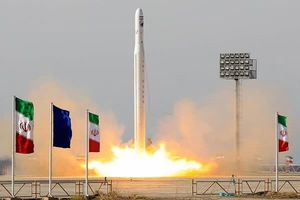
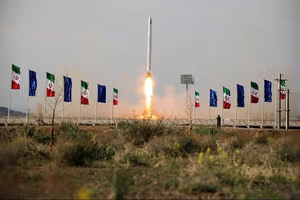
The comments come as Iran pushes ahead with an ambitious space program. The head of the Iranian Space Agency said earlier this month that Tehran plans to launch four satellites by March 2026 and begin operations at its new spaceport in Chabahar, on the country’s southeastern coast.

Among the planned launches are the Zafar, Paya, and a second model of the Kowsar Earth observation satellite, along with test units of the Soleimani narrowband communications constellation.

Western governments have repeatedly voiced concern that Iran’s satellite program could advance ballistic missile technology. Tehran says its activities are for peaceful purposes, adding the satellites will support civilian applications such as communications, agriculture and environmental monitoring.

Iran summons 10 over protests against power and water shortages

Sep 15, 2025, 12:04 GMT+1

Iranian authorities have summoned 10 citizens in the northeastern city of Sabzevar to face charges linked to protests over repeated power and water cuts, the Human Rights Activists News Agency (HRANA) reported on Monday.

HRANA listed their names adding that they were ordered to appear before the third branch of the Sabzevar public and revolutionary prosecutor’s office within 10 days to present their final defense.

According to the report, the individuals face charges of “propaganda against the Islamic Republic,membership in a group aimed at disrupting state security, and assembly and collusion against national security.”

They were previously detained during July demonstrations in Sabzevar against rolling blackouts and water shortages, and later released on bail.

  • Tear gas fired as protests over power and water shortages continue in Iran

    Tear gas fired as protests over power and water shortages continue in Iran

  • ‘Failure at every level’: Iranians pan weekly holiday plan amid energy crisis

    ‘Failure at every level’: Iranians pan weekly holiday plan amid energy crisis

At the time, videos verified by rights groups showed residents rallying outside the governor’s office, chanting “Water, electricity, life — our absolute rights” and “If we don’t get our rights, we won’t leave.”

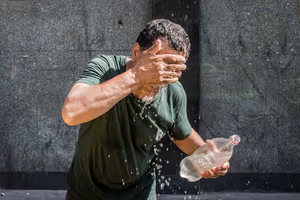
The summons comes amid mounting public frustration. Over the summer, Iran faced its second-driest year in five decades, with rainfall 43% below average. Widespread outages have disrupted daily life, industrial production and the economy, triggering protests in several cities such as Shiraz and Kazeroun.

In Sabzevar, protests entered a second night in July, with security forces firing tear gas at demonstrators. Footage sent to Iran International showed crowds chanting “Shameless, shameless” as they fled the crackdown.

Authorities have attributed the shortages to drought and surging demand, while critics cite years of mismanagement, sanctions and neglected infrastructure.